Understanding Force and Pressure – Class 8 Science Notes
Force and Pressure
Force and Pressure is a key topic in Class 8 Science that helps students understand how physical forces affect objects in motion and rest. This chapter explains the difference between contact and non-contact forces, pressure in liquids, and the application of force in daily life. Students can explore concepts like muscular force, gravitational force, and atmospheric pressure with real-world examples. For complete concept clarity, refer to [NCERT Solutions for Class 8 Science], which provides detailed answers to all textbook questions. Additionally, [Class 8 Notes] on Force and Pressure make revision simple and time-saving before exams. Students who find this topic challenging can take [Home Tuition for Class 8] to get personalized guidance from expert tutors. Home tutors explain numerical problems, diagrams, and real-life applications of force and pressure for better understanding. Learning Force and Pressure helps students connect science with practical experiences like inflating balloons, hydraulic systems, and how force impacts motion. With regular practice and guidance, mastering this chapter becomes easy and interesting.
Introduction
In our everyday experiences, we encounter various situations involving force and pressure:
- Opening or closing doors
- Making a football move
- Making a moving ball move faster
- How goalkeepers stop balls
- Why school bags have wide straps
- Why sharp knives cut better than blunt knives
- Why nails have pointed tips
- Why buildings have wide foundations
- Why rear wheels of tractors are made very wide
To produce motion in a stationary object or to stop it, some effort is required. This effort is called "Force".
Force
- Unit: Newton (N) in M.K.S. system
- Nature: Vector quantity
- Mathematical representation: F = ma (where m = mass, a = acceleration)
Understanding Force Through Examples
Consider a ball kept on a table:
- We can move it by pulling or pushing
- Pushing in direction of motion increases speed
- Pushing opposite to motion decreases speed
- Pushing perpendicular to motion changes direction
- Pushing from both sides changes shape
Effects of Force
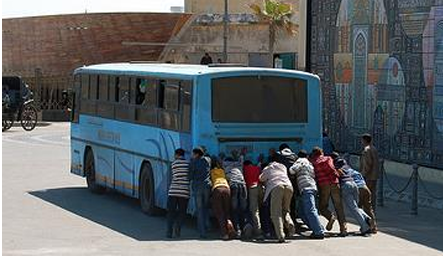
(i) Force can make a stationary object move and change speed
- A stationary football can be made to move by giving it a small push
- A moving toy car can be stopped by applying force
- A tractor can move a trolley by pulling it
- We push doors to open or close them
- Vehicles can be stopped by applying brakes
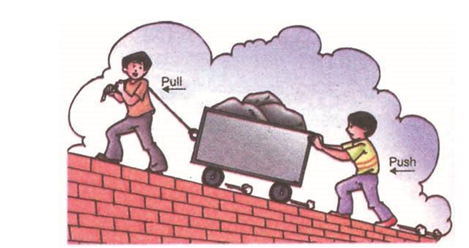
(ii) Force can change direction of a moving object
When force is applied perpendicular to motion, it changes the direction.
- A cricketer applies tangential force to change the direction of a cricket ball
- Kicking a football perpendicular to its motion changes its direction
- Hitting a cricket ball with a bat changes its direction
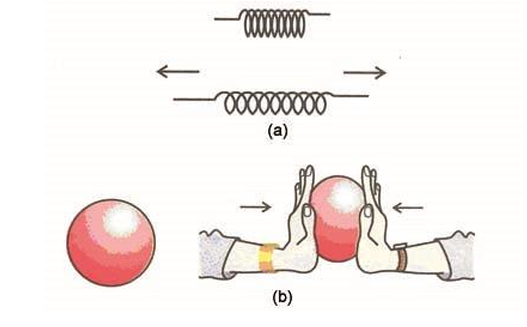
(iii) Force can change shape and size of objects
- Compressing a spring decreases its length
- Stretching a spring increases its length
- Applying force on a balloon changes its shape
(iv) Force can stop moving objects or slow them down
- Applying brakes to a bicycle slows it down and stops it
- A cricket ball is stopped by a player applying force opposite to ball's motion
- Pulling a bicycle from behind slows it down
- A ball thrown vertically upwards slows down due to earth's pull
Acceleration
Units:
- S.I. unit: m/s²
- C.G.S. unit: cm/s²
Units of Force
In C.G.S. System
F = ma → gram × cm/s² = dyne
In S.I. System
F = ma → kg × m/s² = Newton
Resultant Force
- If two forces act in the same direction: Net force = Sum of two forces
- If two forces act in opposite directions: Net force = Difference between two forces
When two teams pull equally hard, the rope doesn't move in any direction because forces are balanced.
Balanced and Unbalanced Forces
Balanced Forces
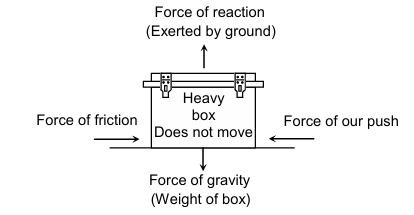
Characteristics:
- Do not produce any motion in the body
- Do not change the state of rest or motion
- Can change the shape of the body
- A heavy box lying on ground with equal push and friction forces
- Tug-of-war with equal forces from both teams
- A spherical balloon pressed between two hands changes shape but doesn't move
Unbalanced Forces
Characteristics:
- Can change the state of rest or uniform motion
- Can change the direction of the body
- Can change the size and shape of the body
- A heavy box moved with very strong force (force of push > friction)
- A ball rolling on ground stops due to friction
- A bicycle slows down when we stop pedaling
Types of Force
Forces are classified into two main types:
- Contact Force
- Non-Contact Force
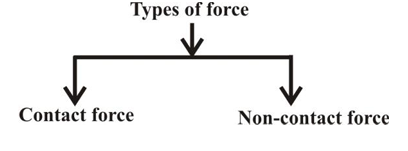
Contact Force
Types of Contact Force:
(i) Normal Force
Forces perpendicular to the surface in contact.
(a) Biological Force (Muscular Force)
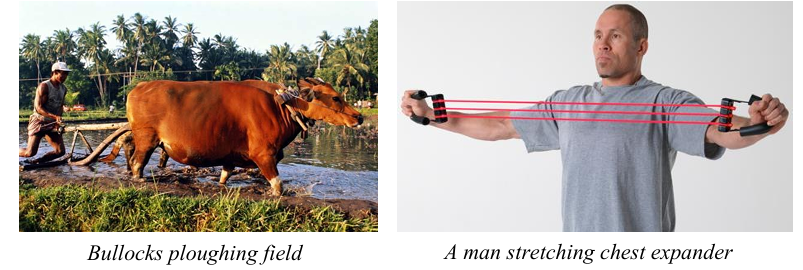
Force applied by our muscles to do work.
- Lifting a school bag
- Kicking a football
- Moving or running
- Lifting heavy weight
- Pulling a wheel cart
- Compressing cotton bale
- Blood pushed into arteries by heart
- Horse pulling a cart
- Bullocks ploughing fields
(b) Mechanical Forces
Forces generated by machines.
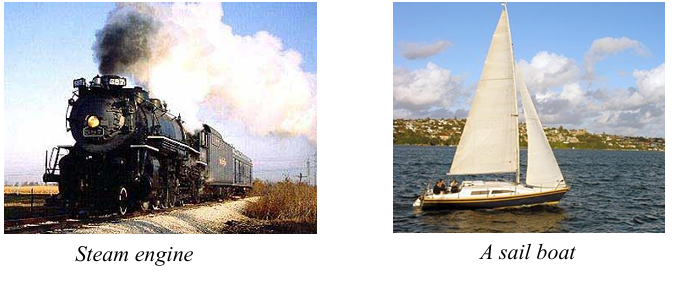
- Motor car engine using energy of petrol
- Steam engine using energy of coal
(ii) Force of Friction
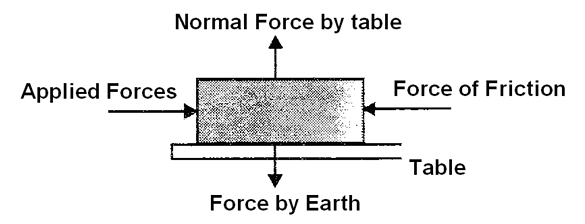
Characteristics:
- Acts parallel to surfaces in contact
- Self-adjusting force up to a limit (limiting friction)
- Slows down or stops moving bodies
Three forces act on a body placed on a table:
- Force by earth (downward)
- Normal force by table (upward)
- Applied force (horizontal)
- Force of friction (opposite to applied force)
Non-Contact Force
(i) Gravitational Force
Key Points:
- Every object in universe attracts every other object
- Force of gravitation acts even if objects are not connected
- For small masses, gravitational force is small and cannot be detected easily
- Dropped objects always fall toward ground
- Ball thrown up falls down toward earth
- Ripe fruits fall toward ground
- Stone on hilltop falls downward if pushed
- Weight = mg (where m = mass, g = acceleration due to gravity)
- g = 9.8 m/s²
- Acts vertically downward
- Gives weight to an object
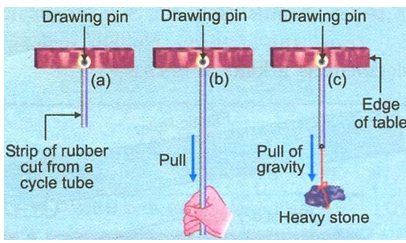
Spring Balance
A device used for measuring force acting on an object. It consists of a coiled spring which stretches when force is applied. The stretching is measured by a pointer on a calibrated scale.
(ii) Electrostatic and Electric Force
Electrostatic Force: Force that can push or pull tiny objects.
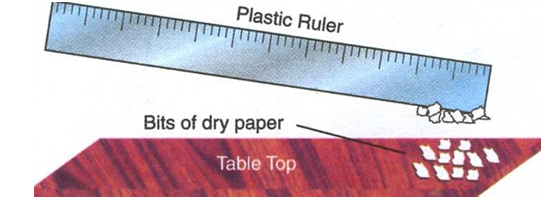
- Rub plastic ruler against dry hair or woolen cloth
- Bring rubbed end near tiny bits of paper
- Paper bits cling to ruler
- Happens because ruler gets electrically charged
Application: Used in removing carbon and ash particles from smoke in factory chimneys, reducing air pollution.
Electric Force: Force acting between charges.
where:
- k = 9 × 10⁹ Nm²/C² (Coulomb's constant)
- q₁, q₂ = charges
- r = distance between charges
Force can be attractive or repulsive.
(iii) Magnetic Force
Characteristics:
- Acts from a distance (non-contact force)
- Attracts objects made of iron or steel
- Can pass through substances like wood or glass
- Can cause both attraction and repulsion
Activities to demonstrate magnetic force:
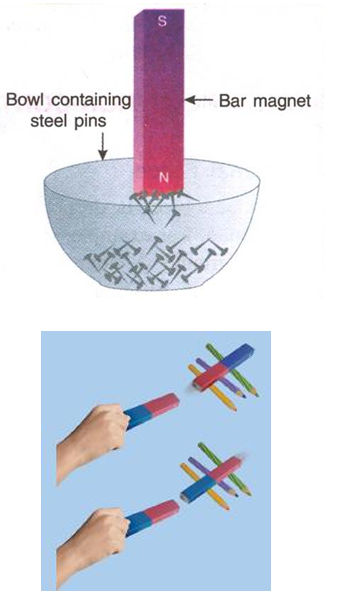
1. Attraction of iron:
- Bring bar magnet near glass bowl containing common pins
- Pins are pulled toward magnet
- Proves magnet exerts force
2. Attraction and repulsion between magnets:
- Place one magnet on round pencils
- Bring north pole of another magnet near north pole of first
- First magnet moves away (repulsion - like poles repel)
- Bring north pole near south pole
- First magnet gets attracted (unlike poles attract)
3. Magnetic force passes through materials:
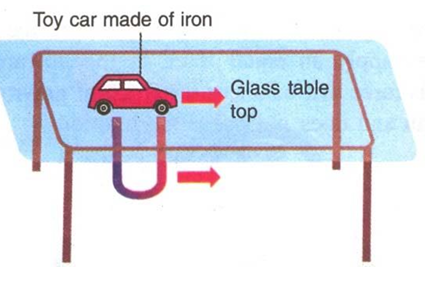
- Place toy car on wooden/glass table
- Move magnet under the table
- Car follows magnet movements
- Proves magnetic force passes through wood and glass
For conductor carrying current in magnetic field: F = B × I × L
For moving charge in magnetic field: F = qvB (maximum force)
where: B = magnetic field strength, I = current, L = length of conductor, q = charge, v = velocity
Important Note on Fundamental Forces
- Gravitational force
- Electromagnetic force
- Weak force (comes into play during radioactivity)
- Strong interactions (responsible for holding nucleus together)
All other forces are manifestations of these fundamental forces. For example, friction, muscular action, etc., arise from electrical attraction and repulsion of electrons and nuclei at atomic scale.
Difference Between Mass and Weight
| Mass | Weight |
|---|---|
| Quantity of matter possessed by a body | Force with which body is attracted toward center of earth |
| Represented by m | Represented by W = mg |
| Constant quantity, same everywhere | Varies from place to place due to variation in g |
| Never zero | Zero at center of earth (g = 0) |
| Unit: kg | Unit: Newton |
| Scalar quantity | Vector quantity |
Magnetic and Direction of Force:
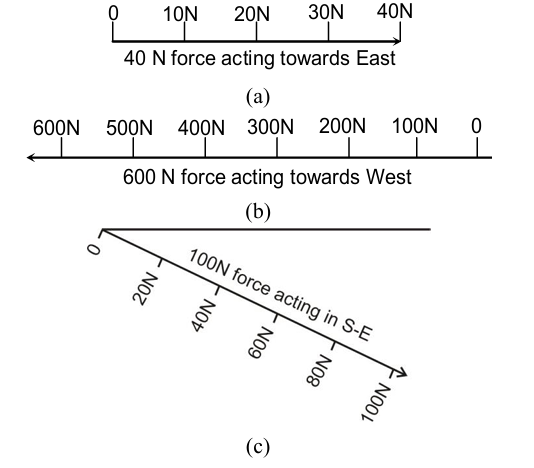
A force can be large or small. The magnitude tells us how large or how small is a force. The amount or the strength of force is called its magnitude. The magnitude of force is generally shown by a straight line. It means the greater the length of line, the more is its
magnitude. The direction of force is shown by placing an arrow head over the line pointing the direction in which force is acting, as shown in figure (a), (b) and (c).
Addition of Forces
Same Direction
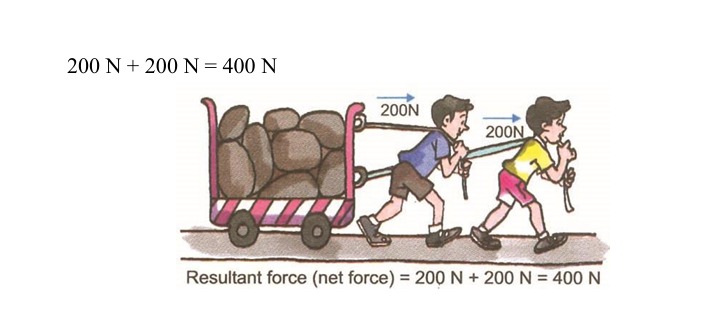
When two forces act in same direction, they add up.
Resultant force = 200 N + 200 N = 400 N
Cart starts moving
Cancellation and Subtraction of Forces
Opposite Direction - Equal Forces
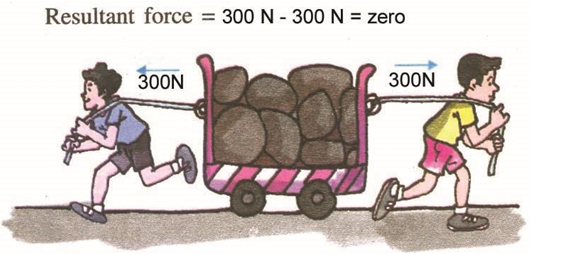
When equal forces act in opposite directions, they cancel each other.
Resultant force = 0
Cart doesn't move
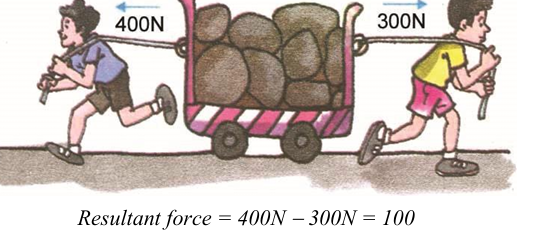
Opposite Direction - Unequal Forces
Net force = Difference of forces in direction of bigger force
Resultant force = 400 N - 300 N = 100 N
Acts in direction of 400 N force
Mathemetical Description Newton's Laws of Motion
Newton's First Law of Motion
Newton's Second Law of Motion
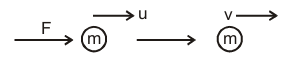
Let force F act on body of mass m moving with velocity u. After time t, velocity changes to v.
- Initial momentum = mu
- Final momentum = mv
- Change in momentum = mv - mu
- Rate of change = (mv - mu)/t
According to second law:
F ∝ (mv - mu)/t
F ∝ m(v - u)/t
F ∝ ma
Newton's Third Law of Motion
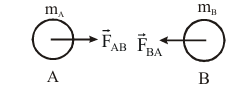
Key Points:
- Forces never occur singly in nature
- Force is result of mutual interaction between two bodies
- Mutual forces between two bodies are always equal and opposite
- Choice of terms "action" and "reaction" is arbitrary
- No cause-effect relationship
- Action and reaction forces act on different bodies
- Action and reaction forces act simultaneously
Principle of Conservation of Momentum
Consider two bodies of masses m₁ and m₂ moving with velocities u₁ and u₂ respectively (u₁ > u₂).
After collision, velocities become v₁ and v₂.
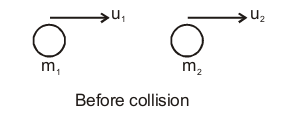
- Force exerted by m₁ on m₂: F₁₂ = (m₁v₁ - m₁u₁)/t
- Force exerted by m₂ on m₁: F₂₁ = (m₂v₂ - m₂u₂)/t
This is the Principle of Conservation of Momentum: During collision of two bodies, total momentum remains constant before and after collision, provided no external force acts on them.
Tension
Direction: Tension force always pulls a body.
- If string is inextensible, magnitude of acceleration of all masses connected through string is same
- If string is massless, tension is same everywhere; if string has mass, tension at different points will be different
- If there is friction between string and pulley, tension is different on two sides; if no friction, tension is same on both sides
Pressure
Thrust: The force acting on an object perpendicular to the surface is called thrust.
Pressure: The thrust (compressive force acting perpendicularly to surface) acting per unit area is called pressure.
Units:
- S.I. unit: Pascal (Pa) = Newton per square meter (N/m²)
- 1 Pascal: When force of 1 N acts perpendicular on area of 1 m², pressure is one pascal
Named after French physicist Blaise Pascal (1623-1662)
Relationship Between Pressure and Area
Pressure is inversely proportional to area of contact:
Applications of Pressure
Increasing Pressure (Small Area)
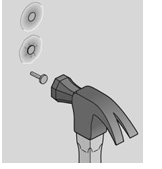
- Nails have flat top but pointed end: Small pressure on flat top through hammer becomes large thrust. Same thrust acts through pointed end on wood, resulting in large pressure. Nail easily fixed in wood.
- Sewing needles have pointed tips: Small force makes needle pierce cloth easily. Sewing becomes quicker.
- Cutting items (knives, blades) have sharp edge: Makes cutting easier.
- Studs on football boots: Small area of contact with ground. High pressure causes them to sink into ground, providing extra grip.
Reducing Pressure (Large Area)
- Vehicle brakes have flat surface: Reduces pressure on tyres, avoids tearing.
- Board sole shoes: Make walking easier on soft land.
- Wide steel belt on army tank wheels: Makes movement easier over marshy land.
- Tractor tyres are broad: Tractors don't sink in soft field land.
- Camel feet are broad and soft: Can walk swiftly on sand. Increased area reduces pressure. Feet sink very little in sand.
- Hanging bags have wide straps: Reduce pressure on shoulders. More comfortable to carry.
- Skis have large area: Reduce pressure on snow. Don't sink in too far.
Why School Bags Have Wide Straps
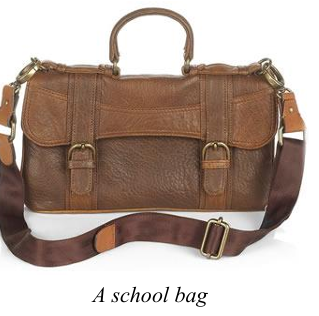
If straps were thin strings, weight would fall over small area, producing large pressure, making it painful to carry.
Why Sharp Knife Cuts Better Than Blunt Knife
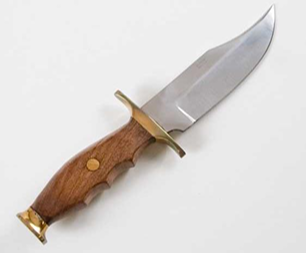
Sharp knife:
- Has very thin edge
- Force falls over very small area
- Produces large pressure
- Cuts objects easily
Blunt knife:
- Has thicker edge
- Force falls over large area
- Produces lesser pressure
- Cuts with difficulty
Why Buildings Have Wide Foundations
Foundations are laid on larger area so that weight of building produces less pressure on ground and building doesn't sink.
Why Camels Have Broad Feet

Camels can easily cross desert because they have broad feet which exert very small pressure on sand, so feet sink very little.
Pressure in Liquids
Unlike solids, liquids:
- Don't have definite shape
- Take shape of containing vessel
- Pressure depends on depth and density of liquid
Consequences of Pressure in Liquids
- Deep sea fishes: Blood flows at very high pressure in their bodies. At surface, pressure suddenly decreases. Bodies burst open due to pressure difference.
- Deep sea divers: Must wear specially designed suits. Otherwise huge water pressure will crush their bodies.
- Submarine hulls: Specially strengthened to bear huge pressure.
- Dam walls: Specially thickened at base to withstand huge pressure at depth.
Atmospheric Pressure
Atmosphere
- Extends up to approximately 200 km above earth's surface
Atmospheric Pressure
Magnitude: Around 100 kilo pascal (100 kPa) at sea level
Composition: Mainly consists of oxygen and nitrogen gas up to approximately 200 km in height.
As we go upward, magnitude of atmospheric pressure decreases gradually.
Consequences of Air Pressure
- Weight of air column: Air column of height of atmosphere with area 15 cm × 15 cm weighs nearly 225 kg (2250 N). We're not crushed because pressure inside our bodies equals atmospheric pressure and cancels pressure from outside.
- Nose bleeding at high altitudes: Pressure inside body > atmospheric pressure. Difference causes tiny blood vessels in nose to burst.
- Fountain pen leaking on hills/aeroplanes: Air inside ink-tube at higher pressure than outside.
- Sucker sticking to surface: Pressing sucker expels air between sucker and surface. Atmospheric pressure acts on sucker and holds it to surface.
- Syringe
- Dropper
- Straw
- Rebreathing apparatus
End of Force and Pressure Theory Notes
For best results, study this document along with practical experiments and problem-solving exercises.