About Class 10 Economics Notes: Consumer Rights
The Class 10 chapter Consumer Rights educates students about the rights and responsibilities of consumers in a market. It highlights the problems faced by consumers such as unfair trade practices, adulteration, and false information about products. These class 10 notes explain the Consumer Protection Act (COPRA), which provides legal rights to consumers. The six important consumer rights include:
- Right to Safety
- Right to Information
- Right to Choose
- Right to be Heard
- Right to Seek Redressal
- Right to Consumer Education
Students also learn about consumer courts and forums where complaints can be filed if a consumer has been cheated or received poor-quality goods and services. These institutions provide justice and ensure fair practices. The chapter emphasizes the role of consumer awareness in preventing exploitation. Educated consumers can make informed decisions, demand quality products, and raise their voices against unfair trade practices. This is why Consumer Awareness Campaigns like "Jago Grahak Jago" play an important role in empowering buyers.
The Consumer In The Market Place
Consumer's consciousness towards his rights and the social and legal obligation of the business community and government towards consumer is known as consumer awareness. If the consumer is not provided the amount of goods and services for which he/she has paid, it is called consumer exploitation.
How Consumers are Exploited?
- Moneylenders in the informal sector that you have read earlier adopt various tricks to bind the borrower: they could make the producer sell the produce to them at a low rate in return for a timely loan;

- Many people who work in the unorganized sector have to work at a low wage and accept conditions that are not fair and are also often harmful to their health.
- Rules and regulations are required for the protection of the consumers in the marketplace.
- Whenever there is a complaint regarding a good or service that had been bought, the seller tries to shift all the responsibility on to the buyer.
- Exploitation in the marketplace happens in various ways. For example, sometimes traders indulge in unfair trade practices such as when shopkeepers weigh less than what they should or when traders add charges that were not mentioned before, or when adulterated/defective goods are sold.
- Markets do not work in a fair manner when producers are few and powerful whereas consumers purchase in small amount and are scattered.
- At times false information is passed on through the media, and other sources to attract consumers. For example, a company for years sold powder milk for babies all over the world as the most scientific product claiming this to be better than mother’s milk.
- It took years of struggle before the company was forced to accept that it had been making false claim.
- Similarly, a long battle had to be fought with court cases to make cigarette-manufacturing companies accept that their product could cause cancer.
- Hence, there is a need for rules and regulations to ensure protection for consumers.
Do Check - Money and Credit
Consumer Movements:
In India, the consumer movement as a 'social force' originated with the necessity of protecting and promoting the interests of consumers against unethical and unfairtrade practices. Rampant food shortages, hoarding, black marketing, adulteration of food and edible oil gave birth to the consumer movement in an orgainsed form in the 1960s. Till the 1970s consumer organisations were largely engaged in writing articles and holding exhibitions.
They formed consumer groups to look into the malpractises in ration shops and overcrowding in the road passenger transport. More recently, India witnessed an upsurge in the number of consumer groups. Becouse of all these efforts, the movement succeeded in bringing pressure on business conduct which may be unfair and against the interests of consumers at large. A major step taken in 1986 by the Indian government was the enactment of the Consumer Protection Act 1986, popularly known as COPRA.
Need for Rules and Regulations to save the Consumers:
- Due to the expansion of the business activities and globalisation there are variety of goods available in the market and producers are spending a lot of money to influence the consumers which makes it difficult for the consumers to make a correct choice. So there is a need for consumer awareness.
- Producers do not provide sufficient information to the consumers and sometime even harass them.
- Consumer awareness is also must because at times greedy traders begin to play with the health of the people by indulging in adulteration of edible oils, milk, butter, ghee etc.
- After 1991, the Government of India has withdrawn it self from most of the productivities and allowed the private sector to take over. So it was felt that there is a greater need to enforce discipline and regulations in the market and to make the consumers aware not only of the commercial aspects of sale and purchase of goods but also the health and security aspects.
- There is a need for rules and regulations because most of goods and services are being produced by private sector with profit as a main motive.
Consumer Rights
Safety Is Everyone’s Right:
- Reji’s suffering shows how a hospital, due to negligence by the doctors and staff in giving anesthesia, crippled a student for life.

- While using many goods and services we have the right to be protected against the marketing of goods and delivery of services that are hazardous to life and property.
- Producers need to strictly follow the required safety rules and regulations.
- There are many goods that require special attention to safety.
- For example, pressure cookers have a safety value which, if it is defective, can cause a serious accident. The manufacturers of the safety valve have to ensure high quality.
- You also need public or government action to see that this quality is maintained.
Do Check - Sectors of the Indian Economy
Information about Goods and Services:
Consumers have the right to be informed about the particulars of goods and services that they purchase. Consumers can then complain and ask for compensation or replacement if the product proves to be defective in any manner. Similarly, one can protest and complain if someone sells a good at more than the printed price on the packet.
This is indicated by 'MRP' - maximum retail price. In fact consumers can bargain with the seller to sell the product at less than the MRP. In October 2005, the Government of India enacted a law, popularly known as RTI (Right to Information) Act, which ensures its citizens all the information about the functions of government departments.
When Choice Is Denied:
Any consumer who receives a service in whatever capacity, regardless of age, gender and nature of service, has the right to choose whether to continue to receive the service. Consumer can choose the products from the given alternatives. In case of a single supplier, consumer must be assured of quality and price of the good.
Where should consumers go to get justice?
- These are some examples in which consumers are denied their rights. Such instances occur quite often in our country.
- Consumers have the right to seek redressal against unfair trade practices and exploitation.
- If any damage is done to a consumer, she has the right to get compensation depending on the degree of damage.
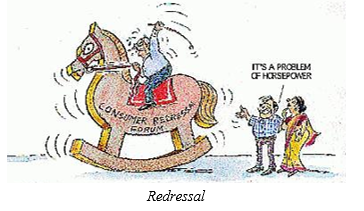
- Let us take the case of Prakash. He had sent a money-order to his village for his daughter’s marriage. The money did not reach his daughter at the time when she needed it nor did it reach months later. Prakash filed a case in a district level consumer court in New Delhi.
- The consumer movement in India has led to the formation of various organisations locally known as consumer forums or consumer protection councils.
- If you are living in a residential colony, you might have noticed name boards of Resident Welfare Association.
- If there is any unfair trade practice meted out to their members they take up the case on their behalf.
- Under COPRA, three-tier quasi-judicial machinery at the district, state and national levels were set up for redressal of consumer disputes.
- The district level court deals with the cases involving claims upto Rs. 20 lakhs, the state level courts between Rs. 20 lakhs and Rs. 1 crore and the national level court deals with cases involving claims exceeding Rs. 1 crore.
- Thus, the Act has enabled us as consumers to have the right to represent in the consumer courts.
Do Check - Globalisation and Indian Economy
Steps Taken By Government for Protection of Consumers:
(a) Legislative step:
Various Acts have been formed, the most important Act is :
- Consumer Protection Act, 1986: To solve the consumer grievances in a speedy, simple & inexpensive manner. Under this three types of courts have been established.
- Separate departments for consumer welfare have been established in both central and state government.
(b) Administrative steps:
- Public distribution system has been established for preventing the exploitation of consumers.
- Government tries to prevent illegal ways of making profit like hoarding and black marketing.
(c) Technical steps:
Government has established various agencies for developing standard for various products and to check and certify the products according to the standards. In India, two agencies are responsible for it.
- BIS or Beureau of Indian standards: Sets the standards for industrial products, checks them and certifies them with ISI mark. Through regular surveillance and taking samples both from market and factories ensures the standards of the products.
- AGMARK: Established under the Ministry of Agriculture is responsible for certifying the food and agricultural products.
At International level:
- ISO or International Standards Organization: Anon-governmental organization with its headquarters located in Geneva, creates standards through international agreements and certifies companies, goods and institutions with ISO 6000, ISO 14000 etc. certificates which indicates specific levels of standards.
- Codex Alimentarius Commission: It was created in 1963 by FAO and WHO. It develops food standards, guidelines and codes of practices for production and international trade in food products.
Learning To Become Well-Informed Consumers:
- When we as consumers become conscious of our rights, while purchasing various goods and services, we will be able to discriminate and make informed choices.
- This calls for acquiring the knowledge and skill to become a well informed consumer.
- The enactment of COPRA has led to the setting up of separate departments of Consumer Affairs in central and state governments.
Must check - Consumer Rights
ISI and Agmark
While buying many commodities, on the cover, you might have seen a logo with the letters ISI, Agmark or Hallmark. These logos and certification help consumers get assured of quality while purchasing the goods and services. The organisations that monitor and issue these certificates allow producers to use their logos provided they follow certain quality standards.
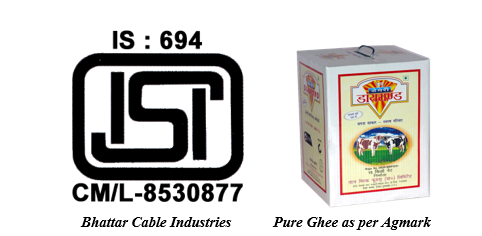
Though these organisations develop quality standards for many products, it is not compulsory for all the producers to follow standards. However, for some products that affect the health and safety of consumers or of products of mass consumption like LPG cylinders, food colours and additives, cement packaged drinking water, it is mandatory on the part of the producers to get certified by these organsations.
Features of Copra 1986:
- Under COPRA 1986, a separate department called consumer affairs department has been formed at the union and state level.
- A three-tier quasi judicial system popularly called consumer courts has been established at the national, state and district level.
- At the national level it is called national consumer court. It can try cases which deal with claims exceeding Rs 1 crore.
- At the district level it is called district consumer courts or consumer forums. It can solve dispute which involves a claim of Rs 20 Lakh and less.
- At the state level it is called the state consumer commission. It can solve disputes which involves a claim of Rs 20 lakh one crore.
- Job of these courts is to provide speedy justice at a very low cost within a time limit.
Taking The Consumer Movement Forward
- India has been observing 24 December as the National Consumers’ Day.
- It was on this day that the Indian Parliament enactment the Consumer Protection Act in 1986.
- The consumer movement in India has made some progress in terms of numbers of organized groups and their activities.
- There are today more than 700 consumer groups in the country of which only about 20-25 are well organized and recognized for their work.
- The consumer redressal process is becoming cumbersome, expensive and time consuming.
- Many a time’s consumers are required to hire lawyers. These cases require time for filling and attending the court proceedings.
- In most purchases cash memos are not issued hence evidence is not easy to gather.
- The existing laws also are not very clear on the issue of compensation to consumers injured by defective products.
- It is often said that consumer movements can be effective only with the consumers’ active involvement.
Must check - NCERT Solutions for Class 10
Important Terms
- Consumer Awareness: Consumer Awareness means the consciousness or awakening among consumers towards their rights and duties.
- Consumer Exploitation: Consumer exploitation signifies a situation in which the consumer is cheated, misbehaved or harassed by the business community.
- Adulteration: Mixing up of inferior goods with the costlier superior goods with a view to make profit.
- Hoarding: Illegal storing of essential commodities by the traders in their godowns with a view to sell them in future at a higher price.
- National Consumer Commission: A consumer court at national level.
- State Consumer Commission: A state level consumer court.
- District Form: It is a consumer court at district level.
- Consumer Protection Act: Consumer Protection Act, 1986 provides a legal procedure concerning consumer rights.
- Bureau of Indian Standards (BIS): It is an institution for setting up the standard for making and producing various products and enforcing them.
- Indian Standard Institution (ISI) : It is an institution whose headquarter is located in New Delhi. It lays down the standards for industrial and consumer goods on a scientific basis. It certifies the goods which meet these standards.
- Standardization: Maintaining quality, grades, size and constituents of the product is called standardization.
- Agmark: Agmark sign is an assurance of conformity to the specification while producing the commodity. It is meant for agricultural products.
- Limited Competitions: It signifies a situation when there is only one producer or a group of producers who are in position to control the supply of goods.
- A.A.Y. : Antyodaya Anna Yojana.
- N.G.Os : Non-Governmental Organisation.
- F.A.O. : Food and Agricultural Organisation.
- W.H.O. : World Health Organisation.
- F.P.S. : Fair Price Shops.
- D.M.I. : Directorate of Marketing and Inspection.
SOLVED QUESTIONS
- What is consumer exploitation?
Ans. Supplying goods having underweight and under measurement, sub-standard quality, duplicate articles, adulteration, impurity, unsafe articles, false information, unsatisfactory after sale service and high prices is termed as consumer exploitation.
- Mention the factors which cause exploitation of consumers.
Ans. Factors for the exploitation of consumers:
(a) Limited information;
(b) Limited supplies of commodities;
(c) Limited competition among suppliers; and
(d) Low literacy of consumers.
- What is the need for consumer awareness?
Ans. Consumer awareness is needed to protect the consumer from the exploitation.
It safeguards their interest and removes their ignorance, unawareness and literacy of the consumers.
Do Check - CBSE Class 10 Syllabus
- When is the World Consumers Rights Day celebrated?
Ans. ‘World Consumers Rights Day’ is celebrated on March 15 every year.
- What is adulteration?
Ans. Adulteration means mixing of sub-standard quality of elements to produce edible items. In costly edible items, such as oil, ghee and spices adulteration is made to earn higher profit. This causes heavy loss to the consumers who suffer monetary loss as well as spoil their health.
- Mention a few organizations which provide certification of standardization in India.
Ans. Bureau of Indian Standards (BIS), Indian Standard Institution (ISI), Agmark and Wool Mark provide certification of standardization.
- Why was Consumer Protection Act, 1986 enacted?
Ans. Consumer Protection Act, 1986 was enacted to safeguard the interests of consumers.
- Name the consumer courts at the district, state and national lands.
Ans. (a) District Forum;
(b) State Consumer Commission
(c) National Consumer Commission.
- Name any two rights of the consumers.
Ans. (i) Right to safety from adulterated articles.
(ii) Right to choice of things of best quality at reasonable rates.
- What is the consumer at the district-level called?
Ans. It is called the District Forum.
- When was the Consumer Court Protection Act amended?
Ans. It was amended twice in 1991 and 1993 respectively.
- What is consumer Protection Act?
Ans. The government enacted a specific law called the Consumer Protection Act in 1986, which provides the establishment of Consumer Disputes Redressal Agencies at district, state and national levels for the protection and promotion of consumers’, interests.
- What is the advantage of public distribution system?
Ans. Public distribution system is expected to prevent hoarding, black marketing, over-charging by traders and to ensure foods security to the poor at a reasonable cost.
- What is AGRMARK?
Ans. AGMARK is implemented under the Agricultural Produce (Grading and Marking) Act, 1937 which was amended in 1986. This scheme is run by the Directorate of Marketing and Intelligence (DMI) in the Ministry of Agriculture, Government in India. Products such as honey and spices have such marks.
- Explain the measures to protect the rights of consumers.
Ans. Consumer’s rights are protected by the following measures:
(i) Measures adopted by consumers themselves for e.g. consumers have formed consumer organizations to educate consumers.
(ii) Many NGOs have been formed to educate consumers about their rights and duties.
(iii) Measures adopted by central and state government for e.g. government has enacted COPRA in 1986.
- Explain three strategies adopted by the government to protect the interest of consumers with reference to Consumer Protection Act of 1986.
Ans. The Government enacted specific law called the Consumer Protection Act in 1986.
(i) The Act provides for the establishment of Consumer Disputes Redressal Agencies at District, State and National levels for the protection and promotion of consumer interests and to redress their grievances in a speedy simple and in expensive manner.
(ii) The agencies are required to dispose of each complaint within three months.
(iii) The Act has led to setting up a separate Department of Consumer Affairs in Central and State governments which focus exclusively on the rights of the consumers as enshrined in the Act.
- Explain the duties of the consumers.
Ans. One who pays price for a commodity or service and use it, is called a consumer.
Duties of Consumers:
(i) Consumers should look at the quality of goods;
(ii) Consumers should look at the guarantee of the products and services;
(iii) Consumer should insist on Warrantee Card;
(iv) Consumer should purchase goods marked with ISI, Agmark etc.
(v) Consumers should ask for cash memo, wherever possible;
(vi) Consumers should form consumer awareness organization
(vii) Consumers must make complaints for their genuine grievances.
- Examine the main factors responsible for the exploitation of consumers in India.
Ans. There are many factors which are responsible for the exploitation of consumers in India.
They are as follows:
(i) In a capitalist economy the producers and the sellers are free to produce any goods or services in any quantity. They exploit consumers for profit motive.
(ii) Due to lack of literacy consumers get exploited.
(iii) Due to limited competition consumers are forced to buy substandard products at higher price.
(iv) Due to lack of supply consumers are forced to buy low quality products.
- What should be the role of the Government to protect the rights of consumers?
Ans. The Government can play a very important role in protecting the rights of consumers. It can take legal measures
(i) to ensure the right to information of the consumers;
(ii) to ensure the production of safe and good quality products by putting pressure on business firms;
(iii) to ensure redressal when consumers are cheated by the traders and the Government can also pass on the information about legal processes to consumers through posters and advertisements through newspapers, TV channels and other media to safeguard the rights of the consumers.
- Describe the salient features of the consumer protection act of 1986. How did it enhance the powers of the redressal machinery of India?
Ans. Salient features of Consumer protection Act, 1986 are :
(i) It applies to all goods and services.
(it) It covers all the sectors whether private, public or cooperative.
(iii) It gives various rights to the consumers.
(iv) It also established consumer protection councils at the central and state levels to promote and protect the rights of the consumers.
(v) It provides a separate three-tier quasi judicial machinery at the national, state and district levels.
The Act provides for the establishment of Consumer Disputes Redressal Agencies of District, State and National levels for the protection and promotion of consumer interests and to redress their grievances in a speedy, simple and inexpensive manner. The agencies are required to dispose of each complaint within three months. At the national level, it is called the National Consumer Commission, which is the apex court under the Act, and it functions at Delhi
At the state level, it is called the State Consumer Commission At the district level, it is called District Forum.
These courts look into grievances and complaints of the consumers against the traders and manufacturers and provide the necessary relief and compensation.
- Explain: 'Consumers have the right to be informed.'
Ans. (i) Consumers have the right to know what kind of goods they are buying. This includes quality, quantity, potency, purity, standard and price of goods and date of expiry (in the case of drugs).
(ii) Detailed information about ingredients used, date of manufacture and the address of the manufacturers should be available to consumers, particularly in the case of drugs (regarding its use and side-effects, if any).
(iii) In the case of a garment, washing instructions should be available. Electrical goods must have information regarding their use.
(iv) Without this information the consumers cannot complain and ask for compensation or replacement if the bought product proves to be defective in any manner.
(v) In recent years, the right to information has been expanded to cover various services provided by the Government by The RTI (Right to Information) Act 2005. This Act ensures citizens' right to relevant information about the functioning of government departments.
- Why are rules and regulations required in the market place? Illustrate with a few examples.
Ans. Whenever there is a complaint regarding a good or service, a consumer find himself helpless and weak as better tries to shift all the responsibility on to the buyer. This necessitates the protection of consumer in the market place. e.g., in order to achieve the goal of profit maximisation and growth, a businessman sometimes resorts to adulteration of goods, poor quality, failure to give fair measure lack of service and courtesy to the customer, misleading or dishonest advertising, etc.
- What factors gave birth to the consumer movement in India? Trace its evolution.
Ans. (i) Unfair practices adopted by sellers, lack of legal system to protect from competition, caused dissatisfaction among the consumers.
(ii) Necessity of protecting and promoting the interests of consumers against unethical and unfair trade practices gave birth to the consumer movements in India. e.g., Hoarding, black-marketing, adulteration of food and edible oil, food shortages gave birth to consumer movements in an organized form in the 1960s.
(iii) Till 1970s consumer organization were engaged is writing articles and holding exhibition.
(iv) When consumer movement increased it put pressure on the government to adopt COPRA in 1986.
- Critically examine the progress of consumer movement in India.
Ans. (i) Hoarding, black-marketing, adulteration of food and edible oil, food-shortages gave birth to consumer movements in an organized form in the 1960s.
(ii) Consumer organizations were mainly involved in writing articles and holding exhibitions and focussed on malpractices in ration shops and overcrowding in road passenger transport till 1970s.
(iii) Consumer movements has led to the formation of consumer forums or consumer protection councils who also receive financial support from the government for creating awareness among the people.
(iv) These forums help in guiding people in the filing cases in the consumer courts.
- Mention some of the rights of consumers and write a few sentences on each.
Ans. The following rights of consumers are provided by law:
(i) The Right of Safety: Goods like electrical goods and pressure cookers can cause serious injury, if there is any manufacturing defect in them. There is also a risk to life. Consumers have the right to be protected against any such danger.
(ii) Right to Choose: The manufacturer should not use aggressive selling techniques to sell a particular product without giving the consumer a chance to choose from alternative products available. Therefore, the consumer should always be given the right to choose.
(iii) Right to be informed: All information regarding the product, its ingredients, date of manufacture, precaution of use, etc. should be enumerated either on the package or separately on a piece of paper. Thus, a consumer has a right to be informed.
(iv) Right to seek redressal: When consumers are cheated or exploited, they have a right to get their claims settled against manufacturer. A number of consumer courts and agencies have been set up specifically for this purpose.
(v) Right to be heard: The consumer should be assured that complaints or grievances regarding a product or service will be considered. Newspapers and consumers associations encourage dissatisfied consumers to write about products. Thus, the right to be heard should be available to every consumer.
(vi) Right to consumer education: A consumer can be protected against frauds only when he/she knows that there is a law dealing with such malpractices. He/she should be aware of the rights and the remedies available.
- What legal measures were taken by the government to empower the consumers in India?
Ans. Legislation Concerning Consumer Rights:
(i) The government has enacted a specific law called the Consumer Protection Act in 1986.
(ii) The Act provides for the establishment of Consumer Disputes Redressal Agencies at District, State and National levels for the protection and promotion of consumer interests and to redress their grievances in a speedy, simple and inexpensive manner.
(iii) The agencies are required to dispose off each complaint within three months.
(iv) At the national level, it is called the National Consumer Commission, which is the apex court under the Act, and it functions at Delhi.
At the state level, it is called the State Consumer Commission.
At the district level, it is called District Forum.
These consumer courts look into grievances and complaints of the consumers against the traders and manufacturers and provide the necessary relief and compensation.
- Explain the need for consumer consciousness awareness by giving two examples.
Ans. There is a great importance need consumer awareness due to the following considerations:
(i) The need for consumer awareness was felt because out of their selfishness, both the manufacturers and traders can go to any extent. They Can charge high prices, stoop to under weigh and under measurement methods. For example-Their lust for money led to an enormous rise in the price of onions in 1999.
(ii) The need for consumer awareness was felt all the more when some unscrupulous traders began to play with the health of the nation by indulging in adulteration of edible oils, milk, butter ghee, etc. Literacy rate is also very low in India.
- What is the rationale behind the enactment of consumer protection Act?
Ans. The enactment of COPRA has led to the setting up of separate departments of Consumer Affairs in central and state governments. The posters that you have seen are one example through which government attempts to educate citizens. You might also be seeing such advertisements on television channels.
- Describe some of your duties as consumers if you visit a shopping complex in our locality
Ans. (i) When we as consumers become conscious of our rights, while purchasing various goods and services, we will be able to discriminate and make informed choices.
(ii)This calls for acquiring the knowledge and skill to become a well-informed consumer.
(iii) Consumers also must ask for bills when we purchase from shopping complex.
- Suppose you buy a bottle of honey and biscuit packet. Which logo or mark will you have to look for and why?
Ans. While buying many commodities, on the cover, you might have seen a logo with the letters AGMARK. These logos and certification help consumers get assured of quality while purchasing the goods and services. The organizations that monitor and issue these certificate allow producers to use their logos provided they follow certain quality standards.
- What legal measures were taken by the government to strengthen the consumers in India?
Ans. (i) The enactment of COPRA has led to the setting up of separate departments of Consumer Affairs in central and state governments.
(ii)Government has helped NGOs to form consumer forums to educate consumers.
- By What means can the consumers express their solidarity?
Ans. (i) The consumer movement in India has led to the formation of various organizations locally known as consumer forums or consumer protection councils.
(ii) They guide consumers on how to file cases in the consumer court. On many occasions, they also represent individual consumers in the consumer courts.
(iii) These voluntary organizations also receive financial support from the government for creating awareness among the people.
- Critically examine the progress of consumer movement in India.
Ans. (i) Consumer movement arose out of dissatisfaction of the consumers due to unfair trade practices.
(ii) But there was no legal system available to protect consumers.
(iii) In India consumer movement as a social force arose with the necessity of of protecting the consumers against food shortages, hoarding and blank marketing.
(iv) Upsurge in consumer movement forced government to exact COPRA.
(v) Many NGOs are formed also are educating consumers.
- Match the following
(i) Availing details of ingredients of (a) Right to safety
a product
(ii) Agmark (b) Dealing with consumer cases
(iii) Accident due to faulty engine in (c) Certification of edible
a scooter
(iv) District Consumer Court (d) Agency that develop standards for
goods and services
(v) Consumers international (e) Right to information
(vi) Bureau of Indian Standards (f) Global level institution of consumer
Ans. (i) Availing details of ingredients of (e) Right to information
a product
(ii) Agmark (d) Agency that develop standards for food
products
(iii) Accident due to faulty engine in (a) Right to safety
a scooter
(iv) District Consumer Court (b) Dealing with consumer cases
(v) Consumers international (f) Global level institution of consumer
(vi) Bureau of Indian Standards (c) Certification of edible
- Say 'true or False :
(i) COPRA applies only to goods.
(ii) India is one of the many countries in the world which has exclusive courts for consumer redressal.
(iii) When a consumer feels that he has been exploited, he must file a case in the District Consumer Court.
(iv) It is worthwhile to move to consumer courts only if the damages incurred are of high value.
(v) Hall mark is the certification maintained for standardisation of jewellry.
(vi) The consumer redressal process is very simple and quick.
(vii) A consumer has the right to get compensation depending on the degree of the damage.
Ans. (i) False
(ii) True
(iii) True
(iv) False
(v) True
(vi) True
(vii) True
Class 10 Economics Consumer Rights Exercise - 1
- In October 2005, the Government of India eneated a law, popularly known as ................... which ensures its citizens all the information about the functions of government departments.
(a) Right to information
(b) Right to awareness
(c) Right to knowledge
(d) None of the above
- When was Consumer Protection Act passed in India?
(a) 1987
(b) 1986
(c) 1984
(d) 1982
- The district level court deals with the cases involving claims upto ...............
(a) Rs 20 lakhs
(b) between Rs 20 lakhs and Rs 1 crore
(c) Exceeding Rs 1 crore
(d) all of the above
- Agmark does not include -
(a) Spices
(b) honey
(c) wheat
(d) mustard oil
- The headquarter of Bureau of Indian Standards (BIS) is located in
(a) New Delhi
(b) Kolkata
(c) Bangalore
(d) Jaipur
- Which organization does the standardisation of products at the international level?
(a) International Organization for Standardisation (ISO)
(b) World Health Origanisation (WHO)
(c) Food and Agricultural Organisation (FAO)
(d) World Trade Organisation (WTO)
- The headquarter of ISO is located at -
(a) New York
(b) Geneva
(c) Paris
(d) Rome
- Codex Alimentarius Commission, the body for setting international food standards was set up in -
(a) 1967
(b) 1962
(c) 1963
(d) 1960
- Which among the following is not a Consumer Right?
(a) Right of safety
(b) Right to the informed
(c) Right to choose
(d) Right against exploitation
- Agmark is meant for ------- goods.
(a) Industrial
(b) agricultural
(c) mining
(d) none of the above
- Which of the following is NOT a consumer duty?
(a) Consumer should look at the quality of goods
(b) Consumer should look for cash memo for the item purchased
(c) Consumer should make complaint for their genuine grievances
(d) Consumer should respect the constitution
- Public distribution system is aimed at –
(a) Providing food security to the poor
(b) to prevent hoarding and black-marketing
(c) to prevent over-charging by traders
(d) all of the above
- A consumer is exploited by –
(a) selling sub-standard goods
(b) Charging a price higher than the prescribed price
(c) Adulteration and impurity
(d) all of the above
- ________ is the major drawback that leads to exploitation of consumers.
(a) Illiteracy
(b) Limited information
(c) Limited competition
(d) Artificial scarcity
- Which among the following provides for the establishment of consumer courts?
(a) Consumer Protection Act, 1986
(b) Essential Commodities Act, 1955
(c) Environment Protection Act
(d) The Monopolies and Restrictive Trade Practices Act, 1969
- India has been observing ________ as the National Consumers Day.
(a) 24 December
(b) 24 January
(c) 24 June
(d) None of the above
- MRP is mainly related with
(a) Sale
(b) Price
(c) Prize
(d) None of the above
- RTI was framed by
(a) Framer of the Indian constitution in 1949
(b) Framed in October 2005
(c) It was passed before freedom
(d) It is not related with any choice mentioned above
- Consumer Courts have been established at:
(a) At three level
(b) At six level
(c) At one level
(d) At nine level
- Common way by which consumers are exploited
(a) Adulteration and impurity
(b) limited information
(c) limited supplies
(d) all the above
- Factor causing exploitation of consumers.
(a) underweight and under measurements
(b) high prices
(c) duplicate articles
(d) low literacy
- Right of consumer do not include
(a) right to education
(b) right to property
(c) right to freedom
(d) right to seek redressed
- Codex alimentarious Commission certifies
(a) food products
(b) cars
(c) medicines
(d) crackers
- AGMARK is meant for the
(a) food products
(b) alluminium products
(c) agricultural products
(d) milk products
ANSWERS TO EXERCISE – 1
- (a)
- (b)
- (a)
- (c)
- (a)
- (a)
- (b)
- (c)
- (d)
- (b)
- (d)
- (d)
- (d)
- (a)
- (a)
- (a)
- (b)
- (b)
- (a)
- (d)
- (d)
- (b)
- (a)
- (c)
Class 10 Economics Consumer Rights Exercise – 2
- What is consumer exploitation?
- How do duplicate articles and adulteration cause heavy loss tot eh consumers? Give two examples.
- Why are rules and regulations required in the market place? Illustrate with a few examples.
- Mention an organisation which provides certification of standardisation in India.
- Which organisation sets international food standards?
- When is the `World Consumers Rights Day' celebrated?
- Explain the importance of consumer awareness in protecting the interests of consumers.
- Describe the salient features of the Consumer Protection Act of 1986. How did it enhance the powers of the redressal machinery of India?
- Explain the main factors responsible for the exploitation of consumers in India.
- Describe the various duties of the consumer.
- What is the rattional behind the enactment of Consumer Protection Act of 1986?
- Explain standardisation of products.
- Explain the Rights of a consumer.
- Write a note on International Organization for Standardisation.
- Describe the other steps taken by the Government to help and protect Consumer Rights, beside the Consumer Protection Act, 1986.
- Discuss the rise and need of consumer awareness in India.
- Discuss the legislative measures taken by the Government to protectthe consumers under the Consumer Protection Act, 1986.
- Describe any six common ways in which consumers are exploited by manufacturers and traders.
- "Limited competition and limited information result in the exploitation of consumer". Do you agree with this statement? If yes give two arguments in support of your answer.