About Class 10 Economics Notes: Sectors of the Indian Economy
The class 10 chapter Sectors of the Indian Economy focuses on how work in India is classified into primary, secondary, and tertiary sectors. The primary sector includes agriculture and related activities, the secondary sector covers industries and manufacturing, while the tertiary sector deals with services like banking, transport, and communication.
Students of Class 10 learn how the contribution of these sectors to India’s GDP has changed over time. Initially, agriculture dominated, but today the service sector plays a much larger role. The notes explain the concept of organized and unorganized sectors. Organized sectors provide job security, fixed working hours, and benefits like pensions, whereas unorganized sectors are marked by low wages and lack of security. The Sectors of the Indian Economy chapter also introduces the concept of public and private sectors. The public sector is run by the government to ensure welfare for all, while the private sector focuses on profit-making. Examples include banks, railways, and industries.
These class 10 notes help students understand the importance of creating more employment opportunities, reducing underemployment, and ensuring fair distribution of resources. The class 10 social science chapter makes students aware of how government initiatives like MGNREGA (Mahatma Gandhi National Rural Employment Guarantee Act) aim to provide job security and improve livelihoods.
Sectors of the Indian Economy - Economics Activities
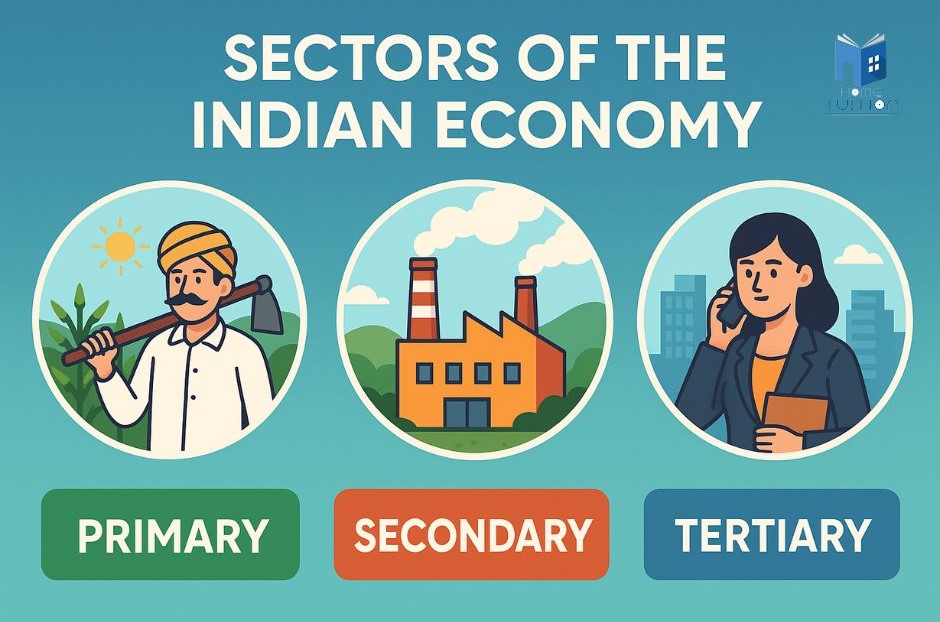
Activities which provides us income in return are known as economic activities, The economic activities can be divided into three sectors- primary sector, secondary sector and tertiary sector.
- Primary Sector:
When the economic activity depends mainly on exploitation of natural resources then that activity comes under the primary sector. Agriculture and agriculture related activities are the primary sectors of economy.
- Secondary Sector:
When the main activity involves manufacturing then it is the secondary sector. All industrial production where physical goods are produced come under the secondary sector.
- Tertiary Sector:
When the activity involves providing intangible goods like services then this is part of the tertiary sector. Financial services, management consultancy, telephony and IT are good examples of service sector.
Comparing The Three Sectors
- The various production activities in the primary, secondary and tertiary sectors produce a very large number of goods and services. Also, the three sectors have a large number of people working in them to produce these goods and services.
- The next step, therefore, is to see how much goods and services and produced and how many people work in each sector.
- In an economy there could be one or more sectors which are dominate in terms of total production and employment, while other sectors are relatively small in size.
- Economists suggest that the values of goods and services should be used rather than adding up the actual numbers. For example, if 10,000 kgs of wheat is sold at Rs. 8 per kg, the value of wheat will be Rs. 80,000. The value of 5000 coconuts at Rs. 10 per piece will be Rs. 50,000. Similarly, the value of goods and services in the three sectors are calculated, and then added up.
- Not every good (or service) that is produced and sold needs to be counted. It makes sense only to include the final goods and services. Take, for instance, a farmer who sells wheat to a flour mill for Rs. 8 per kg. The mill grinds the wheat and sells the flour to a biscuit company for Rs. 10 per kg. The biscuit company uses the flour and things such as sugar and oil to make four packets of biscuits. It sells biscuits in the market to the consumers for Rs. 60 (Rs. 15 per packet). Biscuits are the final goods, i.e., goods that reach the consumers.
- The value of final goods already includes the value of all the intermediate goods that are used in making the final good.
- The value of final goods and services produced in each sector during a particular year provides the total production of the sector of the year. The sum of production in the three sectors gives what is called the Gross domestic product of a country GDP shows how big the economy is.
- If we include the value of intermediary goods it will lead to double counting.
- The task of measuring GDP is undertaken by a Central Government ministry (NSSO). With the help of all the Indian states and union Territories, collect information relating to total volume of goods and services and their prices and the estimates the GDP.
- Secondary, sector gradually became the most important in total production and employment.
- The service sector has become the most important in terms of total production. Most of the working people are also employed in the service sector.
Do Check - CBSE Class 10 Syllabus
Historical Change in Sectors
At initial stages of development, primary sector was the most important sector of economic activity. As the methods of farming changed and agriculture sector began to prosper. It produced much more food than before. Many people could now take up other activities. Over a long time (more than hundred years), and especially because new methods of manufacturing were introduced, factories came up and started expanding.
Those people who had earlier worked on farms now began to work in factories in large numbers. People began to use many more goods that were produced in factories at cheap rates. Secondary sector gradually became the most important in total production and employment. Hence, over time, a shift had taken place. This means that the importance of the sectors had changed.
In the past 100 years, there had been a further shift from secondary to tertiary sector in developed countries. The service sector has become the most important in terms of total production. Most of the working people are also employed in the service sector. This is the general pattern observed in developed countries.
Interdependency of Sectors:
To understand this interdependency, let us take an example of a cold drink. A cold drink contains water, sugar and artificial flavor. Suppose if there is no sugarcane production then procuring sugar will become difficult and costly for the cold drink manufacturer. Now to transport sugarcane to sugar mills and sugar to the cold drink plant needs the services of a transporter. A person or system of persons is required to maintain and monitor all these movements of goods from farm to factory to shop in different locations. That is where role of administrative staffs comes. Let us go back to the farmer. He also needs feritlisers and seeds which is processed in some factory and which will be delivered to his doorstep by some means of transportation. To top it all at every step of these activities we require the proper monetary and banking system. So, in a nutshell this describes how interrelated all sectors of an economy are.
- Growth and Status of Different Sectors in India.
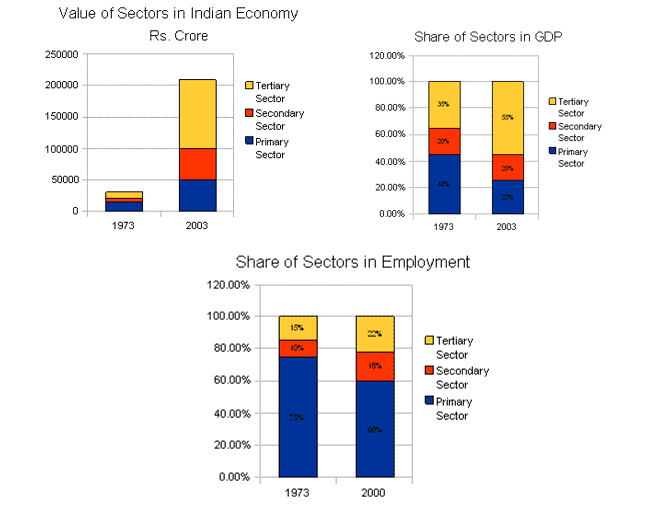
Closely observe the given graphs. The first graph shows the rupeewise turnover of various sectors in 1973 and 2003. The second graph shows the share of three sectors in the GDP during these 20 years and last graph shows share in providing employment.
The first graph shows a massive increase in turnover for all these sectors during 20 years, which shows the way our economy grew. The second graph shows that share of agriculture decreased substantially and that of industry remained static and share of services grew. Particularly the growth of share of services sector was phenomenal from 35% to 55%.
Now the third graph paints a distressing picture. The share in providing employment was not in tune with the share in GDP. The agriculture provided employment to 75% workers and this decreased to 60% in 2000, which is not as big a drop as agriculture’s drop in GDP contribution. On the other hand the growth in employment provided by other two sectors was substantially low.
- The meaning of this finding is as follows:
- Majority of people are still employed in agricultural activities. As agriculture provides seasonal employment during cropping season so chances of hidden employment are big. Moreover, as history suggests a developed nation’s dependency shifts from primary sector towards tertiary sector in all aspects of economic development, so it can be said that India is still way behind because majority still depend on agriculture.
- Secondary and Tertiary Sector have failed to generate enough employment opportunities making a pressure on primary sector. Although educated and skilled workforce do get employed in secondary and tertiary sector but for unskilled and semi-skilled workers there is still shortage of employment avenues.
Must check - NCERT Solutions for Class 10
Other Classifications of Economy
- Organised Sector:
The sector which carries out all activity through a system and follows the law of the land is called organized sector. Moreover, labour rights are given due respect and wages are as per the norms of the country and those of the industry. Labour working organized sector get the benefit of social security net as framed by the Government. Certain benefits like provident fund, leave entitlement, medical benefits and insurance are provided to workers in the organized sector.
These security provisions are necessary to provide source of sustenance in case of disability or death of the main breadwinner of the family. Otherwise the dependents will face a bleak future.
- Unorganized Sector
The sectors which evade most of the laws and don’t follow the system come under unorganized sector. Small shopkeepers, some small scale manufacturing units keep all their attention on profit making and ignore their workers basic rights. Workers don’t get adequate salary and other benefits like leave, health benefits and insurance are beyond the imagination of people working in unorganized sectors.
- Public Sector:
Companies which are run and financed by the Government comprise the public sector. After independence India was a very poor country. India needed huge amount of money to set up manufacturing plants for basic items like iron and steel, aluminum, fertilizers and cements. Additionally infrastructure like roads, railways, ports and airports also require huge investment. In those days Indian entrepreneur was not cash rich so government had to start creating big public sector enterprises like SAIL (Steel Authority of India Limited), ONGC(Oil & Natural Gas Commission).
- Private Sector:
Companies which are run and financed by private people comprise the private sector. Companies like Hero Honda, Tata are from private sectors.
- Government Aided Schemes to Fight Unemployment:
Government, from time to time, announces and implements various employment scheme to fight unemployment or hidden employment to help the weaker section of society. Shcemes like NREG (National Rural Employment Guarantee) is the latest announced by the UPA government in 2004. This programme guarantees a minimum of 100 days of employment to at least one person from every rural household. This is part of government’s effort to ensure the ‘Right to Work’ to the rural poor citizen.
Important Terms
- Poverty: It implies the inability to secure the minimum consumption need for life.
- Poverty Line: It is defined as the minimum intake of 2400 calories in rural areas and 2100 calories in urban areas per person per day.
- Unemployment: It refers to a situation in which all able and willing persons do not get suitable jobs.
- Technological Unemployment: Unemployment caused by technological improvements or advances is called technological unemployment.
- Frictional Unemployment: Unemployment caused by the rigidities and frictions in the economy.
- Structural Unemployment: Unemployment caused by the fact that the economy is going through structural changes.
- Deficit Financing: Spending more than its earning by the government.
- Workforce: It means labour force minus the unemployed.
Sectors of the Indian Economy Solved Questions
- What is work force?
Ans. Work force is labour force minus unemployment.
- Define primary sectors.
Ans. Sector which produces natural goods from land and water.
- Why skill development is required?
Ans. Skill development means achieving the excellence in performing certain piece of work. It is an effective measure to obtain job easily within and outside the country.
- What is open unemployment?
Ans. When the country’s labour force do not get opportunities for gainful employment. It is termed as open unemployment. It is also referred to as usual status unemployment.
- Define density of population.
Ans. Density of population refers to the number of people living per sq km.
- Name two type of unemployment prevalent in rural area.
Ans. Disguised and seasonal unemployment.
- How is the tertiary sector different from other sectors? Illustrate with a few examples.
Ans. (i) These are activities that help in the development of the primary and secondary sectors.
(ii) These activities, by themselves, do not produce a good but they are an aid or a support for the production process.
For example, goods that are produced in the primary or secondary sector would need to be transported by trucks or trains and then sold in wholesale and retail shops. At times, it may be necessary to store these in godowns. He also may need to talk to others over telephone or send letters (communication) or borrow money from banks (banking) to help production and trade. Transport, storage, communication, banking, trade are some examples of tertiary activities. Since these activities generate services rather than goods, the tertiary sector is also called the service sector.
- “It is necessary to have the public sector”. Substantiate your answer examining the role of the government.
Ans. (i) There are some activities, which the government has to support. The private sector may not continue their production or business unless the government encourages it.
(ii) Development of basic services like transport power plants are not attractive for private sector.
(iii) Proving food grains at a low price, providing safe drinking water etc. is the job of the government.
- How does population growth create unemployment?
Ans. (i) Population growth is one of the significant causes for unemployment. We know that population increases at faster rates than the increase in employment opportunities.
(ii) Undoubtedly there is direct and positive relationship between population growth and unemployment. It means that unemployment grows with the growth of population and declines with the reduction in population.
(iii) In order to eradicate with the evils of unemployment, efforts should be made to restrict the population at optimum level.
- State measures that you feel will help to protect the labours in the unorganized sector.
Ans. (i) Farmers should be supported through adequate facility for timely delivery seeds and other agricultural inputs, credit facilities and storage facilities.
(ii) In urban and semi urban areas small industries should be established to provide employment.
(iii) Protection and support should be providing to people in unorganized sectors especially to SCs and STs.
(iv) Tough labour laws should be made so that workers are not exploited.
- Labourers are exploited in the unorganized sector. Do you agree with this views? Give reasons in support of answer.
Ans. (i) Jobs here are low-paid and often not regular. There is no provision for overtime, paid leave, holidays, leave due to sickness etc.
(ii) Employment is subject to high degree of insecurity. People can be asked to leave without any reason.
(iii) When there is less work, such as during some seasons, some people may be asked to leave. A lot also depends on the whims of the employer.
(iv) Here a large number of people are employed on their doing small jobs such as selling on the street or doing repair work.
- Discuss the main features of right to work.
Ans. (i) The Central government in India recently made a law implementing the Right to Work in 200 districts of India.
(ii) It is called National Rural Employment Guarantee Act, 2005 (NREGA, 2005).
(iii) Under NREGA, 2005 all those who are able to and are in need of, work have been guaranteed 100 days of employment in a year by the government.
(iv) The types of work that would in future help to increase the production from land will be given preference under the Act.
(v) Preference is given to women and national rural employment guarantee fund has been created.
- What do you mean by the tertiary sector? State any three factors that have contributed to the growth of this sector in recent years.
Ans. (i) Tertiary sector includes such activities that links primary and secondary sectors by providing services.
(ii) Factors that have contributed to the growth of this sector:-
(i) The government is increasingly providing services such as hospitals, education, transport, etc.
(ii) The development of agriculture and industry has also contributed to its growth.
(iii) With increase in income the demand for other services has increases.
(iv) Emergence of newer services like information and technology has also led to its expansion.
- The sectors are classified into public and private sector on the basis of
(a) employment conditions
(b) the nature of economic activity
(c) ownership of enterprises
(d) number
Ans. Ownership of enterprises
- Production of a commodity, mostly through the natural process, is an activity in ……….…sector.
(a) primary
(b) secondary
(C) tertiary
(d) information technology
Ans. Production of a commodity, mostly through the natural process, is an activity in primary sector.
- GDP is the sum total of the value of ………. produced during a particular year.
(a) all goods and services.
(b) all final goods and services.
(b) all intermediate goods and services.
(d) all intermediate and final goods and services.
Ans. GDP is the sum total of all goods and services produced during a particular year.
- In terms of GDP the share of tertiary sector in 2003 is……
(a) between 20% to 30%
(b) between 30% to 40%
(b) between 50% to 60%
(d) 70%
Ans. In terms of GDP the share of tertiary sector in 2003 is 50% to 60%.
- Match the following:
|
Problems faced by farming sector |
Some possible measures |
|
|
(i) Unirrigated land |
(a) Setting up agro-based mills |
|
|
(ii) Fluctuations in income |
(b) Cooperative marketing societies |
|
|
(iii) Debt burden |
(c) Procurement of food grains by government |
|
|
(iv) No job in the off season |
(d) Construction of canals by the government |
|
|
(v) Compelled to sell their grains to the local traders soon after harvest. |
(e) Banks to provide credit with law interest |
|
|
Ans. |
Problems faced by farming sector |
Some possible measures |
|
(i) Unirrigated land |
(d) Construction of canals by the government |
|
|
(ii) Fluctuations in income |
(c) Procurement of food grains by government |
|
|
(iii) Debt burden |
(e) Banks to provide credit with law interest |
|
|
(iv) No job in the off season |
(a) Setting up agro-based mills |
|
|
(v) Compelled to sell their grains to the local traders soon after harvest. |
(b) Cooperative marketing societies |
- Is the service sector actually growing? Substantiate your answer.
Ans. It is true that the service sector actually growing. Service sector also includes some essential services that may not directly help in the production of goods.
For Example, we require teachers, doctors, and those who provide personal services such as washermen, barbers, cobblers, lawyers, and people to do administrative and accounting works. In recent times, certain new services based on information technology such as internet cafe, ATM booths, call centres, software companies etc. have become important.
- Service sector in India employs two different kinds of people. Do you agree with this statement? Who are these different types?
Ans. It is true that in India employs two different kinds of people.
For example, we require teacher, doctors and those who provide personal services like washermen, barbers, cobblers, lawyer etc. These are people who provide administrative, accounting works and so on.
- Compare the rate of growth of the tertiary sector with other sectors in terms of GDP and employment.
Ans. Over the thirty years between 1973 and 2003, while production in all the three sectors has increased, it has increased the most in the tertiary sector. As a result, in the year 2003, the tertiary sector has emerged as the largest producing sector in India replacing the primary sector.
Sectors of the Indian Economy Exercise – 1
- The sectors are classified into public and private sectors on the basis of:
(a) Employment conditions
(b) The nature of economic activity
(c) Ownership of enterprises
(d) Number of workers employed in the enterprise
- Production of a commodity, mostly through the natural process, is an activity in ............. sector.
(a) Primary
(b) Secondary
(c) Tertiary
(d) Information technology
- GDP is the total value of ............. produced during a particular year.
(a) All goods and services
(b) All final goods and services
(c) All intermediate goods and services
(d) All intermediate and final goods and services
- In terms of GDP the share of tertiary sector in 2003 is.............
(a) Between 20 percent to 30 percent
(b) Between 30 percent to 40 percent
(c) Between 50 percent to 60 percent
(d) 70 percent
- The largest producing sector in 1973 was:
(a) Primary Sector
(b) Secondary Sector
(c) Service Sector
(d) None of the above
- Which was the largest producing sector of India in 2003?
(a) Tertiary sector
(b) Service sector
(c) Primary Sector
(d) Private sector
- The sector which has grown the most over last 30 years is:
(a) Primary sector
(b) Secondary sector
(c) Tertiary sector
(d) Public sector
- The GDP of India in 2003 was __________ crore.
(a) Rs. 21, 0000
(b) Rs. 19, 0000
(c) Rs. 17, 0000
(d) Rs. 15, 0000
- Under employment occurs when people –
(a) Dc not wants to work
(b) Are working in a lazy manner
(c) Are working less than what they are capable of doing
(d) Are not paid for their work
- Production of a commodity, mostly through the natural process, is an activity in ............... sector.
(a) Primary
(b) Secondary
(c) Tertiary
(d) Information technology
- In terms of GDP the share of tertiary sector in 2003 was........
(a) Between to 20 percent to 30 percent
(b) Between 30 percent to 40 percent
(c) Between 50 percent to 60 percent
(d) 70 percent
- In which sectors many workers do not get employment?
(a) Organized Sector
(b) Primary Sector
(c) Unorganized Sector
(d) Secondary Sector
- What kind of a product is Saree?
(a) Raw
(b) Manufactured
(c) Natural
(d) Processed
- When some people are employed only during a part of a year is called.
(a) Structural unemployment
(b) Unemployment
(c) Disguised unemployment
(d) Seasonal unemployment
- What kind of a product is cotton?
(a) Natural
(b) Handmade
(c) Manufactured
(d) Processed
Exercise - 1 Answers
- (c)
- (a)
- (a)
- (c)
- (a)
- (a)
- (c)
- (a)
- (c)
- (a)
- (c)
- (c)
- (b)
- (d)
- (a)
Sectors of the Indian Economy Exercise – 2
- What is meant by the Secondary Sector?
- What is meant by the Tertiary or the Service Sector?
- What is meant by the Gross Domestic Product (GDP) of a country?
- What is disguised unemployment?
- How can tourism help in increasing the employment?
- What has the National Rural Employment Guarantee Act 2005 assured?
- What is an Unorganised Sector?
- Which type of workers also faces social discrimination in the Unorganised Sector?
- Classify the three groups of economic activities in which people are broadly divided.
- Distinguish between: Public Sector and Private Sector.
- What is the importance of tertiary services?
- "India is a developing country. Majority of people in this country are engaged in primary services." Why so?
- Give some reasons for the rise in service sector.
- What does the history of developed country indicate about the shifts that have taken place between sectors?
- Why should we be worried about underemployment?
- Explain measures that can be adopted to remove disguised unemployment in the agriculture sector.
- Explain how public sector contributes to the economic development of a nation.
- Discuss the significance of Secondary Sector. How does it help in the economic development of a country?
- How and why the Indian governments invest in service sector?
- Service sector in India employs two different kinds of people. Do you agree with this statement? What are these different types?
- Labourers are exploited in the unorganised sector. Do you agree with this view? Give reasons in support of your answers.
- Compare the rate of growth of tertiary sector with other sectors in terms of GDP and employment.