About Class 10 Physics Notes & Questions – Human Eye and Colourful World
The chapter Human Eye and Colourful World explains how our eyes function, common vision defects, and fascinating phenomena of light such as the rainbow, scattering, and dispersion. This chapter carries high weightage in board exams, so preparing with detailed notes and solved questions is essential.
The human eye is one of the most valuable and sensitive sense organs, which enable us to see the colourful world around us. It is just like a photographic camera. The lens system of the eye forms an image of the object on a light sensitive screen.
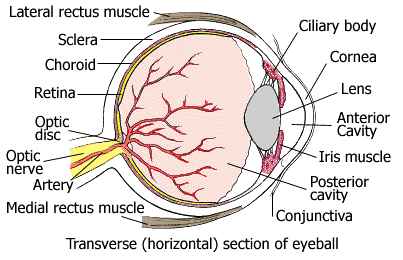
Structure and Working of Human Eye
The human eye has the following parts :
- Cornea : it is the transparent spherical membrane covering the front of the eye.
- Iris : it is the coloured diaphragm between the cornea and lens.
- Pupil : it is the small hole in the iris.
- Eye lens : it is a transparent lens made of jelly like material.
- Ciliary muscles : these muscles hold the lens in positions.
- Retina : it is the back surface of the eye.
- Blind spot : it is the point at which the optic nerve leaves the eye. An image formed at this point is not sent to the brain.
- Aqueous humor : it is clear liquid region between the cornea and the lens.
- Vitreous humor : the space between eye lens and retina is filled with another liquid called vitreous humor.In the eye, the image is formed on the retina by successive refractions at the cornera, the aqueous humor, the lens and the vitreous humor. Electrical signals then travel along the optic nerve to the brain to be interpreted. In good light, the yellow spot is most sensitive to detail and the image is automatically formed there.
Working of the Human Eye
Light rays coming from the object to be seen can enter the eye through pupil and fall on the eye lens. The eye lens being convex, forms a real and inverted image on the retina. The light sensitive cell of the retina gets activated upon illumination and generate electric signals. These signals are sent to the brain via the optic nerve. The brain interprets these signals and finally gives rise to the sensation of vision.
The function of iris and pupil
The iris adjusts the size of the pupil according to the intensity of light received by the eye. The pupil regulates and controls the amount of light entering the eye. When the intensity of outside light is high, the pupil contracts so that less light enters the eye. When the intensity of the outside light is low, the pupil expands so that more light enters the eye and we can see properly.
Power of accommodation
The image of the objects at different distances from the eye are brought to focus on the retina by changing the focal length of the eye-lens, which is composed of fibrous jelly-like material, can be modified to some extent by the ciliary muscles.
Near point and far point
The nearest point at which a small object can be seen distinctly by the eye is called the near point. For a normal eye, it is about 25 cm and is denoted by the symbol d.
With advancing age, the power of accommodation of the eye decreases at the eye lens gradually loses its flexibility. For most of the old persons aged nearly 60 years, the near point is about 200 cm and corrective glasses are needed to see the nearby objects clearly.
The farthest point upto which our eye can seen objects clearly, without any strain on the eye is called the far point. For a person with normal vision, the far point is at infinity.
Least distance of distinct vision
The minimum distance of an object from the eye at which it can be seen most clearly and distinctly without any strain on the eye, is called the least distance of distance of distinct vision. For a person with normal vision, it is about 25 cm and is represented by the symbol d, I.E.
Least distance of distinct vision = d = 25 cm
Persistence of vision
The image formed on the retina of the eye does not fade away. Instantaneously, when the object is removed from the sight. The impression (or sensation) of the object remains on the retina for about (1/16)th of a second, even after the object is removed from the sight. This continuance of the sensation of eye is called the persistence of vision.
Let a sequence of still pictures is taken by a move camera. If the sequence of these still pictures is projected on a screen at a rate of 24 images or more per second then the successive impression of the images on the screen appear to blend or merge smoothly into one another. This is because an image (or a scene) on the screen appears just before the impression of previous image on the retina is lost. Hence, the sequence of images blend into one another giving the impression of a moving picture. This principle is used in motion picture projection or in cinematography
Colour - blindness
The retina of our eye has large number of light sensitive cells having shapes of rods and cones. The rod-shaped cells responds to the intensity of light with different of brightness and darkness were as the cone shaped cells respond to colour. In dim light rods are sensitive, but cones are sensitive only bright. The cones are sensitive to red, green and blue colour of light to different extents.
Due to genetic disorder, some persons do not possess some cone-shaped cells that responds to certain specific colours only. Such persons cannot distinguish between certain colour but can seen well otherwise. Such persons are said to have colour-blindness. Driving licenses are generally not issued to persons having colour-blindness.
Colour perception of animals
Different animals have different colour perception due to which different structure of rod shaped cells and core shaped cells. For example, bees have some cone-shaped cells that are sensitive to ultraviolet. Therefore bees can seen objects in ultraviolet light and can perceive colours which we cannot do.
Human beings cannot seen in ultraviolet light as their retina do not have cone-shaped cells that are sensitive to ultraviolet light.
The retina of chicks have mostly cone shaped cells and only a few rod shaped cells. As rod shaped cells are sensitive to bright light only. Therefore, chicks wake up with sunrise and sleep in their resting place by the sunset.
Cataract
Sometimes due to the formation of a membrane over the crystalline lens of some people in the old age, the eye lens becomes hazy or even opaque. This is called cataract. It results in decrease or loss in vision of the eye. Cataract can be corrected by surgery leading to normal vision.
Defects of vision and their corrections
The ability to see is called vision. Sometimes the eye may gradually lose its power of accommodation. As a result, the eye of a person cannot focus the image of an object on the retina properly. In such cases, the vision of a person becomes blurred. As a result, he cannot see either the distant objects or nearby objects or both clearly and comfortably. The person is said to have defects of the eye. These defects of the eye are also known as the defects of vision or refractive defects of vision or the optical defects of the eye.
Following are the four common defects of vision:
- Myopia or short-sightedness
- HHypermetropia or long-sightedness
- Presbyopia
- Astigmatism
Myopia or short-sightedness
Myopia or short-sightedness is also known as near-sightedness.
Myopia or near-sightedness is the defect of an eye due to which a person can see nearby objects clearly but he cannot see far away (distant) objects clearly and distinctly.
A person with this defect has the far point nearer than infinity.
In a myopic eye, the image of a distant object is formed in front of the retina and not at the retina as shown in the fig. (b)
Causes of defect: the two possible causes of this defect are:-
- Excessive curvature of the eye lens or due to the high converging power of eye lens (short local length).
- Elongation of the eye ball.
Corrective measures: this defect can be corrected by using spectacles with concave lens of suitable focal length or power as shown in the figure (c).
According to lens formula,
Therefore, where x is the far point of myopic eye and µ is the far point of normal eye.
Hypermetropia or long-sightedness
Hypermetropia or long-sightedness also known as far-sightedness, is the defect of an eye due to which a person can see far away (distant) objects clearly but cannot see nearby objects clearly and distinctly.
A person with this defect has the near point farther away from the normal point (25 cm).
In a hypermetropic eye the image of nearby object is formed behind the retina and not on the retina as shown in the figure (b).
Causes of defect: the two possible causes of this defect are:-
- Low converging power of eye lens because of large local length.
- Eye-ball being too short (compressed).
Corrective measures: this defect can be corrected by using spectacles with convex lens of suitable focal length or power as shown in the figure (c).
According to lens formula, 1/f = 1/v - i/u
1/f = 1/-x -1/d = 1/-x + 1/d
f = xd/x-d, where x is near point of hypermetropic eye and d is the near point of normal eye.
Presbyopia or old sight
Presbyopia or old sight is the defect of the eye due to which an old person cannot see the nearby objects clearly. The near point of the old person having presbyopia gradually recedes and becomes much more than 25 cm.
Cause of defect: Presbyopia arises due to the gradual weakening of the ciliary muscles and diminishing flexibility of the eye lens with age.
Presbyopia is the hypermetropia caused by the loss of power of accommodation of the eye due to old age.
Corrective measures: Presbyopia defect is corrected in the same way as hypermetropia I.E. By using spectacles having convex lenses.
Some times, a person may suffer from both myopia and hypermetropia. Such persons often use spectacles having bifocal lenses in which upper part consists of a concave lens to correct myopia (used for distinct vision) and lower part consists of a convex lens to correct hypermetropia (used for reading).
Astigmatism:
The inability of the eye in focusing objects in both horizontal and vertical lines clearly is called astigmatism.
Cause of defect: This defect is caused due to varying curvature in the eye lens in horizontal and vertical lines.
Corrective measure: This defect is corrected by using cylindrical lenses.
Refraction of light through a glass prism
A glass prism is a five-sided solid with a triangular cross-section. It has two parallel, triangular faces and three rectangular faces that are inclined to each other at some suitable angle, which is called the angle of prism.
In the given figure dabc is a glass prism of angle a. A ray of light pe is incident on the face ab of the prism at an angle ðpen1 = I (the angle of incidence). N1n is normal to the face ab at e.
The incident ray pe after refraction at e follows the path ef at an angle ðfen = r (the angle of refraction). Since this ray is going from air (rarer medium) to prism (denser medium), so it bends towards normal n1n.
The refracted ray ef suffers second refraction at f and follows the path fs at an angle ðn2fs = e, known as the angle of emergence. Since, it is going from denser medium (glass prism) to rarer medium (air) so it bends away from normal n2n.
The incident ray pe undergoes two refractions, one at point e, while going from air to glass prism and other at point f, while going from glass prism to air. The path of the ray deviates through an angle ðhgs = d, known as angle of deviation, on passing through the prism.
The deviation of a ray on passing through a prism depends on angle of prism ‘a’ and angle of incidence ‘I’ of the ray on one face of the prism.
Dispersion of white light by a glass prism
The phenomenon of splitting up of white light into its constituent seven colours on passing through a prism is called dispersion of light.
In the year 1665, newton discovered that if a beam of white light is passed through a triangular glass prism, the white light splits to form a band of seven colours on a white screen held on the other side of the prism.
This band of seven colours formed on the white screen, when a beam of light is passed through a glass prism, is called spectrum of white light.
The colour sequence obtained on the screen is given by the famous acronym vibgyor where :
V stands for violet
I stands for indigo
B stands for blue
G stands for green
Y stands for yellow
O stands for orange
R stands for red
Violet colour bends through maximum angle whereas the red colour bends the least on passing through the prism, that is why red colour is at the top and violet colour is at the bottom of the spectrum.
Recomposition of white light
For this experiment, two prisms p1 and p2 of the same material and of the same refracting angle a are arranged as shown is figure. Sunlight from a narrow slit s falls on the first prism p1 with its base downwards and gets dispersed into constituent colours (vibgyor) and the bending takes place downwards. Now this dispersed light falls on the second prism p2 with its base upwards so that is deviates the light upwards.
It is found that the light coming out of the second prism p2 is almost white and is in direction parallel to the direction of light incident of the first prism p1. In fact, the two prisms p1 and p2 combined together effectively acts like a parallel sides glass slab. This shows that the prism p1 simply disperses the white light into its constituent colours and the prism p2 recombines these colours to form white light. The prism p1 is called dispersing-prism and the prism p2 is known as recombination-prism.
Formation of a rainbow
A rainbow is a natural spectrum appearing in the sky in the form of an arch of seven colours which is produced by the dispersion of sunlight by tiny water droplets, present in the atmosphere.
A rainbow is always formed in the opposite direction to that of the sun. The colours come from the dispersion of white light by raindrops suspended in air. The water droplets act like small prisms. Sunlight entering a drop gets refracted and is split into its component seven colours. These light rays of the component colours travel through the drop and fall on its other side.
These light rays get reflected and again fall on the surface of the drop and get refracted on the way out. The two refractions bend the light through a large angle, keeping them separate.
These lights of different colours emerging from the rain drops form a rainbow, such that the red colour is at the top and violet colour at the bottom.
Atmospheric Reaction
The refraction of light caused by the earth’s atmosphere is called atmospheric refraction. The physical conditions of the refracting medium (air) are not stationary. Some of the air layers are cold and act like a denser medium whereas other layers of the atmosphere are comparatively warm and act like a rarer medium. In the atmosphere the air layers have different optical densities. So, when the light rays pass through the air layers of different optical densities, then refraction of light takes place.
For example: the air just above the fire becomes hotter than the air farther up. The hotter air is lighter (rarer medium) than the cooler air (denser medium) above it, and has a refractive index slightly less than that of cooler air. Since the physical conditions of the air are not stationary, therefore when we see the objects through hot and cold air layers then refraction of light takes place due to which the position of the objects fluctuates and the object appears shaking.
Some of the optical phenomena in nature which take place due to the atmospheric refraction of light are as follows:
Twinkling of Stars
The twinkling of stars is due to the atmospheric refraction of star’s light. Since stars are very far off heavenly bodies and therefore are considered single point sources of light.
When the light coming from a star enters the earth’s atmosphere, it undergoes refraction due to the varying optical densities of layers of air. The continuous changing conditions of the atmosphere, refract the light coming from the stars by different amounts from one moment to another. When the atmosphere refracts more star light towards us, the stars appear to be bright and when the atmosphere refracts less star light towards us, the star appears to be dim. This phenomenon goes on thereby giving rise to twinkling of stars.
Planets do not twinkle
The planets are much closer to the earth and are thus considered as the collection of infinite point sources of energy. Therefore the dimming effect produced by some of the point sources of light in one part of the planet is nullified by the brighter effect produced by the other point sources of light in the other part of the planet.
As a result, the total variation in the amount of light entering our eye from all the point sources of light will average out to be zero. Thereby, nullifying the twinkling effect. Hence planets do not twinkle.
The apparent pDosition of the stars is higher than their actual position
The apparent position of the stars is higher than their actual position due to the atmospheric refraction. The upper layers of the atmosphere act like a rarer medium whereas the lower layers which are close to the earth acts like a denser medium. As the star light enters from rarer to denser medium it bends more towards the normal. Since the atmosphere bends starlight towards the normal, the apparent position of the star is slightly different from its actual position, as a result, star appears slightly higher than its actual position, as shown in the figure.
Advanced sunrise and delayed sunset
The sun is visible to us about 2 minutes before the actual sunrise and 2 minutes after the actual sunset because of atmospheric refraction. The actual sunrise takes place when the sun is just above the horizon.
When the sun is slightly below the horizon, the sun’s light coming from rarer medium (I.E. From less dense air) to denser medium (I.E. To more dense air) is refracted downwards as it passes through the atmosphere. Because of this atmospheric refraction, the sun appears to be raised above the horizon whereas it is actually slightly below the horizon (as shown in the figure).
It is again due to the atmospheric refraction that we can see the sun for about two minutes even after the sun has set below the horizon. Because of this atmospheric phenomenon, the time from sunrise to sunset is lengthened by about 2 + 2 = 4 minutes.
Scattering of light
When light falls on tiny particles then diffused reflection takes place and light spreads in all possible direction. This phenomenon is known as scattering of light.
Small particles scatter mainly blue light. When size of the particle increases then the light of longer wavelength also scatter. The path of a beam of light passing through a true solution is not visible. However, its path becomes visible through a colloidal solution where is size of the particles is relatively larger. Rayleigh proved that the intensity of scattered light is inversely proportional to the fourth power of the wavelength, provide the scatters is smaller in size than the wave length o light :
Tyndall effect
The earth’s atmosphere is a heterogeneous mixture of minute particles. These particles include smoke, tiny water droplets, suspended particles of dust and molecules of air. When a beam of light strikes such fine particles, the path of the beam become visible. The light reaches us after being reflected diffusely by these particles. The phenomenon of scattering of light by the colloidal particle gives rise to tyndall effect. This phenomenon is seen when a fine beam of sunlight enters a smoke filled room through a small hole. Thus, scattering or light makes the particles visible. Tyndall effect can also be observed when sunlight passes through a canopy of a dense forest. Here, tiny water droplets in the mist scatter light.]
Phenomena based upon scattering of light
(I) Colour of the clear sky is blue:
The molecules of air and other fine particles in the atmosphere have size smaller than the wavelength of visible light. These are more effective is scattering light of shorted wavelength at the blue end then light of longer wavelength at the red end. The red light has a wavelength about 1.8 times greater then blue light. Thus, when sunlight passes through the atmosphere, the fine particles in air scatter the blue colour more strongly than red. The scattered blue light enters our eyes. If the earth had no atmosphere, there would not have been any scattering. Then, the sky would have looked dark. The sky appears dark to passenger flying at very high attitudes, as scattering is not prominent at such heights.
(ii) Colours of the sun at sunrise and sunset :
Let us do an activity to understand the colour of sun at sunrise and sunset. Place a strong source (s) of white light at the focus of converging lens (l1). This lens provides a parallel beam of light. Allow the light beam to pass through a transparent glass tank (t) containing clear water. Allow the beam of light to pass through a circular hole (c) made in a cardboard. Obtain a sharp image of the circular hole of a screen (mn) using a second converging lens (l2). Dissolve 200 g of sodium thiosulphate in 2 l of clear water taken in the tank. Add 1 to 2 ml of concentrated sulphuric acid to the water.
We observe the microscopic sulphur particles precipitate in 2 to 3 minutes. As sulphur particles being to form we can observe the blue light from the three sided of the glass tank.
It is due to scattering of short wavelengths by minute colloidal sulphur particles. We observe that the colour of the transmitted light from the fourth side of glass tank facing the circular tank at first is orange red colour and then bright crimson red colour of the screen. Light from the sun travels relatively short distance. At moon, the sun appears white as a little of blue and violet colours are scattered. Near the horizon, most of the blue light shorter wavelength are scattered away by the particles. Therefore, the light that reaches our eye is of longer wavelength. This gives rise to the reddish appearance of the sun.
Danger signals are red
Out of all the colours of visible light, red colour has the longest wavelength. Therefore red colour is least scattered. As a result, it can be seen from maximum distance. That is why danger signals are red.
Exercise 1
1. The focal length of eye lens controlled by-
(a) Iris
(b) Cornea
(c) Ciliary muscles
(d) Optic nerve
2. A white lights falls on a glass prism, the least deviated colour is -
(a) Violet
(b) Orange
(c) Red
(d) Yellow
3. Blue colour of sky is due to -
(a) dispersion of light
(b) scattering of light
(c) refraction of light
(d) reflection of light
4. Rainbow is formed due to -
(a) reflection and dispersion of light through a water droplet
(b) Total internal reflection, refraction and dispersion of light through a water droplet
(c) only dispersion of light
(d) only refraction of light
5. Power of accommodation (max. variation in power of eye lens) of a normal eye is about -
(a) 1D
(b) 2D
(c) 3D
(d) 4D
6. Dispersion of light by a prism is due to the change in -
(a) frequency of light
(b) speed of light
(c) scattering
(d) none of these
7. Least distance of distinct vision of a long-sighted man is 40 cm. He wish to reduce it to 25 cm by using a lens, the focal length of the lens is -
(a) +200/3 cm
(b) -200/3 cm
(c) +200 cm
(d) -200 cm
8. Which of the following colour has the least wave length?
(a) red
(b) orange
(c) violet
(d) Blue
9. Convex lens of suitable focal length can correct -
(a) short sightedness
(b) long sightedness
(c) presbyopia
(d) astigmatism
10. The focal length of human eye lens is -
(a) 2.5 cm
(b) 25 cm
(c) 25m
(d) ∞
11. The change in focal length of an eye lens is caused by the action of
(a) Pupil
(b) Ciliary Muscles
(c) Retina
(d) Iris
12. The part of the eye compared with the photographic film of the camera
(a) Iris
(b) pupil
(c) Retina
(d) Cornea
13. The lens of human eye is
(a) Convex
(b) Concave
(c) Name of these
(d) Both of these
14. The part of the eyes which gives it the colour
(a) Pupil
(b) Optic Nerve
(c) Cornea
(d) Iris
15. The cell of the retina which is responsible for colour perception
(a) Circular cell
(b) Rods cells
(c) Cones cells
(d) None of these
16. The property related to the sense of continuity of vision is called
(a) Persistence of vision
(b) Color blindness
(c) Optical illusion
(d) None of these
17. The screen behind the eye lens is called the
(a) iris
(b) ciliary muscle
(c) retina
(d) pupil
18. The eye lens is a
(a) transparent double convex lens
(b) transparent double concave lens
(c) transparent concave-convex lens
(d) none of these
19. The least distance of distinct vision for a normal person is about
(a) 1 m
(b) 0.5 m
(c) 0.25 m
(d) None of these
20. Figure (i), (ii) and (iii) respectively, indicate the focusing of light by
(a) the normal eye, the hypermetropic eye and myopic eye
(b) the hypermetropic eye, the myopic eye and the normal eye
(c) the normal eye, the myopic eye and the hypermetropic eye
(d) the myopic eye, the normal eye, and the hypermetropic eye
21. Long sightedness is caused by the eye-ball being too short. It can be corrected by the use of a
(a) convergent lens
(b) plane mirror
(c) divergent lens
(d) none of these
22. Astigmatism occurs when the cornea does not have a truly spherical shape. This defect can be cured by the use of a
(a) concave lens
(b) cylindrical lens
(c) convex lens
(d) plano-convex lens
23. The amount of light entering in the eye is controlled by the
(a) pupil
(b) cornea
(c) iris
(d) eye lens
24. Our eye makes use of the property of
(a) convex lens
(b) concave lens
(c) cylindrical lens
(d) none of these
25. The eye lens _____ light rays to from real, inverted and highly diminished image on the ___
(a) converges, retina
(b) diverges, retina
(c) converges, pupil
(d) diverges, pupil
26. The image on the retina remains for
(a) 20 s
(b) 10 s
(c) 1/10 s
(d) 1/20 s
27. The eye lens is held in position by
(a) rods and cones
(b) iris and pupil
(c) ciliary muscles
(d) none of these
28. The range of vision of a normal human eye is from
(a) 100 m to 25 cm
(b) 1 km to 25 cm
(c) infinity to 25 m
(d) infinity to 25 cm
29. The 'far point' of a normal human eye is
(a) 25 m
(b) 17 m
(c) 100 m
(d) at infinity
30. The eye consists of an eye lens and a screen called
(a) retina
(b) iris
(c) pupil
(d) none of these
31. Hypermetropia is due to the _____ of the eye.
(a) low converging power
(b) low diverging power
(c) high converging power
(d) high diverging power
32. Long sightedness is to hypermetropia as short sightedness is to
(a) myopia
(b) focussing
(c) astigmatism
(d) accommodation
33. Which of the following lens is used to minimize hypermetropia?
(a) convex lens
(b) concave lens
(c) cylindrical lens
(d) none of these
34. The human eye forms the image of an object at its
(a) cornea
(b) irirs
(c) pupil
(d) retina
35. The change in focal length of an eye-lens to focus the image of objects at varying distances is done by the action of the
(a) pupil
(b) ciliary muscles
(c) retina
(d) blind spot
36. The figure shows the eye suffering from
(a) Hypermetropia
(b) myopia
(c) astigmatism
(d) none of these
37. The figure shows the eye suffering from
(a) Hypermetropia
(b) myopia
(c) astigmatism
(d) none of these
38. The image formed on the retina of a human eye is
(a) temporary
(b) permanent
(c) blurred
(d) none of these
39. When the cilliary muscle is relaxed, the eye lens is ________ and distant object can be seen clearly.
(a) thin
(b) thick
(c) inclined
(d) none of these
40. While looking at nearby objects, the cilliary muscle ______ and its focal length _____.
(a) contracts, increases
(b) contracts, decreases
(c) expands, increases
(d) expands, decreases
Answers to Exercise 1
1. (c)
2. (c)
3. (b)
4. (b)
5. (d)
6. (b)
7. (a)
8. (c)
9. (b)
10. (a)
11. (b)
12. (c)
13. (a)
14. (d)
15. (c)
16. (a)
17. (c)
18. (a)
19. (c)
20. (a)
21. (a)
22. (b)
23. (a)
24. (a)
25. (a)
26. (d)
27. (c)
28. (d)
29. (d)
30. (a)
31. (a)
32. (a)
33. (a)
34. (d)
35. (b)
36. (a)
37. (b)
38. (a)
39. (a)
40. (b)
Exercise 2
1. For a normal eye, the least distance of distinct vision is
(a) 0.25 m
(b) 0.50 m
(c) 25 m
(d) Infinite
2. Circular part in the centre of retina is called
(a) Blind spot
(b) Yellow spot
(c) Red spot
(d) None of the above
3. A person cannot see distinctly at the distance less than one metre. Calculate the power of the lens that he should use to read a book at a distance of 25 cm
(a) +3.0 D
(b) +0.125 D
(c) -3.0 D
(d) +4.0 D
4. A man who cannot see clearly beyond 5 m wants to see stars clearly. He should use a lens of focal length
(a) -100 m
(b) +5 m
(c) -5 m
(d) Very large
5. A man can see the objects upto a distance of one metre from his eyes. For correcting his eye sight so that he can see an object at infinity, he requires a lens whose power is
or
A man can see upto 100 cm of the distant object. The power of the lens required to see far objects will be
(a) +0.5 D
(b) +1.0 D
(c) +2.0 D
(d) -1.0 D
6. The far point of a myopia eye is at 40 cm. For removing this defect, the power of lens required will be
(a) 40 D
(b) -4 D
(c) -2.5 D
(d) 0.25 D
7. If the distance of the far point for a myopia patient is doubled, the focal length of the lens required to cure it will become
(a) Half
(b) Double
(c) The same but a convex lens
(d) The same but a concave lens
8. The impact of an image on the retina remains for
(a) 0.1 sec
(b) 0.5 sec
(c) 10 sec
(d) 15 sec
9. A man is suffering from colour blindness for green colour. To remove this defect, he should use goggles of
(a) Green colour glasses
(b) Red colour glasses
(c) Smoky colour glasses
(d) None of the above
10. The human eye has a lens which has a
(a) Soft portion at its centre
(b) Hard surface
(c) Varying refractive index
(d) Constant refractive index
11. A person wears glasses of power -2.5 D. The defect of the eye and the far point of the person without the glasses are respectively
(a) Farsightedness, 40 cm
(b) Nearsightedness, 40 cm
(c) Astigmatism, 40 cm
(d) Nearsightedness, 250 cm
12. A person cannot see objects clearly beyond 2.0 m. The power of lens required to correct his vision will be
(a) +2.0 D
(b) -1.0 D
(c) +1.0 D
(d) -0.5 D
13. When objects at different distances are seen by the eye, which of the following remains constant
(a) The focal length of the eye lens
(b) The object distance from the eye lens
(c) The radii of curvature of the eye lens
(d) The image distance from the eye lens
14. Match the List I with the List II from the combinations shown
(I) Presbiopia - (A) Sphero-cylindrical lens
(II) Hypermetropia - (B) Convex lens of proper power may be used close to the eye
(III) Astigmatism - (C) Concave lens of suitable focal length
(IV) Myopia - (D) Bifocal lens of suitable focal length
(a) I-A; II-C; III-B; IV-D
(b) I-B; II-D; III-C; IV-A
(c) I-D; II-B; III-A; IV-C
(d) I-D; II-A; III-C; IV-B
15. Near and far points of a human eye are
(a) 0 and 25 cm
(b) 0 and ∞
(c) 25 cm and 100 cm
(d) 25 cm and ∞
16. Two parallel pillars are 11 km away from an observer. The minimum distance between the pillars so that they can be seen separately will be
(a) 3.2 m
(b) 20.8 m
(c) 91.5 m
(d) 183 m
17. Far points of myopic eye is 250 cm, then the focal length of the lens to be used will be
(a) -250 cm
(b) -250/9 cm
(c) +250 cm
(d) +250/9 cm
18. Image formed on retina of eye is proportional to
(a) Size of object
(b) Area of object
(c) Size of object / Size of image
(d) size of image / size of object
19. A camera objective has an aperture diameter d. If the aperture is reduced to diameter d/2, the exposure time under identical conditions of light should be made
(a) √2 fold
(b) 2 fold
(c) 2√2 fold
(d) 4 fold
20. The exposure time of a camera lens at the f/2.8 setting is 1/200 second. The correct time of exposure at f/5.6 is
(a) 0.4 sec
(b) 0.02 sec
(c) 0.002 sec
(d) 0.04 sec
Answers to Exercise 2
1. (a)
2. (b)
3. (a)
4. (c)
5. (d)
6. (c)
7. (b)
8. (a)
9. (d)
10. (c)
11. (b)
12. (d)
13. (d)
14. (c)
15. (d)
16. (a)
17. (a)
18. (a)
19. (d)
20. (b)
Key Topics Covered
-
Structure of the Human Eye – Cornea, iris, pupil, lens, retina, and optic nerve. The eye lens helps to form real and inverted images on the retina.
-
Persistence of Vision – The time for which an image remains on the retina after the object is removed is 1/16th of a second.
-
Power of Accommodation – The ability of the eye lens to adjust its focal length to see near and distant objects clearly.
-
Defects of Vision –
-
Myopia (Near-sightedness): Corrected with a concave lens.
-
Hypermetropia (Far-sightedness): Corrected with a convex lens.
-
Presbyopia: Common in old age, corrected using a bifocal lens.
-
-
Dispersion of Light – Splitting of white light into seven colours by a prism.
-
Rainbow Formation – Caused by dispersion, internal reflection, and refraction of sunlight through raindrops.
-
Atmospheric Refraction & Scattering of Light – Explains phenomena like twinkling of stars, advanced sunrise, delayed sunset, and the blue colour of the sky.
Important Questions – Human Eye and Colourful World
-
Explain the structure and working of the human eye with a neat diagram.
-
What is persistence of vision? How is it related to the working of a cinema projector?
-
Define myopia and hypermetropia. Explain their correction with diagrams.
-
How does a rainbow form? Mention the role of dispersion and reflection.
-
Why does the sky appear blue during the day and reddish at sunrise and sunset?
Why These Notes are Important
-
Diagrams: Detailed and labeled diagrams for the human eye, prism, and rainbow formation.
-
Clear Explanations: Covers difficult topics like atmospheric refraction in simple words.
-
Exam-Oriented: Short notes and direct questions based on the CBSE exam pattern.
Preparation Tips
-
Practice ray diagrams for vision defects and prism experiments.
-
Revise the differences between myopia and hypermetropia.
-
Learn the sequence of colours in VIBGYOR.
-
Focus on conceptual questions from the NCERT and sample papers.
Conclusion
The chapter Human Eye and Colourful World combines biology and physics, making it both conceptual and scoring. With these notes and practice questions, students can understand how our eye works and how light creates beautiful natural phenomena.