The Periodic Table: A Comprehensive Guide to Element Classification

What is the Periodic Table?

The periodic table is a systematic arrangement of all known chemical elements organized according to their properties. This fundamental tool of chemistry places elements with similar characteristics in the same vertical columns (groups) while separating dissimilar elements into different positions. Currently, 114 elements have been identified, making the periodic table an indispensable reference for understanding chemical behavior and relationships.

The need for such classification became apparent as the number of known elements grew from approximately 30 in 1800 to over one hundred today. Studying each element individually would be impractical, prompting scientists to develop organizational systems that reveal patterns and predict properties.

Early Attempts at Element Classification

Dobereiner's Triads (1817)

German chemist J.W. Dobereiner made one of the first systematic attempts to classify elements by organizing them into groups of three, called triads. His key observation was that the atomic mass of the middle element was approximately the arithmetic mean of the other two elements in the triad. For example, in the triad of lithium (Li, atomic mass 7), sodium (Na, atomic mass 23), and potassium (K, atomic mass 39), sodium's atomic mass (23) equals the average of lithium and potassium: (7 + 39) ÷ 2 = 23.

Other notable triads included:

  • Sulfur, Selenium, Tellurium (32, 79, 128)
  • Chlorine, Bromine, Iodine (35.5, 80, 127)
  • Calcium, Strontium, Barium (40, 88, 137)

However, this classification system had significant limitations. It applied only to a small number of elements and failed to account for elements with nearly identical atomic masses, such as iron, cobalt, and nickel. Consequently, Dobereiner's approach was eventually discarded.

Newlands' Law of Octaves (1866)

Building on earlier work, English chemist John Newlands arranged elements in order of increasing atomic mass, starting with hydrogen (atomic mass 1) and extending to thorium (the 56th element). He discovered that every eighth element exhibited properties similar to the first, reminiscent of the eight notes in a musical octave. This pattern led him to propose the "Law of Octaves."

For instance, lithium was the first element in his arrangement, and sodium the eighth element from lithium displayed remarkably similar properties. However, Newlands' system suffered from critical flaws:

  1. The pattern only worked for elements up to calcium (Ca)
  2. It assumed only 56 elements existed in nature, with no provision for future discoveries
  3. To force elements into his table, Newlands placed dissimilar elements (such as cobalt, nickel, fluorine, chlorine, and bromine) in the same column, despite their vastly different properties
  4. Iron was separated from cobalt and nickel, despite having similar properties

Mendeleev's Breakthrough: The First Comprehensive Periodic Table

Development and Fundamental Principles

Russian chemist Dmitri Mendeleev revolutionized element classification in 1869 by publishing the first comprehensive periodic table based on atomic mass. When he began his work, only 63 elements were known. Mendeleev carefully examined relationships between atomic mass and both chemical and physical properties, focusing particularly on compounds formed with hydrogen and oxygen.

His innovative approach involved writing each element's properties on separate cards, including formulas for its hydrides and oxides. By arranging cards with similar properties in vertical columns, he noticed that elements naturally organized themselves in order of increasing atomic mass, with similar properties recurring at regular intervals.

This observation led to Mendeleev's Periodic Law: "The physical and chemical properties of elements are a periodic function of their atomic masses." This concept of periodicity the repetition of properties at regular intervals became the foundation of modern chemistry.

Structure of Mendeleev's Periodic Table

Mendeleev's table consisted of:

  • Eight vertical columns (groups): Designated I through VIII, with groups I-VII subdivided into subgroups A and B
  • Seven horizontal rows (periods): Numbered 1 through 7
  • Group A elements: Normal or representative elements
  • Group B elements: Transition elements
  • Group VIII: Nine transition elements arranged in three triads, appearing in the 4th, 5th, and 6th periods

Revolutionary Achievements

Mendeleev's periodic table demonstrated remarkable foresight:

  1. Reversed atomic mass order when necessary: He prioritized similar properties over strict atomic mass sequence, placing cobalt (58.9 u) before nickel (58.71 u) and tellurium (127.6 u) before iodine (126.9 u)
  2. Left strategic gaps for undiscovered elements: Mendeleev predicted the existence and properties of missing elements using the prefix "Eka" (Sanskrit for "one"). His predictions proved remarkably accurate:
Property Eka-aluminium (Predicted) Gallium (Found) Eka-silicon (Predicted) Germanium (Found)
Atomic mass 68 69.7 72 72.6
Density (g/cm³) 5.9 5.94 5.5 5.36
Melting point Low 303.2 K High 1231 K
Oxide formula R₂O₃ Ga₂O₃ RO₂ GeO₂
Chloride formula RCl₃ GaCl₃ RCl₄ GeCl₄
  1. Accommodated noble gases: When noble gases were discovered in 1900, they were seamlessly added as a zero group without disrupting the existing organization

Limitations of Mendeleev's Approach

Despite its success, Mendeleev's table had several shortcomings:

  • Uncertain position of hydrogen: Could be placed with alkali metals or halogens
  • Isotope problem: Isotopes with different atomic masses should theoretically occupy different positions, yet they share identical chemical properties
  • Anomalous pairs: Several element pairs violated the increasing atomic mass order (Ar-K, Co-Ni, Te-I)
  • Misplaced elements: Copper, silver, and gold were grouped with alkali metals despite significant property differences
  • No explanation for periodicity: Mendeleev could not explain why properties repeated at regular intervals

The Modern Periodic Table: Based on Atomic Number

Moseley's Discovery and the Modern Periodic Law

In 1913, English physicist Henry Moseley demonstrated that atomic number not atomic mass determines an element's properties. The atomic number represents the number of protons in the nucleus and increases by exactly one from element to element. This insight led to the Modern Periodic Law: "Physical and chemical properties of an element are a periodic function of its atomic number."

Cause of Periodicity Explained

The modern periodic table reveals that periodicity results from the recurrence of similar valence shell electron configurations. Elements in the same group share the same number of valence electrons, which determines their chemical behavior. For example, all alkali metals have one electron in their outermost shell (ns¹):

Element Atomic Number Electronic Configuration
Lithium (Li) 3 2, 1
Sodium (Na) 11 2, 8, 1
Potassium (K) 19 2, 8, 8, 1
Rubidium (Rb) 37 2, 8, 18, 8, 1
Caesium (Cs) 55 2, 8, 18, 18, 8, 1
Francium (Fr) 87 2, 8, 18, 32, 18, 8, 1

Structure of the Long Form Periodic Table

The long form periodic table (also called Bohr's table) organizes elements based on their electronic configuration:

Periods (Horizontal Rows)

Period Number of Elements Classification Valence Shell
1st (n=1) 2 Very short period K shell
2nd (n=2) 8 Short period L shell
3rd (n=3) 8 Short period M shell
4th (n=4) 18 Long period N shell
5th (n=5) 18 Long period O shell
6th (n=6) 32 Very long period P shell
7th (n=7) 25 Incomplete period Q shell

Each period begins with an alkali metal (ns¹ configuration) and ends with a noble gas (ns²np⁶ configuration, except helium with 1s²). Elements within a period have different valence electron numbers, resulting in diverse properties.

Groups (Vertical Columns)

The modern table contains 18 groups numbered 1 through 18:

  • Groups 1 & 2: Alkali metals and alkaline earth metals
  • Groups 13-17: Representative elements
  • Group 17: Halogens
  • Group 18: Noble gases (zero group, with valency of zero)
  • Groups 3-12: Transition elements

Elements within the same group share similar valence shell configurations and therefore exhibit similar chemical properties.

Formulas and Relationships in Periodic Classification

Concept Formula/Relationship Explanation
Dobereiner's Triad Atomic mass of middle element = (Mass of 1st + Mass of 3rd) ÷ 2 Middle element's mass is the arithmetic mean
Newlands' Octaves Property of 8th element ≈ Property of 1st element Every eighth element shows similar properties
Mendeleev's Periodic Law Properties = f(Atomic Mass) Properties are periodic functions of atomic mass
Modern Periodic Law Properties = f(Atomic Number) Properties are periodic functions of atomic number
Valence Electron Configuration Group 1: ns¹, Group 2: ns², Group 17: ns²np⁵, Group 18: ns²np⁶ Similar outer shell configurations explain similar properties
Period Number Period number = Number of electron shells Determines which valence shell is being filled

Advantages of the Modern Periodic Table

The atomic number-based organization offers significant improvements:

  1. Fundamental basis: Atomic number is more fundamental than atomic mass
  2. Resolves isotope problem: Isotopes share the same atomic number and thus occupy the same position
  3. Separates isobars: Elements with identical mass but different atomic numbers (like Ar-40 and Ca-40) are correctly placed in different positions
  4. Explains periodicity: Similar valence electron configurations recur at regular intervals
  5. Easy to memorize and reproduce: Logical organization aids learning

Remaining Limitations

Even the modern table has minor limitations:

  • Hydrogen's position remains somewhat ambiguous (could fit with Group 1 or Group 17)
  • Inner transition elements (lanthanoids and actinoids) are placed separately below the main table for spatial convenience

Need for Classification

We have studied earlier that matter around us is present in the form of elements compounds and mixtures and the elements contain only one type of atoms. Around the year 1800 only 30 elements were known. Till date 114 elements are known.

It is very difficult to study the chemistry of more than one hundred elements individually. This practical problem was felt by the scientists and after numerous attempts the scientists were ultimately successful in arranging the elements. This arrangement of elements provided a proper classification of elements leading to the formation of periodic table.

Early attempts to classify elements:

(a) Metals and Non-Metals:

Among the earlier classifications, Lavoisier classified the elements as metals and non-metals. However, this classification proved to be inadequate. In 1803, John Dalton published a table of relative atomic weights (now called atomic masses). This formed an important basis of classification of elements.

(b) Dobereiner's Triads:

(i) In 1817, J.W. Dobereiner a German Chemist gave this arrangement of elements.

(a) He arranged elements with similar properties in the groups of three called triads.

(b) According to Dobereiner the atomic mass of the central element was merely the arithmetic mean of atomic masses of the other two elements.

e.g.

Atomic mass of sodium = Atomic mass of lithium + Atomic mass of postassium / 2 = 7 + 39 / 2 = 23

Some examples of triads are given in the table:

S.No. Triads Relative atomic masses Average of atomic masses of the 1st and the 3rd element
1. S, Se, Te 32, 79, 128 (32 + 128)/2 = 80
2. Cl, Br, I 35.5, 80, 127 (35.5 + 127)/2 = 81.25
3. Ca, Sr, Ba 40, 88, 137 (40 + 137)/2 = 88.5

(ii) Limitations of Dobereiner's Classification:

(a) Atomic mass of the three elements of some triads is almost same.

e.g. Fe, Co, Ni and Ru, Rh, Pd

(b) It was restricted to few elements, therefore discarded.

NEWLANDS’ LAW OF OCTAVES

Dobereiner’s attempt encouraged other scientists to correlate the atomic masses of the elements with their properties.

In 1866, Newlands arranged the elements in order of increasing atomic masses. He started with hydrogen having atomic mass 1 and ended at thorium which was the 56th element. He found that the properties of every eighth element were similar to the first, like 8th note of a musical scale. Therefore, he called it as “Newlands’ law of octaves”.

Newlands’s Octaves

sa

(do)

re

(re)

ga(mi) ma(fa) pa(so) da(la) ni(ti)
H Li Be B C N O
F Na Mg Al Si P S
Cl K Ca Cr Ti Mn Fe
Co and Ni Cu Zn Y In As Se
Br Rb Sr Ce and La Zr - -

In Newlands’ octaves properties of lithium and sodium were similar and sodium is the eighth element from Lithium.

Limitations: 

(i) It was found that the law of octaves was applicable only upto Ca or we can say that it is applicable only for the lighter elements.

After Ca every eighth element did not possess properties similar to that of first one.

(ii) It was assumed by Newland that only 56 elements existed in nature and no more elements would be discovered in the future. But later on many more elements were discovered whose properties did not fit into the law of octaves.

(iii) In order to fit elements into his table, Newlands not only adjusted two elements into the same slot, but also put some unlike elements under the same slot.

For Example, Co and Ni are in the same slot and these are placed in the same column as Fluorine, Chlorine and Bromine which have very different properties than these elements while iron which have properties similar to that of Cobalt and Nickel has been placed in a different column.

Making Order out of Chaos-Mendleev's Periodic Table

While Dobereiner initiated the study of periodic relationship, it was Mendeleev who was responsible for publishing the periodic law for the first time. The first breakthrough in the classification of elements was provided by Mendeleev. He was regarded as the main contributor to the early development of the periodic table. In his periodic table elements were arranged on the basis of their fundamental properties i.e. atomic mass.

A periodic table may be defined as an arrangement which classifies all the known elements on the basis of their properties in such a way that similar elements are placed in the same vertical column while dissimilar elements are placed in different columns.

When he started his work on classification of elements, only 63 elements were known. He carefully examined the relationship between the atomic mass of the element and their chemical and physical properties. Among the chemical properties he concentrated on the compounds formed by the elements with hydrogen and oxygen as they are very reactive and formed compound with most of the elements. Therefore, the formula of oxides and hydrides formed by the elements were taken as the basis of classification of elements.

Mendeleev took 63 cards, each card representing an element, where he wrote down the properties of that element as well as the formulae of its hydride and oxide. He then separated and arranged the elements with similar properties and pinned the cards on the wall one after the other in a vertical column. When he observed these cards after arranging he found that most of the elements automatically got arranged in order of their increasing atomic masses. It was also observed that elements with similar properties occur after a certain interval or In other words there was recurrence of elements with similar physical and chemical properties after a regular interval. On this basis, he formulated a periodic law which states that

“the physical and chemical properties of elements are a periodic function of their atomic masses”.

Periodic function means that the properties of the elements get repeated after certain regular intervals. His law can also be stated as

“when elements are arranged in order of their increasing atomic masses, elements with similar properties are repeated after a certain regular intervals”.

This repetition of properties is called periodicity of properties.

Mendeleev's Periodic Table

Mendeleev arranged the known 63 elements in increasing order of their atomic masses in horizontal rows called periods in such a way that elements with similar properties fall under the same vertical column called groups.

Mendeleev's Periodic Table

Group I II III IV V VI VII VIII
Oxide Hydride

R₂O

RH

RO

RH₂

R₂O₃

RH₃

RO₂

RH₄

R₂O₅

RH₃

RO₃

RH₂

R₂O₇

RH

RO₄

Periods

A B A B A B A B A B A B A B Transition series
1

H

1.008

2.

Li

6.939

Be

9.012

B

10.81

C

12.011

N

14.007

O

15.999

F

18.998

3.

Na

22.99

Mg

24.31

Al

29.98

Si

28.09

P

30.974

S

32.06

Cl

35.453

4. First series:

second series:

K

39.102

Cu

63.54

Ca

40.08

Zn

65.37

Sc

44.96

Ga

69.72

Ti

47.90

Ge

72.59

V

50.94

As

74.92

Cr

50.20

Se

78.96

Mn

54.94

Br

79.909

Fe

55.85

Co

58.93

Ni

58.71

5.First series:

second series:

Rb

85.47

Ag

107.87

Sr

87.62

Cd

112.40

Y

88.91

In

114.82

Zr

91.22
Sn

118.69

Nb

92.91

Sb

121.75

Mo

95.94

Te

127.60

Tc

99

I

126.90

Ru

101.07

Rh
102.91

Pd

106.4

6.First series:

second series:

Cs

132.90

Au

196.97

Ba

137.34

Hg

200.59

La

138.91

Tl

204.37

Hf

178.49

Pb

207.19

Ta

180.95

Bi

208.98

W

183.85


Os

190.2

Ir

192.2

Pt

195.09

CHARACTERISTIC FEATURES OF MENDELEEV’S PERIODIC TABLE:

Mendeleev’s periodic table consists of

Eight vertical columns: Groups

They are designated as I, II, III, IV, V, VI, VII, and VIII. Except group VIII, each group is further sub-divided into two sub groups namely A and B. The elements which lie on the left hand side of the column constitute sub group A while the elements on the right hand side of that column constitute sub-group B.

Elements of sub-group A elements are known as normal or representative elements while sub group B elements are known as Transition elements. This sub division is made due to difference in their properties.

Normal/Representative element Transition elements
I A I B
II A II B
III A III B
IV A IV B
V A V B
VI A VI B
VII A VII B

Group VIII contain 9 transition elements arranged in a group of 3 elements and these lie in the 4th, 5th and 6th period.

Seven horizontal rows: Periods

In Mendeleev’s periodic table there were 7 horizontal columns present which we call as periods and are numbered from 1 to 7.

Nobel gases were not known at the time of Mendeleev. So there was no group for these gases but in 1900 when Nobel gases were discovered new group called zero group was introduced.

Achievements of Mendeleev's Periodic Table:

Mendeleev’s Periodic table was based mainly on two things, which are

(i) Increasing atomic mass.

(ii) Grouping of similar elements together.

In order to place the elements with similar properties together in some cases Mendeleev had to place an element with a slightly greater atomic mass before an element which has slightly lower atomic mass.

Ex. Cobalt (atomic mass 58.9 u) appeared before Nickel (atomic mass = 58.71 u) and Tellurium (atomic mass 127.6 u) was placed before Iodine (126.9 u).

Mendeleev also left some gaps in his periodic table for those elements which were not known or discovered at that time. He was sure about the existence of those elements and also predicted the properties of these elements. Later on, when these elements were discovered their properties were found to be very close to that which were predicted by him.

Ex. Scandium, Gallium and Germanium discovered later have properties similar to Eka-boron, Eka-aluminium and Eka-silicon.

‘Eka’ word was used as a prefix by Mendeleev for the name of the succeeding element in the same group which were not discovered. Therefore, the element which would fill the gap after boron was called eka-boron.

PROPERTY

Eka-aluminium (R)

(predicted)

Gallium

(Found)

Eka-silicon (R)

(predicted)

Germanium

(found)

Atomic mass

Density (g cm-3)

Melting point (K)

Formula of Oxide

Formula of Chloride

68

5·9

Low

R2O3

RCl3

69·7

5·94

303·2

Ga2O3

GaCl3

72

5·5

High

RO2

RCl4

72·6

5·36

1231

GeO2

GeCl4

The above data proved the correctness and usefulness of the Mendeleev’s periodic table. After the discovery of noble gases in 1900 he placed these gases in a separate group called zero group without disturbing the existing order as these gases have very different properties than other elements.

Limitations of Mendeleev’s Periodic Table:

Inspite of many advantages, the Mendeleev’s periodic table has certain defects also. Some of these are given below.

(a) Position of Hydrogen:

Position of Hydrogen in the periodic table is uncertain. It has been placed in 1A group with alkali metals, but certain properties of Hydrogen resemble those of halogens. So, it may be placed in the group of halogens as well.

(b) Position of Isotopes:

Isotopes are the atoms of the same element having different atomic masses. Therefore, According to Mendeleev’s classification these should be placed at different places depending upon their atomic masses. For example, hydrogen isotopes with atomic masses 1, 2 and 3 should be placed at three places. However, isotopes have not been given separate places in the periodic table because of their similar properties.

(c) Anomalous pairs of Elements:

In certain pairs of elements, the increasing order of atomic masses was not obeyed. In these, Mendeleev placed elements according to similarities in their properties and not in increasing order of their atomic masses.

For example,

  • The atomic mass of argon is 39.9 and that of Potassium 39.1. But Argon is placed before Potassium in the periodic table.
  • The positions of Cobalt and nickel are not in proper order. Cobalt (at. mass = 58.9) is placed before Nickel (at. mass = 58.7).
  • Tellurium (at. mass = 127.6) is placed before Iodine (at. Mass = 126.9).

(d) Some similar elements are separated, in the periodic table. For example Copper (Cu) and Mercury (Hg), Barium (Ba) and Lead (Pb). On the other hand, some dissimilar elements have been placed together in the same group.

e.g., Copper (Cu), Silver (Ag) and Gold (Au) have been placed in group I, along with alkali metals. Similarly, Manganese (Mn) is placed in the group of halogens.

(e) Cause of periodicity:

Mendeleev could not explain the cause of periodicity among the elements.

Modern Periodic Table

In 1913, an English physicist, Henry Moseley showed that the physical and chemical properties of the atoms of the elements are determined by their atomic number and not by their atomic masses. Consequently, the periodic law was modified.

Modern Periodic Law (Moseley's Periodic Law):

“Physical and chemical properties of an element are the periodic function of its atomic number”. The atomic number gives us the number of protons in the nucleus of an atom and this number increases by one in going from one element to the next. Elements, when arranged in the order of increasing atomic number Z, lead us to the classification known as the Modern Periodic Table. Prediction of properties of elements could be made ­with more precision when elements were arranged on the basis of increasing atomic number.

PERIODICITY:

The repetition of elements with similar properties after certain regular intervals, when the elements are arranged in order of increasing atomic number, is called periodicity.

Cause of Periodicity:

The periodic repetition of the properties of the elements is due to the recurrence of similar valence shell (outermost shell) electronic configuration after certain regular intervals.

e.g., Alkali metals have similar electronic configuration (ns1) and therefore have similar properties.

Alkali Metals:

At. N.

Element

Symbol

Electronic Configuration

3

Lithium

Li

2,1

11

Sodium

Na

2,8,1

19

Potassium

K

2,8,8,1

37

Rubidium

Rb

2,8,18,8,1

55

Caesium

Cs

2,8,18,18,8,1

87

Francium

Fr

2,8,18,32,18,8,1

Long form of Periodic Table:

(i) The long form of periodic table is based upon Modern periodic law. Long form of periodic table is the contribution of Range, Werner, Bohr and Bury.

(ii) This table is also referred to as Bohr's table since it follows Bohr's scheme of the arrangement of elements into four types based on electronic configuration of elements.

(iii) Long form of periodic table consists of horizontal rows (periods) and vertical columns (groups).

Description of Periods:

(i) A horizontal row of a periodic table is called a period.

(ii) There are seven periods numbered as 1, 2, 3, 4, 5, 6 and 7.

(iii) Each period consists of a series of elements having the same valence shell.

(iv) Each period starts with an alkali metal having outermost shell electronic configuration ns1.

(v) Each period ends with a noble gas with outermost shell electronic configuration ns2, np6 except Helium having outermost electronic configuration 1s2.

(vi) Each period starts with the filling of a new energy level.

(a) 1st Period:

This period is called very short period because this period contains only 2 elements 1H and 2He.

(b) 2nd and 3rd Periods:

These periods are called short periods because these periods contain 8 elements. 2nd period starts from 3Li to 10Ne and 3rd period starts from 11Na to 18Ar.

(c) 4th and 5th Periods:

These periods are called long periods because these periods contain 18 elements. 4th period starts from 19K to 36Kr and 5th period starts from 37Rb to 54Xe.

(d) 6th Period:

This period is called very long period. This period contains 32 elements. Out of the 32 elements14 elements belong to Lanthanoid Series (58Ce to 71Lu). 6th period starts from 55Cs to 86Rn.

(e) 7th Period:

This period is called as incomplete period. It contains 25 elements. Out of the 25 elements 14 elements belong to Actinoid Series (90Th to 103Lr). 7th period starts from 87Fr to 111Rg.

Periods

No. of Elements

Called as

(1st) n = 1

2

Very short period

(2nd) n = 2

8

Short period

(3rd) n = 3

8

Short period

(4th) n = 4

18

Long period

(5th) n = 5

18

Long period

(6th) n = 6

32

Very long period

(7th) n = 7

25

Incomplete period

Different elements belonging to a particular period have different electronic configurations and have different number of valence electrons. That is why elements belonging to a particular period have different properties.

Description of Groups:

(i) A vertical column of elements in the periodic table is called a group.

(ii) There are eighteen groups numbered as 1, 2, 3, 4, 5 ……………… 13, 14, 15, 16, 17, 18.

(iii) A group consists of a series of elements having similar valence shell electronic configuration and hence exhibit similar properties.

e.g. Li, Na, K belong to the same group and have 1 electron in their valence shell.

(iv) The group 18 is also known as zero group because the valency of the elements of this group is zero. The elements of 18thor zero group are called noble gases.

(v) The elements present in groups 1, 2, 13 to 17 are called normal or representative elements.

(vi) Elements of group 1 and 2 are called alkali metals and alkaline earth metals respectively.

(vii) Elements present in group 17 are called halogens.

Merits of long form of periodic table: 

(i) The long form of periodic table is based on atomic number. Atomic number is a more fundamental property of an element as compared to atomic mass.

(ii) In the long form of periodic table, different isotopes can be placed at the same place because they have same atomic number. On the other hand, isobars such as Ar (40) and Ca (40) have to be placed at different places due to their different atomic numbers.

(iii) The long form of periodic table can explain why all the elements in a group have similar properties while the elements in a period have different properties:-

The basis for periodicity of elements is the similar electronic configuration of the outermost shell of elements of the same group. The similar electronic configuration of the elements is repeated at regular intervals so the properties of the elements are also repeated at regular intervals.

(iv) It is easy to remember and reproduce the table.

LIMITATIONS OF LONG FORM OF PERIODIC TABLE:

(i) Position of hydrogen is not accurate.

(ii) Inner transition elements (Lanthanoids and Actinoids) have been given separate positions below in the periodic table.
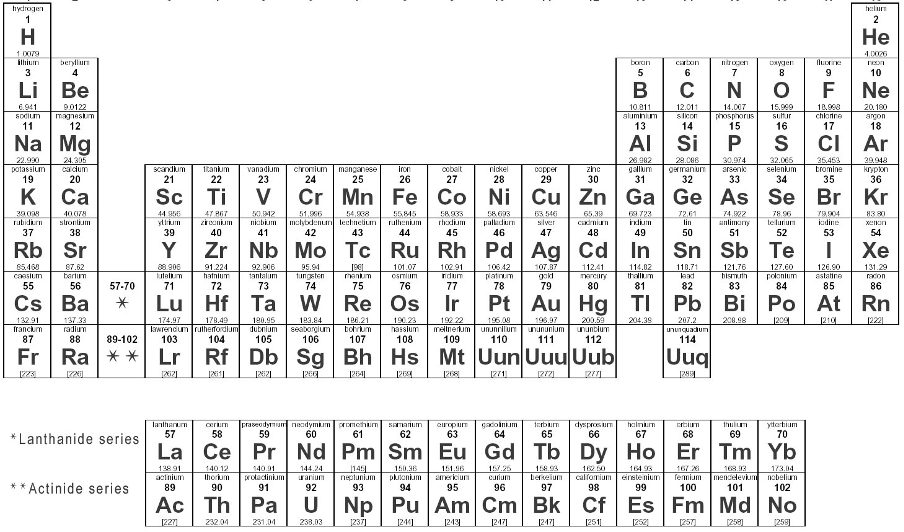
periodic table

Periodicity in Properties:

(i) The electronic configurations of the atoms display periodic variations with increase in atomic number.

(ii) The elements exhibit periodic variations of physical and chemical properties. Following are some of the important properties of the elements­:

(a) Valency (b) Atomic size (c) Metallic and non - metallic character

Valency:

We know that valency of an element is determined by the number of electrons present in outermost shell or valence shell. Valency of an element is also determined by the number of electrons an element loses or gains while combining with atoms of other elements in order to become stable or in other words the combining capacity of an element is called its valency.

Variation of valency in a period:

On moving from left to right in a period the valency first increases from 1 – 4 and than decreases to zero.

In a period, the valency an element is either equal to the number of electrons in the valence shell or eight minus the number of electrons in the valence shell. This can be better understood by the following table.

For the Elements in the third period:

Group No. 1 2 13 14 15 16 17 18
Atomic No. 11 12 13 14 15 16 17 18
Symbol Na Mg Al Si P S Cl Ar
Electronic configuration 2, 8, 1 2, 8, 2 2, 8, 3 2, 8, 4 2, 8, 5 2, 8, 6 2, 8, 7 2, 8, 8
No. of valence

electrons

1 2 3 4 5 6 7 8
Valency 1 2 3 4 3 2 1 0

It is clear from the above table that Na, Mg and Al has 1, 2, and 3 valence electrons respectively therefore these elements can easily lose electrons to acquire the stable electronic configuration of the nearest noble gas i.e.,
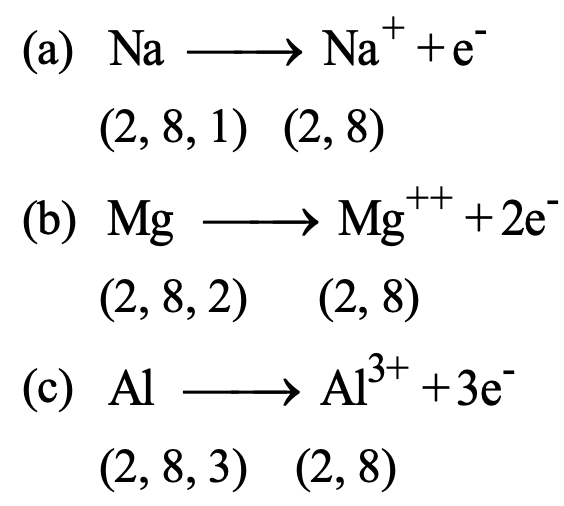
electronic configuration of the nearest noble gas

Silicon has 4 electrons in the valence shell therefore, it can achieve the stable configuration either by losing or gaining or sharing 4 electrons.

As a lot of energy is required to either lose or gain 4 electrons, therefore silicon attains the stable configuration of the nearest noble gas by sharing 4 electrons. Thus, Si has the valency of 4.

Similarly P,S, and Cl requires 3, 2, & 1 electrons respectively to complete their octet, so their valency is 3, 2 and 1 respectively.

The last element is Ar which has 8 electrons in its outermost orbit/shell so it doesn’t require to gain, lose or share electrons in order to complete its octet. Therefore, it does not have any tendency to form bonds. Thus, the valency of Ar is zero.

Variation of valency in a group:

As we know that all the elements in a group have similar outer electronic configuration i.e. they have same number of valence electrons. Therefore, the valency of all the elements in a group is fixed or same. For example, elements of group 1, 2, 3 have valency 1, 2, 3 respectively. Similarly group 17 requires 1 electron to complete its octet so its valency is also 1.

Atomic Size:

The term atomic size refers to the radius of an atom. In general atomic size may be considered as the distance between the centre of the nucleus and the outermost shell of an isolated atom.

Variation of atomic size in a period:

Within each period, the atomic radii decrease with increase in atomic number. e.g., Atomic radii decrease from Lithium to Fluorine in the second period.

Reason:

The decrease of atomic radii along a period can be explained on the basis of increase in nuclear charge. On moving from left to right across the period, the nuclear charge increases progressively by one unit but the additional electron goes to the same shell. As a result the electrons are pulled closer to the nucleus by the increased nuclear charge. This causes a decrease in atomic size.

Atomic Radii of Elements of Second Period:

Element 3Li 4Be 5B 6C 7N 8O 9F 10Ne
Nuclear Charge +3 +4 +5 +6 +7 +8 +9 +10
Configuration 2s1 2s2 2s2 2p1 2s2 2p2 2s2 2p3 2s2 2p4 2s2 2p5 2s2 2p6
Atomic Radii (pm) 133 111 88 77 75 74 72 160

The values given in the table show abrupt increase in the atomic size of Ne. This is due to the reason that the values given for other elements are covalent radii whereas that for Ne it is Vander Waals radius as it does not form covalent bond due to its stable configuration.

Variation of atomic radii within a group:

The atomic radii increase from top to bottom within a group of the periodic table.

Atomic Radii of Alkali Metals and Halogens:

Alkali Metals

Halogens

Element Atomic Radius (pm) Element (pm) Atomic Radius (pm)
Li

Na

K

Rb

Cs

133

157

201

216

235

F

CI

Br

I

64

99

114

133

Reason:

In moving down a group, the nuclear charge increases with increase in atomic number, but at the same time there is a progressive increase in the number of energy levels. Since, the effect of additional energy level is more pronounced than the effect of increased nuclear charge, the distance of the outermost electron from the nucleus increases on going down the group.

  • Atomic radii increase down the group.
  • Atomic radii decrease across the period.

Metallic and Non-Metallic Character:

Metals:

The metals are characterised by their nature of readily giving up the electrons.

(i) Metals comprise of more than 75% of all known elements and most of them appear on the left hand side of the periodic table.

(ii) Metals are usually solid at room temperature (except Mercury).

(iii) They have high melting and boiling points and are good conductors of heat and electricity.

Non–Metals:

(i) Non-metals do not lose electrons but take up electrons to form corresponding anions.

(ii) Non-metals are located at the top right hand side of the periodic table.

(iii) Non-metals are usually solids or gases (except Bromine which is liquid) at room temperature with low melting and boiling points.

(iv) They are poor conductors of heat and electricity.

Metalloids (Semimetals):

(i) Some elements lying at the border of metallic and non-metallic behaviour possess the properties that are characteristics of both metals and non - metals. These elements are called semimetals or metalloids.

(ii) The metalloids comprise of the elements B, Si, Ge, As, Sb, Te and Po.

(iii) Variation of metallic character across a period: Metallic character decreases along a period due to increase in ionisation energy.

(iv) Variation of metallic character along a group: Metallic character increases on going down a group from top to bottom. This can be explained in terms of decrease in ionisation energy on going down a group from top to bottom.

Note: Metals generally form cations by losing electrons from their outermost shell, while non- metals generally form anions by accepting one or more electrons.

e.g. Alkali metals form M+ ions by losing one electron, while alkaline earth metals form M–1 ions by losing two electrons from their outermost shell.

Division of Elements into metals and non-metals:

In the modern or long form of periodic table, the elements have been broadly divided into metals and non-metals, by the thick zig-zag line running diagonally across the periodic table

Metals;

Those elements which lie on the left hand side of this line are metals. For example, Na, K, Mg, etc.

Non-Metals:

Those elements which lie on the right hand side of this line are non-metals like P, O, Cl, etc.

Metalliods:

Elements present along the border of this line show properties of both metals and non-metals. For example, Silicon, Germanium, Arsenic, Antimony and Tellurium. These elements are called metalloids or semi-metals.

The oxides of metals are basic in nature while that of non-metals are acidic in nature.

Frequently Asked Questions

The fundamental difference lies in the organizing principle: Mendeleev's table was arranged by atomic mass, while the modern periodic table is organized by atomic number.

Key Differences:

Aspect Mendeleev's Table Modern Periodic Table
Basis Atomic mass Atomic number
Groups 8 groups (with A & B subgroups) 18 groups
Periods 7 periods 7 periods
Isotopes Should occupy different positions Correctly placed together
Anomalies Several reversed pairs (Ar-K, Te-I) Anomalies resolved
Explanation No explanation for periodicity Explains periodicity through electronic configuration
Transition elements Mixed in groups Separate groups (3-12)
Noble gases Added later as zero group Integrated as Group 18

Why the modern table is superior:

  1. Resolves isotope problem: Isotopes like Carbon-12 and Carbon-14 have different masses but identical atomic numbers (6), so they correctly occupy the same position.
  2. Fixes reversed pairs: When organized by atomic number, argon (18) naturally comes before potassium (19), and tellurium (52) before iodine (53), resolving Mendeleev's forced reversals.
  3. Explains periodicity scientifically: The modern table shows that recurring valence electron configurations cause periodic properties, providing a physical basis for Mendeleev's empirical observations.
  4. Better prediction: Atomic number-based organization more accurately predicts element properties and chemical behavior.

Both tables represent brilliant scientific achievements for their time, but the modern periodic table provides a more fundamental, accurate, and explanatory framework for understanding elements.

The periodic table represents one of humanity's greatest intellectual achievements, serving as the foundational organizing principle for chemistry and influencing virtually every branch of modern science. Its significance extends far beyond simple element classification.

Fundamental scientific importance:

1. Universal language of chemistry:

  • Provides a common framework for scientists worldwide
  • Enables clear communication across languages and cultures
  • Standardizes chemical knowledge and nomenclature
  • Every chemist, regardless of location, uses the same organizational system

2. Predictive power:

  • Allows prediction of element properties before discovery or synthesis
  • Enables design of new materials with desired characteristics
  • Guides research directions by identifying knowledge gaps
  • Reduces trial-and-error in chemical synthesis

3. Demonstrates scientific principles:

  • Shows how empirical observation leads to theoretical understanding
  • Illustrates the power of systematic classification in science
  • Proves that underlying patterns govern natural phenomena
  • Demonstrates how scientific models evolve as understanding deepens

4. Connects multiple scientific disciplines:

  • Physics: Explains atomic structure, quantum mechanics, nuclear properties
  • Chemistry: Predicts reactions, bonding, and molecular structure
  • Biology: Essential for understanding biochemistry, metabolism, and nutrition
  • Geology: Explains mineral formation and Earth's composition
  • Astronomy: Describes stellar nucleosynthesis and cosmic element distribution
  • Materials science: Guides development of alloys, semiconductors, and polymers

Educational significance:

1. Teaches scientific thinking:

  • Pattern recognition and classification
  • Hypothesis formation and testing
  • Relationship between structure and properties
  • Evolution of scientific understanding

2. Provides conceptual framework:

  • Organizes vast amounts of information logically
  • Makes chemistry learnable and memorable
  • Shows connections between seemingly unrelated phenomena
  • Builds foundation for advanced study

Technological and practical significance:

1. Enables modern technology:

  • Electronics: Silicon-based computers, LED displays, photovoltaic cells
  • Medicine: Diagnostic imaging, radiation therapy, pharmaceutical development
  • Energy: Nuclear power, batteries, catalysts, solar cells
  • Communications: Fiber optics, wireless technology, satellites

2. Drives innovation:

  • Guides materials engineering and nanotechnology
  • Informs environmental remediation strategies
  • Directs pharmaceutical research
  • Enables development of sustainable technologies

3. Addresses global challenges:

  • Energy crisis: Battery technology, catalysis, alternative energy sources
  • Climate change: Carbon capture, green chemistry, sustainable materials
  • Resource scarcity: Identifying element substitutes, recycling strategies
  • Health: Developing new drugs, understanding nutritional needs

Philosophical and cultural significance:

1. Symbol of human achievement:

  • Represents triumph of pattern recognition and systematic thinking
  • Shows humanity's ability to understand nature's fundamental organization
  • Demonstrates power of international scientific collaboration
  • Featured in classrooms, laboratories, and popular culture worldwide

2. Continuously evolving:

  • New elements regularly added (most recently elements 113-118 in 2016)
  • Alternative arrangements proposed for specific purposes
  • Digital versions enable interactive learning
  • Remains relevant despite being over 150 years old

3. Inspires curiosity:

  • Encourages exploration of natural world
  • Motivates students to pursue scientific careers
  • Connects abstract concepts to tangible reality
  • Shows that significant discoveries are still possible

Historical significance:

The periodic table's development demonstrates several important lessons:

  • Collaboration: Multiple scientists (Dobereiner, Newlands, Mendeleev, Moseley) contributed iteratively
  • Refinement: Scientific models improve as knowledge expands
  • Prediction: Good models must explain existing data AND predict new phenomena
  • Universality: True scientific principles apply everywhere in the universe

Future significance:

The periodic table will continue to be central to:

  • Element synthesis: Creating new superheavy elements
  • Space exploration: Understanding composition of other planets and stars
  • Quantum computing: Utilizing exotic element properties
  • Medicine: Developing targeted therapies and diagnostics
  • Sustainability: Finding replacements for rare or toxic elements

The periodic table's enduring significance lies not just in what it tells us about the elements, but in what it represents: humanity's capacity to discover order in nature, predict the unknown, and use systematic knowledge to improve life on Earth. It remains the single most important tool in chemistry and one of science's crowning achievements.

Yes, the periodic table's structure allows remarkably accurate predictions of an unknown element's properties based on its position, even before the element is synthesized or fully characterized. This predictive power is one of the periodic table's most valuable features.

How to predict properties systematically:

Step 1: Identify the element's position Determine the group (vertical column) and period (horizontal row) where the element would be located based on its atomic number.

Step 2: Analyze neighboring elements Examine elements directly above, below, and beside the unknown element, as properties typically change gradually.

Step 3: Apply periodic trends

Moving down a group (increasing period number):

  • Atomic radius increases
  • Ionization energy decreases
  • Electronegativity decreases
  • Metallic character increases
  • Reactivity increases (for metals) or decreases (for non-metals)

Moving across a period (increasing group number):

  • Atomic radius decreases
  • Ionization energy increases
  • Electronegativity increases
  • Metallic character decreases
  • Elements transition from metals to metalloids to non-metals

Step 4: Interpolate specific values Take numerical averages of properties from surrounding elements to estimate:

  • Atomic mass
  • Density
  • Melting point
  • Boiling point
  • Atomic radius

Step 5: Predict chemical behavior Based on group membership:

  • Determine likely oxidation states
  • Predict ion formation (+1, +2, -1, etc.)
  • Estimate reactivity level
  • Predict compound formulas (oxides, chlorides, hydrides)

Historical example: Mendeleev's predictions

Eka-silicon (predicted 1871) vs. Germanium (discovered 1886):

Mendeleev examined silicon (above) and tin (below) in Group 14, plus neighboring elements:

Predictions made:

  • Atomic mass: ~72 (actual: 72.6)
  • Density: 5.5 g/cm³ (actual: 5.36 g/cm³)
  • Appearance: Dirty gray metal
  • Oxide formula: RO₂ (actual: GeO₂)
  • Chloride formula: RCl₄ (actual: GeCl₄)
  • Would form an acid R₂O₃ when burned

Why this works: The periodic law ensures that properties change predictably. Silicon and tin bracket germanium's position, so germanium's properties logically fall between them.

Modern application: Predicting element 119

If element 119 is synthesized, we can predict:

  • Group: 1 (alkali metal)
  • Period: 8
  • Electron configuration: [Og] 8s¹
  • Properties:
    • Highly reactive alkali metal (most reactive known)
    • Forms +1 ions
    • Extremely low ionization energy
    • Very large atomic radius
    • Reacts violently with water
    • Soft, easily cut metal
    • Low melting point

Limitations of predictions:

  1. Superheavy elements: Relativistic effects at very high atomic numbers can cause unexpected behavior
  2. Transition metals: Variable oxidation states make predictions more complex
  3. Radioactive elements: Short half-lives prevent thorough characterization
  4. Quantum effects: Some properties don't follow simple linear trends

Despite these limitations, the periodic table remains chemistry's most powerful predictive tool, allowing scientists to anticipate properties decades before experimental confirmation—exactly as Mendeleev demonstrated over 150 years ago.

The periodic table has undergone substantial evolution since Mendeleev's 1869 version, with changes in organization, understanding, and the addition of numerous new elements.

Major structural changes:

1. Reorganization by atomic number (1913):

  • Moseley's discovery shifted the organizing principle from atomic mass to atomic number
  • Resolved anomalies like Ar-K and Te-I positioning
  • Provided scientific explanation for periodicity

2. Expansion of groups:

  • Mendeleev had 8 groups (with A and B subgroups)
  • Modern table has 18 groups with clearer distinctions
  • Transition metals now occupy separate groups (3-12)

3. Addition of noble gases (1900):

  • Entirely new group added after discovery by Ramsay and Rayleigh
  • Helium, neon, argon, krypton, xenon discovered between 1868-1898
  • Added as Group 18 (or zero group) without disrupting existing structure

4. Lanthanides and actinides separation:

  • These 28 elements (14 lanthanides, 14 actinides) are placed below the main table
  • Mendeleev's table didn't accommodate these "inner transition elements"
  • Keeps the table compact and readable

New elements discovered:

Mendeleev's time (1869): 63 elements known

Major discoveries since:

  • Noble gases (1890s-1900s): He, Ne, Ar, Kr, Xe, Rn
  • Naturally occurring elements (1900-1940): Radium, polonium, actinium, protactinium
  • Synthetic elements (1940-present): All elements from 93 (Neptunium) onward

Current total: 114+ confirmed elements, with period 7 still incomplete

Theoretical advancements:

1. Quantum mechanics (1920s-1930s):

  • Explained electron shell structure (K, L, M, N shells)
  • Introduced orbital theory (s, p, d, f subshells)
  • Provided mathematical basis for electronic configurations

2. Electronic configuration understanding:

  • Explained why groups have similar properties (same valence electrons)
  • Predicted chemical behavior more accurately
  • Resolved why periodicity occurs

3. Isotope discovery:

  • Revealed that elements can have multiple forms with different masses
  • Explained why atomic masses aren't whole numbers (weighted averages)
  • Justified placement of isotopes together

Visual and practical improvements:

1. Color coding: Modern tables use colors to distinguish:

  • Metals, non-metals, metalloids
  • Element states (solid, liquid, gas)
  • Natural vs. synthetic elements
  • Element categories (alkali, alkaline earth, halogens, etc.)

2. Additional information: Contemporary periodic tables include:

  • Electron configurations
  • Electronegativity values
  • Oxidation states
  • Discovery dates
  • Element origins

3. Digital versions: Interactive online periodic tables provide:

  • Detailed information on demand
  • 3D visualizations
  • Trend animations
  • Real-time updates when new elements are confirmed

Continuing evolution:

The periodic table continues to change as:

  • New superheavy elements are synthesized in laboratories (elements 113-118 officially named in 2016)
  • Alternative arrangements are proposed for educational or specialized purposes
  • Understanding of quantum mechanics deepens
  • New applications drive demand for rare and unusual elements

Despite these changes, Mendeleev's fundamental insight—that elements can be systematically organized to reveal patterns and predict properties—remains the cornerstone of the modern periodic table, demonstrating the enduring power of his original contribution.

Understanding the periodic table has practical applications across numerous industries, technologies, and everyday life situations, making it far more than just an academic exercise.

Materials Science and Engineering:

  • Alloy design: Engineers combine metals (like iron with carbon for steel, or copper with tin for bronze) based on periodic properties to create materials with desired strength, flexibility, or conductivity
  • Semiconductor technology: Silicon and germanium (Group 14) are chosen for electronics because their position gives them perfect electron characteristics for controlling electrical current
  • Corrosion resistance: Understanding reactivity trends helps select appropriate metals for specific environments (titanium for seawater, stainless steel for medical implants)

Medicine and Healthcare:

  • Radioactive isotopes: Elements like Technetium-99m (transition metal) are used in medical imaging
  • Drug design: Halogens (Group 17) are frequently incorporated into pharmaceutical compounds to modify their properties
  • Dietary supplements: Understanding Group 1 and 2 elements helps formulate calcium, magnesium, and potassium supplements

Environmental Science:

  • Pollution tracking: Heavy transition metals like mercury, lead, and cadmium are monitored as toxins
  • Water treatment: Chlorine (halogen) disinfects water; aluminum compounds aid in purification
  • Catalytic converters: Platinum, palladium, and rhodium (transition metals) reduce vehicle emissions

Energy Production:

  • Nuclear power: Uranium and plutonium (actinides) understanding enables nuclear energy
  • Battery technology: Lithium (alkali metal) batteries power phones and electric vehicles because lithium's position indicates it readily releases electrons
  • Solar cells: Silicon's semiconductor properties make it ideal for photovoltaic cells

Agriculture:

  • Fertilizers: Nitrogen, phosphorus, and potassium (NPK) ratios are determined by understanding these elements' roles in plant growth
  • Pesticides: Halogens are incorporated into many agricultural chemicals

Consumer Products:

  • Cooking: Understanding sodium and chlorine explains salt's properties
  • Cleaning: Alkaline

Consumer Products (continued):

  • Cooking: Understanding sodium and chlorine explains salt's properties and its role in food preservation
  • Cleaning: Alkaline metals form the basis of many cleaning products; chlorine bleaches work because of halogen reactivity
  • Cosmetics: Zinc oxide (transition metal) in sunscreen, titanium dioxide in makeup
  • Fireworks: Different metals produce specific colors—strontium (alkaline earth) for red, copper (transition) for blue, sodium (alkali) for yellow

Technology and Electronics:

  • Smartphones: Contain over 30 different elements from the periodic table, including rare earth elements for displays and lithium for batteries
  • Computer chips: Silicon-based semiconductors, gold for connections (due to its non-reactive nature)
  • LED lights: Gallium, indium, and other elements create efficient lighting

Food Industry:

  • Food preservation: Sodium (Group 1) in salt inhibits bacterial growth
  • Packaging: Aluminum (Group 13) foil protects food due to its malleability and non-toxic nature
  • Fortification: Iron supplements in cereals, iodine in salt for thyroid health

Career applications:

  • Chemists: Use it daily for predicting reactions and designing synthesis pathways
  • Pharmacists: Understand drug interactions based on elemental composition
  • Geologists: Identify minerals and predict element distributions in Earth's crust
  • Environmental scientists: Track pollutants and design remediation strategies
  • Materials engineers: Develop new alloys, polymers, and composite materials

Understanding the periodic table enables professionals and consumers to make informed decisions about materials, health, safety, and environmental impact in countless real-world situations.

The periodic table is the single most important reference tool in chemistry education, serving as a comprehensive roadmap for understanding chemical behavior, predicting reactions, and organizing vast amounts of information systematically.

Key educational benefits:

1. Simplifies learning: Instead of memorizing properties of 114+ individual elements, students learn patterns and trends. Understanding that all Group 1 elements behave similarly reduces memorization dramatically.

2. Enables predictions: Students can predict:

  • Which elements will react together
  • What type of bonds will form (ionic vs. covalent)
  • What charge ions will carry
  • Relative reactivity of elements
  • Physical properties like melting points and atomic size

3. Visualizes relationships: The table's layout immediately shows:

  • Which elements are similar (same column)
  • How properties change gradually (across rows and down columns)
  • Where metals, non-metals, and metalloids are located
  • Patterns in electron configuration

4. Supports problem-solving: Students use the periodic table to:

  • Balance chemical equations
  • Determine molecular formulas
  • Calculate molar masses
  • Understand bonding patterns
  • Write electron configurations

5. Builds scientific thinking: The periodic table demonstrates:

  • How classification systems work in science
  • The power of pattern recognition
  • How empirical observations lead to theoretical understanding
  • The predictive nature of scientific models

6. Provides historical context: Studying the table's development from Dobereiner through Mendeleev to Moseley shows how scientific knowledge evolves through hypothesis, prediction, and verification.

Learning strategies for students:

  • Start with groups (families) to understand similar behaviors
  • Learn common elements first (H, C, N, O, Na, Cl, Fe, Cu)
  • Use mnemonic devices for group members
  • Practice predicting properties before looking them up
  • Connect periodic trends to real-world applications

The periodic table transforms chemistry from disconnected facts into a coherent, logical system making it indispensable for students at every level.

The periodic table is organized to provide instant information about any element's properties and behavior through its position, group, and period membership.

Step-by-step guide to reading the periodic table:

1. Locate the element: Each element occupies one square/cell containing:

  • Element symbol: 1-2 letter abbreviation (H, He, Na)
  • Atomic number: Whole number indicating protons (appears above or beside symbol)
  • Element name: Full name (Hydrogen, Helium, Sodium)
  • Atomic mass: Decimal number indicating average mass (below symbol)

2. Identify the period (horizontal row):

  • The period number tells you how many electron shells the atom has
  • Period 3 elements (Na, Mg, Al, Si, P, S, Cl, Ar) all have 3 electron shells

3. Identify the group (vertical column):

  • The group number often indicates the number of valence electrons
  • Group 1 = 1 valence electron, Group 17 = 7 valence electrons
  • Elements in the same group have similar chemical properties

4. Determine element category:

  • Left side and center: Metals (good conductors, malleable, lose electrons)
  • Right side: Non-metals (poor conductors, brittle, gain electrons)
  • Staircase line: Metalloids (intermediate properties)
  • Groups 3-12: Transition metals (variable oxidation states, colored)

5. Predict chemical behavior:

  • Group 1: Forms +1 ions, very reactive
  • Group 2: Forms +2 ions, moderately reactive
  • Group 17: Forms -1 ions, very reactive
  • Group 18: Unreactive (stable electron configuration)

Practical example: If you need to know about chlorine (Cl):

  • Atomic number 17 → 17 protons, 17 electrons
  • Period 3 → 3 electron shells
  • Group 17 → 7 valence electrons, halogen family
  • Prediction: Highly reactive non-metal, forms -1 ions, gains 1 electron in reactions

Halogens (Group 17) and Noble Gases (Group 18) represent two chemically contrasting groups at the right side of the periodic table—one highly reactive, the other remarkably unreactive.

Halogens (Group 17):

Members: Fluorine (F), Chlorine (Cl), Bromine (Br), Iodine (I), Astatine (At)

Common characteristics:

  • Seven valence electrons (ns²np⁵ configuration)
  • Extremely reactive non-metals
  • Need only one electron to complete their outer shell (octet)
  • Form -1 ions readily by gaining one electron
  • Exist as diatomic molecules in elemental form (F₂, Cl₂, Br₂, I₂)
  • Powerful oxidizing agents
  • React vigorously with metals to form salts

Physical states at room temperature:

  • Fluorine and Chlorine: Gases
  • Bromine: Liquid
  • Iodine: Solid

The name "halogen" means "salt-former" in Greek, because these elements readily combine with metals to produce salts (like sodium chloride, NaCl).

Noble Gases (Group 18/Zero Group):

Members: Helium (He), Neon (Ne), Argon (Ar), Krypton (Kr), Xenon (Xe), Radon (Rn)

Common characteristics:

  • Complete outer electron shells (ns²np⁶, except He with 1s²)
  • Extremely stable and unreactive (chemically inert)
  • Zero valency (cannot form compounds easily, hence "zero group")
  • Exist as single atoms (monatomic gases)
  • Colorless, odorless gases at room temperature
  • Low boiling points

Why they're "noble": The term "noble" was borrowed from "noble metals" (like gold and platinum), which are unreactive. Noble gases similarly don't readily "associate" with other elements, remaining chemically aloof.

Historical note: Noble gases were discovered around 1900, after Mendeleev published his periodic table. When discovered, they were seamlessly added as a new group without disrupting the existing structure, demonstrating the robustness of the periodic system.

Practical applications:

  • Helium: Balloons, cryogenics, breathing mixtures for deep-sea divers
  • Neon: Advertising signs, lasers
  • Argon: Inert atmosphere for welding, light bulb filling
  • Xenon: Flash lamps, medical anesthesia

Alkali metals (Group 1) and alkaline earth metals (Group 2) are highly reactive metals that form the first two groups of the periodic table's representative elements.

Alkali Metals (Group 1):

Members: Lithium (Li), Sodium (Na), Potassium (K), Rubidium (Rb), Caesium (Cs), Francium (Fr)

Common characteristics:

  • One valence electron (ns¹ configuration)
  • Highly reactive, especially with water and oxygen
  • Soft metals that can be cut with a knife
  • Low melting points compared to other metals
  • Form +1 ions by losing their single valence electron
  • Produce alkaline (basic) solutions when reacting with water
  • Never found free in nature due to high reactivity

Example reactions:

  • 2Na + 2H₂O → 2NaOH + H₂ (violent reaction producing hydrogen gas)
  • 4Li + O₂ → 2Li₂O (rapid oxidation in air)

Alkaline Earth Metals (Group 2):

Members: Beryllium (Be), Magnesium (Mg), Calcium (Ca), Strontium (Sr), Barium (Ba), Radium (Ra)

Common characteristics:

  • Two valence electrons (ns² configuration)
  • Reactive, but less so than alkali metals
  • Harder and have higher melting points than alkali metals
  • Form +2 ions by losing both valence electrons
  • React with water (though less vigorously than Group 1)
  • Produce alkaline solutions when their oxides dissolve in water

Why the names?

  • Alkali: comes from Arabic "al-qali" meaning "ashes," as these metals' compounds were historically isolated from plant ashes
  • Alkaline earth: refers to their oxides, which were called "earths" and produce alkaline solutions

Both groups exemplify how similar valence electron configurations create similar chemical properties within a group.

Transition elements (or transition metals) are elements found in Groups 3 through 12 of the periodic table. In Mendeleev's classification, these were called "B group elements" and were noted for their distinct properties compared to representative (A group) elements.

Defining characteristics of transition elements:

  1. Partially filled d-orbitals: Transition metals have electrons filling their d-subshells, which gives them unique properties
  2. Variable oxidation states: Unlike representative elements, transition metals can form ions with different charges (e.g., iron forms Fe²⁺ and Fe³⁺)
  3. Colored compounds: Most transition metal compounds are colored (copper sulfate is blue, potassium permanganate is purple)
  4. Catalytic activity: Many transition metals and their compounds serve as excellent catalysts
  5. Complex formation: They readily form coordination compounds with ligands
  6. Magnetic properties: Many transition metals and their compounds are paramagnetic

Examples of transition elements:

First transition series (Period 4): Scandium (Sc), Titanium (Ti), Vanadium (V), Chromium (Cr), Manganese (Mn), Iron (Fe), Cobalt (Co), Nickel (Ni), Copper (Cu), Zinc (Zn)

Special groups:

  • Group VIII in Mendeleev's table: Contained nine transition elements arranged in triads: Fe-Co-Ni, Ru-Rh-Pd, and Os-Ir-Pt

Practical applications:

  • Iron, copper, and nickel are essential construction and electrical materials
  • Platinum and palladium serve as catalysts in automotive converters and chemical industries
  • Titanium is used in aerospace applications due to its strength and low density
  • Gold, silver, and platinum are precious metals used in jewelry and electronics

Transition elements form the "bridge" between the highly reactive metals on the left side of the periodic table and the non-metals on the right side.

Isotopes are atoms of the same element that have the same number of protons (same atomic number) but different numbers of neutrons, resulting in different atomic masses. Despite having different masses, isotopes share identical chemical properties because they have the same number of electrons.

Example: Hydrogen isotopes

  • Protium (¹H): 1 proton, 0 neutrons, atomic mass ≈ 1
  • Deuterium (²H): 1 proton, 1 neutron, atomic mass ≈ 2
  • Tritium (³H): 1 proton, 2 neutrons, atomic mass ≈ 3

All three isotopes behave chemically like hydrogen because they all have 1 electron and 1 proton (atomic number = 1).

Placement in the periodic table:

Modern periodic table: All isotopes of an element occupy the same single position because the table is organized by atomic number. Since isotopes share the same atomic number, they belong together. This is one of the major advantages of the atomic number-based system.

Mendeleev's periodic table problem: Because Mendeleev organized elements by atomic mass, his system theoretically required isotopes to occupy different positions (since they have different masses). This created a logical inconsistency, as isotopes couldn't be separated despite their different masses, because they're chemically identical.

Importance in chemistry:

  • Some isotopes are radioactive (like Carbon-14), useful for dating archaeological samples
  • Different isotopes have slightly different physical properties (like different rates of diffusion)
  • The atomic mass listed on the periodic table is actually a weighted average of all naturally occurring isotopes of that element

Valence electrons are the electrons present in the outermost shell (energy level) of an atom. These electrons determine an element's chemical properties, reactivity, and bonding behavior because they're the electrons involved in chemical reactions and bond formation.

Why valence electrons matter:

  1. Determine chemical reactivity: Elements with 1 valence electron (like sodium) are highly reactive, while those with 8 (like neon) are extremely stable and unreactive.
  2. Control bonding patterns: The number of valence electrons determines how many bonds an element typically forms. Carbon with 4 valence electrons forms 4 bonds, nitrogen with 5 forms 3 bonds.
  3. Define group membership: All elements in the same group have the same number of valence electrons, explaining their similar chemical behavior.
  4. Predict ion formation: Elements tend to gain or lose valence electrons to achieve a stable configuration (usually 8 valence electrons, called the octet rule).

Examples:

  • Group 1 (Alkali metals): 1 valence electron → easily lose it to form +1 ions
  • Group 17 (Halogens): 7 valence electrons → easily gain 1 to form -1 ions
  • Group 18 (Noble gases): 8 valence electrons (except He with 2) → extremely stable, rarely react

How to determine valence electrons from the periodic table:

For representative elements (Groups 1, 2, 13-18), the group number often indicates valence electrons. Group 1 has 1 valence electron, Group 2 has 2, Group 13 has 3, and so on up to Group 18 with 8 (or 2 for helium).

Understanding valence electrons is essential for predicting chemical reactions, drawing Lewis structures, and explaining why the periodic table is organized the way it is.

Periodicity is caused by the recurring pattern of valence shell electronic configurations as atomic number increases. When elements are arranged by atomic number, the number and arrangement of electrons in the outermost shell repeat at regular intervals, creating the periodic repetition of chemical and physical properties.

The scientific explanation:

As atomic number increases, electrons fill atomic orbitals in a specific order. After a noble gas configuration is achieved (completely filled outer shell), the next element starts a new period by adding an electron to a new shell. This creates a cycle where valence electron patterns repeat.

Example demonstrating periodicity:

Period 2: Li (1 valence e⁻) → Be (2) → B (3) → C (4) → N (5) → O (6) → F (7) → Ne (8)

Period 3: Na (1 valence e⁻) → Mg (2) → Al (3) → Si (4) → P (5) → S (6) → Cl (7) → Ar (8)

Notice how lithium and sodium both have 1 valence electron, beryllium and magnesium both have 2, and so on. This repetition of valence electron numbers creates periodicity in:

  • Chemical reactivity (elements with 1 valence electron are highly reactive metals)
  • Bonding behavior (elements with 7 valence electrons form -1 ions)
  • Physical properties (metallic character, atomic radius, ionization energy)

Mendeleev observed periodicity but couldn't explain it because atomic structure wasn't understood in his time. The modern understanding of electron configuration, developed in the early 20th century, finally revealed why properties repeat at regular intervals.

The periodic table is a systematic arrangement of all known chemical elements organized by their atomic number, electron configuration, and recurring chemical properties. It displays elements in rows called periods and columns called groups, placing elements with similar characteristics together.

The periodic table is crucial because it allows scientists and students to:

  • Predict chemical behavior and reactivity of elements
  • Understand relationships between different elements
  • Identify trends in properties like atomic size, ionization energy, and electronegativity
  • Discover new elements by recognizing gaps in the pattern
  • Study chemistry systematically rather than memorizing over 100 individual elements

Currently, 114 elements are recognized, and the periodic table serves as the fundamental reference tool for chemistry, physics, materials science, and related fields.

Elements in the same group have similar chemical properties because they possess the same number of valence electrons in their outermost shell. Valence electrons are the electrons involved in chemical bonding and reactions, so elements with identical valence electron configurations behave similarly.

Example: Alkali Metals (Group 1)

All alkali metals have one electron in their outermost shell:

  • Lithium (Li): 2, 1
  • Sodium (Na): 2, 8, 1
  • Potassium (K): 2, 8, 8, 1
  • Rubidium (Rb): 2, 8, 18, 8, 1

Despite having different numbers of total electrons, all these elements:

  • Readily lose their single valence electron to form +1 ions
  • React vigorously with water, producing hydrogen gas
  • Are soft, shiny metals with low melting points
  • Form similar compounds (like NaCl and KCl)

This explains the cause of periodicity: The periodic recurrence of similar valence shell configurations creates the periodic repetition of chemical and physical properties. As you move across a period, the number of valence electrons changes, which is why properties differ horizontally. But moving down a group maintains the same valence electron count, preserving similar chemical behavior.

This principle is the foundation of the modern periodic table and allows chemists to predict how unfamiliar elements will behave based on their group membership.

Groups are the 18 vertical columns in the periodic table, numbered 1 through 18. Elements within the same group share similar chemical properties because they have the same number of valence electrons.

Characteristics of groups:

  • Elements have similar valence shell electronic configurations
  • Chemical reactivity patterns are similar within a group
  • Physical properties show gradual trends down a group
  • Elements can be predicted to form similar compounds

Important Group Classifications:

Group 1 - Alkali Metals: Lithium, sodium, potassium, rubidium, caesium, francium (all have ns¹ configuration)

Group 2 - Alkaline Earth Metals: Beryllium, magnesium, calcium, strontium, barium, radium (all have ns² configuration)

Groups 13-17 - Representative/Normal Elements: Show characteristic group properties

Group 17 - Halogens: Fluorine, chlorine, bromine, iodine, astatine (highly reactive non-metals)

Group 18 - Noble Gases: Helium, neon, argon, krypton, xenon, radon (extremely unreactive, also called zero group due to zero valency)

Groups 3-12 - Transition Elements: Exhibit variable oxidation states and form colored compounds

The group number often indicates the number of valence electrons for representative elements, making it easy to predict chemical behavior.

Periods are the seven horizontal rows of the periodic table, numbered 1 through 7. Each period represents elements that have the same number of electron shells (energy levels).

Characteristics of periods:

  • Each period begins with an alkali metal (ns¹ configuration)
  • Each period ends with a noble gas (ns²np⁶ configuration, except helium)
  • Elements within a period have different numbers of valence electrons
  • Properties change progressively across a period from metallic to non-metallic

Period Classifications:

Period Elements Length Name
1 H, He 2 elements Very short period
2 Li to Ne 8 elements Short period
3 Na to Ar 8 elements Short period
4 K to Kr 18 elements Long period
5 Rb to Xe 18 elements Long period
6 Cs to Rn 32 elements Very long period
7 Fr to Rg 25 elements Incomplete period

The period number directly corresponds to the number of electron shells an atom possesses. For example, all Period 3 elements (Na through Ar) have three electron shells.

The Modern Periodic Law, established by Henry Moseley in 1913, states: The physical and chemical properties of elements are periodic functions of their atomic number.

This represents a crucial refinement of Mendeleev's original periodic law, which was based on atomic mass. Moseley discovered through X-ray spectroscopy that atomic number (the number of protons in the nucleus) was the fundamental property determining an element's characteristics.

Why atomic number matters more than atomic mass:

  • Atomic number increases by exactly one from element to element
  • It determines the number of electrons, which controls chemical behavior
  • It resolves anomalies like the Ar-K and Te-I pairs that violated atomic mass order
  • It correctly places isotopes together (same atomic number, different masses)

The modern periodic law explains that properties repeat periodically because electronic configurations of valence shells recur at regular intervals. For example, all elements in Group 1 have one valence electron (ns¹), which explains their similar reactive behavior regardless of which period they're in.

Despite its groundbreaking success, Mendeleev's periodic table had several significant limitations:

1. Uncertain Position of Hydrogen: Hydrogen could logically fit with alkali metals (Group 1) due to its single valence electron, or with halogens (Group 17) due to its tendency to gain one electron. Mendeleev couldn't resolve this ambiguity.

2. Isotope Problem: Isotopes are atoms of the same element with different atomic masses. According to Mendeleev's atomic mass-based system, hydrogen's three isotopes (mass 1, 2, and 3) should occupy different positions. However, they share identical chemical properties and should be grouped together.

3. Anomalous Pairs: Several element pairs violated the increasing atomic mass order:

  • Argon (39.9) placed before Potassium (39.1)
  • Cobalt (58.9) placed before Nickel (58.7)
  • Tellurium (127.6) placed before Iodine (126.9)

4. Misplaced Elements: Some dissimilar elements were grouped together (copper, silver, gold with alkali metals), while similar elements were separated.

5. No Explanation for Periodicity: Mendeleev couldn't explain why properties repeated at regular intervals this required understanding atomic structure, which wasn't available until the 20th century.

These limitations were largely resolved when the periodic table was reorganized based on atomic number rather than atomic mass.

Mendeleev left strategic gaps in his periodic table for elements that had not yet been discovered, confidently predicting their properties based on the patterns he observed. He used the prefix "Eka" (meaning "one" in Sanskrit) to name these hypothetical elements according to their position relative to known elements.

His methodology involved:

  1. Identifying gaps where element properties didn't follow expected patterns
  2. Analyzing neighboring elements above, below, and beside the gap
  3. Interpolating properties like atomic mass, density, melting point, and chemical formulas
  4. Making specific numerical predictions rather than vague estimates

Remarkable Examples of Mendeleev's Predictions:

Eka-aluminium (predicted) vs. Gallium (discovered 1875):

  • Predicted atomic mass: 68 → Actual: 69.7
  • Predicted density: 5.9 g/cm³ → Actual: 5.94 g/cm³
  • Predicted oxide formula: R₂O₃ → Actual: Ga₂O₃

Eka-silicon (predicted) vs. Germanium (discovered 1886):

  • Predicted atomic mass: 72 → Actual: 72.6
  • Predicted density: 5.5 g/cm³ → Actual: 5.36 g/cm³
  • Predicted oxide formula: RO₂ → Actual: GeO₂

The accuracy of these predictions validated Mendeleev's periodic table and demonstrated the power of systematic classification in science.

Newlands' Law of Octaves, proposed by English chemist John Newlands in 1866, stated that when elements are arranged by increasing atomic mass, every eighth element exhibits properties similar to the first, much like the repeating pattern of notes in a musical scale.

For instance, lithium was followed by sodium as the eighth element, and both shared similar chemical properties. This pattern resembled the musical octave (do, re, mi, fa, sol, la, ti, do), which inspired the law's name.

Limitations of Newlands' approach:

  • The pattern only worked for lighter elements up to calcium
  • It assumed only 56 elements existed with no room for new discoveries
  • Newlands forced dissimilar elements into the same positions to maintain the pattern
  • Elements like cobalt and nickel were placed with halogens despite having completely different properties

Despite these flaws, Newlands' work was an important stepping stone toward Mendeleev's more successful periodic table, as it recognized the concept of periodicity in element properties.

J.W. Dobereiner, a German chemist, introduced the concept of "triads" in 1817, representing one of the earliest attempts to classify elements systematically. He organized elements with similar properties into groups of three, discovering that the atomic mass of the middle element was approximately the arithmetic mean of the other two.

Example of Dobereiner's Triads:

  • Lithium (7), Sodium (23), Potassium (39): Sodium's atomic mass (23) = (7 + 39) ÷ 2
  • Chlorine (35.5), Bromine (80), Iodine (127): Bromine's atomic mass ≈ average of chlorine and iodine
  • Calcium (40), Strontium (88), Barium (137): Strontium's atomic mass ≈ average

While this system was limited and applied to only a small number of elements, it was historically significant as the first recognition that elements could be grouped by mathematical relationships in their properties. Dobereiner's work inspired later scientists to search for more comprehensive patterns in element classification.

Dmitri Mendeleev, a Russian chemist, is credited with creating the first comprehensive periodic table in 1869, though several scientists contributed to its development. Mendeleev arranged the 63 known elements by increasing atomic mass and grouped elements with similar properties together.

What made Mendeleev's work revolutionary was his willingness to:

  • Leave gaps for undiscovered elements and predict their properties
  • Reverse the order of elements when necessary to maintain similar properties in groups
  • Create a system that could accommodate future discoveries

However, the modern periodic table is based on work by Henry Moseley (1913), who discovered that atomic number not atomic mass should be the organizing principle. Moseley's contribution transformed Mendeleev's table into the modern periodic table we use today.

Other important contributors include Dobereiner (triads), Newlands (law of octaves), and scientists like Range, Werner, Bohr, and Bury who developed the long form of the periodic table.

Periodic refers to the repeating pattern of chemical and physical properties that occur at regular intervals when elements are arranged by increasing atomic number. This phenomenon is called periodicity.

For example, if you start with lithium (Li) and move through the elements in order, you'll encounter sodium (Na) after 8 elements. Both lithium and sodium share remarkably similar properties—they're both soft, highly reactive metals that react vigorously with water. This pattern continues with potassium (K), rubidium (Rb), and other alkali metals.

The periodicity exists because elements in the same group (vertical column) have the same number of valence electrons in their outermost shell, which determines their chemical behavior. This recurring electronic configuration creates the periodic repetition of properties that gives the table its name.

As of the current scientific consensus, 114 elements have been identified and named. However, the number continues to grow as scientists synthesize new superheavy elements in laboratories.

The periodic table has evolved significantly since the early 1800s when only about 30 elements were known. By the time Mendeleev created his groundbreaking periodic table in 1869, 63 elements had been discovered. The 7th period of the modern periodic table remains incomplete with 25 elements currently identified, leaving room for potential future discoveries.

Elements 1-92 (hydrogen through uranium) occur naturally on Earth, while elements 93 and beyond are artificially created through nuclear reactions in particle accelerators and nuclear reactors.