Agriculture
Agriculture also called farming or husbandry is the cultivation of animals, plants, fungi, and other life forms for food, fiber, biofuel and other products used to sustain life. Agriculture was the key development in the rise of sedentary human civilization, whereby farming of domesticated species created food surpluses that nurtured the development of civilization. The study of agriculture is known as agricultural science. Agriculture generally speaking refers to human activities, although it is also observed in certain species of ant and termite. The word agriculture is the English adaptation of Latin agricultūra, fromager, "a field", and cultūra, "cultivation" in the strict sense of "tillage of the soil". Thus, a literal reading of the word yields "tillage of fields".
Importance Of Agriculture In India:
(i) Nearly two-third of India's population is dependent on agriculture.
(ii) Agriculture has been the backbone of the Indian economy
(iii) Agriculture accounts for 26% of the gross domestic product.
(iv) Agriculture ensures food security for the millions and raw materials for Industries.
(v) Agriculture's share in providing employments and livelihood to the population continues to be as high as 63 percent in 2001.
Factors that make India a unique country from agricultural point of view:
It has vast expense of level land, rich soil, wide climatic variations suited for various types of crops, ample sunshine and a long growing season.
Types Of Farming In India
Primitive Subsistence Farming
This type of farming is still practised in few pockets of India. Primitive subsistence agriculture is practised on small patches of land with the help of primitive tools like hoe, dao and digging sticks, and family/community labour. This type of farming depends upon monsoon, natural fertility of the soil and suitability of other environmental conditions to the crops grown. It is ‘slash and burn’ agriculture. Farmers clear a patch of land and produce cereals and other food crops to sustain their family. When the soil fertility decreases, the farmers shift and clear a fresh patch of land for cultivation. This type of shifting allows Nature to replenish the fertility of the soil through natural processes; land productivity in this type of agriculture is low as the farmer does not use fertilisers or other modern inputs. It is known by different names in different parts of the country.
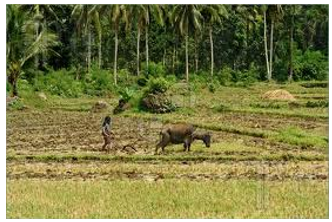
It is known as jhumming in north-eastern states like Assam, Meghalaya, Mizoram and Nagaland; Pamlou in Manipur, Dipa in Bastar district of Chattishgarh, and in Andaman and Nicobar Islands. This primitive form of cultivation is called ‘Bewar’ or ‘Dahiya’ in Madhya Pradesh, ‘Podu’ or ‘Penda’ in Andhra Pradesh, ‘Pama Dabi’ or ‘Koman’ or Bringa’ in Orissa, ‘Kumari’ in Western Ghats, ‘Valre’ or ‘Waltre’ in South-eastern Rajasthan, ‘Khil’ in the Himalayan belt, ‘Kuruwa’ in Jharkhand, and ‘Jhumming’ in the North-eastern region.
Shifting Agriculture:
- It is ‘slash and burn’ agriculture. Farmers clear a patch of land by cutting and burning and produce cereals and other food crops to sustain their family.
- When the soil fertility decreases, the farmers shift and clear a fresh patch of land for cultivation.
- This type of shifting allows Nature to replenish the fertility of the soil, is low as the farmer does not use fertilizers or other modern inputs.
- It is known as jhumming in north-eastern states like Assam, Meghalaya, Mizoram and Nagaland. It is known by different names in difference places.
Local names of shifting agriculture in the world
- Milap - Mexico, Central America.
- Roca - Brazil
- Lading - Indonesia
- Ray - Vietnam
Local names of shifting agriculture in India
- Jhuming - North-Eastern States
- Dahia - Madhya Pradesh
- Podu - Andhra Pradesh
- Kumari - Western Ghats
- Khil - Himalayan belts
Intensive Subsistence Farming:
This type of farming is practised in areas of high population pressure on land. It is labour intensive farming, where high doses of biochemical inputs and irrigation are used for obtaining higher production.
Though the ‘right of inheritance’ leading to the division of land among successive generations has rendered land-holding size uneconomical, the farmers continue to take maximum output from the limited land in the absence of alternative source of livelihood. Thus, there is enormous pressure on agricultural land.
Commercial Farming:
- In this type of farming crops are grown for market
- Use of higher doses of modern inputs, e.g. high yielding variety (HYV) seeds, chemical fertilizers, insecticides and pesticides.
- Degree of commercialization of agriculture varies from one region to another.
- Certain crops are considered commercial in certain areas, for eg. in Haryana and Punjab rice is a commercial crop but in Orissa it is a subsistence crop.
- Cultivation of cotton in Maharashtra and Gujrat and Sugar cane in Uttar Pradesh are other examples of commercial crops.
Plantation Agriculture:
Plantation is also a type of commercial farming. In this type of farming, a single crop is grown on a large area. The plantation has an interface of agriculture and industry. Plantations cover large tracts of land, using capital intensive inputs, with the help of migrant labourers. All the produce is used as raw material in respective industries. In India, tea, coffee, rubber, sugarcane, banana, etc.. are important plantation crops. Tea in Assam and North Bengal coffee in Karnataka are some of the important plantation crops grown in these states. Since the production is mainly for market, a well developed network of transport and communication connecting the plantation areas, processing industries and markets plays an important role in the development of plantations.
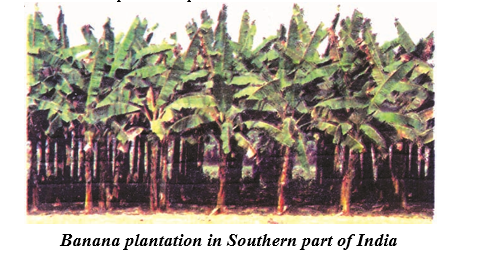
Banana plantation in Southern part of India
Cropping Pattern
India has three cropping seasons — rabi, kharif and zaid.
Rabi:
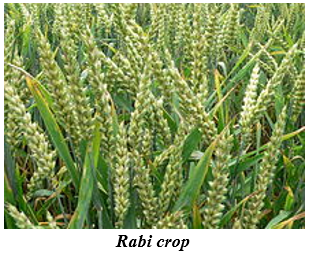
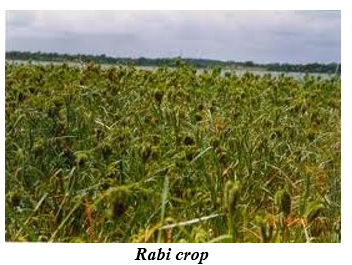
Rabi crops are sown in winter from October to December and harvested in summer from April to June. Some of the important rabi crops are wheat, barley, peas, gram and mustard. Though, these crops are grown in large parts of India, states from the north and northwestern parts such as Punjab, Haryana, Himachal Pradesh, Jammu and Kashmir, Uttaranchal and Uttar Pradesh are important for the production of wheat and other rabi crops. Availability of precipitation during winter months due to the western temperate cyclones helps in the success of these crops. However, the success of the green revolution in Punjab, Haryana, western Uttar Pradesh and parts of Rajasthan has also been an important factor in the growth of the above mentioned rabi crops.
Kharif:
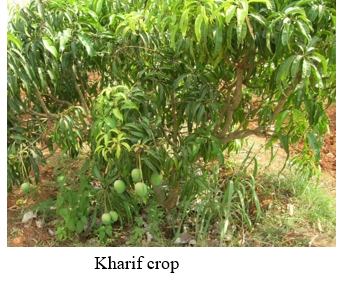
Kharif crops are grown with the onset of monsoon in different parts of the country and these are harvested in September-October. Important crops grown during this season are paddy, maize, jowar, bajra, tur (arhar), moong, urad, cotton, jute, groundnut and soyabean. Some of the most important rice-growing regions are Assam, West Bengal, coastal regions of Orissa, Andhra Pradesh, Tamil Nadu, Kerala and Maharashtra, particularly the (Konkan coast) along with Uttar Pradesh and Bihar. Recently, paddy has also become an important crop of Punjab and Haryana. In states like Assam, West Bengal and Orissa, three crops of paddy are grown in a year. These are Aus, Aman and Boro.
Zaid:
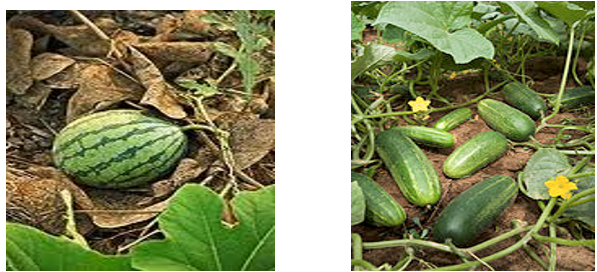
In between the rabi and the kharif seasons, there is a short season during the summer months known as the Zaid season. Some of the crops produced during ‘zaid’ are watermelon, muskmelon, cucumber, vegetables and fodder crops. Sugarcane takes almost a year to grow.
Major Cropping Regions
In a vast country like India various agricultural regions grow different crops depending upon types of soil, climate and agricultural practice.
Major crops grown in India are rice, wheat, millets, pulses, tea, coffee, sugarcane, oil seeds, cotton and jute, etc.
Rice:
It is the staple food crop of a majority of the people in India. Our country is the second largest producer of rice in the world after China. It is a kharif crop which requires high temperature, (above 25°C) and high humidity with annual rainfall above 100 cm. In the areas of less rainfall, it grows with the help of irrigation. Rice is grown in the plains of north and north-eastern India, coastal areas and the deltaic regions.
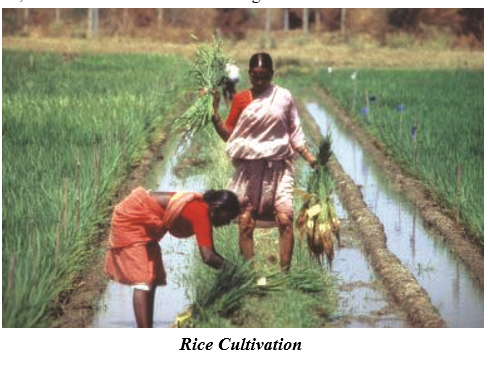
Development of dense network of canal irrigation and tubewells have made it possible to grow rice in areas of less rainfall such as Punjab, Haryana and western Uttar Pradesh and parts of Rajasthan.
Wheat:
Importance
(i) Second most important food crop,
(ii) Second largest producer of wheat.
(iii) Grown on about 1/6th of the cropped area.
Climatic Conditions:
(i) Is a Rabi crop.
(ii) Ideal temperature at the time of sowing is 10°-15° C, at harvesting 20°-25° C.
(iii) Rainfall required is 50-75 cm annually.
(iv) Requires well drained fertile soil.
Production areas:
Two important wheat-growing zones: the Ganga-Satluj plains and black soil region of the Deccan.
Major producing states: Uttar Pradesh, Punjab, Haryana, Rajasthan and Bihar.
Millets: Are known as coarse grain, have a very high nutritional value.
Jowar:
(i) Third most important food crop.
(ii) Monthly temperature required 18°-32° C, rainfall 30-60 cm.
(iii) Major producing states are Maharashtra, Karnataka, Andhra Pradesh, Tamil Nadu and Madhya Pradesh.
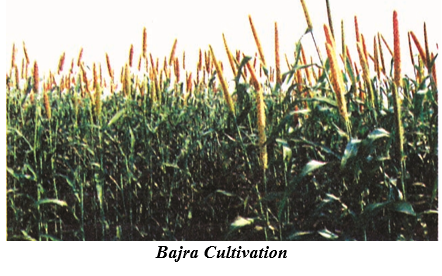
Bajra:
(i) Crop of dry and warm climate.
(ii) Producing states are Rajasthan, Uttar Pradesh, Maharashtra, Gujarat, and Haryana.
Ragi:
(i) A rain fed kharif crop.
(ii) Requires well drained alluvial loams, red or black sandy loam.
(iii) Grown in drier parts of Karnataka and Tamil Nadu.
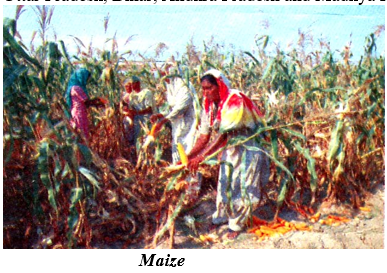
Maize: It is a crop which is used both as food and fodder. It is a kharif crop which requires temperature between 21°C to 27°C and grows well in old alluvial soil. In some states like Bihar maize is grown in rabi season also. Use of modern inputs such as HYV seeds, fertilisers and irrigation have contributed to the increasing production of maize. Major maize-producing states are Karnataka, Uttar Pradesh, Bihar, Andhra Pradesh and Madhya Pradesh.
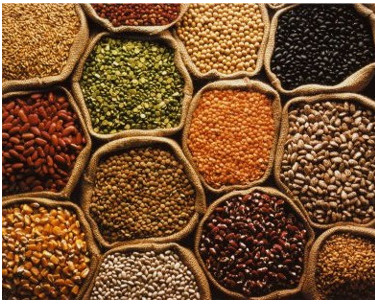
Pulses: India is the largest producer as well as the consumer of pulses in the world. These are the major source of protein in a vegetarian diet. Arhar, urad, moong, masur, chana and peas are major pulses of India. Pulses help in restoring soil fertility. That is why they are produce in rotation with other crops. UP, MP, Rajasthan and Karnataka are major pulse producing states in India.
Food Crops Other Than Grains
Sugarcane:
Sugarcane belongs to grass-family and grown in tropical and subtropical regions of the world.
- It is the most irrigated crop of India.
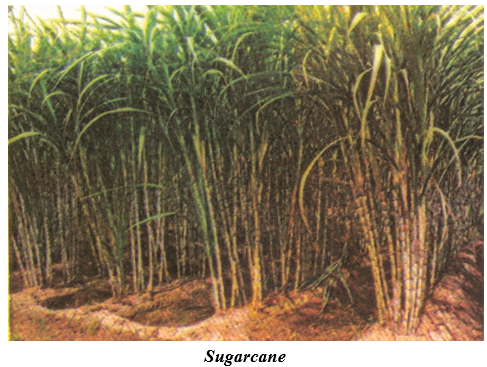
- It is the sweet juice content which make it an important source of food and raw material.
- It grows well in hot and humid climate with a temperature of 21°C to 27°C and an annual rainfall between 75 cm and 100 cm.
- Irrigation is required in the region of low rainfall.
- It can be grown on a variety of soils and need manual labour from sowing to harvesting.
- India is the second largest producer of sugarcane only after Brazil.
- The major sugarcane- producing states are Uttar Pradesh, Maharashtra, Karnataka, Tamil Nadu, Andhra Pradesh, Bihar, Punjab and Haryana.
Oil Seeds:
India is the largest producer of oilseeds in the world. Different oil seeds are grown covering approximately 12 per cent of the total cropped area of the country. Main oil-seeds produced in India are groundnut, mustard, coconut, sesamum (til), soyabean, castor seeds, cotton seeds, linseed and sunflower. Most of these are edible and used as cooking mediums. However, some of these are also used as raw material in the production of soap, cosmetics and ointments.
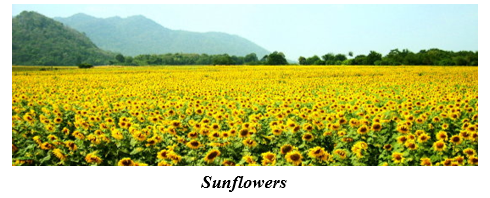
Groundnut is a kharif crop and accounts for about half of the major oilseeds produced in the country. Andhra Pradesh is the largest producer of groundnut followed by Tamil Nadu, Karnataka, Gujarat and Maharashtra – linseed and mustard are rabi crops. Sesamum is a kharif crop in north and rabi crop in south India. Castor seed is grown both as rabi and kharif crop.
Tea:
Importance:
(i) An important beverage crop.
(ii) Classic example of plantation agriculture.
(iii) India is leading producer as well as exporter of tea.
Climatic Conditions:
(i) Tropical as well as sub-tropical plant requires hot and humid climate.
(ii) Temperature required 200C -300C, annual rainfall 150-300 cm.
(iii) High humidity is good for the crop.
(iv) Grows well in drained soil, requires abundant, cheap and skilled labour.
Major Producing States: Assam, West Bengal, Tamil Nadu, Kerala. Apart from these, Himachal Pradesh, Uttaranchal, Meghalaya, Andhra Pradesh and Tripura and also tea-producing states in the country.
Coffee:
Importance:
(i) Second most important beverage crop.
(ii) Because of good quality is in much demand in the international market.
(iii) Brings handsome amount of foreign exchange.
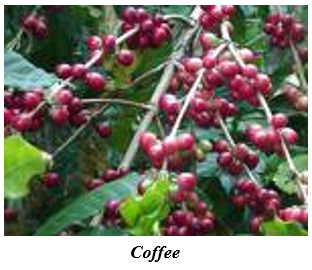
Climatic Conditions:
(i) Hot and humid climate
(ii) Temperature between 150 – 280C rainfall required 150 – 200 cm.
Major Producing States: Karnataka, Kerala, Tamilnadu
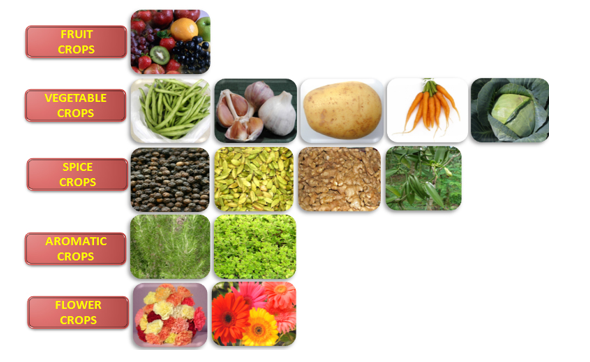
Horticulture Crops:
Importance:
(i) India is the largest producer of fruits and vegetables in the world.
(ii) India leads the world in production of Mango and Banana.
(iii) India is the largest exporter of Cashew nut in the world.
- Mango: Most important fruit, grown in almost all parts of the country.
- Apple: Temperate fruit crop, grown in Himachal Pradesh, Jammu and Kashmir and Uttaranchal.
- Banana: Tropical as well as sub-tropical plant, Tamil Nadu and Maharashtra are major producer.
- Orange: Produced in Maharashtra, Uttaranchal, West Bengal, Himachal Pradesh, Meghalaya, Andhra Pradesh, Karnataka, Kerala and Tamil Nadu.
- Grapes: A subtropical plant, Major producers are Uttaranchal, Himachal Pradesh, Jammu and Kashmir, Punjab, Maharashtra, Andhra Pradesh, Tamil Nadu and Karnataka.
- Vegetables: India produces about 13 percent of the world's vegetables. It is an important producer of pea, cauliflower, onion, cabbage, tomato, brinjal and potato.
Non-food Crops:
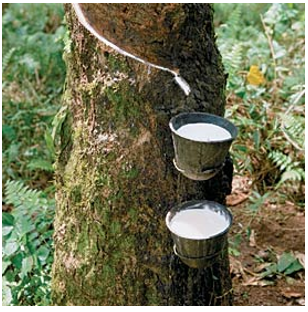
Rubber: It is an equatorial crop, but under special conditions, it is also grown in tropical and sub-tropical areas. It requires moist and humid climate with rainfall of more than 200 cm. and temperature above 25°C. Rubber is an important industrial raw material. It is mainly grown in Kerala, Tamil Nadu, Karnataka and Andaman and Nicabar islands and Garo hills of Meghalaya. India ranks fifth among the world’s natural rubber producers.
Cotton: India is believed to be the original home of the cotton plant. Cotton is one of the main raw materials for cotton textile industry. India is the third-largest producer of cotton in the world. Cotton grows well in drier parts of the black cotton soil of the Deccan plateau. It requires high temperature, light rainfall orirrigation, 210 frost-free days and bright sunshine for its growth. It is a kharif crop and requires 6 to 8 months to mature. Major cotton-producing states are – Maharashtra, Gujarat, Madhya Pradesh, Karnataka, Andhra Pradesh, Tamil Nadu, Punjab, Haryana and Uttar Pradesh.
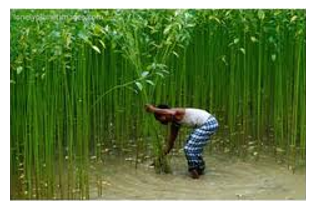
Jute: It is known as the golden fibre. Jute grows well on well-drained fertile soils in the flood plains where soils are renewed every year. High temperature is required during the time of growth. West Bengal, Bihar, Assam, Orissa and Meghalaya are the major jute producing states. It is used in making gunny bags, mats, ropes, yarn, carpets and other artefacts. Due to its high cost, it is losing market to synthetic fibres and packing materials, particularly the nylon.
Technological And Institutional Reforms
(a) Technological Reforms:
(i) The Persian wheel has now been replaced by the water plough by the tiller and harrow drawn by tractors, bullock carts by trucks.
(ii) All weather roads and faster means of communications have been introduced.
(iii) Flooding of fields are now been replaced by drip irrigation and use of sprinkles.
(iv) Chemical fertilizers, bio-fertilizers, HYV and early maturing quality seeds have been developed.
(b) Institutional Reforms:
(i) Government abolished the zamindari system followed with consolidation of small land holdings.
(ii) Widespread use of radio and television for providing knowledge to formers in new and improved techniques and special weather bulletins have been introduced.
(iii) Crop insurance to protect the farmers against loses by natural and man – made calamities.
(iv) Availability of capital or investment through banks and cooperative societies.
(v) Minimum support price for various crops ensures minimum price for the crop grown by the farmers.
(vi) Kisan Credit Card (KCC) and Personal Accident Insurance Scheme (PAIS) are some schemes introduced by the government for the benefit of farmers.
Growth Rate In Agriculture Is Decelerating:
(i) Indian farmers are facing a big challenge from international competition.
(ii) Reduction in the public investment in agriculture sector particularly in irrigation, power, rural roads, market and mechanization.
(iii) Subsidy or fertilizers is decreased leading to increase in the cost of production.
(iv) Reduction in import duties on agricultural products have proved detrimental to agriculture in the country.
(v) Farmers are withdrawing their investment from agriculture causing a downfall in the employment in agriculture.
Food Security
If any segment of our population does not have this access, that segment suffers from lack of food security. The number of people who do not have food security is disproportionately large in some regions of our country, particularly in economically less developed states with higher incidence of poverty. The remote areas of the country are more prone to natural disasters and uncertain food supply. In order to ensure availability of food to all sections of society our government carefully designed a national food security system. It consists of two components
(a) buffer stock and
(b) public distribution system (PDS).
Public Distribution System: PDS is a programme which provides food grains and other essential commodities at subsidised prices in rural and urban areas. India’s food security policy has a primary objective to ensure availability of foodgrains to the common people at an affordable price. It has enabled the poor to have access to food. The focus of the policy is on growth in agriculture production and on fixing the support price for procurement of wheat and rice, to maintain their stocks. Food Corporation of India (FCI) is responsible for procuring and stocking foodgrains, whereas distribution is ensured by public distribution system (PDS).
The FCI procures foodgrains from the farmers at the government announced minimum support price (MSP). The government used to provide subsidies on agriculture inputs such as fertilizers, power and water. These subsidies have now reached unsustainable levels and have also led to large scale inefficiencies in the use of these scarce inputs. Excessive and imprudent use of fertilizers and water has led to waterlogging, salinity and depletion of essential micronutrients in the soil. The high MSP, subsidies in input and committed FCI purchases have distorted the cropping pattern. Wheat and paddy crops are being grown more for the MSP they get. Punjab and Haryana are foremost examples. This has also created a serious imbalance in inter-crop parities.
In PDS consumers are divided into two categories:
Below poverty line(BPL) and Above poverty line (APL), with the issue price being different for each category.
However, this categorisation is not perfect and a number of deserving poor have been excluded from the BPL category. Moreover, some of the so called APL slip back to BPL, because of the failure of even one crop and it is administratively difficult to accommodate such shifts.
Suggestion for Future: Each district and block can be made self sufficient in foodgrain production if government provides proper agricultural infrastructure, credit linkages and also encourages the use of latest techniques. Instead of concentrating only on rice or wheat, the food crop with a better growth potential in that particular area must be encouraged. Creation of necessary infrastructure like irrigation facilities, availability of electricity etc. may also attract private investments in agriculture.
The focus on increasing foodgrain production which should be on a sustainable basis and also free trade in grains will create massive employment and reduce poverty in rural areas.
Shifting Agricultural Pattern:
There has been a gradual shift from cultivation of food crops to cultivation of fruits, vegetables, oil-seeds and industrial crops. This has led to the reduction in net sown area under cereals and pulses. With the growing population of India, the declining food production puts a big question mark over the country’s future food security. The competition for land between non-agricultural uses such as housing etc. and agriculture has resulted in reduction in the net sown area. The productivity of land has started showing a declining trend. Fertilisers, pesticides and insecticides, which once showed dramatic results, are now being held responsible for degrading the soils. Periodic scarcity of water has led to reduction in area under irrigation. Inefficient water management has led to water logging and salinity.
Impact of Globalisation on Agriculture:
Under globalisation, particularly after 1990, the farmers in India have been exposed to new challenges. Despite being an important producer of rice, cotton, rubber, tea, coffee, jute and spices our agricultural products are not able to compete with the developed countries because of the highly subsidised agriculture in those countries.
Change in cropping pattern for example from cereals to high-value crops will mean that India will have to import food. During 1960’s this would have been seen as a disaster. But if India imports cereals while exporting high-value commodities, it will be following successful economies like Italy, Israel and Chile.
These countries exports farm products (fruits, olives, speciality seeds and wine) and import cereals.
IMPORTANT TERMS
- Agriculture: It is an economic activity related to cultivation of crops, animal rearing and fishing.
- Commercial Farming: Farming in which crops are grown with the use of modern technology mainly for commercial purposes to obtain high productivity.
- Green Revolution: A package programme to increase the productivity of food grains with the help of HYV seeds, machines, irrigation and fertilizers, etc.
- Horticulture: Specialized cultivation of fruits and vegetables.
- Kharif: An agricultural season where crops are grown with the onset of rains and harvested by the retreat of the monsoon, mainly June to September.
- Plantation Agriculture: A large scale single crop farming which resembles factory production. It is both labour intensive and capital intensive.
- Primitive Subsistence Farming: A type of farming done on small fields using primitive tools mainly in the form of shifting agriculture.
- White Revolution: A package programme meant for increasing the productivity of milk.
- Sericulture: Rearing of silkworms to produce raw silk.
- Zaid: It is a short season summer crop where fruits like watermelon and vegetables like cucumber are grown.
Agriculture
Importance of Agriculture:
- Provides livelihood to almost 60% of population.
- Provides maximum employment (63%).
- Contributes significantly to GDP.
- Supports agro based Industries.
- From the export of food grains we earn foreign exchange.
Type of Farming
- Primitive subsistence: Yield per hectare is very low.
- Shifting agriculture: Practiced in hilly area by tribals
- Intensive subsistence: Use of more input to get highly yield.
- Commercial: Production for sale, practiced on a very large scale.
- Plantation agriculture: ® Single crop bush or tree farming, requires huge capital.
Cropping Regions
- Food crops
- Rice (staple food).
- Wheat (2nd most staple food).
- Millets – Coarse grain.
- Pulses – molor source of proteins.
- Cash crops
- Sugar cane – most irrigated crop.
- Tea – Bevrage crop introduced by Britishers.
- Coffee – Bevrage crop.
- Rubber – Plantation crop.
- Fiber crops
- Cotton – crops.
- Kharif crop grows well in black soil
- Jute – concentrated in eastern states, requires well drained fertile soil.
Cropping seasons
- Rabi: Winter season crop ex. wheat, peas, gram
- Kharif: Monsoon season crops ex. Rice, maize, towar
- Zaid: Short growing summer season crop ex. water mealon, cucumber
Agricultural reforms
- Abolition of zamindari system.
- Land ceiling act has been imposed
- Crop insurance policy started.
- Minimum support price have been announced.
- Special weather bulletin on t.v.
- Irrigation facilities have been provided.
- Use of modern tools, HYV seed fertilizers.
Solved Examples
1. Which is the most important cereal crop of India? Name the two major producing states of this crop.
Ans. Rice is the most important cereal crop in India. It is mainly grown in plains of northern India, deltas of eastern coastal plain and North eastern states.
2. Which are the two major fibre crops of India? Name the major producing state of each crop.
Ans. Major fibre crops- Cotton, Jute
Major producing state-Maharashtra and West Bengal.
3. How has climate make our land more valuable from the agricultural point of view? Give two points.
Ans. Climate has made our land more valuable for agriculture because
(i) We have a long growing season as there is ample sunshine.
(ii) Climate variations enable us to grown variety of crops in a year.
4. Explain two reasons for the production of various types of crops in our country.
Ans. Two reasons for the production of various crops in our country are:
(i) ample sunshine and
(ii) long growing season.
5, What is the sowing and harvesting period of Kharif season? Name two main crops of Kharif season.
Ans. Kharif season sowing is done with the onset of monsoon (June) and harvesting is done with the retreat of the monsoon (September). Two main crops of Kharif season are rice and cotton.
6. Name four plantation crops of India.
Ans. Four plantation crops of India are tea, coffee, rubber, sugar cane.
7. Which crop is called as ‘Golden Fibre of India’? Why?
Ans. Jute is called the ‘Golden Fibre of India’ as it brings a lot of foreign exchange to India through exports and raw jute has a golden yellow colour.
8. Name two leading producers of the following crops.
(a) Mangoes (b) Oranges
(c) Apples (d) Bananas.
Ans. (a) Mangoes – Maharashtra, Andhra Pradesh
(b) Oranges – Nagpur, Meghalaya
(c) Apples – Jammu Kashmir, Himachal Pradesh
(d) Bananas – Kerala, Mizoram
9. Agriculture is the mainstay of Indian economy. Explain the statement by giving four points.
Ans. Agriculture is the mainstay of Indian economy because:
(i) Two third of the population is dependent on agriculture and generates large scale employment.
(ii) It provides food for of people millions.
(iii) It provides raw materials to many agro-based industries like cotton, rubber, sugar.
(iv) Export of agricultural products earns valuable foreign exchange like tea, spices.
(v) It contributes to 26% of gross domestic product (GDP).
10. What is ‘slash and burn’ agriculture? Give four salient features of this agriculture.
Ans. ‘Slash and burn’ agriculture is the other name for shifting Agriculture. It is the most primitive farming type practiced by the tribal people living in tropical regions.
Salient features of this agriculture are:
(i) Forests are cleared and trees are burnt to make the land available for cultivation.
(ii) Digging stick is mainly used for cultivation.
(iii) Mainly root crops and food crops are grown for their own needs.
(iv) After few years when the soil loses its fertility they move to another forest area and the same process in repeated.
(v) Productivity is very low as there is less use of fertilizers, pesticides, etc.
11. Write four point of different between climatic condition required by wheat and rice.
Ans.
Wheat
Rice
(i) It is a Rabi crop and a temperate crop.
(i) It is a Kharif crop and a tropical crop.
(ii) It requires about 10-15°C temperature and a rainfall of 50-75 cms.
(ii) It requires more than 25°C temperature high humidity with ann ual rainfall of above 100 cms.
(iii) It requires well drained fertile soil
(iii) It requires fertile alluvial soil with a clayey layer above.
(iv) Leading producers are Punjab, Haryana and Uttar Pradesh.
(iv) Leading producers are West Bengal Kerala, Punjab.
12. What is implied by ‘Operation Flood’? How can it supplement the meagre income of small and marginal farmers?
Ans. (i) ‘Operation Flood’ or ‘White Revolution’ is a package programme introduced to increase the production of milk.
(ii) It has supplemented the small and marginal farmers by providing additional income through selling of milk.
(iii) Dairy cooperatives have contributed to large scale rural employment.
13. Describe any four features of Indian agriculture.
Ans. Four features of Indian agriculture are:
(i) Majority of Indian agriculture is of intensive subsistence type
(ii) Small fields cultivated with human labour.
(iii) Mainly food crops are grown.
(iv) Agriculture depends largely on monsoon.
(v) Animals play and important role in farming.
14. Explain any six problems faced by Indian agriculture.
Ans. (i) Farmers hold small landholdings.
(ii) Depend on monsoons due to lack of irrigation.
(iii) Use of poor quality seed
(iv) Lack of storage facilities.
(v) Mostly food crops are grown.
(vi) In adequate means of transport.
15. What are the two most important beverage crops in India? State the favourable conditions for their growth. Mentions two major producing states of each crop.
Ans. Two most important beverage crops of India are (i) Tea and (ii) Coffee.
Tea:
- Temperature - 200 to 300C
- Rainfall - 150 to 200 cms.
- Soil - Well drained soils
- Labour - Cheap, abundant and
- intensive crop - skilled labour
- Areas - Assam, West Bengal, Tamil Nadu and Kerala
Coffee:
- Temperature - 150 to 280C
- Rainfall - 150 to 200 cms.
- Soil - rich, well drained loamy soil
- Labour - Cheap labour is essential.
- Areas - hills around Nilgiris, Karnataka, kerala and Tamil Nadu
16. Give an account of cotton cultivation in India, under the following heads:
(a) Temperature, rainfall and irrigation requirements.
(b) Soil requirements.
(c) Two major cotton producing states.
Ans. Cotton:
(a) Temperature: cotton is grown in tropical and subtropical areas. It requires atleast 210 frost-free days in a year. At the time of harvest the weather should be fine to maintain the luster of the cotton.
(b) Soil: It grows well in blank and alluvial soils.
(c) Producing state: Maharashtra, Andhra Pradesh, Haryana, Punjab and Gujarat.
17. Give an account of rice cultivation in India, under the following heads:
(a) Climatic condition.
(b) Soil requirements.
(c) Two major cotton producing states.
Ans. Rice:
(a) Temperature: 160 to 320 C. High temperature and high humidity.
Rainfall: 150 to 200 cms.
(b) Irrigation: Areas of inadequate rainfall needs irrigation.
Soils: Alluvial and Red soil.
(c) Major producing states: West Bengal, Tamil Nadu, Andhra Pradesh, Punjab, Haryana, Uttaranchal.
18. Name the staple crop of India and the regions where it is produced.
Ans. Rice is the most important staple crop in India. It is mainly grown in plains of northern India, deltas of eastern coastal plain and North eastern states.
19. Enlist the various institutional reform programmes introduced by the government in the interest of farmers.
Ans. Major institutional reforms are
(i) Abolition of zamindari system.
(ii) Consolidation of small landholdings.
(iii) Introduction of crop insurance.
(iv) Rural Bank and Cooperative Societies to provide credit facilities for farmers.
20. The land under cultivation has got reduced day by day. Can you imagine its consequence?
Ans. Consequences of decreasing land under cultivation will result in
(i) foods shortage
(ii) import of food grains to meet the needs will put greater strain on our financial resources.
(iii) poverty
(iv) less contribution to economy.
21. Suggest the initiative taken by the government to ensure the increase in agricultural production.
Ans. (i) The government has established India council of agricultural research (ICAR).
(ii) Agricultural universities have been established to study about modern farming.
(iii) Animal breeding centres, horticultural have been established.
(iv) Research and development in weather forecast being development.
(v) Rural infrastructure facilities have been developed.
22. How did the partition of the country in 1947 affect the jute industry?
Ans. (i) At the time of partition jute growing area went to East Pakistan (Now Bangladesh) and jute mills remained with India.
(ii) This was a big blow to jute industry.
23. Suggest the initiative taken by the government to ensure the increase in agricultural production.
Ans. (i) Government has started land reform policies under which government has abolished zamindari system and started consolidation of land holding.
(ii) Crop insurance policy has been introduced.
(iii) Regional rural banks has been established and farmers are provided with kisan credit card.
(iv) Technical reforms have been introduced to provide facilities, HYU seeds, irrigation facilities and use of modern tools and machines.
24. Which one of the following describes a system of agriculture where a single crop is grown on a large area?
(a) Shifting Agriculture
(b) Plantation Agriculture
(c) Horticulture
(d) Intensive Agriculture
Ans. (b) Plantation Agriculture
25. Which one of the following is a rabi crop?
(a) Rice
(b) Millets
(c) Gram
(d) Cotton
Ans. (c) Gram
26. Which one of the following is a leguminous crop?
(a) Pulses
(b) Millets
(c) Jawar
(d) Sesamum
Ans. (a) Pulses
27. Which one of the following is announced by the government in support of a crop?
(a) Rice
(b) Millets
(c) Gram
(d) Cotton
Ans. (b) Millets
28. Jhumming refers to
(a) Primitive subsistence farming in Brazil.
(b)‘Slash and burn’ agriculture in North-eastern states of India.
(c) Primitive farming in Malaysia.
(d) Commercial farming in Punjab.
Ans. (b)‘Slash and burn’ agriculture in North-eastern states of India.
Exercise – 1
1. The percentage of food crop in total cropped area is:
(a) 80%
(b) 75%
(c) 85%
(d) 70%
2. Which cereal occupies the largest cropped area %?
(a) Wheat
(b) Maize
(c) Jowar
(d) Rice
3. In the production of castor seeds, India stands
(a) First
(b) second
(c) third
(d) none of these
4. Sugarcane needs
(a) Hot climate
(b) cool climate
(c) moderate climate
(d) none of these
5. The largest producer of sugarcane in India is:
(a) Sihar
(b) Punjab
(c) Maharashtra
(d) Uttar Pradesh
6. Cotton's largest producer in India is:
(a) Maharashtra
(b) Punjab
(c) Uttar Pradesh
(d) Gujarat
7. Which of the following is the important cotton producing area in India?
(a) Indo-Gangetic Plain
(b) Deccan Trap
(c) Damodar Valley
(d) Yamuna Valley
8. Which one of the following describes a system of agriculture where a single crop is grown on a large area?
(a) Intensive
(b) Plantation
(c) Horticulture
(d) Shifting
9. Which state is the largest producer of tea?
(a) Assam
(b) Tamil Nadu
(c) Kerala
(d) West Bengal
10. In wheat production, India's position in the world is:
(a) First
(b) fifth
(c) second
(d) third
11. Which one of the following is a leguminous crop?
(a) Miliets
(b) Jawar
(c) Pulses
(d) Sesamum
12. What is the position of India in the production of sugarcane?
(a) First
(b) second
(c) fourth
(d) third
13. Which one of the following is a Rabi crop?
(a) Rice
(b) Millets
(c) Gram
(d) Cotton
14. Bhoodan – Gramdan movement was initiated by
(a) Mahatma Gandhi
(b)Jawaharlal Nehru
(c) Vindobha Bhave
(d) Bal Gangadhar Tilak
15. India is the leading producer and exporter of _______ in the world.
(a) Rubber
(b)Sugar cane
(c) Tea
(d) Sericulture
16. Rearing of silkworms is called as
(a) Pisciculture
(b)Agriculture
(c) Silviculture
(d) Sericulture
17. Yellow revolution refers to
(a) Increased production of eggs.
(b)Increased production of oilseeds.
(c) Increased production of pulses.
(d) Increased production of fish.
18. Cultivation of fruits and vegetables is called.
(a) Floriculture
(b)Sericulture
(c) Horticulture
(d) Agriculture
19. Golden fiber of India is
(a) Cotton
(b) Jute
(c) Silk
(d) Woolen fiber
20. Amongst the following which is the most labour intensive crop
(a) Cotton
(b) Rubber
(c) Tea
(d) Sugar cane
21. Watermelon is a crop of
(a) Summer season
(b) Winter season
(d) Rabi season
(c) Zaid season
22. Leading producer of ragi is
(a) Kerala
(b) Karnataka
(c) Tamil Nadu
(d) Bihar
23. Penda is the name of shifting cultivation in
(a) Punjab
(b) Arunachal Pradesh
(d) Andhra Pradesh
(d) Kerala
Answers To Exercise – 1
| 1. (b) | 7. (b) | 13. (c) | 19. (b) |
| 2. (d) | 8. (a) | 14. (c) | 20. (c) |
| 3. (b) | 9. (a) | 15. (c) | 21. (d) |
| 4. (a) | 10. (c) | 16. (d) | 22. (b) |
| 5. (d) | 11. (c) | 17. (b) | 23. (c) |
| 6. (d) | 12. (b) | 18. (c) | — |
Exercise – 2
1. Which is the most primitive type of farming practiced in India?
2. Why is there enormous pressure on agricultural land in intensive subsistence farming?
3. Which is the short cropping season? Name some crops grown in this season.
4. What is called as the golden fiber of India? What is its importance?
5. Which variety of coffee is mainly grown in India? Where is it grown?
6. What is another name for White Revolution?
7. What is India's rank among the world's rubber producers?
8. What are leguminous crops?
9. Name the agriculture in which there is enormous pressure on land.
10. What is the share of agriculture in providing employment and livelihood to the population?
11. Why is agriculture important for Indian economy?
12. Compare the geographical conditions required for the growth of rice and white in India. Write three points of difference between rabi and kharif season.
13. The land under cultivation is being reduced day by day, what will be its consequences?
14. Write short on Horticulture.
15. What is the difference between subsistence and commercial agriculture?
16. Kerala leads in the production of rubber. Give two reasons.
17. Suggest the initiative taken by the government to ensure the increase in agricultural production.
18. Describe the contribution of agriculture to the national economy, employment and output.
19. Describe the impact of globalization on Indian agriculture.
20. Describe the geographical conditions required far the growth of rice.
21. Why India growth of almost every crop is possible?
22. At is said that India produces almost every crop under the sun'. Explain.
23. What is the new technology in agriculture? Describe its significance in the development of Indian agriculture with three examples.
24. Kerala leads in the production of rubber, Give two reasons.
25. Rice grows well in Punjab and Haryana also, State two reasons for it.
26. Name the two main food crops of India. Mention three major producing areas of each crop.
27. Name the two natural fibres except cotton. Write the type of climate and soil needed for the cultivation of cotton.
28. What are millets? Why are millets very important food crops in India? Explain with the help of three points.
29. Why is jute grown mainly in West Bengal?
30. "Wheat and Rice farming in India are fairly different from each other". Explain with the help of four points.
31. Describe the temperature and rainfall conditions necessary for the growth of rice and wheat. Name the major areas of rice and wheat production.
32. " It is said that India produces almost every crop under the sun". Explain this statement with four examples.
33. Explain the favorable temperature and rainfall conditions for the growth of tea and coffee. Name the leading tea and coffee producing states.
34. How is Rice farming different from Wheat farming in respect of the following?
(a) Sowing and harvesting time. (b) Rainfall / Irrigation requirements.
(c) Areal distribution (d) Yield per hectare.
35. What is implied by 'Operation Flood’? How can it supplement the meagre income of the small and marginal farmers?