Minerals and natural resources form the backbone of a nation’s economic development. In Class 10 Geography Chapter – Minerals and Energy Resources, students explore how minerals are formed, their classification, distribution, and importance in everyday life. This chapter helps learners understand India’s rich mineral wealth—ranging from metallic and non-metallic minerals to energy resources like coal, petroleum, and natural gas.
It also emphasizes the need for sustainable resource management, conservation, and responsible mining practices to protect our environment. Understanding this chapter builds a strong foundation for topics in geology, economics, and environmental studies, making it essential for CBSE Class 10 board exam preparation and competitive exams.
Important Terms from the Chapter – Minerals and Energy Resources
- Alloys: These are those metals which are mixed with iron as base.
- Biogas: Energy produced by using shrubs, form waste, animal and human wastes.
- Conventional Sources of Energy: Traditional sources of energy like coal, petroleum, natural gas.
- Minerals: Naturally occurring substances on the earth’s surfaces having a definite chemical composition.
- Non-conventional sources of energy: Renewable sources of energy which are recently developed like solar, wind tidal, etc.
- Open cast mining: A method of mining by removing the overlying materials to extract the minerals from shallow depth.
- Mining: An economic activity which deals with profitable extraction of minerals.
- Placer deposits: Minerals which occur as alluvial deposits brought down by the rivers such as gold, silver, tin, etc.
- Rocks: Natural substances which consists of one or more minerals.
- Shaft mining: A method of mining where vertical and horizontal shafts are made to extract the minerals from deep under the earth.
Minerals
Mineral are “homogenous, naturally occurring substance with a definable internal structure.” Minerals are found in varied forms in nature, ranging from the hardest diamond to the softest talc. You have already learnt about rocks.
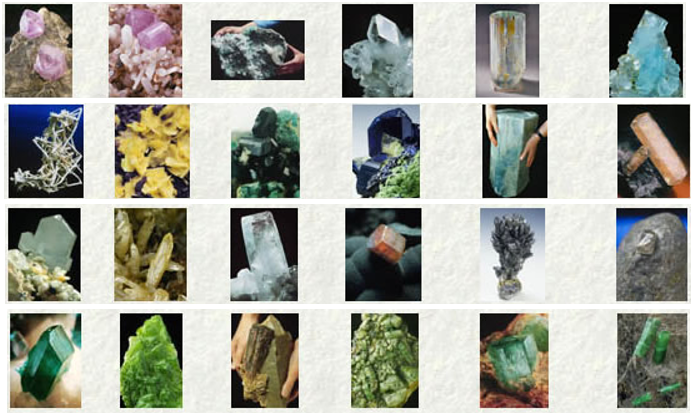
A particular mineral that will be formed from a certain combination of elements depends upon the physical and chemical conditions under which the material forms. This, in turn, results in a wide range of colours, hardness, crystal forms, lustre and density that a particular mineral possesses. Geologists use these properties to classify the minerals.
Importance Of Minerals For A Country:
(i) Minerals are an indispensable part of our lives. Almost everything we use are made up of minerals.
(ii) Car, buses, trains, aeroplanes are manufactured from minerals and run on power resources derived from the earth.
(iii) Even the food that we eat contains minerals.
(iv) In all stages of development, human beings have used minerals for their livelihood, decoration, festivities, religious and ceremonial rites.
Classification Of Minerals:
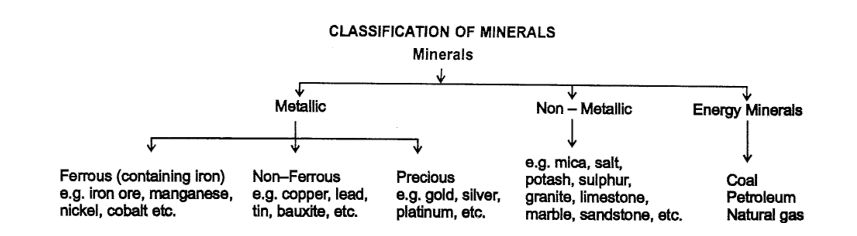
Geologists classify minerals according to their chemical composition and crystalline structure. Some minerais consist of only one element while others of two or more elements.
|
Metaillc |
Non-Metaillc |
|
Minerals consist metal |
Does not consist any metal |
|
Are solid in nature Example: Iron, Copper, Manganese etc. |
Can be semi-solid, liquid or even in Gaseous form Example: Coal, Petroleum, Natural gas etc |
Mode Of Occurrence Of Minerals:
Minerals are usually found in “ores”. The term ore is used to describe an accumulation of any mineral mixed with other elements. The mineral content of the ore must be in sufficient concentration to make its extraction commercially viable. The type of formation or structure in which they are found determines the relative ease with which mineral ores may be mined. This also determines the cost of extraction. It is, therefore, important for us to understand the main types of formations in which minerals occur.
- In igneous and metamorphic rocksminerals may occur in the cracks, crevices, faults or joints. The smaller occurrences are called veins and the larger are called lodes. In most cases, they are formed when minerals in liquid/ molten and gaseous forms are forced upward through cavities towards the earth’s surface. They cool and solidify as they rise. Major metallic minerals like tin, copper, zinc and lead etc. are obtained from veins and lodes.
- In sedimentary rocksa number of minerals occur in beds or layers. They have been formed as a result of deposition, accumulation and concentration in horizontal strata. Another group of sedimentary minerals include gypsum, potash salt and sodium salt. These are formed as a result of evaporation especially in arid regions.
- Another mode of formation involves the decomposition of surface rocks, and the removal of soluble constituents, leaving a residual mass of weathered material containing ores. Bauxite is formed this way.
- Certain minerals may occur as alluvial deposits in sands of valley floors and the base of hills. These deposits are called ‘placer deposits’ and generally contain minerals, which are not corroded by water. Gold, silver, tin and platinum are most important among such minerals.
- The ocean waters contain vast quantities of minerals, but most of these are too widely diffused to be of economic significance. However, common salt, magnesium and bromine are largely derived from ocean waters. The ocean beds, too, are rich in manganese nodules.
Ferrous Minerals
Ferrous minerals are iron-rich minerals that tend to be dark and heavy and generally crystallize at the highest temperatures and pressures (farther from the Earth's crust), causing them to contain less stable crystal structures and be more prone to rapid decomposition than non-ferrous minerals.
Iron Ore:
Importance:
(i) Backbone of modern civilization.
(ii) Metal of universal use.
(iii) Used for manufacturing of machines, agricultural implements and items of general use.
Varieties:
(i) Magnetite: The finest iron ore with a very high content of iron up to 70 percent. It has excellent magnetic qualities, especially valuable in the electrical industry.
(ii) Hematite: The most important industrial iron ore in terms of the quantity used, but has a slightly lower iron content than magnetite. (50-60 percent).
Major Iron Ore Belts in India:
- Orissa-Jharkhand belt: In Orissa high grade hematite ore is found in Badampahar mines in the Mayurbhanj and Kendujhar districts. In the adjoining Singbhum district of Jharkhand haematite iron ore is mined in Gua and Noamundi.
- Durg-Bastar-Chandrapur belt lies in Chhattisgarh and Maharashtra. Very high grade hematites are found in the famous Bailadila range of hills in the Bastar district of Chattisgarh. The range of hills comprise of 14 deposits of super high grade hematite iron ore. It has the best physical properties needed for steel making. Iron ore from these mines is exported to Japan and South Korea via Vishakapatnam port.
- Bellary-Chitradurga-Chikmaglur-Tumkur belt in Karnataka has large reserves of iron ore. The Kudermukh mines located in the Western Ghats of Karnataka are a 100 per cent export unit. Kudremukh deposits are known to be one of the largest in the world. The ore is transported as slurry through a pipeline to a port near Mangalore.
- Maharashtra-Goa belt includes the state of Goa and Ratnagiri district of Maharashtra. Though, the ores are not of very high quality, yet they are efficiently exploited. Iron ore is exported through Marmagao port.
Manganese Ore:
Importance:
(i) Used for making Iron and Steel and preparing ferromanganese alloys.
(ii) Used for manufacturing Bleaching powder, Insecticides, Paints and Batteries.
Orissa is the largest producer of manganese ore in India. It accounted for one-third of the country's total production in 2000-01.
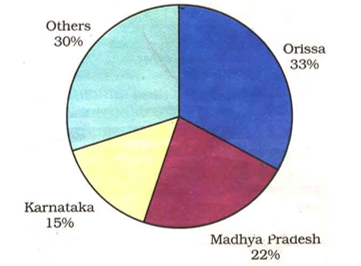
Production of Manganese showing state-wise share in percent 2003-04
Non-ferrous Minerals
India’s reserves of non-ferrous minerals are not satisfactory.
These minerals are very important for metallurgical, electrical industries, engineering industry.
Copper:
Copper is a good conductor of electricity and has other physical/ chemical properties like malleable, ductile make it one of the most important mineral mainly for electronic, electrical cables, chemical industry.
- India is deficient in the reserve of copper.
- The Balaghat mines in Madhya Pradesh produce 52 per cent of India’s copper.
- The Singbhum district of Jharkhand is also a leading producer of copper.
- The Khetri mines in Rajasthan are also famous for copper production.
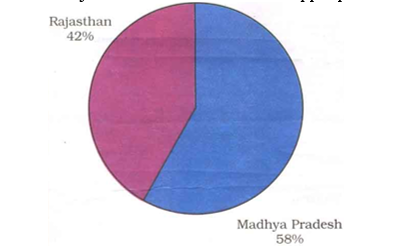
Production of Copper showing state-wise share in percent 2003-04
Bauxite:
Though, several ores contain aluminium, it is from bauxite, a clay-like substance that alumina and later aluminium is obtained. Bauxite deposits are formed by the decomposition of a wide variety of rocks rich in aluminium silicates. Aluminium is an important metal because it combines the strength of metals such as iron, with extreme lightness and also with good conductivity and great malleability.
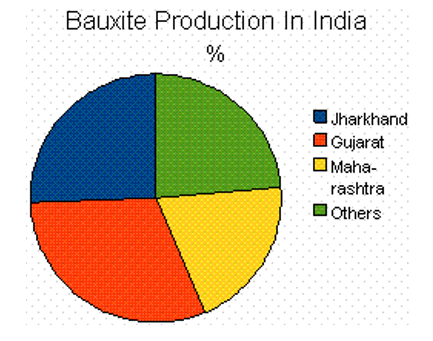
India’s bauxite deposits are mainly found in the Amarkantak plateau, Maikal hills and the plateau region of Bilaspur- Katni. Orissa is the largest bauxite producing state in India with 45 per cent of the country’s total production in 2000-01. Panchpatmali deposits in Koraput district are the most important bauxite deposits in the state.
Non-metallic Minerals:
Mica:
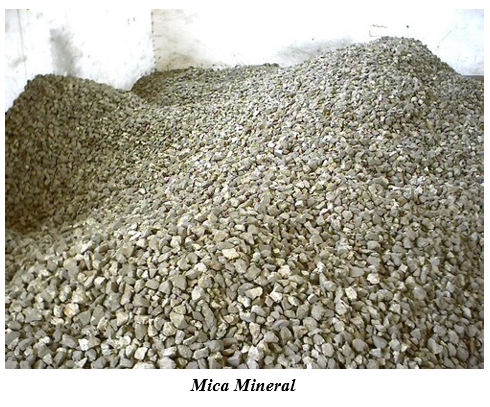
- Due to its excellent di-electric strength, low power loss factor, insulating properties and resistance to high voltage, mica is one of the most indispensable minerals used in electric and electronic industries.
- It is a mineral made up of a series of plates or leaves.
- Mica can be clear, black, green, red, yellow or brown.
- Mica deposits are found in the northern edge of the Chota Nagpur plateau. Koderma - Gaya - Hajaribagh belt of Jharkhand is the leading producer.
- In Rajasthan, the major mica producing area is around Ajmer. Nellore mica belt of Andhra Pradesh is also an important producer in the country.
Rock Minerals
Pure limestone can be white or pale grey. It is found in association with calcium carbonates or magnesium carbonate.
It is found in sedimentary rock. Limestone is the basic raw material for the cement industry and essential for smelting iron ore in the blast furnace.
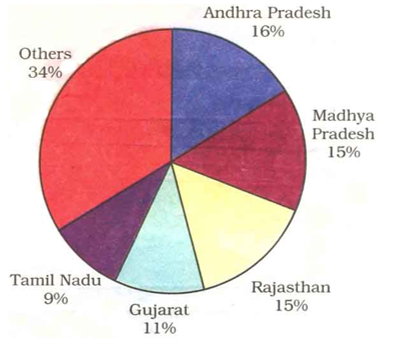
Production of Limestone showing state-wise share in percent 2003-04
Hazards Of Mining:
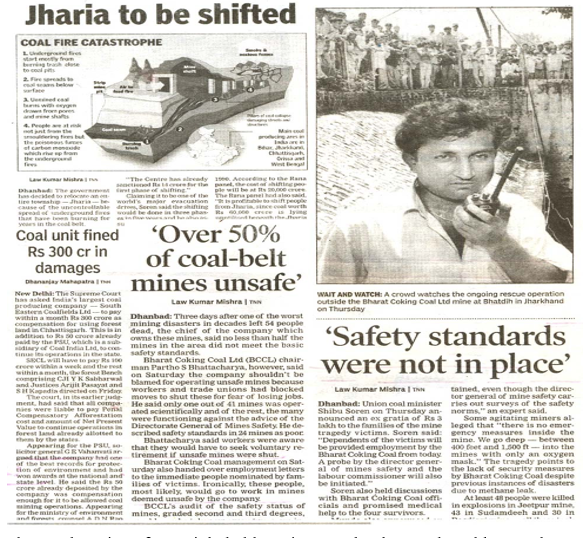
The dust and noxious fumes inhaled by miners make them vulnerable to pulmonary diseases. The risk of collapsing mine roofs, inundation and fires in coalmines are a constant threat to miners. The water sources in the region get contaminated due to mining. Dumping of waste and slurry leads to degradation of land, soil, and increase in stream and river pollution.
Conservation Of Minerals
The role of minerals in an economy and in daily life is appreciable in the sense that the substance and items manufactured from them has become part and parcel of human life.
Industry and agriculture also heavily depends upon minerals directly or indirectly.
Why To Conserve Minerals:
- Nature of minerals, their availability and growing demand is forcing human society to find ways to conserve minerals. They are non-renewable and unevenly distributed.
- The total volume of mineral deposits available to us is very less. It is only one percent of the earth’s crust.
- Minerals are non renewable and we are rapidly consuming minerals. If it gets exhausted it may take millions of years for formation or it may never be reformed.
- Continued extraction of ores leads to increasing cost as they are extracted from greater depths and as extraction continues their quality decreases.
Ways To Conserve Minerals:
- A continual and concerted effort is to make use of our limited exhaustible mineral resources in a planned and sustainable manner in safeguarding our future.
- Improved technologies need to be constantly evolved to allow use of low grade ores at low costs.
- Recycling of metals, using scrap metals and other substitutes are steps in conserving our mineral resources for the future.
Energy Resources
Energy can be generated from fuel minerals like coal, petroleum, natural gas, uranium and from electricity. Energy resources can be classified as conventional and nonconventional sources.
Conventional Sources:
Firewood, cattle dung cake, coal, petroleum, natural gas and electricity (both hydel and thermal).
Non-conventional Sources:
Solar, wind, tidal, geothermal, biogas and atomic energy. Firewood and cattle dung cake are most common in rural India. According to one estimate more than 70 per cent energy requirement in rural households is met by these two ; continuation of these is increasingly becoming difficult due to decreasing forest area. Moreover, using dung cake too is being discouraged because it consumes most valuable manure which could be used in agriculture.
|
CONVENTIONAL |
NON-CONVENTIONAL |
|
Have been in use for quite some time. |
New sources of energy. |
|
Mostly non renewable. |
Mainly renewable. |
|
Creates pollution. |
Mainly pollution free form of energy. |
|
By using conventional sources, energy can be produced anywhere. |
Production of energy depends upon physical location and climatic condition. |
|
Eg. Coal, Petroleum, Natural Gas etc. |
Eg. Solar, Wind, Tidal, Geothermal etc. |
|
COMMERCIAL |
NON-COMMERCIAL |
|
Are the continuous source of energy. |
Non-continuous source of energy |
|
Can be used for commercial purpose such as industires. |
Only can be used for non-commercial purpose such as domestic use, street lightning etc. |
Conventional Resources
Coal:
Importance: In India, coal is the most abundantly available fossil fuel. It provides a substantial part of the nation’s energy needs. It is used for power generation, to supply energy to industry as well as for domestic needs.
Coal is formed due the compression of plant material over millions of years. Coal, therefore, is found in a variety of forms depending on the degrees of compression and the depth and time of burial. Decaying plants in swamps produce peat. Which has a low carbon and high moisture contents and low heating capacity.
Types of Coal
Lignite: Lignite is a low grade brown coal, which is soft with high moisture content. The principal lignite reserves are in Neyveli in Tamil Nadu and are used for generation of electricity.
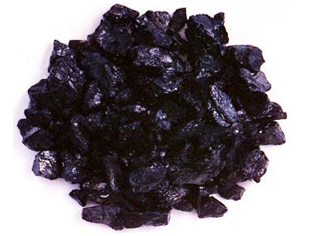
Bituminous Coal: Coal that has been buried deep and subjected to increased temperatures is bituminous coal. It is the most popular coal in commercial use. Metallurgical coal is high grade bituminous coal which has a special value for smelting iron in blast furnaces.
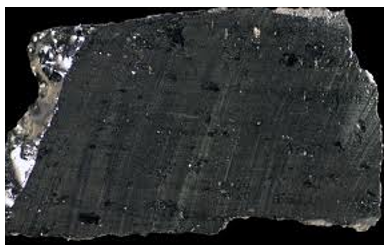
Anthracite: Anthracite is the highest quality hard coal.
In India coal occurs in rock series of two main geological ages, namely Gondwana, a little over 200 million years in age and in tertiary deposits which are only about 55 million years old. The major resources of Gondwana coal, which are metallurgical coal, are located in Damodar valley (West Bengal-Jharkhand). Jharia, Raniganj, Bokaro are important coalfields. The Godavari, Mahanadi, Son and Wardha valleys also contain coal deposits.
Tertiary coals occur in the north eastern states of Meghalaya, Assam, Arunachal Pradesh and Nagaland.
Petroleum:
Importance:
Petroleum or mineral oil is the next major energy source in India after coal. It provides fuel for heat and lighting, lubricants for machinery and raw materials for a number of manufacturing industries. Petroleum refineries act as a “nodal industry” for synthetic textile, fertiliser and numerous chemical industries.
Occurrence:
Most of the petroleum occurrences in India are associated with anticlines and fault traps in the rock formations of the tertiary age. In regions of folding, anticlines or domes, it occurs where oil is trapped in the crest of the upfold. The oil bearing layer is a porous limestone or sandstone through which oil may flow. The oil is prevented from rising or sinking by intervening non-porous layers.
Petroleum is also found in fault traps between porous and non-porous rocks. Gas, being lighter usually occurs above the oil.
About 63 per cent of India’s petroleum production is from Mumbai High, 18 per cent from Gujarat and 16 per cent from Assam.
Natural Gas
Natural gas is the most eco-friendly fuel found in association with petroleum.
- It has low carbon dioxide emissions thus seen as a fuel of the present century.
- It is not only a source of energy but also industrial raw material of petro chemical industry.
- Large reserves of natural gas have been discovered in the Krishna-Godavari basin.
- Along the west coast the reserves of the Mumbai High and allied fields are supplemented by finds in the Gulf of Cambay.
- The 1700 km long Hazira-Bijaipur- jagdishpur cross country gas pipeline links Mumbai High and Bassien with the fertilizer, power and industrial complexes in western and northern India.
- This artery has provided an impetus to India’s gas production.
- Use of Compressed Natural Gas (CNG) for vehicles to replace liquid fuels is gaining wide popularity in the country.
HBJ Pipeline: The 1700 km long Hazira - Bijaipur - Jagdishpur cross country gas pipeline links Mumbai High and Bassien with the fertilizer, power and industrial complexes in western and northern India. This artery has provided an impetus to India’s gas production. The power and fertilizer industries are the key users of natural gas. Use of Compressed Natural Gas (CNG ) for vehicles to replace liquid fuels is gaining wide popularity in the country
Electricity:
Electricity is generated mainly in two ways: by running water which drives hydro turbines to generate hydro electricity; and by burning other fuels such as coal, petroleum and natural gas to drive turbines to produce thermal power. Once generated the electricity is exactly the same.
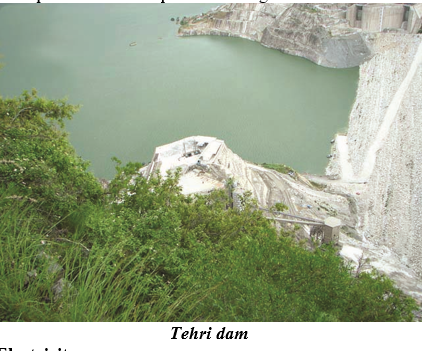
Tehri dam
(a) Thermal Electricity:
(i) Obtained by using Coal, Petroleum and Natural Gas.
(ii) Out of the total production, share of thermal electricity is about 70%.
(iii) Over 310 thermal power plants distributed in Assam, Jharkhand, Gujarat, Madhya Pradesh, Chattisgarh, Uttar Pradesh, West Bengl, Punjab and Haryana, Rajasthan, Karnataka, Orissa and Delhi.
(b) Hydroelectricity:
(i) Are renewable resources of energy.
(ii) Accounts for 25% of the total electricity produced in India.
(iii) Hydel power potential is 150000 MW
(iv) Total installed capacity of 23488 MW.
(v) Important Hydel power producing states Andhra Pradesh, Karnataka.
Difference between Thermal Electricity and Hydroelectrocity:
| Thermal Electricity | Hydro Electricity |
|
Derived from coal, petroleum, natural gas |
Derived from fast flowing stream of water. |
|
Non-renewable |
Renewable |
|
Creats pollution |
Pollution free, also known as White electricity |
|
Can be installed anywhere. |
Installation depends upon physical properties of land (only applicable in mountainous areas) |
|
Per Unit Cost is high |
Requires only one time investment |
Nuclear Energy:
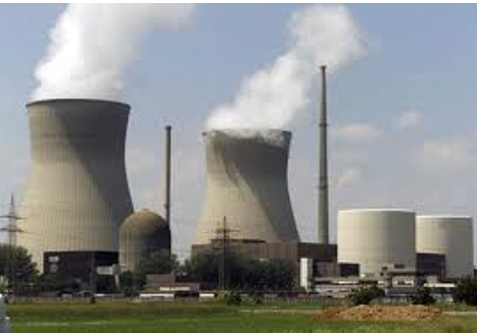
Nuclear or Atomic Energy is obtained by altering the structure of atoms. When such an alteration is made, much energy is released in the form of heat and this is used to generate electric power. Uranium and thorium, which are available in Jharkhand and the Aravalli ranges of Rajasthan are used for generating atomic or nuclear power. The Monazite sands of Kerala is also rich in thorium. Locate the 6 nuclear power stations and find out the state in which they are located.
Non-conventional Sources Of Energy
"India is very rich as far as non-conventional sources of energy are concerned."
(i) Wind energy is used for pumping water, irrigating farms and generating electricity. The states of Gujarat, Tamilnadu, Orrisa and Maharashtra are in better position to produce and use such an energy.
(ii) The gulf of Kuchch and Cambay are suitable for the development of tidal energy.
(iii) Geothermal energy is prouuced from hot springs in Himachal Pradesh. It is used for running cold storage plaints.
(iv) Every effort is being made to make use of biomass comprising energy plantation, urban waste, farm waste, human waste etc. to generate power.
(v) Energy plantations like fast-growing shrubs and trees with high calorific value are being grown on waste and denuded lands.
(vi) Urban or municipal wastes and sewages in cities are also used for generating gas and electricity.
(vii) Electricity can also be oroduced from farm wastes like rice husk and bagasse (sugarcane waste).
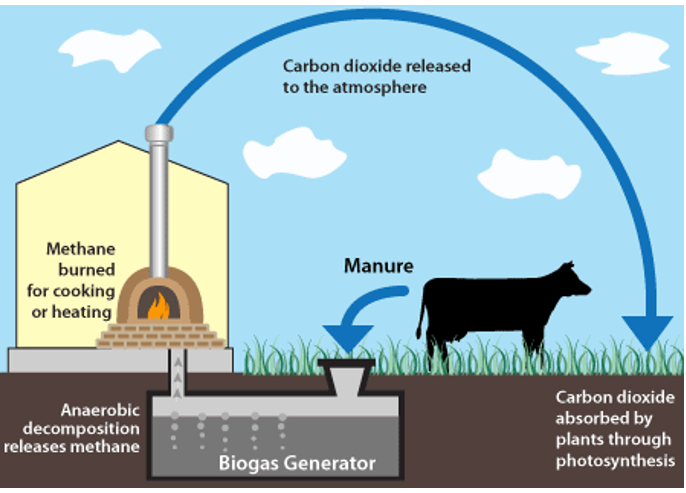
(viii) Animal and poultry wastes -and human excreta etc. have also been used in `bio-gas' plants to provide power in rural areas for different purposes.
(ix) The sun provides abundant and inexhaustible amount of energy. It has a huge potential and is a universal source of energy.
Solar Energy:
Photovoltaic technology converts sunlight directly into electricity. Solar energy is fast becoming popular in rural and remote areas. The largest solar plant of India is located at Madhapur, near Bhuj, where solar energy is used to sterilise milk cans. It is expected that use of solar energy will be able to minimise the dependence of rural households on firewood and dung cakes, which in turn will contribute to environmental conservation and adequate supply of manure in agriculture.
Wind Power:
- India now ranks as a “winds super power” in the world.
- India has a very long coast line so there is huge potential to develop wind energy.
- The largest wind farm cluster is located in Tamil Nadu from Nagarcoil to Madurai.
- Andhara Pradesh, Karnataka, Gujarat, Kerala, Maharashtra and Lakshadweep have important wind farms.
Biogas:
(i) Energy derived from shrubs, farm wastes, animal and human wastes.
(ii) Has higher thermal efficiency in comparison to Kerosene, Dung cake and Charcoal.
(iii) Energy produced can be used for cooking and lighting and the residual can be used as manure.
"Solar Energy in Rajasthan and Biogas in the plains and hills of North India have greater potential as non-conventional source of energy."
Solar Energy has a greater potential as:
(i) Rajasthan is a hot and dry region.
(ii) It has clear skies for a considerable part of the year.
(iii) Abundant insolation.
(iv) Cheaper installation, easier management.
(v) Renewable, pollution free and residue-free source of energy.
Biogas has a greater potential in plains as:
(i) Dense vegetation.
(ii) Large number of cattle and livestock.
(iii) High density of population, and hence huge decay and human waste material.
Tidal Energy:
Oceanic tides can be used to generate electricity. Floodgate dams are built across inlets. During high tide water flows into the inlet and gets trapped when the gate is closed. After the tide falls outside the flood gate, the water retained by the floodgate flows back to the sea via a pipe that carries it through a power-generating turbine.
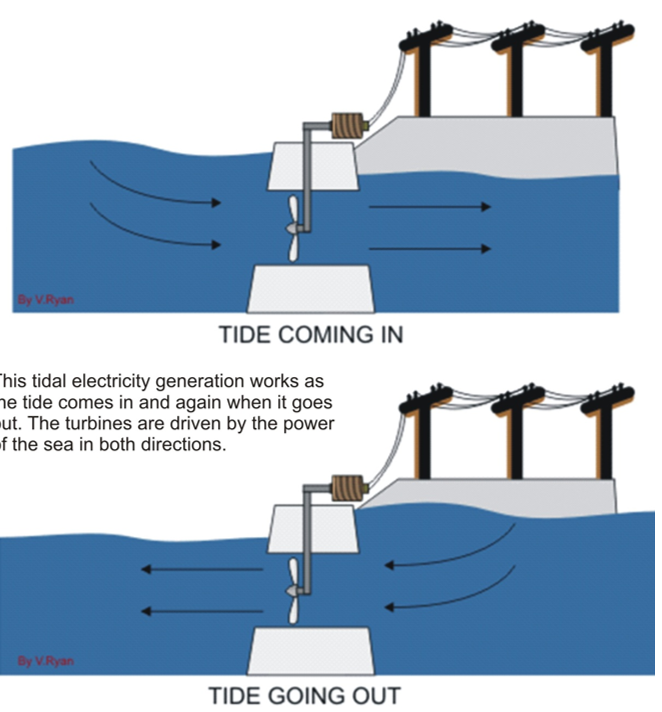
In India, the Gulf of Kuchchh, provides ideal conditions for utilising tidal energy. A 900 mw tidal energy power plant is set up here by the National Hydropower Corporation.
Geo Thermal Energy:
Geothermal energy refers to the heat and electricity produced by using the heat from the interior of the Earth. Geothermal energy exists because, the Earth grows progressively hotter with increasing depth. Where the geothermal gradient is high, high temperatures are found at shallow depths. Groundwater in such areas absorbs heat from the rocks and becomes hot. It is so hot that when it rises to the earth’s surface, it turns into steam. This steam is used to drive turbines and generate electricity.
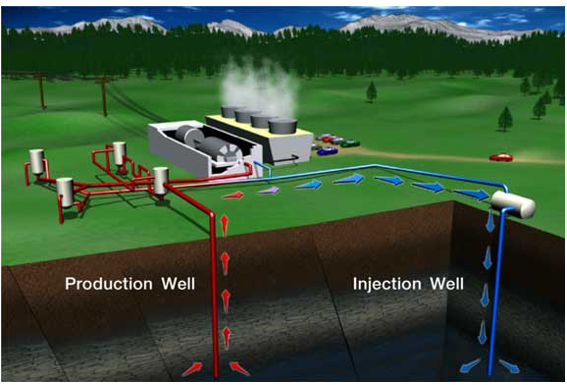
There are several hundred hot springs in India, which could be used to generate electricity.
Two experimental projects have been set up in India to harness geothermal energy. One is located in the Parvati valley near Manikarn in Himachal Pradesh and the other is located in the Puga Valley, Ladakh.
Conservation Of Energy Resources:
-
The wheel of an economy is being driven by the use of energy resource.
-
Some of the sources of energy production are limited and exhaustible but consumption of energy in all forms has been steadily rising all over the country.
-
Every sector of the economy whether industry, agriculture, transport system, domestic use or commercial use in the malls and call centres needs a heavy inputs of energy.
-
In this background, there is an urgent need to develop a sustainable path of energy development.
-
Promotion of energy conservation and increased use of renewable energy sources are the twin planks of sustainable energy.
-
India is presently one of the least energy efficient countries in the world.
-
We have to adopt a cautious approach for the judicious use of our limited energy resources.
-
We can do our bit by using public transport systems instead of individual vehicles; switching off electricity when not in use.
- Using power-saving devices and using non-conventional sources, of energy. After all, “energy saved is energy produced”.
Mode Of Occurrence Of Mineral:
Where are these minerals found.
Minerals are usually found in “Ores”. The term ore is described as accumulation of any mineral mixed with other elements, it should have sufficient concentration to make its extraction viable. The type of formation or structure in which they are found determines their relative ease of mining and cost of extraction.
Minerals Generally Occur in These forms:
(i) In igneous and metamorphic rocks minerals may occur in the cracks, crevices, faults or joints. The smaller occurrences are called vein and the larger are called lodes. They are formed when minerals in liquid / molten & gaseous forms are forced upwards through cavities towards earth’s surface. They cool and solidify as they rise. They include tin, copper, Zinc, lead etc.
(ii) Sedimentary Rocks : No. of minerals occur in beds and layers. They have been formed as a result of deposition, accumulation and concentration of horizontal strata eg Gypsum, potash salt & sodium salt. They are formed as a result of evaporation in arid region.
(iii) Decomposition of Surface Rocks : Involves the removal of soluble constituents, leaving a residual mass of weathered material containing ores eg. Bauxite.
(iv) Alluvial Deposits : Occur in sands of valley floors and the base of hills. These are called ‘Placer deposits ‘ and are not corroded by water eg gold, silver, tin platinum.
(v) Ocean waters contain vast quantities of minerals but most of these are too widely diffused to be of economic significance, however common salt, magnesium & bromine are largely derived.
Major Iron Ore Belts In India:
- Orissa Jharkand Belt : In Orissa high grade hematite ore is found in Badampahar mines in the Mayurbhanj and Kendujhar. In Jharkand haematite iron ore is mined in Gua and Noamundi.
- Durg - Bastar - Chandrapur belt : Lies in chattisgarh and Maharashtra high grade hematitis are found in Bailadila range of hills in Chatisgarh.
- Bellavy Chitradurga - Chikmaglur - Tumkur Belt : In Karnataka has large reserves of iron ore. Kudermuch mines located in western Ghats of Karnataka and known to be one of the largest.
- Maharashtra- Goa Belt : Includes state of Goa and Ratnagir district of Maharashtra. Although ores are not of very high quality yet they are efficiently exploited.
Conservation Of Energy Resources:
Energy is a basic requirement for economic development. Every sector of national economy agriculture, industry, transport, commercial and domestic needs inputs of energy. There is an urgent need to develop a sustainable path of energy development. India is presently one of the least energy efficient countries in the world. We have to adopt a caution approach for judicious use.
- Using public transport instead of individual.
- Switching of electricity when not in use.
- Using power saving devices.
- Using non conventional sources of power.
Solved Questions
- Name properties which are used by geologists to classify minerals?
Ans. The five properties are: colour, hardness, crystal, form, luster and density.
- Name three important seaports through which iron-ore is exported and name one major importing country?
Ans. Important ports are: 1. Vishakhapatnam, 2. Mangalore and 3. Marmagao. The major importing country is Japan.
- Write three leading manganese producing States and their share in the total production.
Ans. Three leading States of manganese production' are: Orissa - 33%, Madhya Pradesh - 22% and Karnataka - 15%.
- Write two uses of manganese.
Ans. Manganese is used in the manufacturing of 1. Steel, 2. Ferro-manganese alloy, 3. Bleaching powder. and 4. Insecticides
- Name four major States of iron-ore production along with their percentage share.
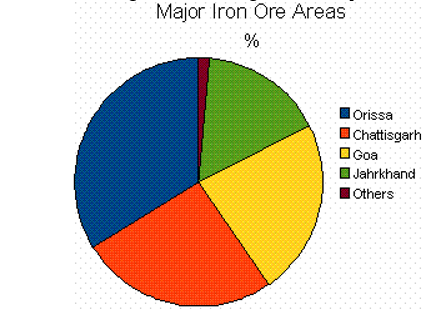
Ans. Five leading States are: Karnataka - 26%, Orissa - 25%, Chhattisgarh – 19%, Goa - 17% and Jharkhand - 12%.
- Where is the largest wind farm cluster located? List two well known places which are making effective use of wind energy in the country.
Ans. Largest wind farm cluster is located in Tamil Nadu from Nagarcoil to Madurai. Nagarcoil and Jaisalmer are well known places for effective use of wind energy.
- What is a Gobar Gas Plant? Write its two benefits for a farmer.
Ans. Biogas plants using cattle dung are known as gobar gas plants in rural India. Two benefits of the gobar gas plant to a farmer are:
(i) It provides energy which does not cause any pollution.
(ii) It also provides improved quality of manure.
- "Minerals are an indispensable part of our lives." Comment.
Ans. (i) Almost everything we use, from a tiny pin to a towering building or a ship, all are made from minerals.
(ii) All means of transport are manufactured from minerals and run on power resources derived from the earth.
(iii) Even the food that we eat contains minerals. In all stages of development, human beings have used minerals for their livelihood, decorations, festivities, etc.
- Name four types of iron-ore found in India and write atleast two points each for the two best quality ores.
Ans. Four types of iron-ores are: Magnetite, Hematite, Siderite and Limonite.
Two best ores are:
Magnetite
(i) It is the finest iron-ore available with upto 70% iron content.
(ii) It has excellent magnetic qualities and is especially valuable in the electrical industry.
Hematite
(i) It is the most important industrial iron-ore in terms of quantity used.
(ii) It has 50-60% iron content.
- Why mining is called killer industry?
Ans. Mining is called killer industry due to
(i) The risk of collapsing mine roofs.
(ii) Inundation, i.e. flooding in mines.
(iii) Fires in coalmines is a constant threat to miners.
(iv) Poisonous gases, dust and noxious fumes inhaled by miners make them vulnerable to pulmonary diseases. All these incidents kill thousands of people.
- Why does solar energy have a bright future in India?
Or
Why solar energy is called the energy of future?
Ans. It has bright future
(i) India is a tropical country and gets abundant sunshine. It has enormous possibilities of tapping solar energy.
(ii) It is an inexhaustible source of energy which is freely available in nature.
(iii) It is fast becoming popular in rural and remote areas also because photovoltaic technology converts sunlight directly into electricity.
(iv) Because of its abundant and free availability in all parts of India in addition to its ecofriendly nature, solar energy is called the energy of future.
- Name the most important ore from which aluminium is obtained. Write why aluminium is an important metal.
Ans. Aluminium is obtained from bauxite ore.
Aluminium is an important metal because:
(i) It combines the strength of metals such as iron.
(ii) It is a light metal and its alloys are hard and light.
(iii) It has good conductivity. It has great malleability.
(iv) Its alloy is strategically importent to us.
- Why is mica one of the most indispensable minerals used in electric and electronic industry? Give four reasons.
Ans. Mica is indispensable for electric and electronic industry because it has
(i) Excellent di-electric strength.
(ii) Low power loss factor.
(iii) Insulating properties.
(iv) Resistance to high voltage.
- Distinguish between thermal power and hydel power. Give four points. How Hydel power scores over thermal power?
Ans.
|
Thermal Power |
Hydel Power |
||
|
1. |
Thermal power is generated by burning fossil fuels to drive turbines to generate power, e.g. coal, petroleum and natural gas. |
1. |
Hydro power is generated by fast flowing waters which are made to fall from a great height which drives hydro turbines. |
|
2. |
These fossils are exhaustible in nature. |
2. |
It is an inexhaustible source of energy. |
|
3. |
Thermal power causes pollution. |
3. |
It is pollution-free and eco-friendly. |
- Write four factors which affect mining activity.
Ans. (i) The mineral content of the ore must be in sufficient in concentration to make its extraction commercially viable.
(ii) The type of formation or structure in which they are found determines the relative ease with which minerals may be mined.
(iii) Depth at which the mineral is found also determines the cost of extraction.
(iv) Closeness to market affects the economic viability of a reserve.
- Classify minerals and mention their subtypes.
Ans. Minerals can be broadly classified in three groups:
(i) Metallic minerals give us metals, e.g. bauxite.
(ii) Non-metallic minerals, e.g. mica, salt, marble, etc.
(iii) Energy minerals. They generally contain fossil fuels (e.g. coal, petroleum and natural gas) and nuclear "minerals (e.g. uranium and thorium) from which we can obtain energy for commercial purposes.
Metallic minerals can be further classified into:
(a) Ferrous minerals: Metals which have iron in them, e.g. iron-ore, manganese.
(b) Non-ferrous minerals do not contain iron, e.g. copper.
(c) Precious metals, e.g. gold, silver and platinum
- Why is conservation of minerals necessary? Give four reasons.
Ans. Conservation of minerals is necessary because of the following reasons:
(i) The formation of minerals takes a long geological period for their formation.
(ii) They are finite, i.e. limited in nature.
(iii) Many of them are non-renewable and exhaustible.
(iv) They have to be preserved for our future generations because they are very important for industrial development of the nation.
- Discuss coal as an important source of energy.
Ans. Coal as an important source of energy:
(i) It provides a substantial part of the nation’s energy needs as it is abundantly available. It is used for power generation, to supply energy for industrial and domestic needs.
(ii) India is highly dependent on coal for meeting its commercial needs. It share in total is about 67%.
(iii) It can easily be converted into other forms of energy – electricity, gas, oil, etc.
(iv) Coal is an important source of energy for domestic purpose. It is also used in brick industries.
(v) Coal is also an important source of energy for many industries like iron and steel and cement industry.
- Name four types of coal and write two characteristic of each.
Ans. Anthracite:
(i) It is the highest quality hard coal.
(ii) it contains more than 80% carbon content, it gives less smoke.
Bituminous:
(i) It is the most popular coal in commercial use and has 60-80% carbon content.
(ii) Metallurgical coal is high grade bituminous coal and is of special value for smelting iron in blast furnace.
Lignite:
(i) It is a low grade brown coal.
(ii) It is soft with high moisture content.
Peat:
(i) It has a low carbon and high moisture content.
(ii) It has low heating capacity and gives lot of smoke on burning.
- Why petroleum acts as a nodal industry?
Ans. It acts as a modal industry as
(i) It is the second most important energy source of India after coal. It provides fuel for heat and light.
(ii) It is an important fuel used in transportation sector.
(iii) It provides lubricants for machinery.
(iv) It provides raw material for a number of manufacturing industries like chemical fertilizer, synthetic textile etc.
- Why Natural gas is called energy of the present generation?
Ans. It is called the energy of the present generations:
(i) Natural gas is an important clean energy resource.
(ii) It is used as a source of thermal power.
(iii) It is considered an environment friendly fuel because of low carbon-dioxide emissions.
(iv) It is used as an industrial raw material in the petrochemical, fertilizer and power industry.
(v) Use of compressed natural gas (CNG) for vehicles is gaining wide popularity in the country. Recently we have found a huge reserve of natural gas.
- Distinguish between conventional and non-conventional sources of energy.
Ans.
|
Conventional Sources |
Non-conventional Sources |
||
|
1. |
They have been in use since ages. |
1. |
The technology for their large scale development is relatively new. |
|
2. |
Except hydel power they are exhaustible or non-renewable, e.g. coal, petroleum and natural gas. |
2. |
They are inexhaustible sources of energy, e.g. solar, wind and tidal energy. |
|
3. |
These non-renewable resources create pollution. |
3. |
They are pollution-free, therefore are eco-friendly. |
|
4. |
Except water, all other sources of energy are available in limited quantities. |
4. |
They are freely and abundantly available in nature. |
|
5. |
Because of their limited availability and exhaustible nature, we cannot depend on them for long time. |
5. |
Because of their abundant availability, they are dependable sources. Therefore, they are called our future energy resources. |
- Distinguish between the following in not more than 30 words.
(a) Ferrous and non-ferrous minerals
(b) Conventional and non conventional sources of energy.
Ans. (a)
|
Ferrous Minerals |
Non-Ferrous Minerals |
|
|
(a) |
Minerals which have iron content. |
Minerals which do not have iron content. |
|
(b) |
They help in the development of meta lurgical industries. India has rich reserve of ferrous minerals. e.g., Iron ore, manganese. |
India is deficient in non-ferrous minerals like copper, lead, zinc, gold. |
(b)
|
Conventional sources of energy |
Non-conventional sources of energy |
|
|
(a) |
Traditional source of energy produced from coal, petroleum. |
Recently developed source of energy developed from Sun, wind, water, tides. |
|
(b) |
It is generally non-renewable. |
It is generally renewable. |
|
(c) |
Generation is expensive. |
They are cheapest source of energy. |
|
(d) |
They pollute the atmosphere on large scale. |
They are generally pollution free sources. |
- What is a mineral?
Ans. Minerals are naturally occurring substances on the earth’s crust having a definite chemical composition or internal structure. They can be as hard as a diamond or soft as talc.
- How are minerals formed in igneous and metamorphic rocks?
Ans. Minerals occur in igneous rocks and metamorphic rocks mainly in the cracks, crevices and faults or joints. When the occurrence is thin and small it is called as veins but when its occurrence is large and thick it is called lodes.
- Why do we need to conserve mineral resources?
Ans. (i) Minerals are non-renewable and exhaustible.
(ii) Minerals are unevenly distributed.
(iii) Minerals are needed for industrialization and economic development.
(iv) Minerals need to be conserved to meet the needs of present as well as future generation as they are depleting faster.
- Describe the distribution of coals in India.
Ans. (i) Gondwans ages coal, which are metallurgical coal, are found in Damodar valley, Godawari, Mahanadi, son and wardha valley.
(ii) Thertiary coal deposits which are about 55 million old are found in the north eastern states of meghalaya, Assam, Arunachal Pradesh and Nagaland.
(iii) Lignite or brown coal is found in Rajasthan, Assam and Tamil Nadu.
- Why do you think that solar energy has a bright future in India?
Ans. (i) Solar energy is a renewable source of energy unlike coal and petroleum.
(ii) India being a tropical country has ample sunshine throughout the year.
(iii) India has developed technology for the production and utilization of solar energy.
(iv) Solar energy is becoming popular in rural areas where its is used for cooling, heating of water, space heating, lighting of homes and streets.
(v) In Bhuj district of Gujarat it is used for sterilizing milk cans.
Exercise - 1
1. Which one of the following mineral is formed by decomposition of rocks, leaving a residual mass of weathered material?
(a) Coal
(b)bauxite
(c) Gold
(d) zinc
2. Koderma, in Jharkhand is the leading producer of which one of the following minerals?
(a) Bauxite
(b)mica
(c) Iron ore
(d) copper
3. Minerals are deposited and accumulated in the strata’s of which of the following rocks?
(a) Sedimentary rocks
(b)igneous rocks
(c) Metamorphic rocks
(d) none of the above
4. Which one the following minerals is contained in the Monazite sand?
(a) Oil
(b)uranium
(c) Thorium
(d) coal
5. The sparkle in some tooth paste is due to the presence of
(a) Fluorine
(b)Calcium
(c) Silica
(d) Mica
6. Copper and zinc deposit are generally found in
(a) Sedimentary rocks
(b)In oceans
(c) Igneous and metamorphic rocks
(d) Residual mass of weathered material
7. Which state is the leading producer of manganese
(a) Orissa
(b)Madhya Pradesh
(c) Jharkhand
(d) Bihar
8. Which one of the following is note non-ferrous mineral
(a) Copper
(b)Bauxite
(c) Manganese
(d) lead
9. Kudermukh’s iron ore is exported through which port
(a) Mumbai
(b)Goa
(c) Tuticorine
(d) Manglore
10. Balaghat and khetri mines are the mines of
(a) Copper
(b)Iron ore
(c) Coal
(d) Mica
11. Which metal is often termed as back-bone of modern civilization?
(a) Copper
(b) Iron
(c) Bauxite
(d) Zinc
12. Which one is not a ferrous mineral?
(a) Iron ore
(b) Manganese ore
(c) Gold
(d) Pyrite
13. Which state is the largest producer of manganese ore in India?
(a) Orissa
(b) Bihar
(c) Chattisgarh
(d) W. Bengal
14. Khetri mines in Rajasthan are famous for the mining of -
(a) Iron
(b) Copper
(c) Bauxite
(d) Uranium
15. The state where copper reserves are not found.
(a) Madhya Pradesh
(b) Rajasthan
(c) Tamil Nadu
(d) Jharkhand
16. Solar, Wind, Tidal, Geo-thermal, Atomic energy and Biogas are called ___________ energy.
(a) Conventional
(b) Non-conventional
(c) Metallic
(d) Non-metallic
17. Coal is so useful that it is often called ________
(a) Liquid Gold
(b) Yellow Gold
(c) Black Gold
(d) Burning Gold
18. Neyveli in Tamil Nadu is famous for which type of coal?
(a) Bituminous
(b) Peat
(c) Anthracite
(d) Lignite
19. About __________ of India's crude petroleum production is produced from Mumbai high, _______ from Gujarat and ______ from Assam.
(a) 63%, 18%, 16%
(b) 73%, 8%, 19%
(c) 83%, 10%, 7%
(d) 63%, 16%, 18%
20. The most abundantly available fossil fuel is -
(a) Petroleum
(b) Natural Gas
(c) Coal
(d) Iron
21. Total length of HBJ cross country, gas pipeline is -
(a) 1200 km.
(b) 1400 km.
(c) 2400 km.
(d) 1700 km.
22. Today India has an installed power dapacity of _____________
(a) 104917 MW
(b) 140917 MW
(c) 104719 MW
(d) 140719 MW
23. The total hydel power potential of India is estimated to be _________
(a) 15000 MW
(b) 150000 MW
(c) 1500000 MW
(d) 155000 MW
24. The Gulf of Kutch & Cambay are suitable for the development of _________energy.
(a) Tidal
(b) Hydel
(c) Solar
(d) Wind
25. The largest wind power cluster of 150 MW is located in the state of_________
(a) Gujarat
(b) Karnataka
(c) Tamil Nadu
(d) Kerala
ANSWERS TO EXERCISE - 1
| 1 (b) | 2 (b) | 3 (c) | 4 (c) |
| 5 (d) | 6 (c) | 7 (a) | 8 (c) |
| 9 (d) | 10 (a) | 11 (b) | 12 (c) |
| 13 (a) | 14 (b) | 15 (c) | 16 (b) |
| 17 (c) | 18 (d) | 19 (a) | 20 (c) |
| 21 (d) | 22 (a) | 23 (b) | 24 (a) |
| 25 (c) |
EXERCISE - 2
- What are rocks? Give examples.
- Why is it important to understand the main type of formations in which mineral occurs?
- How is bauxite formed?
- What are placer deposits? Give examples.
- Durg-Bastar-Chandrapur belt in known for which mineral?
- Why do we need to conserve mineral resources?
- What is the difference between ferrous and non-ferrous minerals?
- Why is natural gas considered as enviornment friendly fuel?
- What do you understand by geo thermal energy?
- Which non-conventional source of energy is most abundant in India?
- What are minerals? Give examples of metallic and nonmetallic minerals.
- What is the importance of Iron, aluminum, manganese and mica?
- What are anthracite and bituminous? Where are they found in India?
- Which factors make the production of solar energy convenient in India? What are the uses of solar energy?
- How is limestone formed? Where is it found in India?
- What is wind energy? Where is it harnessed in India?
- Distinguish between natural gas and biogas.
- Distinguish between conventional and non-conventional sources of energy.
- "India's Energy hope lies in Nuclear power". How we can say that?
- What are the non-conventional sources of energy?
- State the facts about the iron ore found in India with reference to the following:
(a) two types of ores (b) two leading states in their deposits.
(c) two exporting ports (d) major destination of the exports.
- What is nuclear electricity? Where are the nuclear power stations located?
- Differentiate between thermal electricity and hydro electricity.
- How do non-conventional sources of energy excel over other sources of energy?
- Describe the distribution of iron-ore in India.
- Write a brief note on our mineral oil and gas deposits covering the following points:\
(a) Potential area of deposits (b) Production trends
(c) Growth in demand and (d) Consumption
- What is the necessity of conserving our mineral wealth? What steps should we take to conserve our mineral wealth?
- Write briefly two merits of water as a source of power.
- Describe any two facts regarding the importance of manganese in our daily iife. Also name the four states which are known for its production.
- Describe any two facts regarding the importance of bauxite. Name the four major states which are known for its production.
- What are the two main qualities of iron ore deposits of India? Name the two types of iron ore mainly found in the country. Which are the two sates known for the production of iron ore?
- Why is solar energy called the energy of the future? Explain with four examples.
- "Hydel power is a more important source of energy than thermal power". Discuss this fact with four examples.
- Why is coal called the most important source of energy even today? Expalin any four reasons.
- State the facts about iron ore found in India with reference to the following
(a) Two types of ores (b) Leading states in their deposits
(c) Two exporting ports (d) Major destination of the exports
- State the facts about coal found in India with reference to the following.
(a) Their total reserves (b) Annual production
(c) Two important coal fields (d) Two major uses
- What is solar energy? Write its three characteristics.
- State two main uses of copper. Also mention four major copper producing districts of india.
- Name the ore from which Aluminum is extracted. State four important uses of Aluminum. Name two states where is found.
- Mention four uses of manganese ore.