Class 10 Geography Notes – Lifelines of National Economy
Class 10 Transport and communication are called the lifelines of the national economy because they connect people, markets, and industries. This chapter explains modes of transport and the importance of trade.
Means of Transport in India
-
Roadways – Flexible, connect rural and urban areas. National Highways, Expressways, Golden Quadrilateral are important projects.
-
Railways – Largest public sector transport, essential for long-distance travel and freight.
-
Airways – Fastest mode of transport, important for passengers and valuable goods.
-
Waterways – Cheapest transport, includes rivers and sea routes.
-
Pipelines – Transport petroleum, natural gas, and water.
Communication
-
Personal Communication: Telephone, mobile, internet.
-
Mass Communication: Newspapers, radio, TV, cinema, online platforms.
International Trade
India trades goods and services with other nations.
-
Exports: Engineering goods, petroleum products, textiles, jewellery, spices.
-
Imports: Crude oil, machinery, gold, chemicals.
Introduction
- Balance of trade: It is the difference between the total value of exports and imports of goods of a nation.
- Border roads: These are roads constructed along the international frontier for maintaining the defence of the country.
- Communication: Exchange of ideas, emotions, messages, either written or oral, from one place to another all over the world.
- Exports: Goods dispatched/sent from one country to another.
- Golden quadrilateral super ways: Roads built for fast and uninterrupted traffic having four to six lanes connecting the four metropolitan cities of Delhi, Mumbai, Chennai and Kolkata.
- Hinterland: An area served by a port.
- International trade: Trade carried on between countries.
- Mass communication: The means of communication through which one can communicate with several people at the same time.
- Pipelines: A new means of transport for carrying oil and natural gas from the oilfields and refineries to far off places.
- Personal communication: Communication between two or more persons at personal level.
- Port: A commercial part of a harbour where loading and unloading of goods takes place in ships.
- Trade: Exchange of goods and commodities between or among countries or within the country.
- Transport: A system by which goods and passengers are carried from one place to another.
"The means of transport and communication are called the lifelines of a country and its economy"
Lifelines of a human being are his veins which carry blood to all parts of the body and provide them energy. Same way means of transport and communication bring all the regions of a country closer and develop them equally. A country can make tremendous progress only on the basis of its developed means of transport and communication.
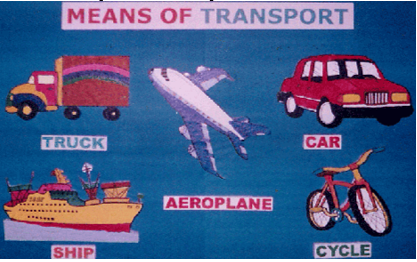
Earlier people used to move on foot, the means of transportation were not at all developed, going from one place to another was considered as a burden, but now a days no place in the world is far away. With the present means of transportation, one can reach to any part of the world within hours. Earlier the means of communication also were not developed. It took a long time to send message from one place to another. In the present world with the means like telephone, television and most importantly internet, none of the countries or any part of world is far away.
Roadways
India has one of the largest road networks in the world, aggregating to about 2.3 million km at present. In India, roadways have preceded railways. They still have an edge over railways in view of the ease with which they can be built and maintained.
Importance of road transport vis-a-vis rail transport
- Construction cost of roads is much lower than that of railway lines,
- Roads can traverse comparatively more dissected and undulating topography,
- Roads can negotiate higher gradients of slopes and as such can traverse mountains such as the Himalayas,
- Road transport is economical intransportation of few persons and relatively smaller amount of goods over short distances,
- It also provides door-to-door service, thus the cost of loading and unloading is much lower
- Road transport is also used as a feeder to other modes of transport such as they provide a link between railway stations, air and sea ports.
In India, roads are classified in the following six classes according to their capacity.
Golden quadrilateral
The government has launched a major road development project linking Delhi-Kolkata- Chennai-Mumbai and Delhi by six-lane Super Highways. The North-South corridors linking Srinagar (Jammu & Kashmir) and Kanyakumari (Tamil Nadu), and East-West Corridor connecting Silcher (Assam) and Porbander (Gujarat) are part of this project. The major objective of these Super Highways is to reduce the time and distance between the mega cities of India. These highway projects are being implemented by the National Highway Authority of India (NHAI).
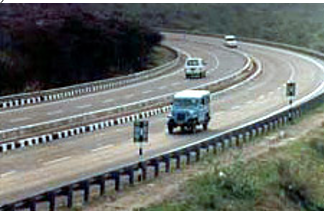
National Highways
National Highways link extreme parts of the country. These are the primary road systems and are laid and maintained by the Central Public Works Department (CPWD). A number of major National Highways run in North-South and East-West directions.
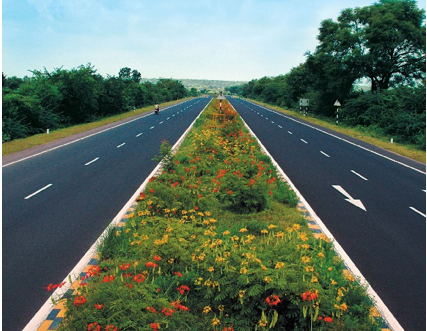
State Highways
Roads linking a state capital with different district headquarters are known as State Highways. These roads are constructed and maintained by the State Public Works Department (PWD) in State and Union Territories.
District roads
These roads connect the district headquarters with other places of the district. These roads are maintained by the Zila Parishad.
village roads
- Rural roads, which link rural areas and villages with towns, are classified under this category.
- These roads received specials impetus under the Pradhan Mantri Grameen Sadak Yojana.
- Under this scheme special provisions are made so that every village in the country is linked to a major town in the country by an all season motorable road.
- These roads open the rural economy for the urban economy.
- These roads connect one village to another.
Border roads
Border Road Organisation a Government of India undertaking constrructs and maintains roads in the bordering areas of the country. This organisation was established in 1960 for the development of roads of strategic importance in the northern and north-eastem border areas. These roads have improved accessibility in areas of difficult terrain and have helped in the economic development of these areas.
The another classification can be done on the basis of type of material used for building roads.
| S.No. | Surfaced road | Unsurfaced road |
| 1. | Metalled roads built of coal tar, cement and stone. | Unmetalled roads made of loose soils & stone |
| 2. | Smooth and polished roads. | Rugged and dusty roads. |
| 3. | All weather roads. | Seasonal roads which turn into mud during the rainy season. |
| 4. | Constructed and maintained by state and central government. | Constructed and maintained by local authourities village panchayats etc. |
| 5. | 53% of the total road network. | 47% of the total road network. |
Road density
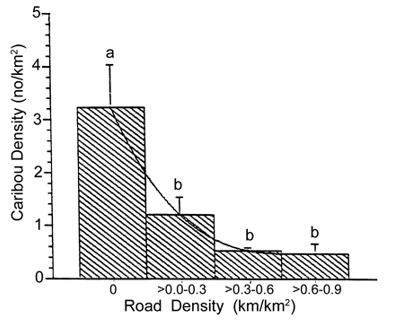
The length of road per 100 sq. km of area is known as density of roads. Distribution of road is not uniform in the country. Density of all roads varies from only 10 km in Jammu & Kashmir to 375 km in Kerala with the national average of 75 km (1996-97).
Problems of road transport
- The road network is inadequate.
- Half of the roads are unsurfaced which become muddy during the rainy season.
- National highways are inadequate, highly congested in cities, their bridges and culverts are narrow.
- Road side amenities like telephone booths, books, emergency with services and police protection are poor, needs improvement.
Railways
Railways are the principal mode of transportation for freight and passengers in India. Railways also make it possible to conduct multifarious activities like business, sightseeing, and pilgrimage along with transportation of goods over longer distances.
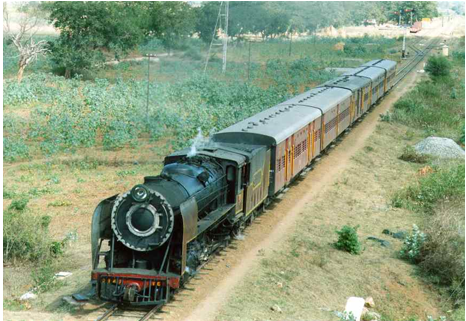
Apart from an important means of transport the Indian Railways have been a great integrating force for more than 150 years. Railways in India bind the economic life of the country as well as accelerate the development of the industry and agriculture.
Rail Network
The Indian Railway have a network of 7, 031 stations spread over a route length of 63, 221 km. with a fleet of 7817 locomotives, 5321 passenger service vehicles, 4904 other coach vehicles and 228, 170 wagons as on 31.
Rail gauge and length of routes in india
|
Gauge in Meters Broad Gauge 1.676 |
Route (km) 46807 |
Running Track (km) 66754 |
Total Track (km) 88547 |
| Metre Gauge 1 | 13209 | 13976 | 16489 |
| Narrow Gauge 0.762 & 0.610 | 3124 | 3129 | 3450 |
Development of Railways
The Indian Railway is now reorganised into 16 zones. The distribution pattern of the Railway network in the country has been largely influenced by physiographic, economic and administrative factors.
The northern plains with their vast level land, high population density and rich agricultural resources provided the most favourable condition for their growth. However, a large number of rivers requiring construction of bridges across their wide beds posed some obstacles. In the hilly terrains of the peninsular region, railway tracts are laid through low hills, gaps or tunnels. The Himalayan mountainous regions too are unfavourable for the construction of railway lines due to high relief, sparse population and lack of economic opportunities. Likewise, it was difficult to lay railway lines on the sandy plain of western Rajasthan, swamps of Gujarat, forested tracks of Madhya Pradesh, Chhattisgarh, Orissa and Jharkhand. The contiguous stretch of Sahyadri could be crossed only through gaps or passes (Ghats). In recent times, the development of the Konkan railway along the west coast has facilitated the movement of passengers and goods in this most important economic region of India.
Problems of Indian Railways
- Today, the railways have become more important in our national economy than all other means of transport put together.
- However, rail transport suffers from certain problems as will.
- Many passengers travel without tickets. Thefts and damaging of railway property has not yet stopped completely.
- People stop the trains, pull the chain unnecessarily and this causes heavy damage to the railway.
Pipeline
Importance
- A convenient mode of transport for mineral oil and natural gas.
- Can be constructed over land as well as in water.
- Initial cost of laying pipelines is more but subsequent running costs are minimum.
- Pipeline transport rules out transshipment losses or delays.
- The transportation cost is also very low.
Important networks of pipeline transportation
- From oil fields in upper Assam to Kanpurvia Guwhati, Barauni and Allahabad.
- From Salaya in Gujarat to Jalandher in Punjab via Virangam, Mathura, Delhi and Panipat.
- Gas pipeline from Hazira in Gujarat to Jagdishpur in U.P. via Bijaipur in M.P.
- Pipelines between Mumbai high and Mumbai, Mumbai and Pune.
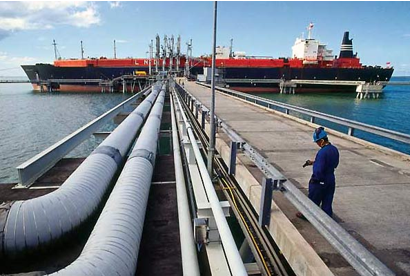
Advantages of pipleline transportation
Although initial cost of laying pipelines is high put the subsequent running and maintenance cost is low.
It is ideal for the transportation of oil and gas.
It reduces Tran’s shipment losses.
It can be built on land, below the surface and even under water.
Waterways
- Since time immemorial, India was one of the seafaring countries.
- Its waterways are the cheapest means of transport.
- They are most suitable for carrying heavy and bulky goods.
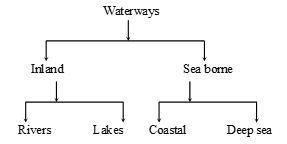
- It is a fuel-efficient and environment friendly mode of transport.
- India has inland navigation waterways of 14,500 km in length.
- Out of these only 3,700 km are navigable by mechanized boats.
National Water Ways
- The Ganga river between Allahabad and Haldia (1620 km)-N.W. No. 1.
- The West-Coast Canal in Kerala (Kottapurma-Komman, Udyogamandal and Champakkara canals-205 km) – N.W. No. 3 The other viable inland waterways include the Godavari, Krishna, Barak, Sunderbans, Buckingham Canal, Brahmani, East-west Canal and Damodar Valley Corporation Canal.
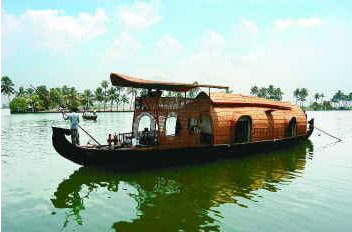
- Apart from these, India’s trade with foreign countries is carried from the ports located along the coast.
- 95 per cent of the country’s trade volume (68 per cent in terms of value) is moved by Sea.
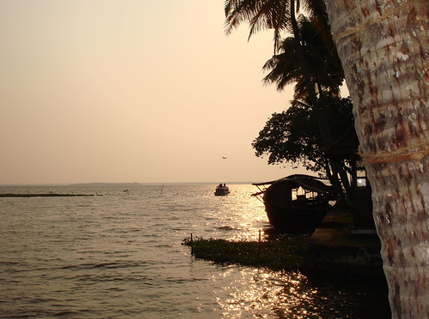
- India is dotted with 12 major and 181 medium and minor ports. These major ports handle 95 per cent of India’s foreign trade.
- Kandla in Kuchcha was the first port developed soon after Independence to ease the volume of trade on the Mumbai port, in the wake of loss of Karachi port to Pakishtan after the Partition.
- Kandla is a tidal port. It catlers to the convenient handling of exports and imports of highly productive granary and industrial belt stretching across the states of Jammu and Kashmir, Himachal Pradesh, Punjab, Haryana, Rajasthan and Gujarat.
- Mumbai is the biggest port with a spacious natural and well-sheltered harbour.
- The Jawaharla Nehru port was planned with a view to decongest the Mumbai port and serve as a hub port for this region.
- Marmagao port (Goa) is the premier iron ore exporting port of the country.
- This port accounts for about fifty per cent of India’s iron ore export.
- New Mangalore port, located in Karnataka caters to the export of iron ore concentrates from Kudremukh port, located at the entrance of a lagoon with a natural harboour.
- Tuticorine port on the east coast in you port of this port has a natural harbour and rich hinterland.
- Thus, it has a flourishing trade handling of a large variety of cargoes to even our neighbouring countries like Sri Lanka, Maldives, etc. and the coastal regions of India.
- Chennai is one of the oldest artificial ports of the country. It is ranked next to Mumbai in terms of the volume of trade and cargo.
- Vishakhapatnam is the deepest landlocked and well-protected port.
- This port was, originally, conceived as an outlet for iron ore exports.
- Paradip port located in Orissa, specializes in the export of iron ore.
- Kolkata is an inland riverine export. This port serves a very large and rich hinterland of Ganga-Brahmaputra basin. Being a tidal port, it requires constant dredging of Hoogley.
- Haldia port was developed as a subsidiary port, in order to relieve growing pressure on the Kolkata port.
Airways
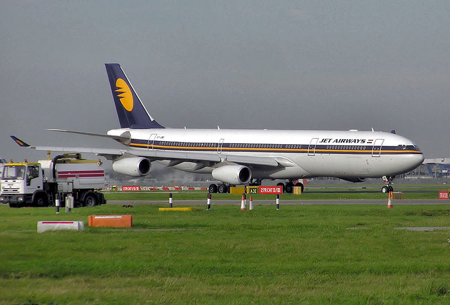
The air transport was nationalised in 1953. On the operational side, Indian Airlines, Alliance Air (subsidiary of Indian Airlines), private scheduled airlines and non- scheduled operators provide domestic air services. Air India provides international air services. Pawanhans Helicopters Ltd. Provides helicopter services to Oil and Natural Gas Commission in its off- shore operations, to inaccessible areas and difficult terrains like the north-eastern states and the interior parts of Jammu and Kashmir, Himachal Pradesh and Uttaranchal. Indian Airlines operations also extend to the neighbouring countries of South and south-east Asia and the Middle east.
It can cover very difficult terrains like high mountains, dreary deserts, dense forests and also long oceanic stretches with great ease.
Communication
Personal communication and mass communication including television, radio, press, films, etc. are the major means of communication in the country.
Indian post
The Indian postal network is the largest in the world. It handles parcels as well as personal written communications. Cards and envelopes are considered first–class mail and are airlifted between stations covering both land and air. The second–class mail includes book packets, registered newspapers and periodicals. They are carried by surface mail, covering land and water transport. To facilitate quick delivery of mails in large towns and cities, six mail channels have been introduced recently. They are called Rajdhani Channel, Metro Channel, Green Channel, Business Channel, Bulk Mail Channel and Periodical Channel.

Telephone
India has one of the largest telephone networks in Asia. In order to strengthen the flow of information from the grass root to the higher level, the government has made special provision to extend twenty-four hours STD facility to every village in the country. There is a uniform rate of STD facilities all over India. It has been made possible by integrating the development in space technology with communication technology.

Mobile telephones
India is one of the fastest growing mobile network in the world. Mobile phones have changed the way Indians conducted business. Now even low income group people like vegetable vendors, plumbers and carpenters get better business because they are connected through mobile phones.

Mass comunication
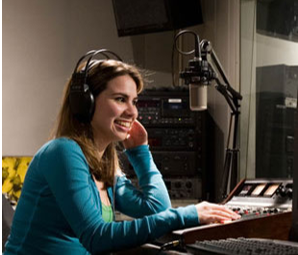
Mass communication provides entertainment and creates awareness among people about various national programmes and policies. It includes radio, television, newspapers, magazines, books and films. All India Radio (Akashwani) broadcasts a variety of programmes in national, regional and local languages for various categories of people, spread over different parts of the country. Doordarshan, the national television channel of India, is one of the largest terrestrial networks in the world. It broadcasts a variety of programmes from entertainment, educational to sports, etc. for people of different age groups.
Newspapers
India publishes a large number of newspapers and periodicals annually. They are of different types depending upon their periodicity. Newspapers are published in about 100 languages and dialects. Largest number of newspapers published in the country are in Hindi, followed by English and Urdu.

Films
India is the largest producer of feature films in the world. It produces short films; video feature films and video short films. The Central Board of Film Certification is the authority to certify both Indian and foreign films.
International Trade
Importance of Trade
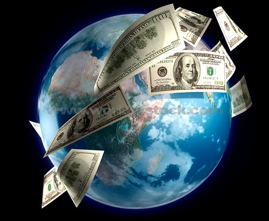
Modern life is so complex that one has to depend on others. No country today can prosper without the cooperation and assistance of others. In the present world, Trade has become a necessity as
- No country is self reliant, each country lacks in one resource or the other. On the other hand some resources are in excess. Requirements can be fulfilled only through trade.
- In times of calamities, trade relations are very useful as help can be received through the friendly countries.
- Trade relations are a guarantee of peace. It is generally believed that the trading countries are not going to fight with each other as they are interdependent.
Components of international trade
- Export and import are the components of trade.
- The balance of trade of a country is the difference between its export and import.
- When the value of export exceeds the value of imports. It is called a favourable balance of trade.
- On the contrary, if the value of imports exceeds then the value of exports, it is termed as an unfavourable balance of trade.
Balance of trade
The difference between exports & imports is known as the balance of trade. If value of exports is more than the value of imports it is called favourable balance of trade and if value of import is move than the value of export it is called unfavaurable balance of trade. In 2000-01 India had a foreign trade of Rs 43 lakh crore. Import constituted 53% and export 47% so it is unfavourable balance. India has trade relations with all the trading blocks of the world, most of the commodities exported from India consist of both raw material and manufactured goods which fetches less income. Commodities imported are mostly petroleum, gold, chemicals etc. which are more costly. Thus the overall balance of trade is unfavourable.
International trade has undergone a sea change in the last fifteen years. Exchange of commodities and goods have been superseded by the exchange of information and knowledge. India has emerged as a software giant at the international level and it is earning large foreign exchange through the export of information technology.
Tourism as a trade
- Tourism in India has grown substantially over the last three decades.
- Foreign tourist’s arrivals in the country witnessed an increase of 23.5 per cent during the year 2004 as against the year 2003, thus contributing Rs 21,828 crore of foreign exchange.
- Over 2.6 million foreign tourists visit India every year.
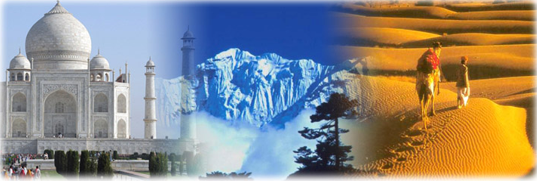
- Indian is ranked worlds 4th best holiday haven.
- More than 15 million people are directly engaged in the tourism industry.
- Tourism also promotes national integration, provides support to local handicrafts and cultural pursuits.
- It also helps in the development of international understanding about our culture and heritage.
- Foreign tourists visit India for heritage tourism, eco tourism, adventure tourism, cultural tourism, medical tourism and business tourism.
- Rajasthan, Goa, Jammu and Kashmir and temple towns of south India are important destinations of foreign tourists in India. There is vast potential of tourism development in the north-eastern states and the interior parts of Himalayas, but due to strategic reasons these have not been encouraged so far.
Summary
Roadways
India has one of the largest road networks in the world. Its importance can be viewed.
- Construction cost of roads is much lower.
- Roads can traverse comparatively more dissected and undulating topography.
- Roads can negotiate higher gradients of slope & as such can traverse mountains.
- It is economical.
- It provides door to door services.
- It is used as feeder to other modes of transport.
Golden quadrilateral super highways
- The Govt. has launched a major road development project linking DelhiKolkata-Chennai-Mumbai & Delhi by six-lane super highways.
- The North-South corridors linking Srinagar [Jammu & Kashmir] & Kanyakumari [T.N.] & East-West Corridor Connecting silcher (Assam) & Porbander (Gujarat). The major objective of these super highways is to reduce time & distance.
Railways
- The distribution pattern of the railway network in the country has been largely influence by physiographic, economic and administrative factors.
- The Himalyan mountains regions are unfavourable for the construction of railway lines due to high relief sparse population & each of economic opportunities.
- The northern plains provide most favourable condition having high population density.
- Rivers also create problem for lay down of railway tracts.
Pipelines
Pipelines transport network is a new arrival on the transportation map of India. Its initial cost is high but subsequent running costs are minimal. It is used for transporting crude oil, petroleum product & natural gas.
3 Important Networks
- Oil field in Assam to Kanpur (U.P.), via Guwahati, Barauni & Allahabad.
- From Salaya in Gujarat to Jalandhar. In Punjab via Viramgam, Mathura, Delhi & Panipat.
- Gas pipelines from Hazira in Gujarat connects Jagdishpur in UP via Vijaypur in Madhya Pradesh.
International trade
- The exchange of goods among people; states & countries is referred to as trade. Trade between two countries is called International Trade.
- Exports and imports are the components of trade. The balance of a trade of a country is the difference b/w its export and import.
- When the value of exports exceeds the value of imports, it is called favourable balance of trades.
Tourism as a trade
- Tourism has proved itself as one of the most important. aspect of trade. Tourism in India has grown substantially. It helps as
- Promotion of National Integration.
- Provide support to local handicrafts
- Provides support to cultural pursuits.
- Development of international understanding about our culture and heritage.
Solved Questions
State two main uses of pipeline transportation.
Ans. Uses of pipelines are:
- They transport water for domestic and industrial purposes mainly in the urban areas.
- Pipelines are now used for long distance transportation of crude oil, petroleum products, natural gas and even solids in the slurry form.
How are the major ports of India very important for the economy of the country? Explain it with two main points.
Ans. Importance of Major Ports of India:
- They handle over 95% of India’s international trade.
- These ports handle imports and exports.
Name the two essential components of international trade. How does its one component differ from the other?
Ans.
- Two components of International Trade are: (i) Imports and (ii) Export.
- Difference: (i) Goods brought into or purchased by a country from other countries are called it import and goods sold to other countries is called export.
Write about three most important networks of pipeline transportation.
Ans. Important networks are:
- From oilfield in Upper Assam to Kanpur.
- From Salaya (Gujarat) to Jalandhar (Punjab).
- Gas pipelines from Hazira (Gujarat), Bijaipur (M.P.), Jagdishpur (U.P.), called HBJ gas pipeline.
Name the Northernmost and Southernmost ports of Eastern and Western coast respectively.
Ans.
The Northernmost port : of Eastern Coast - Kolkata
of Western Coast - Kandla
The Southernmost port : of Eastern Coast - Tuticorin
of Western Coast – Kochi
Name two tidal ports and write their hinterlands.
Ans. Two tidal ports are Kandla and Kolkata.
- Hinterland of Kandla. It stretches across the States of Jammu and Kashmir, Himachal Pradesh, Punjab, Haryana, Gujarat and Rajasthan.
- Hinterland of Kolkata is very large, stretching over Ganga-Brahmaputra Basin.
What are 'Pawan Hans' services? Write two purposes for which these services are used.
Ans. The Pawan Hans Helicopter Ltd., a public sector undertaking, provides helicopter services to:
- Oil and Natural Gas Commission (ONGC) in its offshore operations.
- Inaccessible areas and difficult terrains like the North-Eastern States, the interior parts of Jammu & Kashmir, Himachal Pradesh and Uttrakhand.
- They are also pressed into service at the time of emergencies and for providing relief measures at the time of natural calamities.
Under which scheme rural roads are being developed.
Ans. Pradhan Mantri Grameen Sadak Yojana.
Name the three categories of transport with example.
Ans. Three category of transport are :
- Land transport : Railways, Roadways and pipelines
- Water transport : Inland waterways and national waterways
- Air transport : Domestic airways and international airways.
State any three disadvantages of Road Transport in India.
Ans. Disadvantage of Road Transport:
- Not suitable for long distances
- Cannot transport huge and bulky goods
- Journey by road is not very comfortable
- Cost of road transport is higher than that of railways and waterways
“Road transport in India is not competitive but complementary to railways”. Justify the statement by giving four supporting arguments.
Ans. Arguments are:
- Road transport is suitable for short distances whereas rail transport for long distances;
- Road transport increases the efficiency of railways by backing up the linkages;
- Road transport links the rural or remote areas with nearby railway stations.
State two main advantages of Inland waterways and also name any four National waterways of India.
Ans.(a) Advantages are:
- They are the cheapest means of transport;
- They are most suitable for carrying heavy and bulky goods;
- They are natural routes, hence do not involve cost of construction;
(b) Names of National waterways are:
- River Ganga between Allahabad and Haldia (1620 km);
- River Brahmaputra between Sadhya and Dhubri (891 km);
- West Coast Canal (in Kerala) between Kollam and Kottayam (168 km);
- Champakara Cannal (in Kerala) (14 kms); and
- Udyogmandal Canal (in Kerala) (22 km).
Name the two means of communication along with two example of each.
Ans. (a) Two major means of communication are : (i) Personal Communication and (ii) Mass Communication.
(b) Example : (i) Personal Communication – Post and telegram, telephone, telex, e-mail, etc. and (ii) Mass Communication – Radio, films, television, print media such as newspapers, periodicals, books, etc.
Distinguish between Personal Communication and Mass Communication by stating two differences of each.
Ans.(a) Personal Communication:
- Sending and receiving messages at the individual or personal level.
- Means are: Postal services, telegraph, telephone telex, e-mail, etc.
(b) Mass Communication:
- Spreading information, entertainment, etc. among many people at the same time.
- Means are: Radio, television, films, newspapers, magazines, books, etc.
Explain the meaning of Balance of Trade. How favourable Balance of Trade differs from unfavourable balance of trade.
Ans.
- Balance of Trade is the difference between the values of exports and import of a country in a given year.
- Favourable balance of trade is when the total value of exports exceeds that of imports, and contrary to it when the total value of imports is more than the total value of exports, it is called unfavourable balance of trade.
Study the above the table an answer the following questions:
(a) Name the region with which India’s foreign trade is the highest. Also state the percentages of exports and imports with this region.
(b) Name the two regions with which India’s percentage export are equal and also state this percentage.
Ans. (a) (i) Asia and Oceania: (ii) Exports : 38% and import 27%.
(b) (i) West Europe and (ii) Americas, (iii) Percentage 25%.
|
Table : Direction of India’s Foreign Trade (2000 – 2001) |
|||
|
S.No. |
Regions |
Exports (in % age) |
Imports (in % age) |
|
1. 2. 3. 4. 5. |
West Europe East Europe Asia and Oceania Africa Americas |
25 3 38 5 25 |
27 2 27 4 8 32 |
Explain any four points regarding the importance of tourism for India.
Ans. Importance of Tourism :
- It promotes national integration;
- Helps in developing international understanding;
- It supports local handicrafts and cultural pursuits;
- It promotes invisible trade of our country, as India earns a lot of foreign exchange every year for the millions of foreign tourists visiting this country; and
- Millions of our countrymen are directly and indirectly engaged in the tourism industry.
“Means of transport and communication have converted the world into a large village”. Explain with four suitable examples.
Ans. We are now living in an age of fast means of transport and the most modern means of communication. Our old concept of time and distance has been changing.
- Local market has been linked to national and even international market. Thus the while country has become a single market and the world is moving towards interdependent global country.
- Through air transport we can reach the remotest area within the shortest possible time. Through communication satellite we can contact any part of the world within no time.
- Multinational companies have used the modern transport and communication facilities and have stated expanding throughout the world, making the world a global village.
- No country can prosper without the cooperation of other country. International trade provides us various necessities and amenities of life. Physical distances between countries have now become meaningless.
Discuss the socio-economic significance of transport and communication.
Ans. Transport and communication plays an important role in social and economic development.
- Social and economic development of a region depends on transport as it links various production activities.
- Transport and communication has led to the spread of education and health facilities in rural as well as urban area. For ex. Kerala is high on HDI and Kerala has maximum concentration of roadways.
- It has helped to develop feeling of unity and oneness. It has also led to the spread of ideas and regional skills.
- Transport has helped in integrating local market with national and international market. This increases trade.
- It has increased the mobility of the people and has also helped in brining regional balance.
- Developed means of transport and communication has led to modedrnisation of agriculture, industries and service sectors.
- They have helped in production and distribution of goods and service and has provided employment opportunity to large number of people.
“Transport and communication are called life lines of modern economy.” Justify this statement.
Ans. Like arteries and veins transport and communication links different aspects of modern economy so it is called life lines of the economy.
- Economy development of a region depends on dense network of transport and communication. They link areas of production with consumption, agriculture with industry and villages with towns and cities.
- They help in industrial development by assembling raw material at factory sites and give distribution of finished goods to market.
- They bring mobility to our work force
- They help in the development of all sectors of the economy i.e., primary, secondary and tertiary.
- They help in knitting the far-flung regions into a single economy and also helps in balanced regional development.
- They are important both in times of peace and war and also during natural disaster.
How road transport has an edge over rail transport.
Ans. Road transports have many advantages
- Roads provide door to door service. So cost of loading and unloading is lower than railways.
- It is much economical to construct road on hilly and difficult terrains.
- Roads are suitable for short and medium distance.
- Road transport is very flexible i.e. vehicles can be stopped anywhere for picking goods and passengers.
- Roads increase the efficiency of other mode of transport as it is an auxiliary to other mode of transport.
What are Border roads? Mention its significance.
Ans. These are vital roads which are constructed along the frontiers of our country. These roads are built by the Border road organization (BRO).
- These roads are strategically important to us as they help in the defence of the country.
- Through these roads we supply arms, ammunitions and other requirements to our soldiers.
- Sometimes these roads are used for international trade.
- These roads also help in the development of border areas.
What are village roads mention its significance.
Ans. These roads are unmetallic kuchcha roads. These roads are constructed by local government. Under “Pradhan Mantri Grameen Sadak Yojana ”efforts are being made to connect every village with near by towns by all season roads.
- These roads link the rural economy with the urban economy.
- Locally available raw materials reach to urban area through these roads.
- These roads connects villages therefore unifies the rural areas.
Explain the four main problems, being faced by Indian Railways.
Ans. Problems faced by Indian Railways are:
- Many passengers travel without tickets causing loss of railway revenue;
- They pull chains unnecessarily which leads to late running of trains;
- People stop trains which cause heavy losses to the railways;
- Theft and damage of railway property are serious problems.
|
S.No. |
Items |
1950-51 |
2000-01 |
|
1. |
Route Length (In Kilometres) (a) Electrified (b) Non-Electrified (c) Total (d) Running Track |
388 53208 53596 59315 |
14261 48498 62759 81252 |
|
2. |
Number of Locomotives (a) Steam (b) Diesel (c) Electric |
1820 17 72 |
56 4651 2810 |
|
3. |
Number of Coaches |
19628 |
41348 |
|
4. |
Number of Wagons |
205596 |
244419 |
|
5. |
Passengers Originating (in lakh) |
12840 |
45849 |
|
6. |
Total Goods Originating (in lakh tones) |
930 |
4782 |
Describe three factors for each of the following:
(a) Development of dense network of railways in the North Indian Plains.
(b) Very few railway lines in the Himalayan and North-Eastern Region.
Ans.(a) Factors are:
- North India Plain is a level land hence construction of railway tracks is easy;
- It has high density of population so there is availability of passenger.
- It is both agriculturally and industrially developed. So economically it is feasible
(b) Factors are:
- Himalayan and the North-Eastern Regions are hilly and have rugged terrain, hence construction of railway tracks is very difficult;
- They are also forests and many rivers flow in these areas.
- They have sparse population so economically not feasible.
- Economic development of these regions is low.
Study the above table and answer the following questions
(a) Which commodity is at the top of India’s export items and what is its percentage in the total value of exports?
(b) Which commodity is at the top of India’s import items? Why does this commodity imported by India despite its large production?
(c) Which commodities occupy second position in both exports and imports? How they are interrelated with import and export?
(d) Which commodities related to agriculture find place in both export and import lists? What are their percentages?
Ans. Table: India-Exports and Imports of Principal Commodities (2000-201)
<td">Gems & Jewellery Pearls and Precious stenes 3.
| S. No. | Commodities | Percentage of Total Export | Commodities | Percentage of Total Export |
| 1. | Textiles | 24 | Petroleum and Petroleum products | 31 |
| 2. | 17 | 10 | ||
| Chemicals and related products | 14 | Machinery | 8 | |
| 4. | Engineering goods | 13 | Chemicals | 5 |
| 5. | Agricultural products | 9 | Edible Oil | 3 |
State any three merits of roadways.
Ans. Three merits of roadways are:
- Roads are suitable for short distances.
- They are cheaper to construct and maintain.
- They can be constructed even at high altitudes.
Where and why is rail transport the most convenient means of transportation?
Ans.
- The northern plains have the densest network of railways due to its level land, and densest population.
- Being on important agricultural and industrial region of India favours the conditions for its growth.
What is the significance of the Border Roads?
Ans.
- Border roads are constructed along the international frontier mainly for maintaining the defence of our country.
- Hence they are of strategic importance.
What is meant by trade? What is the difference between International and local trade?
Ans.
- Trade refers to the exchange of goods between or among countries or within the country.
- Local trade is the trade carried on within the country but international trade is trade carried on between two or more countries.
What are means of transportation and communication called the lifelines of a national and its economy?
Ans. Transport and communication are called lifelines of a nation arid its economy because:
- They help in the mobility of men, materials and services from one part of the country to another.
- They promote trade and tourism.
- They interlink different aspects of production.
- They help in the movement of raw material and finished products.
Write a note on the changing nature of the international trade in the last fifteen years.
Ans.
- India's foreign trade has undergone a change in terms of volume of goods and items of trade.
- India's foreign trade is multilateral in nature and carried mainly through seas and oceans.
- India has become exporter of manufactured goods unlike the exporter of raw materials.
- With globalization of international trade has increased.
- India has emerged as a software giant and it is earning large foreign exchange through export of information technology.