Class 10 History Notes – Nationalist Movement in Indo-China
The Class 10 chapter Nationalist Movement in Indo-China focuses on how nationalism grew in Vietnam and other parts of Indo-China under French colonial rule. It highlights the struggles of peasants, students, women, and intellectuals who played an important role in shaping modern Vietnam.
French Colonialism in Indo-China
The French History occupied Vietnam in the late 19th century and exploited its resources. They introduced plantations for rice and rubber, forced peasants into heavy taxation, and controlled the local economy. While they claimed to be “civilizing” the region with modern education and infrastructure, their main goal was economic profit.
Growth of Nationalism in Vietnam
Nationalism in Vietnam developed due to colonial exploitation. Several factors shaped this struggle:
-
Peasant Resistance: Farmers revolted against high taxes and land exploitation.
-
Intellectual Awakening: Vietnamese scholars studied in France and Japan, bringing modern ideas of liberty and democracy.
-
Student Movements: Young students opposed the French system of education, demanding reforms and national identity.
-
Women’s Role: Women participated in protests, wrote about freedom, and joined revolutionary organizations.
Phases of the Nationalist Movement
-
Early Resistance: Inspired by Confucian traditions, Vietnamese scholars protested against French rule.
-
The Formation of Nationalist Organizations: Groups like the Vietnamese Nationalist Party (VNQDD) spread patriotic ideas.
-
Communist Movement: The most significant contribution came from Ho Chi Minh, who founded the Vietnamese Communist Party and united peasants and workers.
-
Struggles in the 1930s and 1940s: Revolts against plantations and forced labor intensified. The Japanese occupation during World War II gave rise to the Viet Minh, which eventually led to independence.
Role of Ho Chi Minh and Viet Minh
Ho Chi Minh became the leading figure in Vietnam’s independence struggle. Under his leadership, the Viet Minh Front mobilized peasants and intellectuals against colonial powers. This movement inspired unity among different sections of society.
Importance of the Chapter for Class 10
Students should note:
-
Economic exploitation under French rule
-
Role of students, peasants, and women in protests
-
Contribution of Ho Chi Minh and the Viet Minh
-
Various stages of the nationalist movement
Quick Revision Notes – Nationalist Movement in Indo-China
-
French colonization exploited Vietnam’s resources.
-
Peasants, students, and women actively resisted French control.
-
Vietnamese Nationalist Party and the Communist Party played vital roles.
-
Ho Chi Minh emerged as a key leader.
-
Viet Minh united the masses against colonialism.
Introduction
Vietnam gained formal independence in 1945, before India, but it took another three decades of fighting before the Republic of Vietnam was formed. Nationalism in Indo-China developed in a colonial context. The knitting together of a modern Vietnamese nation that brought the different communities together was in part the result of colonisation but, as importantly, it was shaped by the struggle against colonial domination.
Emerging from the Shadow of Chine
Indo-China comprises the modern countries of Vietnam, Laos and Cambodia. Its early history shows many different groups of people living in this area under the shadow of the powerful empire of China. Even when an independent country was established in what is now northern and central Vietnam, its rulers continued to maintain the Chinese system of government as well as Chinese culture. Vietnam was also linked to the maritime silk route that brought in goods, people and ideas. Other networks of trade connected it to the hinterlands where non-Vietnamese people such as the Khmer Cambodians lived.
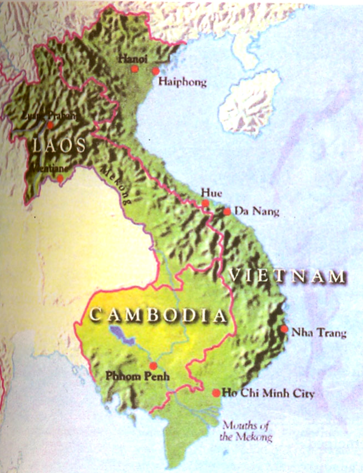
Colonial Domination and Resistance
French troops landed in Vietnam in 1858 and by the mid-1880s they had established a firm grip over the northern region. After the Franco-Chinese war the French assumed control of Tonkin and Annam and, in 1887, French Indo-China was formed. In the following decades the French sought to consolidate their position, and people in Vietnam began reflecting on the nature of the loss that Vietnam was suffering.
Nationalist resistance developed out of this reflection.
The colonisation of Vietnam by the French brought the people of the country into conflict with the colonisers in all areas of life. The most visible form of French control was military and economic domination but the French also built a system that tried to reshape the culture of the Vietnamese. Nationalism in Vietnam emerged through the efforts of different sections of society to fight against the French and all they represented.
Nees of Colony for French
Europe was passing through a period of intense nationalism. Each of the major European powers sought to expand its sphere of influence. This was the only way they could beat their rivals.
The three important reasons that explain why the French thought colonies as necessary:
1. Intense Rivalry Among European Powers: This rivalry found expression not only within Europe, each of the big powers began to spread out and develop colonies in other continents. France was a big European power of the time. It could not be left out when others like Great Britain were going out in a big way.
2. Business Interests: Colonies were seen as opportunities to earn big business profits. Colonies were the source of natural products and other essential goods that were required for the ever-growing industrialization in the mother country. Similarly, colonies also provided captive markets for the goods manufactured in the mother country.
3. Civilising Mission: The colonial masters always viewed their culture as superior to native cultures. Uninvited, they took upon themselves the task of uprooting native cultures and transplanting western culture on the natives.
The French Build the Railway System in Vietnam
- The French undertook the construction of a trans-Indo-China rail network that would link the northern and southern parts of Vietnam and China. This link was completed by 1910. The second line was also built, linking Vietnam to Siam, via the Cambodian capital of Phnom Penh. Militarily, railways helped in faster movement of the army. This in turn helped in exercising effective control over the entire region.
- Economically, railways helped in faster movement of goods. Natural products should be speedily moved from the hinterlands to ports and other similarly, machine-made manufactured goods could be easily transported to hinterlands. Thus, railways contributed to the growth of trade and business and hence, offered opportunities for earning huge profits.
National Emerge in Vietnam
- Nationalism emerged in Vietnam through the efforts of different sections of society to fight against the French and all they represented.
- The colonization of Vietnam had brought the people of the country into conflict with French in all areas of life.
- The most visible form of French control was military and economic domination. Irrigation and railway networks were laid down to promote rice cultivation and plantation crops for exports.
- This enabled the big landowners and foreign trades to earn huge profits. The economic condition of the poor sections of the society deteriorated further.
- The French also built a system that tried to reshape the culture of the Vietnamese. This destroyed local cultures, traditions and religions.
- The people of Vietnam resented all these forms of domination. They were only waiting for a spark to ignite the fire of nationalist revolution.
The Dilemma of Colonial Education
French colonisation was not based only on economic exploitation. It was also driven by the idea of a 'civilising mission'. Like the British in India, the French claimed that they were bringing modern civilization to the Vietnamese. They took for granted that Europe had developed the most advanced civilisation. So it became the duty of the Europeans to introduce these modern ideas to the colony even if this meant destroying local cultures, religions and traditions, because these were seen as outdated and prevented modern development. Education was seen as one way to civilise the 'native'.
But in order to educate them, the French had to resolve a dilemma. This dilemma was about the extent to which the Vietnamese needed to be educated. The French needed an educated local labour force but they feared that education might create problems. Once educated, the Vietnamese may begin to question colonial domination. Moreover, French citizens living in Vietnam (called colons) began fearing that they might lose their jobs to the educated Vietnamese. So they opposed policies that would give the Vietnamese full access to French education.
Talking Modern:
- To consolidate their power the French systematically dismantled the traditional educational system and established French schools for the Vietnamese.
- Some policy-makers emphasized the need to use the French language, they felt by learning the language the Vietnamese would be introduced to the culture and civilization of France and the educated people in Vietnam would respect French sentiments and ideals, see the superiority of French culture, and work for the French. Others suggested that Vietnamese be taught in lower classes and French in the higher classes.
Drawbacks of Education System:
- Only a small fraction of the population could enroll in the schools, and only a few among those admitted ultimately passed the school leaving examination, because of a deliberate policy of failing students so that they could not qualify for the better-paid jobs.
- School textbooks glorified the French and justified colonial rule. The Vietnamese were represented as primitive and backward, capable of manual labor but not of intellectual reflection; they could work in the fields but not rule themselves; they were 'skilled copyists' but not creative. School children were told that only French rule could ensure peace in Vietnam.
Looking Modern
The Tonkin Free School was started in 1907 to provide a Western style education. This education included classes in science, hygiene and French. It was not enough to learn science and Western ideas: to be modern the Vietnamese had to also look modern. The school encouraged the adoption of Western styles such as having a short haircut. For the Vietnamese this meant a major break with their own identity since they traditionally kept long hair.
Resistance in Schools
Teachers and students did not blindly follow the curriculum. Sometimes there was open opposition, at other times there was silent resistance. As the numbers of Vietnamese teachers increased in the lower classes, it became difficult to control what was actually taught. While teaching, Vietnamese teachers quietly modified the text and criticised what was stated. Elsewhere, students fought against the colonial government's efforts to prevent the Vietnamese from qualifying for white-collar jobs. They were inspired by patriotic feelings and the conviction that it was the duty of the educated to fight for the benefit of society. This brought them into conflict with the French as well as the traditional elite, since both saw their positions threatened. By the 1920s, students were forming various political parties, such as the Party of Young Annan, and publishing nationalist journals such as the Annanese Student. Schools thus became an important place for political and cultural battles.
The French sought to strengthen their rule in Vietnam through the control of education. They tried to change the values, norms and perceptions of the people, to make them believe in the superiority of French civilisation and the inferiority of the Vietnamese. Vietnamese intellectuals, on the other hand, feared that Vietnam was losing not just control over its territory but its very identity: its own culture and customs were being devalued and the people were developing a master-slave mentality. The battle against French colonial education became part of the larger battle against colonialism and for independence.
Hygiene, Diesase and Everyday Resistance
Rats were most common in the modern, newly built areas of Hanoi.
- The French colonialists began to create a modern Vietnam. This was done, one, to provide living quarters for the French and other elites, and, two, to demonstrate the capabilities of the French to achieve modernisation and show what modernisation stood for.
- The French part of Hanoi was built as a beautiful and clean city, with wide avenues and a well-laid out sewer system. The other part of Hanoi, known as the native quarter; was left untouched; it was not provided with any modern facilities. The refuse from the native quarter drained straight out into the river. During heavy rains or floods, it overflowed into the streets.
- The large sewers in the French Hanoi were an ideal and protected breeding ground for rats. The rats could freely move around the city within the sewer system. This made it possible for the rats to enter the well-cared for homes of the French through the sewage pipes.
- A bubonic plague swept through the area in 1903.
The Rat Hunt:
- The French Hanoi, i.e., the new city of Hanoi, was faced with a serious problem of fast-multiplying rats. The sewerage system of Hanoi provided both a safe breeding ground and a secure transport system. Hanoi was consistently living under the threat of the outbreak of plague. Plague did outbreak in 1903.
- To check the invasion by rats, the government started the 'rat hunt' in 1902.
- As a part of the rat hunt, the French hired Vietnamese workers and paid them for each rat they caught. The rat hunt began on an enthusiastic note; rats began to be caught in thousands.
- But, soon, the system of bounty payment turned counter-productive. New ways were found to cheat the authorities. It was in the interest of the poor people to breed more rats. It was also in their mutual interest to help each other rather than the government. The campaign was a total failure as far as its stated objective of eliminating rats was concerned.
- But, from the nationalist point of view two positive aspects of the campaign were as follows:
- It demonstrated to the poor their collective strength; even the mighty French government could be brought down to its knees.
- It enlightened a feeling of patriotism and nationalism among different sections of the society. This in turn provided a solid foundation for the freedom movement.
Religious and Anti-Colonialism
The Nationalist Movemnt in Vietnam
- Religion had a contradictory relationship with the mainstream nationalism. On the one hand, religion played an important role in strengthening the control of the colonial rule. On the other hand, religion also provided strong ways of resistance.
- Strengthening the Control of the Colonial Rule: Vietnamese religious beliefs were a mixture of Buddhism, Confucianism and local practices. Many of the rituals were based on superstitions which simply worked to retard the growth of the Vietnamese society.
- Moreover, Confucianism that formed the basis of many religious beliefs in Vietnam taught the people that the relationship between the ruler and the people was the same as that between children and parents.
- The colonial power was quick to seize the opportunity. Christianity began to be pushed as an alternative religion. Christianity had a relatively more modern outlook and appealed to large sections of the population. Similarly, there were many popular religions in Vietnam, that were spread by people who claimed to have seen a vision of God. Some of these supported the French. This in turn helped to strengthen the colonial rule.
- Resistance to the Colonial Rule: It was religion again that provided strong resistance to the colonial rule. The Vietnamese had strong beliefs in Buddhism and Confucianism. Anything different from these was not acceptable to them.
- They began to look down on Christianity as a danger to their religion. Similarly, there were many popular movements that inspired emotions against the colonial rule.
Scholars Revolt:
An early movement against French control and the spread of Christianity was the Scholars Revolt in 1868. The revolt was led by officials at the imperial court who were against the spread of Catholicism and French power. They led a general uprising in NGU and Ha Tinh provinces where over a thousand Catholics were killed. The French crushed the movement but this uprising served to inspire other patriots to rise up against them.
HOA HAO Movements
The movement was launched by Huynh Phu So in 1939 and gained great popularity in the fertile Mekong delta area. Most of his followers were Vietnamese nationalists. His criticism against useless expenditure had a wide appeal. He also opposed the sale of child brides, gambling and the use of alcohol and opium. The movement played a major role in arousing anti-imperialist sentiments. The French tried to suppress the movement inspired by Huynh Phu So. They declared him mad, called him the mad bonze, and put him in a mental asylum. The French authorities exiled him to Laos and sent many of his followers to concentration camps.
The Vision Modernisation
Some intellectuals felt that Vietnamese traditions had to be strengthened to resist the domination of the west, while others felt that Vietnam had to learn from the West even while opposing foreign domination.
PHAN BOI CHAU:
Educated in the Confucian tradition, Phan Boi Chau (1867-1940) was one such nationalist. He became a leading figure in the anti-colonial resistance from the time he formed the Revolutionary Society (Duy Tan Hoi) in 1903, with Prince Cuong De as the head. Phan Boi Chau met the Chinese reformer Liang Qichao (1873-1929) in Yokohama in 1905. Phan's most influential book, The History of the Loss of Vietnam was written under the strong influence and advice of Qichao. The book focuses on two connected themes, the loss of sovereignty and the severing of ties with China—ties that bound the elites of the two countries within a shared culture. It is this double loss that Phan laments, a lament that was typical of reformers from within the traditional elite.
PHAN CHUU TRINH (1871-1926):
He was intensely hostile to the monarchy and opposed to the idea of resisting the French with the help of the court. His desire was to establish a democratic republic. Profoundly influenced by the democratic ideals of the West, he did not want a wholesale rejection of Western civilization. He accepted the French revolutionary ideal of liberty but charged the French for not abiding by the ideal. He demanded that the French set up legal and educational institutions, and develop agriculture and industries.
Other Ways of Becoming Modern: Japan and China:
(i) Go East Movement: In the first decade of the twentieth century a 'go east' movement became popular. In 1907-08 some Vietnamese nationalist students went to Japan to acquire modern education. For most of them the primary objective was to drive out the French from Vietnam, overthrow the puppet emperor and reestablish the Nguyen dynasty that had been deposed by the French. These nationalists looked for foreign arms and help. They appealed to the Japanese as fellow Asians.
(ii) Restoration Society: Most of the nationalists also wanted to establish a strong military in Vietnam on the lines of Japan which had defeated Russia in 1907. Vietnamese students established a branch of the Restoration Society in Tokyo but after 1908, the Japanese Ministry of interior clamped down on them. Many nationalists including Phan Boi Chau were deported and forced to seek exile in China and Thailand.
(iii) Chinese Revolution a source of inspiration: The Vietnamese nationalists were also inspired by the revolutionary movement which occurred in China. In 1911, the long established monarchy in China was overthrown by a popular movement under Sun Yat-Sen and a Republic was set up. Inspired by these developments, Vietnamese students organized the Association for the Restoration of Vietnam (Viet-Nam Quan Phuc Hoi).
The Communist Movement and Vietnamese Nationalism
The Great Depression of the 1930s had a profound impact on Vietnam. The prices of rubber and rice fell, leading to rising rural debts, unemployment and rural uprisings, such as in the provinces of Nghe An and Ha Tinh. These provinces were among the poorest, had an old radical tradition, and have been called the 'electrical fuses' of Vietnam – when the system was under pressure they were the first to blow. The French put these uprisings down with great severity, even using planes to bomb demonstrators.
In February 1930, Ho Chi Minh brought together competing nationalist groups to establish the Vietnamese Communist (Vietnam Cong San Dang) Party, later renamed the Indo-Chinese Communist Party. He was inspired by the militant demonstrations of the European communist parties. In 1940 Japan occupied Vietnam, as part of its imperial drive to control Southeast Asia. So nationalists now had to fight against the Japanese as well as the French. The League for the Independence of Vietnam (Viet Nam Doc Lap Dong Minh), which came to be known as the Vietminh, fought the Japanese occupation and recaptured Hanoi in September 1945. The Democratic Republic of Vietnam was formed and Ho Chi Minh became Chairman.
Finish Line and Beyond Partition of Vietnam
The new republic faced a number of challenges. The French tried to regain control by using the emperor, Bao Dai, as their puppet. Faced with the French offensive, the Vietminh were forced to retreat to the hills. After eight years of fighting, the French were defeated in 1954 at Dien Bien Phu. The Supreme French Commander of the French armies, General Henry Navarre had declared confidently in 1953 that they would soon be victorious. But on 7 May 1954, the Vietminh annihilated and captured more than 16,000 soldiers of the French Expeditionary Corps. The entire commanding staff, including a general, 16 colonels and 1,749 officers, were taken prisoner. In the peace negotiations in Geneva that followed the French defeat, the Vietnamese were persuaded to accept the division of the country. North and south were split: Ho Chi Minh and the communists took power in the north while Bao Dai's regime was put in power in the south.
This division set in motion a series of events that turned Vietnam into a battlefield bringing death and destruction to its people as well as the environment. The Bao Dai regime was soon overthrown by a coup led by Ngo Dinh Diem.
Diem built a repressive and authoritarian government. Anyone who opposed him was called a communist and was jailed and killed. Diem retained Ordinance 10, a French law that permitted Christianity but outlawed Buddhism. His dictatorial rule came to be opposed by a broad opposition united under the banner of the National Liberation Front (NLF). With the help of the Ho Chi Minh government in the north, the NLF fought for the unification of the country.
The Entry of the us into the war
Causes of the US Involvement in the War in Vietnam:
The Vietnamese had to fight a long struggle first against France, then against Japan and lastly against USA. Following were some of the causes for the involvement of US in Vietnam:
- Spread of Communism: US regarded the spread of Communism a great danger to the capitalist countries. US were ready to fight against Communism in any part of the world. So when Communism showed its head in Vietnam, she at once came forward to check it.
- To support France: France faced a humiliating defeat in Vietnam. Being the champion of the capitalist countries, US wanted to crush Vietnam at all costs to save the prestige of the capitalist countries, especially France which was an ally of US in the Second World War.
- Against Unification: USA was against the unification of Vietnam. The Geneva Conference had divided Vietnam into two parts: North Vietnam and South Vietnam. When the Ho Chi Minh government in North Vietnam and National Liberation Front in South Vietnam tried to unify the two parts, in violation of the Geneva Conference, US could not tolerate this. Hence, she decided to intervene in Vietnam. Within no time, she sent a large number of US soldiers with latest war equipment. This war dragged on for many years (1965-1972).
THE BRUTALITIES COMMITTED BY US IN VIETNAM:
This phase of struggle with the US was brutal. Thousands of US troops arrived equipped with heavy weapons and tanks and backed by the most powerful bombers of the time - B52s. The widespread attacks and use of chemical weapons - Napalm, Agent Orange, and phosphorous bombs - destroyed many villages and decimated jungles. Civilians died in large numbers.
Effects of US Involvement on Life within US itself:
America had to suffer a huge loss of men and money though she caused great destruction in North Vietnam through bombardment. America lost about 75,000 soldiers in the war by 1975 A.D. It evoked strong reaction in America. Various countries of the world strongly criticized the American intervention in the internal affairs of Vietnam. As a result, America was compelled to start the withdrawal of her troops in April 1975. Saigon also surrendered after the withdrawal of American troops. In this way, the United Vietnam came into existence on April 30, 1975 A.D.
HO CHI MINH Trail
- The Ho Chi Minh trail was an immense network of footpaths and roads. It was used to transport men and materials from the north to the south.
- The trail had support bases and hospitals along the way. In some parts, supplies were transported in trucks, but mostly they were carried by porters.
- Most of the trail was outside Vietnam, in neighbouring Laos and Cambodia, with branch lines extending into South Vietnam.
- The US regularly bombed this trail trying to disrupt supplies, but efforts to destroy this important supply line by intensive bombing failed because they were rebuilt very quickly.
AN EVALUATION OF THE VIETNAMESE WAR AGAINST THE US FROM THE POINT OF A PORTER ON THE HO CHI MINH TRAIL AND A WOMAN SOLDIER:
A Porter:
It was commonly perceived that the US had imposed an unjustified war on Vietnam. The highly patriotic and emotionally nationalist Vietnamese were determined to defeat the US forces which had come to the support of imperialism.
- Working on Ho Chi Minh trail involved tons of sacrifices on the part of workers. They were engaged in highly strenuous, physically exhausting and dangerous work. For example, porters carried about 25 kilos on their backs, or about 70 kilos on their bicycles.
- As could be expected, a porter on the Ho Chi Minh trail would have nothing to say but to curse the US for the hardship he was undergoing. But he willingly underwent all this in pursuit of his single goal–defeat of the US army.
A Woman Soldier:
As the war with US emerged, Vietnamese women assumed a new role. Women responded to the call of duty. They joined the resistance movement in large numbers. They helped in nursing the wounded, constructing underground rooms and tunnels, and fighting the army.
Photographs in magazines and journals showed women as brave fighters. Apparently, women liked the new role. But this new role was forced upon them by the US war. It involved huge doses of sacrifice, patience and tolerance. If the women were happy in this role, it was only because they were driven by a sense of patriotism and nationalism.
Stories about women showed them eager to join the army. A common description was: 'A rosy-cheeked woman, here I am fighting side by side with you men. Then prison is my school, the sword is my child, the gun is my husband.'
The Nation and It's Heroes
Another way of looking at social movements is to see how they affect different groups in society. Let us see how the roles of women were specified in the anti-imperialist movement in Vietnam, and what that tells us about nationalist ideology.
WOMEN AS REBELS: Women in Vietnam traditionally enjoyed greater equality than in China, particularly among the lower classes, but they had only limited freedom to determine their future and played no role in public life. As the nationalist movement grew, the status of women came to be questioned and a new image of womanhood emerged. Writers and political thinkers began idealising women who rebelled against social norms. In the 1930s, a famous novel by Nhat Linh caused a scandal because it showed a woman leaving a forced marriage and marrying someone of her choice, someone who was involved in nationalist politics. This rebellion against social conventions marked the arrival of the new woman in Vietnamese society.
HEROES OF PAST TIMES: highlight the contribution of women in the Vietnam's history, the nationalist Phan Boi Chau wrote a play based on the lives of the Trung sisters who had fought against Chinese domination in 39-43 CE. In this play, he depicted these sisters as patriots fighting to save the Vietnamese nation from the Chinese. After Phan's play the Trung sisters came to be idealized and glorified. They were depicted in paintings, plays and novels as representing the indomitable will and the intense patriotism of the Vietnamese. It was shown through the play how the sisters gathered a force of over 30,000, resisted the Chinese for two years and when ultimately defeated, they committed suicide, instead of surrendering to the enemy.
WOMEN AS WARRIORS:In the 1960s, photographs in magazines and journals showed women as brave fighters. There were pictures of women militia shooting down planes. They were portrayed as young, brave and dedicated. Stories were written to show how happy they felt when they joined the army and could carry a rifle. Some stories spoke of their incredible bravery in single-handedly killing the enemy – Nguyen Thi Xuan, for instance, was reputed to have shot down a jet with just twenty bullets. Women were represented not only as warriors but also as workers: they were shown with a rifle in one hand and a hammer in the other. Whether young or old, women began to be depicted as selflessly working and fighting to save the country. As casualties in the war increased in the 1960s, women were urged to join the struggle in larger numbers. Many women responded and joined the resistance movement. They helped in nursing the wounded, constructing underground rooms and tunnels and fighting the enemy.
Along the Ho Chi Minh trail young volunteers kept open 2,195 km of strategic roads and guarded 2,500 key points. They built six airstrips, neutralised tens of thousands of bombs, transported tens of thousands of kilograms of cargo, weapons and food and shot down fifteen planes. Between 1965 and 1975, of the 17,000 youth who worked on the trail, 70 to 80 per cent were women. One military historian argues that there were 1.5 million women in the regular army, the militia, the local forces and professional teams.
WOMEN IN TIMES OF PEACE:By the 1970s, as peace talks began to get under way and the end of the war seemed near, women were no longer represented as warriors. Now, she was being represented as a worker. She was shown working in agricultural cooperatives, factories and production units, rather than as fighters.
Important Personalities
NHAT LINH:
- Nhat Linh is the name of a novel that was published in the 1930s.
- It caused a scandal because it showed a woman leaving a forced marriage and marrying someone of her choice, someone who was involved in nationalist politics.
PHAN BOI CHAU:
Phan Boi Chau wrote a play in 1913 based on the lives of the Trung sisters. The Trung sisters had fought against Chinese domination in 39–43 CE. They wanted to save the Vietnamese nation from the Chinese.
TRIEU AU:
- Trieu Au was one of the women rebels who were part of the popular nationalist stories.
- Trieu Au lived in the third century CE. She was orphaned in childhood; she lived with her brother. On growing up, she left home, went into the jungles, organised a large army and resisted the Chinese rule.
- When her army was defeated, she committed suicide.
- Trieu Au became a sacred figure. The nationalists popularised her image to inspire people to action.
NGUYEN THI XUAN:
She joined the Vietnamese army. She single-handedly shot down a jet with just twenty bullets.
The End of the war
- In the first stage, US negotiated a peace treaty with the nationalist Vietnamese. It was clear that the US had failed to achieve its objectives. The Paris Accord provided them a way out of the war.
- In the second stage, the South Vietnamese regime was engaged in fighting with the National Liberation Front (NLF).
- The NLF occupied the presidential palace in Saigon on 30 April 1975. North Vietnam and South Vietnam were unified into a single nation.
Important Dates and Terms
| Year | Event |
|---|---|
| 1802 | Nguyen Anh becomes emperor symbolising the unification of the country under the Nguyen dynasty |
| 1867 | Cochinchina (the South) becomes a French colony |
| 1902 | Rat hunt started |
| 1903 | The modern part of Hanoi was struck by bubonic plague |
| 1910 | Indo-China rail network was completed |
| 1911 | Development in China also inspired Vietnamese nationalists |
| 1920s | French business interests were pressurizing the government in Vietnam to develop infrastructure further |
| 1926 | A major protest erupted in the Saigon Native Girls School |
| 1930 | Ho Chi Minh formed the Vietnamese Communist Party |
| 1945 (September 23) | Vietminh start a general popular insurrection. Bao Dai abdicates. Ho Chi Minh declares independence in Hanoi |
| 1954 | The French army is defeated at Dien Bien Phu |
| 1961 | Kennedy decides to increase US military aid to South Vietnam |
| 1974 | Paris Peace Treaty |
| 1975 (April 30) | NLF troops enter Saigon |
| 1976 | The Socialist Republic of Vietnam is proclaimed |
IMPORTANT TERMS:
- Obscurantist: Person or ideas that mislead.
- Napalm: An organic compound used to thicken gasoline for fire bombs.
- Agent Orange: It is a defoliant, a plant killer because it was stored in drums marked with an orange band.
SUMMARY FLOWCHART
Colonial Domination by the French and the Resistance
- French troops invaded Vietnam in 1858.
- After French-Chinese war, French assumed control of Tonkin and Annam in 1887.
- Anti-French feeling developed amongst students, teachers.
- Scholars revolt started, students organized many organizations.
Development of Modernisation under Nationalist
- Phan Boi Chau wanted to overthrow French first with help of monarchy.
- Vietnamese students started go east movement.
- In 1911, a Republic was set up in China under Sun-Yat-Sen. It inspired the people of Vietnam.
- Phan Chu Trinh wanted to remove monarchy and establish modern democracy.
Communist Movement and Vietnamese Nationalism
- Under Ho Chi Minh, the Vietnamese communist leaders came together. The organisation came to be known as Indo-Chinese Communist Party.
- From 1965-1972 US fought in Vietnam, but finally US was defeated.
Participation of Women in offering Resistance
- Participation of women in nationalist movement gave them a new status.
- Trung sisters came to be idealized and glorified.
- When peace treaties were being signed in 1970's, women started working in agricultural cooperatives and factories etc.
EXERCISE - 1 (MULTIPLE CHOICE QUESTIONS)
- When was the Indo-China Rail network completed?
- (a) 1915
- (b) 1910 ✓
- (c) 1918
- (d) 1920
- Who became the chairman of the Democratic Republic of Vietnam?
- (a) Sun-Yat-Sen
- (b) Phan Boi Chau
- (c) Phan Chu Trinh
- (d) Ho Chi Minh ✓
- Who was Do Sam?
- (a) The colonel of North Vietnamese artillery regiments. ✓
- (b) The leader of Chinese army.
- (c) An American political leader.
- (d) The General of South Vietnamese army.
- When was the Paris Peace treaty signed?
- (a) 1968
- (b) 1972
- (c) 1974 ✓
- (d) 1939
- Most of the Ho Chi Minh trail lied
- (a) In Vietnam
- (b) In Cambodia
- (c) In Laos
- (d) Outside Vietnam ✓
- Agent orange was
- (a) A US secret agent
- (b) A deadly poison ✓
- (c) A French secret agent
- (d) None of the above
- In 1945 Vietnam became a
- (a) Democratic country
- (b) Communist country ✓
- (c) Dictatorial
- (d) Monarchy
- Who was called mad Bonze
- (a) Huynh Phu So ✓
- (b) Hoa Hao
- (c) Phan Boi Chau
- (d) Phan Chu Trinh
- Aim of Hoa Hao movement was
- (a) To overthrow
- (b) To bring social reform ✓
- (c) To industrialize Vietnam
- (d) All the above
- Revolution in China was led by
- (a) Ho Chi Minh
- (b) Sun Yat-sen ✓
- (c) Bao Dai
- (d) Phan Boi Chau
- Which European country colonised Vietnam
- (a) Germany
- (b) England
- (c) France ✓
- (d) Italy
- When was French Indo-China formed?
- (a) 1884
- (b) 1847
- (c) 1904
- (d) 1887 ✓
- Which nationalist journal did the students publish?
- (a) The French Students
- (b) The China students
- (c) The Vietnamese students ✓
- (d) The Yaman students
- When was the Tonkin free school started?
- (a) In 1917
- (b) In 1907 ✓
- (c) In 1887
- (d) In 1897
- Which was the language used by the Vietnamese elite?
- (a) French
- (b) Chinese ✓
- (c) Vietnamese
- (d) Yaman
- Who was allowed to enroll in the French Schools?
- (a) The Chinese elite
- (b) The Vietnamese elite ✓
- (c) The German elite
- (d) The Japanese elite
- When did French troops land in Vietnam?
- (a) In 1858 ✓
- (b) In 1868
- (c) In 1848
- (d) In 1842
- Where was Huynh Phu So exiled to?
- (a) To Cambodia
- (b) To Geneva
- (c) To Paris
- (d) To Laos ✓
- Who came in power in South Vietnam?
- (a) Duy Tan Hoi
- (b) Bao Dai ✓
- (c) Huynh Phu So
- (d) Ho Chi Minh
- When was Vietnamese communist party set up?
- (a) In 1930 ✓
- (b) In 1940
- (c) In 1945
- (d) In 1935
- When did Japan occupy Vietnam?
- (a) In 1931
- (b) In 1929
- (c) In 1940 ✓
- (d) In 1950
- Who was Noam Chomsky?
- (a) Religious Leader
- (b) A Scholar ✓
- (c) A Chinese ruler
- (d) Chinese artist
- When was the peace settlement signed between US and Vietnam?
- (a) January 1969
- (b) January 1971
- (c) January 1973
- (d) January 1974 ✓
- Where was the peace settlement signed?
- (a) In Laos
- (b) In Geneva
- (c) In Paris ✓
- (d) In China
- When did Trieu Au live?
- (a) In the 3rd century ✓
- (b) In the 4th century
- (c) In the 2nd century
- (d) In the 5th century
EXERCISE - 2 (SHORT ANSWER QUESTIONS)
- Did the French introduce education in Vietnam as a civilizing mission?
- Why did some sections of the French in Vietnam oppose policies that give Vietnamese complete access to French education?
- Who led the revolt of 1868 against the French?
- Who was Phan Boi Chau? What were the ideas advocated by him?
- What kind of Vietnam did Phan Chu Trinh want to create after overthrowing the French?
- Who established the Vietnamese Communist Party and when?
- With whose help did the French remained in Vietnam after Second World War?
- Name the incident with which the French rule came to an end in Vietnam.
- Why did the dictatorship of Ngo Dinh Diem become unpopular?
- When and why did the war came to an end?
- What was meant by the Civilizing mission of the colonizers?
- Why did the people of Vietnam protest against the spread of Christianity?
- Describe the ideas behind the Tonkin Free School. To what extent was it a typical example of colonial in Vietnam?
- Describe the significance of Hoa Hao Movement in the Vietnamese struggle for freedom.
- Explain the following: Rats were most common in the modern, newly built areas of Hanoi.
- How did the French rule came to an end in Vietnam?
- Why did the American Senate and the Congress pass a resolution allowing President Lyndon Johnson to take 'all necessary measures' to assist South Vietnam in its defense?
- "The French thought colonization's necessary". Give reasons. Why do some historians consider this war in Vietnam more brutal than the Second World War?
- What was scholars' revolt?
- Describe, giving examples, reactions of the people to French colonialism.
- How was education used as a weapon by the Vietnamese to fight against the colonialism?
- Analyse the debate within Vietnam on "what is modern" among intellectuals in the early 20th century.
- Describe the role played by Ho Chi Minh in the resurgence of Vietnamese nationalism in the inter war years.
- Describe the role played by women in the national movement of Vietnam.
- Under what circumstances Vietnam was divided into north and South Vietnam?