Class 10 History Notes – Work, Life, and Leisure
This History chapter studies the transformation of cities in the modern world, focusing on London and Bombay (Mumbai). It explains how urban life changed due to industrialisation, migration, and modern planning.
London as an Industrial City
During the 19th century, London became the world’s largest city. Industrialisation attracted people from villages to work in factories. However, this rapid growth created problems such as overcrowding, pollution, unemployment, and poor sanitation.
Housing and Living Conditions
Poor families lived in slums and overcrowded houses. Diseases like cholera spread quickly. The government introduced housing reforms and improved public transport to tackle urban problems.
Leisure and Entertainment in London
Despite hardships, Londoners enjoyed new forms of leisure:
-
Music halls and theatres
-
Sporting events like cricket and football
-
Parks, gardens, and clubs for recreation
Development of Bombay (Mumbai)
Bombay developed as a colonial port city. It grew as a center for cotton textile industries and trade. Migrants from different regions settled in the city, making it culturally diverse.
Problems in Bombay
Bombay also suffered from overcrowding and a lack of sanitation. Chawls (multi-storey tenements) became the main housing solution for workers. Cinema and cricket became popular forms of entertainment.
Importance of the Chapter
Class 10 Students should focus on:
-
Growth of London and Bombay
-
Housing conditions and reforms
-
Leisure activities in cities
-
Social and cultural impacts of urbanisation
Quick Revision Notes – Work, Life and Leisure
-
London grew rapidly during the Industrial Revolution.
-
Housing shortages led to slums.
-
Entertainment included theatres, parks, and sports.
-
Bombay developed as a port and industrial hub.
-
Overcrowding and poor sanitation were common problems.
Reflections of Durgacharan's Novel
The novel 'Debganer Martye Aagaman' written by Durgacharan Ray concludes the following aspects of city life by symbolic story of "The Gods Visit Earth".
The Positive Aspects:
- The simple city is changed into modern metro city.
- The city has the features of big markets having big shops with variety of commodities.
- Bullock cart is replaced by variety of means of transport such as water ways on river Ganges, trains buses etc.
- There is a High court and a remarkable museum.
- Flourished trade and commerce, schools and colleges for education and variety of job opportunities. Besides these features Calcutta city changed a lot.
The Negative Aspects:
- Anti social activities like theft and cheating were also growing.
- The extreme gap between poor and rich.
- Big industries spoiled the environment. Problems of sanitation and poor housing were also there.
- Distinction on the basis of caste, creed and gender - the predominant features of Hindu society were in a changed position.
- The city was in transitional state having contradictory experience such as extreme wealth and poverty, opportunities and frustration, glamour and dirt. God Brahma was cheated while buying the glasses. The creator of world, Brahma was astonished by splendid form of city as cited in the novel of Durga Charan Ray.
Charcterstics of the City:
Towns and cities that first appeared along river valleys, such as Ur, Nippur and Mohenjodaro, were larger in scale than other human settlements. Ancient cities could develop only when an increase in food supplies made it possible to support a wide range of non-food producers. Cities were often the centres of political power, administrative network, trade and industry, religious institutions, and intellectual activity, and supported various social groups such as artisans, merchants and priests.
Cities themselves can vary greatly in size and complexity. They can be densely settled modern-day metropolises, which combine political and economic functions for an entire region, and support very large populations. Or they can be smaller urban centres with limited functions.
Industrialisation and the Rise of the Modern City in England:
Industrialization changed the form of urbanisation in the modern period. However, even as late as the 1850s, many decades after the beginning of the industrial revolution, most Western countries were largely rural. The early industrial cities of Britain such as Leeds and Manchester attracted large numbers of migrants to the textile mills set up in the late eighteenth century. In 1851, more than three-quarters of the adults living in Manchester were migrants from rural areas.
Opportunities in London:
London can be an ideal example of development of a city. By 1750, one out of every nine people of England and Wales lived in London. It was a colossal city with a population of about 675,000. Over the nineteenth century, London continued to expand. Its population multiplied fourfold in the 70 years between 1810 and 1880, increasing from 1 million to about 4 million.
The Growth of London: A map showing its population in four different eras (1784, 1862, 1914, 1880) demonstrates the continuous expansion of the city along the River Thames.
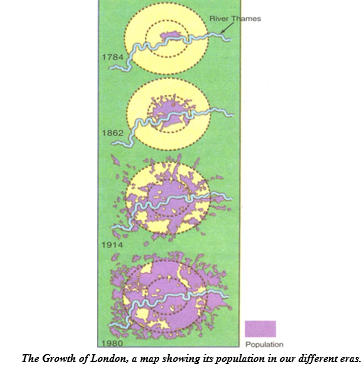
The city of London was a powerful magnet for migrant populations, even though it did not have large factories. 'Nineteenth century London,' says the historian Gareth Stedman Jones, 'was a city of clerks and shopkeepers, of small masters and skilled artisans, of a growing number of semi skilled and sweated outworkers, of soldiers and servants, of casual labourers, street sellers, and beggars.'
Major Industrial Sectors
Apart from the London dockyards, five major types of industries employed large numbers: clothing and footwear, wood and furniture, metals and engineering, printing and stationery, and precision products such as surgical instruments, watches, and objects of precious metal. During the First World War (1914-18) London began manufacturing motor cars and electrical goods, and the number of large factories increased until they accounted for nearly one-third of all jobs in the city.
Marginal Groups:
- As London grew, crime flourished, it is said that 20,000 criminals were living in London in the 1870s. We know a great deal about criminal activities in this period, for crime became an object of widespread concern. The police were worried about law and order and industrialists wanted a hard-working and orderly labour force.
- In the mid-nineteenth century, Henry Mayhew wrote several volumes on the London labour, and compiled long lists of those who made a living from crime.
- Many of whom he listed as 'criminals' were in fact poor people who lived by stealing lead from roofs, food from shops lump of coal, and clothes drying on hedges.
- There were the cheats and tricksters, pickpockets and petty thieves crowding the streets of London. In an attempt to discipline the population, the authorities imposed high penalties for crime and offered work to those who were considered the 'deserving poor'
Employment Among Women:
Factories employed large numbers of women in the late eighteenth and early nineteenth centuries. With technological developments, women gradually lost their industrial jobs, and were forced to work within households. The 1861 census recorded a quarter of a million domestic servants in London, of whom the vast majority were women, many of them recent migrants. A large number of women used their homes to increase family income by taking in lodgers or through such activities as tailoring, washing or matchbox making. However, there was a change once again in the twentieth century. As women got employment in wartime industries and offices, they withdrew from domestic service.
Apart from them large number of children were pushed into low-paid work, often by their parents. It was only after the passage of the Compulsory Elementary Education Act in 1870, and the factory acts beginning from 1902, that children were kept out of industrial work.
Industrilisation and Children:
- Large numbers of children were pushed into low-paid work, often by their parents.
- Andrew Mearns, a clergyman who writes the Bitter Cry of Outcast London in 1880s, showed why crime was more profitable than labouring in small underpaid factories. 'A child seven years old is easily known to make 10 shillings 6 pence a week from thieving. Before he can gain as much as the young thief [a boy] must make 56 gross of matchboxes a week or 1296 a day.
- It was only after the passage of the compulsory elementary education act in 1870, and the factory acts beginning from 1902, that children were kept out of industrial work.
Housing
- When people began pouring in London after the Industrial Revolution Individual landowners put up cheap, and usually unsafe, tenements for the new arrivals.
- Poverty was concentrated and starkly visible in the city. In 1887, Charles Booth a Liverpool Shipowner found that as many as 1 million Londoners were very poor and were expected to live only up to an average age of 29. They were more likely to die in a 'workhouse, hospital or lunatic asylum, London, he concluded 'needed the rebuilding of at least 400,000 rooms to house its poorest citizens.
- A large number of people recognize the need for housing for the poor as the vast masses of one room houses occupied by the poor were seen as a threat to public health, they were overcrowded, badly ventilated, and lacked sanitation, there were worries about fire hazards created by poor housing, there was a widespread fear of social disorder, especially after the Russian Revolution in 1917.
Causes of Need for Housing:
The vast mass of one-room houses, occupied by the poor, were seen as a serious threat to public health: they were overcrowded, badly ventilated, and lacked sanitation. Apart from this there were worries about fire hazards created by poor housing. Additionally there was a widespread fear of social disorder, especially after the Russian Revolution in 1917. Workers' mass housing schemes were planned to prevent the London poor from turning rebellious.
Cleaning London:
A variety of steps were taken to clean up London.
- Attempts were made to decongest localities, green the open spaces, reduce pollution and landscape the city.
- Large blocks of apartments were built, similar to those in Berlin and New York – cities which had similar housing problems.
- Rent control was introduced in Britain during the First World War to ease the impact of a severe housing shortage.
- Many wealthy residents of London were able to afford a holiday home in the countryside.
- Demands were made for new 'lungs' for the city, and some attempts were made to bridge the difference between city and countryside through such ideas as the Green Belt around London.
- Architect and planner Ebenezer Howard developed the principle of the Garden City, a pleasant space full of plants and trees, where people would both live and work.
- Raymond Unwin and Barry Parker designed the garden city of New Earswick.
- There were common garden spaces, beautiful views, and great attention to detail. In the end, only well-off workers could afford these houses.
- Between the two World Wars (1919-39) the responsibility for housing the working classes was accepted by the British state, and a million houses, most of them single family cottages, were built by local authorities.
Transports in the City:
- Due to the expansion of cities and the development of suburbs made new forms of mass transport because necessary.
- The London underground railway partially solved the housing crisis by carrying large masses of people to and from the city.
- The very first section of the underground in the world opened on 10 January 1863 between Paddington and Farrington street London.
- By 1880 the expanded train service was carrying 40 million passengers a year. At first people were afraid to travel underground.
Harmful Effects of Underfround Railways:
- People used to smoke cigarettes and pipes in the compartment
- Coal dust, sulphur dioxide due to the burning coal in engines also caused suffocation and respiratory diseases.
- Foul fumes from the gas lamps in the compartment also caused problem to travellers.
- For laying Railway tracks houses were knocked down, pits and trenches were dug which also caused problems.
- Yet the Underground eventually became a huge success. By the twentieth century, most large metropolises such as New York, Tokyo and Chicago could not do without their well-functioning transit system.
- As a result, the population in the city became more dispersed. Better planned suburbs and a good railway network enabled large numbers of live outside central London and travel to work.
Social Changes in the City
In the eighteenth century, the family had been a unit of production and consumption as well as of political decision-making. The function and the shape of the family were completely transformed by life in the industrial city.
Ties between members of households loosened, and among the working class the institution of marriage tended to break down. Women of the upper and middle classes in Britain, on the other hand, faced increasingly higher levels of isolation, although their lives were made easier by domestic maids who cooked, cleaned and cared for young children on low wages.
Women who worked for wages had some control over their lives, particularly among the lower social classes. However, many social reformers felt that the family as an institution had broken down, and needed to be saved or reconstructed by pushing these women back into the home.
Men, Women and Family in the City:
- The city encouraged a new spirit of individualism. Men and women did not have equal access to this new urban space. Women were forced to withdraw into their homes. The public space became increasingly a male preserve. Most political movements of the nineteenth century, such as Chartism (a movement demanding the vote for all adult males) and the 10-hour movement (limiting hours of work in factories) mobilized large numbers of men.
- By the twentieth century, the urban family had been transformed yet again, by women, who were employed in large numbers to meet war demands. The family now consisted of much smaller units.
- The family became the heart of a new market - of goods and services, and of ideas.
Leisure and Consumption
For wealthy Britishers, there had long been an annual 'London Season'. Several cultural events, such as the opera, the theatre and classical music performances were organised for an elite group of 300-400 families in the late eighteenth century. Meanwhile, working classes met in pubs to have a drink, exchange news and sometimes also to organise for political action. Many new types of large-scale entertainment for the common people came into being, some made possible with money from the state. Libraries, art galleries and museums were established in the nineteenth century to provide people with a sense of history and pride in the achievements of the British. At first, visitors to the British Museum in London numbered just about 15,000 every year, but when entry was made free in 1810, visitors swamped the museum: their number jumped to 127,643 in 1824-25, shooting up to 825,901 by 1846. Music halls were popular among the lower classes, and, by the early twentieth century, cinema became the great mass entertainment for mixed audiences.
Pleasure gardens came in the nineteenth century to provide facilities for sports, entertainment and refreshments for the well-to-do.
- Libraries, art galleries and museums were established in the nineteenth century to provide people with a sense of history and pride in the achievements of the British.
- Music halls were popular among lower classes. By the early twentieth century cinema became the great mass entertainment for mixed audience.
- British industrial workers were increasingly encouraged to spend their holiday by the sea, so as to derive the benefits of the sun and bracing winds.
The working poor created spaces of entertainment wherever they lived.
Politics in the City
In the severe winter of 1886, when outdoor work came to a standstill, the London poor exploded in a riot, demanding relief from the terrible conditions of poverty. Alarmed shopkeepers closed down their establishments, fearing the 10,000-strong crowd that was marching from Deptford to London. The marchers had to be dispersed by the police. A similar riot occurred in late 1887; this time, it was brutally suppressed by the police in what came to be known as the Bloody Sunday of November 1887. Two years later, thousands of London's dockworkers went on strike and marched through the city.
These are good example of how large masses of people could be drawn into political causes in the city. A large city population was thus both a threat and an opportunity. State authorities went to great lengths to reduce the possibility of rebellion and enhance urban aesthetics. Better town planning was carried out with lots of greenery and open spaces to induce a sense of calm. This was believed to help produce more responsible citizens.
The City in Colonial India
Indian cities did not mushroom in the nineteenth century. The pace of urbanisation in India was slow under colonial rule. A large proportion of these urban dwellers were residents of the three Presidency cities. These were multi-functional cities: they had major ports, warehouses, homes and offices, army camps, as well as educational institutions, museums and libraries. Bombay was the premier city of India.
Bombay:
In the seventeenth century, Bombay was a group of seven islands under Portuguese control. In 1661, control of the islands passed into British hands after the marriage of Britain's King Charles II to the Portuguese princess. The East India Company quickly shifted its base from Surat, its principal western port, to Bombay. At first, Bombay was the major outlet for cotton textiles from Gujarat. Later, in the nineteenth century, the city functioned as a port through which large quantities of raw materials such as cotton and opium would pass. Gradually, it also became an important administrative centre in western India, and then, by the end of the nineteenth century, a major industrial centre.
Work in the City:
Bombay became the capital of the Bombay Presidency in 1819, after the Maratha defeat in the Anglo-Maratha war. The city quickly expanded. With the growth of trade in cotton and opium, large communities of traders and bankers as well as artisans and shopkeepers came to settle in Bombay. The establishment of textile mills led to a fresh surge in migration.
The first cotton textile mill in Bombay was established in 1854. By 1921, there were 85 cotton mills with about 146,000 workers. Only about one-fourth of Bombay's inhabitants between 1881 and 1931 were born in Bombay: the rest came from outside. Large numbers flowed in from the nearby district of Ratnagiri to work in the Bombay mills. Women formed as much as 23 per cent of the mill workforce in the period between 1919 and 1926. After that, their numbers dropped steadily to less than 10 per cent of the total workforce. By the late 1930s, women's jobs were increasingly taken over by machines or by men.
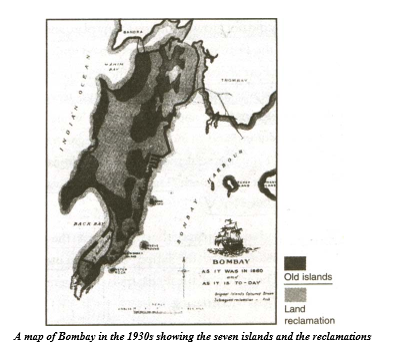
Bombay dominated the maritime trade of India till well into the twentieth century. It was also at the junction head of two major railways. The railways encouraged an even higher scale of migration into the city. For instance, famine in the dry regions of Kutch drove large numbers of people into Bombay in 1888-89. The flood of migrants in some years created panic and alarm in official circles.
Worried by the influx of population during the plague epidemic of 1898, district authorities sent about 30,000 people back to their places of origin by 1901.
Note: A map of Bombay in the 1930s showing the seven islands and the reclamations demonstrates how land reclamation expanded the city over time.
Housing and Neighborhoods:
- Bombay was a crowded city. From its earliest days, Bombay did not grow according to any plan, and houses especially in the Fort area, were interspersed with gardens.
- With the rapid and unplanned expansion of the city, the crisis of housing and water supply became acute by the mid-1850s.
- The richer Parsi, Muslim and upper-caste traders and industrialists of Bombay lived in sprawling, spacious bungalows. More than 70 percent of the working people lived in the thickly chawls of Bombay
- Chawls were multistoried structures largely owned by private landlords, looking for quick ways of earning money from anxious migrants. Each chawl was divided into smaller one-room tenements which had no private toilets.
- Many families could reside at a time in a tenement. High rents forced workers to share homes, either with relatives or caste fellows who were streaming into the city. Though water was scarce, and people often quarreled every morning for a turn at the tap, observers found that houses were kept quite clean.
- The homes being small, streets and neighborhoods were used for a variety of activities such as cooking, washing and sleeping. Streets were also used for different types of leisure activities.
- Caste and family groups in the mill neighbourhoods were headed by someone who was similar to a village headman. He settled disputes, organised food supplies, or arranged informal credit. He also brought important information on political developments.
- People who belonged to the 'depressed classes' were kept out of many chawls and often had to live in shelters made of corrugated sheets, leaves, or bamboos poles.
- Planning in Bombay came about as a result of fears about the plague epidemic. The City of Bombay Improvement Trust was established in 1898; it focused on clearing poorer homes out of the city centre. In 1918, a Rent Act was passed to keep rents reasonable.
LAND RECLAMATION IN BOMBAY:
The seven islands of Bombay were joined into one landmass only over a period of time. The earliest project began in 1784. The Bombay governor William Hornby approved the building of the great sea wall which prevented the flooding of the low-lying areas of Bombay. Since then, there have been several reclamation projects.
The need for additional commercial space in the mid-nineteenth century led to the formulation of several plans, both by government and private companies, for the reclamation of more land from the sea. Private companies became more interested in taking financial risks. In 1864, the Back Bay Reclamation Company won the right to reclaim the western foreshore from the tip of Malabar Hill to the end of Colaba. Reclamation often meant the levelling of the hills around Bombay. By the 1870s, although most of the private companies closed down due to the mounting cost, the city had expanded to about 22 square miles.
As the population continued to increase rapidly in the early twentieth century, every bit of the available area was built over and new areas were reclaimed from the sea. A successful reclamation project was undertaken by the Bombay Port Trust, which built a dry dock between 1914 and 1918 and used the excavated earth to create the 22-acre Ballard Estate. Subsequently, the famous Marine Drive of Bombay was developed.
A familiar landmark of Bombay, it was built on land reclaimed from the sea in the twentieth century.
Bombay as the City of Dreams: The World of Cinema and Culture
- Despite its massive overcrowding and difficult living conditions, Bombay appears to many as a 'mayapuri' a city of dreams.
- Many Bombay films deals with the arrival in the city of new migrants, and their encounters with the real pressures of daily life.
- Some popular songs from the Bombay film industry speak of the contradictory aspects of the city.
- In the film CID (1956) the hero's buddy sings, 'Ai dil hai mushkil jeena yahan, zara hatke zara bachke, ye hai Bambai meri jaan' (my heart, it is difficult to live here, move over a little, take care of yourself! this is Bombay my love.
- Harishchandra Sakharam Bhatwadekar shot a scene of a wrestling match in Bombay's Hanging Gardens and it became India's first movie in 1896.
- Soon after, Dadasaheb Phalke made Raja Harishchandra (1913). After that, there was no turning back. By 1925, Bombay had become India's film capital, producing films for a national audience.
- Most of the people in the film industry were themselves migrants who came from cities like Lahore, Calcutta, Madras and contributed to the national character of the industry. Those who came from Lahore, then in Punjab, were especially important for the development of the Hindi film industry.
- Many famous writers, like Ismat Chughtai and Saadat Hasan Manto, were associated with Hindi cinema.
- Bombay films have contributed in a big way to produce an image of the city as a blend of dream and reality, or slums and star bungalows.
CITIES AND THE CHALLENGE OF THE ENVIRONMENT
City development everywhere occurred at the expense of ecology and the environment. Natural features were flattened out or transformed in response to the growing demand for space for factories, housing and other institutions. Large quantities of refuse and waste products polluted air and water, while excessive noise became a feature of urban life.
AIR POLLUTION:
The widespread use of coal in homes and industries in nineteenth century England raised serious problems. In industrial cities such as Leeds, Bradford and Manchester, hundreds of factory chimneys spewed black smoke into the skies. People joked that most inhabitants of these cities grew up believing that the skies were grey and all vegetation was black! Shopkeepers, homeowners and others complained about the black fog that descended on their towns, causing bad tempers, smoke-related illnesses, and dirty clothes.
When people first joined campaigns for cleaner air, the goal was to control the nuisance through legislation. This was not at all easy, since factory owners and steam engine owners did not want to spend on technologies that would improve their machines.
By the 1840s, a few towns such as Derby, Leeds and Manchester had laws to control smoke in the city. But smoke was not easy to monitor or measure, and owners got away with small adjustments to their machinery that did nothing to stop the smoke. Moreover, the Smoke Abatement Acts of 1847 and 1853, as they were called, did not always work to clear the air.
Calcutta too had a long history of air pollution. Its inhabitants inhaled grey smoke, particularly in the winter. Since the city was built on marshy land, the resulting fog combined with smoke to generate thick black smog. High levels of pollution were a consequence of the huge population that depended on dung and wood as fuel in their daily life. But the main polluters were the industries and establishments that used steam engines run on coal.
Colonial authorities were at first intent on clearing the place of miasmas, or harmful vapours, but the railway line introduced in 1855 brought a dangerous new pollutant into the picture – coal from Raniganj. The high content of ash in Indian coal was a problem. Many pleas were made to banish the dirty mills from the city, with no effect. However, in 1863, Calcutta became the first Indian city to get smoke nuisance legislation.
SUMMARY
Individualism: A theory which promotes the liberty, rights or independent action of the individual, rather than of the community.
Philanthropist: Someone who works for social upliftment and charity, donating time and money for the purpose.
Tenement: A run-down and often overcrowded apartment house, especially in a poor section of large city.
London Season: An annual show where several cultural events were organized for an elite groups.
London Underground: Railway opened on January 10, 1863 between Paddington and Farrington street in London.
Russian Revolution: Took place in Russia. The czar was overthrown, the communist party took over control and established the Union of Soviet Socialist Republics.
Temperance movement: A largely middle class-led social reform movement which emerged in Britain and America in the 19th century. It identified alcoholism as the cause of the ruin of families and social and aimed at reducing the consumption of alcoholic drinks, particular among the working classes.
CONCEPTUAL OVERVIEW
Development of Bombay as the city of Dreams
- Bombay appears to many as a mayapuri – a city of dreams.
- Films depicted the life of the migrant workers and their miserable conditions.
- Most of the film makers were themselves migrants.
- Bombay films produced an image of city as the blend of dream and reality of slums and star Bungalows.
Development of Bombay
- It expanded rapidly from late 19th century.
- Bombay was the major outlet for cotton textile.
- It then became an important administrative centre.
- Development of Railways also attracted migrants.
- Land reclamation led to the growth of the city.
Development of London city
- It started with the spread of industrial revolution.
- London became a powerful magnet for migrant population.
- Attempt was then made to clean London.
- Underground Railways was developed.
- New types of Leisure activity developed.
Social change in cities
- It changed the family life.
- Nuclear family started displacing joint family.
- New spirit of Individualism started.
- Family tie became weak.
- Role of women got confined within household.
Effects of industrialization
- Changed the form of urbanization.
- It created the problems of Housing law and order and unemployment.
- It brought changes in social life and family life.
- It changed the family values and norms.
SOLVED QUESTIONS
Ans. Chartism was the name given to a political movement in the nineteenth century. It demanded right to vote for all adult males in England.
Ans. It was a political movement in the 19th century in England. It demanded fixation of hours of work in factories.
Ans. Taverns were places of rest and relaxation for the travellers. These were set up in the pre-railway age
Ans. Bombay films have contributed in a big way to produce an image of a city as a blend of dream and reality, of slums and star bungalows.
Ans. Harishchandra Sakharam Bhatwadekar shot a scene of a wrestling match in Bombay's Hanging Gardens. It became India's first movie in 1896.
In 1913, Dadasaheb Phalke made Raja Harishchandra. Since then, the film industry in Bombay has gone from strength to strength.
Ans.
- With technological development in industries, the requirements of labour were undergoing a change. Women labourers were not found suitable for operating machines. Instead, male labour came to be employed. Thus women were thrown out of the factories.
- Many of these factory-workers became unemployed and stayed back in their homes. They become, what can be called, a housewife.
- Large number of women became domestic servants.
- Some women began to work from their homes. They began to accept guests against payment. Other household activities included tailoring, washing or matchbox making.
It was only with the beginning of the First World War in 1914 that many new job opportunities were thrown open. Women came out in large number and joined the workforce.
Ans.
- With growing urbanization and fast expanding population poverty exploded in cities like London. With no jobs and even no hopes of getting one, many persons were resorting to criminal activities.
- Henry Mayhew wrote several volumes on the London labour, and compiled long lists of those who made a living from crime.
- Crime became an object of widespread concern. Social workers, intellectuals, industrialist and other sections of the society raised their voice against this growing unsocial tendency. As a result, a number of steps were taken to check it:
- The population of criminals was counted. Their activities were watched.
- Ways of life of criminals were investigated. High penalties for crime were imposed.
- Paid jobs were offered to those who were considered the deserving poor.
Ans.
- With the coming up of the factories and workshops with the Industrial Revolution, a whole mass of people migrated to London from the country. There were no means to accommodate them. Slums spread fast. Well-off Londoners saw in this a threat to their own quality of living. These people increasingly began to support the need to build housing for the poor.
- The vast mass of one-room tenements were overcrowded, badly ventilated and lacked sanitation. These were seen as a serious threat to public health.
- There were worries over fire hazards created by poor housing.
- The Russian Revolution had taken place in 1917. The communist party had assumed control in that country. There was a widespread fear of a social disorder breaking out in London. The poor had to be appeased.
- Between the two World Wars, the responsibility for housing the working class was accepted by the British state, and a million houses, most of them single family cottages, were built by the local authorities.
Ans.
- The principle of Garden City advocated the growth of a pleasant space full of plants and trees, where people would both live and work. The principle was put forward by an architect and planner by the name of Ebenezer Howard.
- Following these ideas, Raymond Unwin and Barry Parker designed the Garden City of New Earswick. There were common garden spaces, beautiful views, and great attention to detail.
- The Garden City of New Earswick emerged to be a posh residential locality of London. Although only well-off workers could afford these houses.
Ans. With industrialisation and growing urbanisation, new forms of entertainment as follows, came up in England:
- Annual 'London Season'. This was an annual cultural show. In this show several cultural events, such as the opera, the theatre and classical performances were organised. However, this show was limited to the wealthy Britishers. An elite group of 300-400 families used to attend and enjoy it.
- Establishment of Libraries, Cinema, Art Galleries and Museums. Many of these were set up with financial assistance from the government. These were established to provide people with a sense of victory and pride in the achievements of the British.
- British industrial workers were increasingly encouraged to spend their holidays by the sea. This enabled them to get the benefits of the sun and bracing winds.
Ans.
- It is true that industrialization gets immediately followed by urbanization. This is borne out by the experience of all the countries, whether in Europe or in India. In Europe, fast industrialization during the 19th century saw the mushrooming growth of urban population.
- As urban population increased, cities and towns began to expand. All the European countries took steps to ensure a planned urban growth. Large scale migration started from rural to urban areas.
- In India, some serious modern industrialization began only in the 20th century. Hence, it is only in the 20th century that the urban population in India began to grow. Here also migration started from rural to urban area.
Ans.
- A large number of poor people lived in London. In 1886, poor had no jobs. In the wake of severe winter, all outdoor work had stopped.
- A crowd of 10,000 marched from Deptford to London. They were demanding relief from the terrible conditions of poverty. Police used force to disperse the crowd.
- Again in 1887, the same type of riots got repeated. This time the riots were brutally suppressed. Many persons died and many more were injured in the police action. This came to be known as the 'Bloody Sunday' of November 1887.
Ans. A plague epidemic broke out in Bombay in 1898. Alarmed by this, the authorities began to think about the need for a planned development of the city. The following steps were taken to remove overcrowding and provide better housing in Bombay:
- The City of Bombay Improvement Trust was established in 1898. It focused on clearing poorer homes out of the city centre. It also arranged for resettlement of displaced persons. By 1918, Trust schemes had deprived 64,000 people of their homes. But only 14,000 were resettled in new colonies.
- In 1918, a Rent Act was passed to keep rents reasonable. But it had the opposite effect. Landlords withdrew houses from the market. A severe housing crisis followed.
- Land reclamation projects started for settlements, cultivation or other uses.
Ans.
- The London city had expanded beyond the range where people could walk to work. They began to live in suburbs. Development of suburbs made new forms of mass transport absolutely necessary.
- Migration from the countryside and flow of people who needed to travel long distances was becoming a permanent feature.
- The poor were feeling left out of the development process. Something urgently required to address their needs.
As a result of the opening of the underground railway, housing problem in the main city got somewhat eased. People moved to the suburbs.
The underground railway was criticised by many people on different grounds:
- Underground railway was considered a menace to health.
- Many felt that the iron 'monsters' added to the mess and unhealthiness the city.
- Many others pointed towards the massive destruction that was caused during the process of construction of the underground.
Ans. The function and shape of the family were completely transformed by life in the industrial city.
- The city encouraged a new spirit of individualism among both men and women.
- People developed a sense of freedom from the collective values.
- Ties between members of households loosened.
- Among the working class, the institution of marriage tended to break down.
- Women of the upper and middle classes faced increasingly higher levels of isolation. In short, family as an institution had broken down.
Ans. During the initial phase of industrialization following changes occurred:
- In this changing social environment, women had to undergo hardships and misery. Women of upper and middle classes faced increasingly higher levels of isolation, although their lives were made easier by domestic maids.
- Women from the lower social classes worked in low-wage paying jobs, such as that of housemaids. They cooked, cleaned and cared for young children on low wages.
- The public space became increasingly a male preserve. Domestic sphere was seen as the proper place for women.
- Conservative people railed against those women who moved out of their homes for work. Most political movements demanded voting rights for all adult males only; women were totally ignored.
With the beginning of the late 19th century, and specially after the First World War, urban family once again began to change. With that, the position of women also changed:
- Going by the experience of the valuable wartime work done by the women, a more liberal attitude came to be adopted towards them.
- Political movements included the demand for voting rights to women.
- The demand for women's right to property also came to be raised.
Ans. Bombay expanded rapidly from late 19th century onwards. Its population increased from about 6.45 lakhs in 1872 to about 15 lakhs in 1947.
A number of factors, as given below, account for this tendency:
- The East India Company shifted its base from Surat to Bombay as a trading centre.
- Bombay began to function as a port through which large quantities of raw materials, such as cotton and opium, would pass. This attracted migrants.
- It also became an administrative centre in western India.
- By the end of the nineteenth century, Bombay became a major industrial centre. This also attracted migrant population.
- Bombay was at the junction head of two major railways. The railways encouraged an even higher scale of migration into the city.
Ans. The chawls were multi-storyed structures. Each chawl was divided into smaller one-room tenements. They shared a common toilet.
These were largely owned by private landlords, such as merchants, bankers and building contractors.
The main features of living in chawls can be stated as follows:
- Many families could reside at a time in a tenement.
- High rents forced workers to share homes, either with relatives or caste fellows who were streaming into the City.
- Chawls had filthy gutters, privies and buffalo stables in close proximity. Therefore, inhabitants had to keep the windows of their rooms closed even in humid weather.
- Streets and neighborhoods were used for a variety of activities such as cooking, washing and sleeping.
- Liquor shops and wrestling grounds (akharas) came up in vacant spaces.
Ans.
- Bombay turned out to be a dreamland alike for factory workers and artists and everyone else. In fact, most of the people in the film industry themselves were migrants. The migrants had different life experiences. Each of them experienced the pressure of encounter with the real life.
- Life of misery and poverty became common. These life experiences served different purposes as far as the film industry was concerned.
- They provided fodder for preparing true to life scripts which could be shot in a camera. The tales would get invariably related to true life experiences of people all around. This provided a ready audience, both local and national, that would lap these films. Thus, lives of migrants became a favourite subject with the film-makers.
Ans. Till the beginning of the 18th century, London was a small human settlement along the River Thames. The city began to expand from the middle of the 18th century. Two important reasons for this development were as follows:
- As the textile mills and other factories began to be set up around this period, in and around London, these offered large job opportunities. Large number of people began to migrate from the countryside to the city in search of jobs.
- Because of industrialization, trade and other associated activities also expanded. These again offered better employment opportunities and living standards. So people started migrating to these towns.
Ans. During the early 19th century till the early 20th century, the profile of women underwent a change. The kind of work available to women in this period was different from the kind of work available earlier.
- With technological development in industries, the requirements of labour were undergoing a change. Women labourers were not found suitable for operating machines. Instead, male labour came to be employed. Thus, women were thrown out of the factories.
- Many of these factory-workers became unemployed and stayed back in their homes. They became, what can be called, a housewife.
- Large number of women became domestic servants.
- Some women began to work from their homes. They began to accept guests against payment. Other household activities included tailoring, washing or matchbox making.
It was only with the beginning of the First World War in 1914 that many new job opportunities were thrown open. Women came out in large numbers and joined the workforce.
(a) A private landlord
(b) A Police Superintendent in charge of law and order
(c) A leader of political party.
Ans.
- Expanding large urban population inevitably means a rising demand for human settlements. Supply of houses cannot keep pace with rising demand. Landlords are in the best position to make use of this situation.
- They can charge exorbitant rents for the accommodation they offer for lease.
- Anything and whatever, even a simple mud hut that passes as a night shelter, would find takers.
Examples: Tenements in London and chawls in Bombay, besides the growing and ever sprawling slums in different cities throughout the world.
- Things are different for a police superintendent in charge of law and order. Growing urban population also carries with it increasing loads of criminals, i.e., those persons who earn their living by indulging in crime. He has to fight it by all means.
- Political parties find a good playground. Large population becomes a large football ground. Each political party seeks to take the cake by using people power. Growing, fast-expanding population throws up many social, political and economic issues to the fore.
Ans. Haussmanisation gets its name from Baron Haussman, who was the chief architect of the new Paris during the second half of the 19th century. Haussmanisation stands for:
- Forcible eviction of the poor from the city, and
- Forcible reconstruction of the city.
This was done for Beautification of the city of Paris.
Eviction of the poor to reduce the possibility of political rebellion. Haussmanisation had both its admirers and critics.
Those who supported it argued along the following lines:
- Straight broad avenues or boulevards come to be established. Likewise, open spaces within the city are designed. Full-grown trees are transplanted. The new city becomes a matter of civic pride. It becomes the pride of all people, not only within the country but all around in the continent.
- Life in the new city becomes more comfortable. It becomes more secure with regular patrolling by police, both during day and night. Transportation becomes convenient and cheaper. Public utilities are planned and provided to all.
- The new city becomes the hub of many architectural, social and intellectual developments.
- The city, in particular, and the country, in general, comes to be associated with higher levels of development and achievements. Its status in the hierarchy of a nation goes up.
But it is not to say that it is all pinks and roses with Haussmanisation. There is a negative side also.
- Haussmanisation relies upon force and violent eviction of the poor. They undergo immense misery and agony.
- The ancient culture and civilisation of the city gets uprooted.
- An upper-class culture comes to be established.
- Haussmanisation 'kills the street' and its life. In its place is transplanted an empty, boring city, full of similar-looking boulevards and facades.
EXERCISE – 1 (MULTIPLE CHOICE QUESTIONS)
(a) Berlin (b) New York (c) Bombay (d) London
(a) M. Vengsakar (b) Mahdev Panade (c) G.G. Agarkar (d) Lokmanya tilak
(a) Bombay (b) Calcutta (c) Madras (d) Pune
(a) Seven Islands (b) Six Islands (c) Four Islands (d) Three Islands
(a) Bombay (b) Madras (c) Kanpur (d) Ahmedabad
(a) Charles booth (b) Ebenezer Howard (c) Andrew mearns (d) Barry packer
(a) Industrialization (b) underground railways (c) Crime in London (d) Sanitation
(a) Universal adult franchise (b) Limiting the hour of work (c) Allowing women to work in factories (d) Voting right to all adult male
(a) British (b) Portuguese (c) Dutch (d) French
(a) Bombay (b) London (c) Calcutta (d) Paris
(a) Durga Charan (b) Brahma (c) Varun (d) None of these
(a) Industrial capitalism (b) Establishment of colonial rule (c) Democratic ideals (d) Dictatorship
(a) Development of a city or town (b) People migrating from rural to urban (c) Expansion of city (d) All these
(a) Two fold (b) Three fold (c) Fourfold (d) Seven fold
(a) Footwear (b) Wood and furniture (c) Printing and stationary (d) Textile
(a) 1856 (b) 1810 (c) 1870 (d) 1880
(a) Ebenezer Howard (b) Raymond Unwin (c) Barry Parker (d) None of these
(a) 1857 (b) 1853 (c) 1863 (d) 1870
(a) 1805 (b) 1810 (c) 1816 (d) 1819
(a) Factory system (b) Market system (c) Office system (d) Housing system
EXERCISE – 2 (SHORT AND LONG ANSWER TYPE QUESTIONS)
- Why was it difficult for the depressed classes to find housing in Bombay?
- Why was the City of Bombay Improvement Trust established?
- Why has the expansion of the city of Bombay always been a problem?
- What is meant by 'Reclamation'?
- Which Bombay governor was the first to approve of the building of the 'Great Sea Wall' to prevent flooding?
- Name the Reclamation projects undertaken between 1914 and 1918 to create the famous landmarks of Bombay.
- List the popular songs from Bollywood which tell us about contradictory aspects of the city of Bombay.
- Who are the people referred to as 'depressed classes'?
- When did the Bombay film industry make an appearance?
- When and by whom was 'Raja Harishchandra' made?
- What steps did the British take to fulfill the responsibility for housing lower classes?
- Why were people initially afraid to travel in the underground railway network?
- Why is London's underground considered a huge success?
- Explain giving examples, to show that large masses of people were drawn into political causes in the city of London.
- What was the importance of Bombay to the British in the colonial times?
- Why did more and more people migrate to Bombay by the early 20th century?
- Describe the 'Chawl culture' of Bombay.
- Why is Bombay referred to as mayapuri or mayanagri?
- Why did use of coal in homes and industries create a serious problem in England in the 19th century? What measures were taken in order to resolve the problem?
- Why were a number of films made on migrants?
- Write in brief the message of 'Debganer Martye Agaman' Novel written by Durgacharan
- Discuss the positive and negative aspects of city narrated by Durgacharan through Brahma.
- What was the work pattern in London before industrialization?
- Write in brief about the growth of London city.
- What were the consequences and problems resulted from industrialization in London.
- Compare the growth of London and Bombay cities.
- Write main features of Bombay city.
- Write an essay on industrialization and environment pollution.
- Write some illustration with historical examples about:
- (i) Leisure time activities of Chawls in Bombay.
- (ii) Growth of individualism versus collectivism
- (iii) Leisure patterns of nineteenth century in England.
- (iv) Bombay the Film City