About Class 10 Science (Biology) Notes on Chapter 06 – Management of Natural Resources
Management of Natural Resources is an important Class 10 Science chapter that emphasizes the sustainable use of resources. It explains how forests, wildlife, water, coal, and petroleum must be conserved to meet present needs without harming future generations. Forests provide habitat, oxygen, and raw materials, while wildlife maintains ecological balance. Water resources are vital for agriculture and human survival, so their conservation through dams, rainwater harvesting, and watershed management is essential.
Coal and petroleum are non-renewable sources of energy, and their overuse leads to pollution and scarcity. The chapter stresses the importance of sustainable development, where resources are used wisely without damaging the environment. Students also learn about case studies like the Chipko Movement and issues of resource distribution.
This chapter is significant for exams as it connects Science with social responsibility. Questions may include short notes on fossil fuels, dams, and conservation methods. By using the NCERT textbook and NCERT solutions for Class 10 Science, students can revise key points and prepare effectively. Understanding this chapter not only helps in exams but also builds awareness about environmental conservation and responsible living practices.
Natural Resources
Natural resources are resources in the environment that have not been disturbed by mankind. By resource, one refers to any physical entity which has limited availability. These resources occur in their natural form. Few examples are as follows:
- Air, wind, and atmosphere
- Plants (Flora)
- Animals (Fauna)
- Agronomy (the science of using plants for food, fuel, feed, and fiber)
- Wildlife
- Forestry and Agroforestry
- Coal and fossil fuels
- Range and pasture
- Soils
- Water, oceans, lakes, and rivers
Important Note: A substance becomes a resource when its demand is increased by the society. For example, uranium was found in abundance in nature because its use was not known. It has become a valuable resource now because of its use in nuclear energy.
Types Of Natural Resources
Natural resources on the basis of their availability and abundance are classified as inexhaustible (air, water) and exhaustible (minerals, fossil fuels) resources.
Exhaustible resources can be of two types:
- Renewable resources: These resources can maintain themselves if managed wisely. These include forest, crops, ground water, wildlife, etc.
- Non-renewable resource: These get exhausted with use because they are not recycled or replenished. These include minerals, fossil fuels, etc.
Management Of Natural Resources
Natural resource management refers to the management of natural resources such as land, water, soil, plants and animals, with a particular focus on how management affects the quality of life for both present and future generations (stewardship).
Natural resource management deals with managing the way in which people and natural landscapes interact. It brings together land use planning, water management, biodiversity conservation, and the future sustainability of industries like agriculture, mining, tourism, fisheries and forestry. It recognises that people and their livelihoods rely on the health and productivity of our landscapes, and their actions as stewards of the land play a critical role in maintaining this health and productivity.
Natural resource management is also congruent with the concept of sustainable development, a scientific principle that forms a basis for sustainable global land management and environmental governance to conserve and preserve natural resources.
Natural resource management specifically focuses on a scientific and technical understanding of resources and ecology and the life-supporting capacity of those resources. Environmental management is also similar to natural resource management. In academic contexts, the sociology of natural resources is closely related to, but distinct from, natural resource management.
Conservation And Judicious Use Of Natural Resources
Progress in science and technology has developed such tools and technology with which man has started extracting natural resources at a much larger scale. This has led to their depletion because nature has only a limited amount of them in reserve. The only solution to save the life of mankind is the conservation of natural resources.
Conservation
Conservation is an ethic of resource use, allocation, and protection. Its primary focus is upon maintaining the health of the natural world its fisheries, habitats, and biological diversity. Secondary focus is on materials conservation and energy conservation, which are seen as important to protect the natural world.
Why We Need To Manage Or Conserve Our Resources?
We need to use our resources carefully for the following reasons:
- The human population is increasing at a tremendous rate due to the improvement in health-care. Hence the demand for all the resources is increasing at an exponential rate but it is not unlimited.
- The use of natural resources should be a long-term perspective so that these will last for generations to come and should not be exploited to the hilt for short term gains.
- An equitable distribution of resources should be there for all, so that not just a handful of rich and powerful people benefit from the development of these resources.
What Should Man Do To Conserve Natural Resources?
In order to conserve natural resources, man should:
- Reduce: This means 'to use less'. We can save electricity by switching off unnecessary lights and fans. We can save water by repairing leaky taps.
- Recycle: This means that we can collect plastic, paper, glass and metal items and recycle these materials to make required things instead of synthesizing or extracting fresh plastic, paper, glass or metal. In order to recycle, we first need to segregate our waste so that the material that can be recycled is not dumped along with other waste.
- Reuse: This is actually even better than recycling because the process of recycling uses some energy. In the 'reuse' strategy, we can simply use things again and again.
Wildlife
It means all those naturally occurring animals, plants and their species which are not cultivated, domesticated and tamed.
Conservation of Wildlife
It is the sensible use of the earth's natural resources in order to avoid excessive degradation and betterment of the environment. It includes - the search for alternative food and fuel supplies these are endangered, an awareness of the dangers of pollution and the maintenance conservation of habitats and its biodiversity.
Steps for conservation of Wildlife
- Laws should be imposed to ban poaching or capturing of any animal or bird belonging to an endangered species.
- The natural habitats of wild animals and birds should be preserved by National Parks, Sanctuaries and Biosphere reserves throughout the country.
- The Government Department should conduct periodic surveys of National Parks sanctuaries and Biosphere Reserves to have knowledge of all the species of wild animals and birds.
- More attention should be given to conserve the endangered species of wild animals and birds to prevent their extinction.
- Unauthorized cutting of forest trees should be stopped.
Stakeholders Of Forests
The conservation of forests depends on its forest resources or its various stakeholders, who are as follows:
(a) People Who Live in or Around Forests:
- They depend on forest produce, for various aspects of their life.
- The local people need large quantities of firewood, small timber.
- Bamboo is used to make slats for huts and baskets for collecting and storing food.
- Implements for agriculture, fishing and hunting are largely made of wood.
- People collect fruits, nuts and medicines from forests, their cattle also graze in forest.
(b) Forest Department of the Government:
- Which owns the land and controls the forest resources?
- People develop practices to ensure that forest resources are used in a sustainable manner.
- The forest resources were overexploited after the British took control of the forest.
- Forest department of independent India then owned the land and control the resources of the forest but local needs such as herbs, fruits and fodder were ignored.
- Monoculture of pine, teak or eucalyptus have been started which can destroy the biodiversity of the area.
(c) Industrialist:
- Industries consider the forest as a source of raw material for its factories.
- These industries are not interested for the sustainability of the forest in one area as they go to a different area after cutting down all trees in one area.
(d) Wildlife and Nature Enthusiasts:
- They are not dependent on the forest but conserve nature and take part in its management.
- Conservationists started with conserving large animals but are now preserving biodiversity as a whole.
- The local people, for instance the Bishnoi community in Rajasthan worked for conservation of forest and wildlife as a religious act. Thus management of forest resources has to take the interests of various stakeholders into account.
Traditional Use Of Forest
- Alpine grasslands in Himalayas were grazed by sheep in summer.
- Nomadic shepherds drove their flock every summer in this area.
- But when the great Himalayan National Park was formed this practice was put to an end. This resulted in tall grasses, preventing fresh growth.
(a) Causes of Damages to Forests:
- Local people damage forests to fulfil their daily needs.
- Deforestation caused by industrial needs.
- Deforestation caused for development projects like building roads or dams.
- By tourists or in making arrangements for tourists.
(b) Conservation of Forests:
It includes the following methods:
(i) Afforestation:
It is the practice of transforming an area into forest have not grown there, it involves three types of forestry programmes.
- Social and Environmental forestry: It involves raising of trees for firewood, fodder and agricultural implements for the benefit of rural and tribal community.
- Agro forestry: It is an absolute commercial forestry developed to fulfil the need of various forest based industries. It is done on the fallow land or free-grazing lands.
- Urban forestry: It involves growing of ornamental trees along roads, vacant lands and common parts of urban areas.
Role Of Local People In Management Of Forest
Management of protected areas by keeping local people away cannot possibly be successful in the long run. Studies have shown that the prejudice against the traditional use of forest areas has no basis. Here is an example – The Great Himalayan National park contains, within its reserved area, alpine meadows which were grazed by sheep in summer. Nomadic shepherds drove their flock up from the valleys every summer.
When this national park was formed, this practice was put to an end. Now it is seen that, without the regular grazing by sheep the grass first grows very tall, and then falls over, preventing fresh growth. Let us study some instances where ordinary people have played a great role in the conservation of forests.
The case of Khejri tree
There is a Bishnoi community in Rajasthan for whom conservation of forest and wildlife has been a religious belief. In 1731, Amrita Devi Bishnoi led a group of 363 persons who sacrificed their lives for the protection of Khejri trees in Khejrali village near Jodhpur. The government has recently instituted an 'Amrita Devi Bishnoi National Award for wildlife conservation' in the memory of Amrita Devi Bishnoi.
The Chipko Andolan
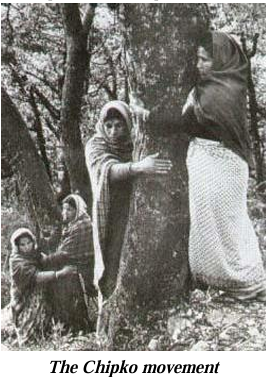
The Chipko movement or Chipko Andolan is a movement that practised the Gandhian methods of satyagraha and non-violent resistance, through the act of hugging trees to protect them from being felled. The modern Chipko movement started in the early 1970s in the Garhwal Himalayas of Uttarakhand, Then In Uttar Pradesh with growing awareness towards rapid deforestation.
The landmark event in this struggle took place on March 26, 1974, when a group of peasant women in Reni village, Hemwalghati, In Chamoli district, Uttarakhand, India, acted to prevent the cutting of trees and reclaim their traditional forest rights that were threatened by the contractor system of the state Forest Department. Their actions inspired hundreds of such actions at the grassroots level throughout the region. By the 1980s the movement had spread throughout India and led to formulation of people-sensitive forest policies, which put a stop to the open felling of trees in regions as far reaching as Vindhyas and the Western Ghats.
The first recorded event of Chipko however, took place in village Khejarli, Jodhpur district, in 1731, When 363 Bishnois, led by Amrita Devi while protecting green Khejri trees, considered sacred by the community, by hugging them, and braved the axes of loggers sent by the local ruler. Today, it is seen as an inspiration and a precursor for Chipko movement of Garhwal.
Arabari sal forest
In 1972, The West Bengal forest department formulated a novel scheme to revive the degraded sal forests by involving the local people. It was started in the Arabari forest range of midnapore district. A.K. Banerjee, the remove forest officer involved the villagers of the area around the forest in the protection of 1272 hectares of badly degraded sal forest. In return, the villagers were given employment in both silviculture (a programme to replenish the forest by growing more trees and plants) and harvesting operations of the forest. 25% of the final harvest produce were given and they were allowed to collect firewood and fodder from the forest on a nominal payment. With this participation of the local people, the degraded sal forest of Arabari became green within ten years.
Economic growth and Ecological conservation
- Forest resources should be used in an environmentally and developmentally should be manner.
- The benefits of controlled exploitation of resources goes to the people and the environment is also preserved.
- If the exploitation is too high, economic and social development will be faster but the environment will further deteriorate.
- We should use natural resources cautiously so that economic growth and ecological conservation go hand in hand.
- Amrita Devi Bishnoi National Award. In 1731, Amrita Devi Bishnoi sacrificed her life along with 363 persons for the protection of 'Khejri' trees in Khejrali village near Jodhpur in Rajasthan. In her memory Government of India have recently instituted this award for 'Wildlife Conservation'.
- Chipko Movement: During 1970, In Reni village of Garhwal, a contractor was allowed to cut trees in a forest near the village. When the contractor's workers went to the forest to cut trees the woman of the village hug the tree trunks to prevent the workers from cutting trees. Chipko means 'hug' and the movement started by the villagers by hugging trees is called the 'Chipko Andolan'.
Water as a Basic Natural Resource
- It is a valuable national asset.
- It is the main requirement of human beings.
- Water is of two types - salt water and fresh water.
- Fresh water is an unlimited natural resource, it can be obtained from three natural resources - rain water, surface water and ground water.
- Human intervention pollutes water and also changes the availability.
(a) Water Sources
- Rain in India is due to monsoon.
- Failure to sustain underground water due to loss of vegetative cover, development of water demanding crop and pollution from industrial effluents.
- Small dams, canals and tanks were used for irrigation purpose and to fulfil the basic minimum needs.
- Large dams and canals were made by British as well as our own government.
- Due to the mega projects, focal irrigation methods got neglected and the focal people lost control over management of local water sources.
- Large dams and canals were made by British as well as our own government.
DAMS
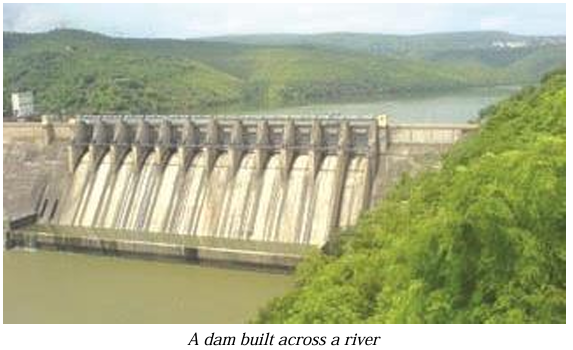
Dams are the large water storing bodies usually built by the government agencies. This stored water is then allowed to flow downstream at the desired rate.
Usefulness of dams for the society
The dams are useful to the society in the following ways:
- Water stored in a dam is used for irrigation through a network of canals. It ensures round the year water supply to the crop fields and help raise agricultural production. For example, the Indira Gandhi canal has brought greenery to considerable area of Rajasthan.
- Dams ensure continuous water supply to the people in towns and cities through pipelines after suitable treatment.
- The falling of water from the dam is used for generating electricity. The electricity thus produced is called hydro electricity.
Purposes for building a dam
- Generation of electricity
- Irrigation
- Control of flood which either stops or slows the amount of water in the river.
Criticism about large dams
- Social problems: They displace large number of farmers and tribals.
- Economic problems: They consume huge amount of public money without proportionate benefit.
- Environmental problems: As they cause deforestation and loss of biological diversity.
Problems created by dams
(a) Social problems
- (i) Mismanagement of the water has largely led to the benefits being cornered by a few people. There is no equitable distribution of water, thus people close to the source grow water intensive crops like sugarcane and rice while people farther downstream do not get any water.
- (ii) A large number of human settlements are submerged in the water of large reservoir formed by the dam and many people are rendered homeless. It is therefore necessary that these people are given adequate compensation by the government for rehabilitation so as to start their life afresh.
(b) Environmental problems:
- (i) The construction of dams on the rivers has contributed to deforestation and loss of biodiversity.
- (ii) A large variety of flora and fauna get submerged in the water of large reservoir formed by the dam which disturbs the ecological balance.
(c) Economic problems:
A huge amount of public money is spent without proportionate benefits.
Management And Conservation Of Water Resources
It includes:
- Integrated water-shed plan for drinking, irrigation and industrial uses.
- Flood control
- Transfer of surplus water to water deficit basins by inter-linking of rivers.
- Hydrogeological survey to identify over-exploited areas.
- Artificial recharging of the ground water.
- Mass awareness programmes through public or private agencies.
- Dams: They are massive barriers built across rivers and streams to confine and utilize the flow of water for human purposes such as irrigation and generation of electricity.
- Large dams can also ensure the storage of adequate water.
- Canal system leading from dams transfer large quantity of water upto great distances, e.g., Indira Gandhi Canal of Rajasthan brought greenery to considerable areas.
(c) Missuse of Water Distribution:
Due to mismanagement in distribution of water, the benefit of constructing a dam goes to few people only. For example, people close to the water source grow water intensive crop like sugarcane and rice while people farther downstream do not get any water. This resulted in discontentment among the people who have been displaced by building of dam.
(i) Watershed management:
It means scientific conservation of soil and water to increase the biomass production.
- Watershed management not only increases the production and income of the watershed community but also overcomes drought and flood.
- It increases the life of downstream dams and reservoirs.
(ii) Water harvesting:
It means capturing rainwater where it falls or capturing the runoff water in a local area and taking measures to keep the water clean by not allowing polluting activities to take place.
(A) Techniques of water harvesting:
Water harvesting techniques are mainly location specific. It is an age - old concept in India.
- Khadins, tanks and nadis in Rajasthan.
- Bandharas and tals in Maharashtra
- Ahars and Pynes in Bihar
- Kulhs in Himanchal Pradesh
- Ponds in kandi belt of Jammu.
- Eris (tanks) in Tamil Nadu.
- Surangams in Kerala.
- Kattas in Karnataka.
- Due to own control of the local population over exploitation of the local water resources is reduced.
(B) Some of the water harvesting techniques are:
- Capturing of runoff water roof tops.
- Capturing of runoff water from local catchments.
- Capturing seasonal flood water from local streams.
(C) Benefits of water harvesting:
- Provide drinking water.
- Provide irrigation water.
- Increase in ground water resources.
- Reduces storm water discharge, urban flood and overloading of sewage treatment plants.
(D) Advantages of ground water:
- It does not evaporate.
- It spreads out to recharge wells.
- It provides moisture for vegetation.
- It does not provide breeding grounds for mosquitoes.
- It is relatively protected from contamination by human and animal waste.
(E) Traditional water harvesting system:
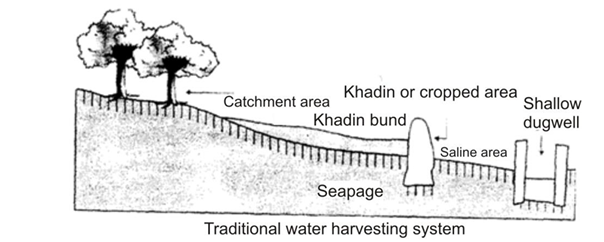
- The water harvesting structures are mainly crescent shaped.
- Monsoon rains fill ponds behind the structures.
- The large structure hold water throughout the year while most dry up after monsoon.
- The main purpose of this system is to recharge the ground water and not to hold surface water.
Advantages of water harvesting system:
The various advantages of water harvesting system are:
- The water stored in ground does not evaporate.
- The water stored in ground spreads out to recharge wells and provides moisture for crops.
- The water stored in ground does not promote breeding of mosquitoes.
- The water stored in ground is protected from contamination by human and animal wastes.
- The water stored in ground is utilized for the benefit of the local population.
Coal And Petroleum
Coal and petroleum are fossil fuels found in earth's crust. They are non-renewable and exhaustible resources.
Coal is a combustible fossilized rock derived from a large accumulation of plant remains that is gradually compressed. It occurs in many countries like China, Japan, U.S.A, Iran, Kuwait, India, etc. It is used for cooking, heating in industry and thermal power plants. The coal reserve will last for another two hundred years.
Petroleum is another fossil fuel that occurs in the form of liquid-oil. It has been formed from plant and animal remains. Petroleum is mainly used as fuel for transport, agricultural operations, generators and some industries. The petroleum resource will last for another forty years. Kerosene and LPG (liquified petroleum gas), obtained from petroleum are used as domestic fuels for cooking food, etc.
Pollution Caused By Burning Coal And Petroleum Based Fuels
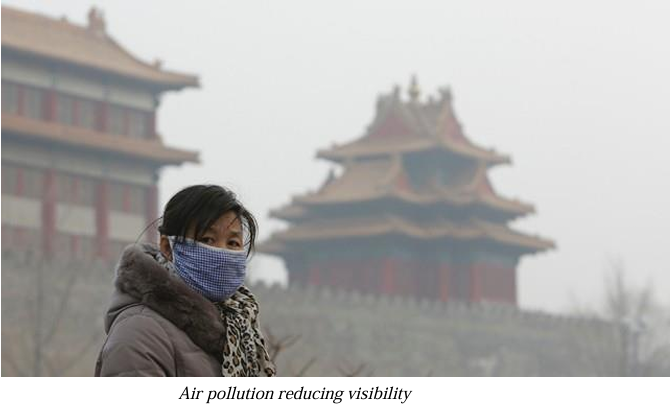
Coal and petroleum have been formed from bio-mass. In addition to carbon, these contain hydrogen, nitrogen and sulphur. When these are burnt, the products are carbon dioxide, water, oxides of nitrogen and sulphur. When combustion takes place in insufficient air (oxygen), then carbon monoxide is formed instead of carbon dioxide. These products are harmful and hence pollute the environment.
Examples of pollution caused:
- (i) Sulphur dioxide causes bronchitis and when it dissolves in rain water, it makes it acidic. The acid rain damages trees, buildings, metals, etc.
- (ii) Nitrogen oxides also attack the breathing system and cause acid rain.
- (iii) Carbon monoxide is a very poisonous gas. It stops RBC's from carrying oxygen from lungs and thus causing suffocation.
- (iv) Carbon dioxide is not a poisonous gas but it is a greenhouse gas which traps solar energy and leads to global warming.
Thus, we need to use these resources judiciously.
Steps To Reduce The Consumption Of Coal And Petroleum
Some simple choices can make a difference in our energy consumption patterns.
- Switch off the lights, fans, etc when not needed. Also use of energy efficient electrical appliances will save electricity.
- Use of bio gas as domestic fuel should be encouraged.
- Pressure cookers should be used for cooking food.
- Reduce the use of light as much as possible.
- Solar cookers should be used wherever possible.
Solved Examples
1. Define natural resources.
Sol. Natural resources are those living or non-living substances available in the environment which are being exploited for supporting life and meeting human requirements.
2. Name any two renewable resources.
Sol. Forest and crop.
3. What is deforestation?
Sol. Deforestation is destruction, reduction or removal of forest cover.
4. Write the expanded form of IUCN.
Sol. International Union for Conservation of Nature and Natural resources.
5. Can you suggest some changes in your school which would make it environment friendly?
Sol. Usually the schools have a large open space like play ground and prayer ground. I can suggest to grow plants and trees all around the play ground along with the boundary. Another suggestion I wish to give is to make arrangement for water harvesting which can easily be managed at the roofs of class rooms.
6. What can you as an individual do to reduce your consumption of the various natural resources?
Sol. As an individual, I will try my best:
- (a) To avoid wastage of food, papers, clothing, etc
- (b) To minimize the use of electricity, fuel, etc
7. What would be the advantages of exploiting resources with short term aims?
Sol. Exploitation of resources with short term aims provides immediate advantages that meet current basic human needs. For example, we must reduce our basic needs. We should not waste water, food and other consumable items. We should also try to avoid using non-biodegradable plastics. We should save electricity by switching off unnecessary lights and fans.
8. What changes would you suggest in your home in order to be environment friendly?
Sol. We have come across the three R's, i.e., reduce, recycle and reuse, which must be followed in each home to save the environment. Therefore, I will also suggest to follow:
- (i) Reduce i.e., use the natural resources in reasonable amount so that they are not wasted.
- (ii) Recycle i.e., collect the items such as plastic, paper, glass, etc. for making the required materials. We should not throw them along with other waste materials.
- (iii) Reuse i.e., we should use the things again and again. For example, the used envelops, bottles, cans, etc. should be kept for their use in future.
9. List five things you have done over the last one week to:
(a) Conserve our natural resources
Sol. Five things which I have done over the last week to conserve our natural resources are:
- (i) I have not wasted food.
- (ii) I have not wasted water.
- (iii) I have not wasted electricity.
- (iv) I have not used petroleum products.
- (v) I have not purchased toys.
(b) Increase the pressure on our natural resources
Sol. Five things which I have done over the last week to increase the pressure on our natural resources are:
- (i) I purchased a new shirt.
- (ii) I spoilt two exercise books.
- (iii) I visited my friend's house on bike.
- (iv) I did not close the tap while brushing my teeth.
- (v) I did not switch off my room lights last night.
10. Name any two fossil fuels.
Sol. Coal and Petroleum.
11. Find out the traditional systems of water harvesting/management in your region.
Sol. The traditional system of water harvesting/management in our region are ponds, pits, lakes and other water reservoirs where rain water is stored.
12. What is coal?
Sol. Coal is black coloured combustible fossilized rock formed from a large accumulation of plant remains that is gradually compressed.
13. Find out the source of water in your region/locality. Is water from this source available to all people living in that area?
Sol. In our locality, the water is supplied by municipal board through taps. This water is mainly obtained from river or from tube wells. The water supply is not sufficient to cater the needs of general people. Some rich and resourceful people get more water supplies as compared to poor people. Some village people get their water supply from wells.
14. Write some steps to reduce the consumption of coal and petroleum.
Sol. Some simple choices can make a difference in our energy consumption patterns.
- (i) Switch off the lights, fans, etc when not needed. Also use of energy efficient electrical appliances will save electricity.
- (ii) Use of bio gas as domestic fuel should be encouraged.
- (iii) Pressure cookers should be used for cooking food.
- (iv) Reduce the use of light as much as possible.
- (v) Solar cookers should be used wherever possible.
15. Write the different advantages of water harvesting system.
Sol. The various advantages of water harvesting system are:
- (i) The water stored in ground does not evaporate.
- (ii) The water stored in ground spreads out to recharge wells and provides moisture for crops.
- (iii) The water stored in ground does not promote breeding of mosquitoes.
- (iv) The water stored in ground is protected from contamination by human and animal wastes.
- (v) The water stored in ground is utilized for the benefit of the local population.