About Class 10 Science (Biology) Notes on Chapter 05 – Our Environment
Our Environment in Class 10 Science highlights the relationship between living beings and their surroundings. It introduces students to ecosystems, food chains, and food webs. An ecosystem consists of biotic and abiotic components that interact with each other. Producers, consumers, and decomposers play crucial roles in energy transfer. The chapter explains how energy flows in a unidirectional manner through food chains, with only ten percent of energy transferred at each level. Pyramids of energy and numbers are also important topics. The chapter also addresses environmental issues like ozone layer depletion, global warming, and waste management. The harmful effects of plastic, non-biodegradable materials, and overuse of chemicals are discussed to spread awareness about sustainable living. Students should understand how human activities disturb ecological balance and why conservation is important. This chapter often includes questions on energy flow diagrams and real-life examples of environmental issues. For exam success, practicing with the NCERT textbook and NCERT solutions for Class 10 Science can provide conceptual clarity. The chapter not only helps in scoring well but also creates awareness about protecting nature and living responsibly in harmony with the environment.
Environment is defined as the surroundings in which the organism lives. The environment may be the physical environment, the chemical environment or the biological environment. Thus, the environment has two components
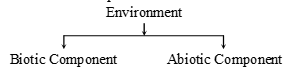
Biotic component: It is the living component of the environment. All the living organisms are included in it. Abiotic component: It is the non-living component of the environment. The abiotic components are the physical factors such as:
- Climatic factors like light, wind, humidity, temperature, precipitation etc.
- Edaphic factors like soil texture, minerals, ph, topography etc.
Ecosystem
- The term ecosystem was coined by tansley. According to him ecosystem is a symbol of structure and function of nature.
- The term ecology was coined by reiter.
- The term ecology was first of all described by e.Haeckel.
- Father of indian ecology-prof. Ramdas mishra.
- The boundaries of ecosystem are indistinct and have an overlapping character with each others
- "The total group of living things and environment of factors present in a particular place is called as ecosystem."
- It means any structural and functional unit of the environment that can be identified and studied is called as ecosystem.
- Ecosystem may be natural or artificial, permanent or temporary. Large ecosystem is called as biome such as desert, forest etc.
Homeostasis and cybernetics
- Homeostasis: self maintainable characteristic is found in ecosystem. It means an ecosystem maintains the balance between the different trophic levels. Each trophic level controls the other trophic level in an ecosystem.
- Cybernetics: a science of self control [homeostasis] In an ecosystem is called as "Cybernetics".
Types of ecosystem
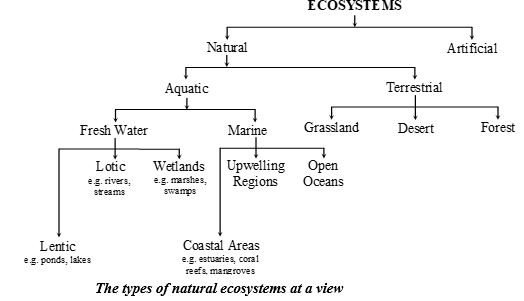
In the biosphere, ecosystems may be classified on the basis of their nature, duration and size : Nature: On the basis of nature, ecosystems may be classified as :
- Natural ecosystems: These ecosystems operate in the nature by themselves without any human interference. Common examples of natural ecosystems are: a pond, a lake, a meadow, a desert, a grassland, a forest, an ocean etc.
- Artificial ecosystems: These are maintained by man and hence are also termed man-made or man-engineered ecosystem. In these ecosystems, man maintains the natural balance by the addition of energy and planned manipulations. Common examples of artificial ecosystems are cropland, orchard, garden, aquarium etc.
- Duration: On the basis of duration, ecosystems may be classified as:
- Temporary ecosystems: These are short-lived ecosystems which may be natural or man-made. Common examples include rainfed pond and laboratory culture of protozoans.
- Permanent ecosystems: These are self-supporting natural ecosystems that maintain themselves for relatively long duration, e.G., a lake, a forest, a desert etc.
Size: on the basis of size, ecosystems may be classified as :
- Small ecosystems: Small-sized ecosystems are also termed as micro-ecosystems, e.G. A flowerpot, water in a dish, a site under a stone etc.
- Large ecosystems: Very large-sized ecosystems are also termed macro-ecosystems, e.G., an ocean, a forest, a desert etc.
Components of ecosystem
Ecosystem consists of two components:
- Biotic component
- Abiotic component (environment, soil etc.)
Biotic components: Different biotic components are connected, through food chain or other relation. That is why it is said that all the living organisms comes under biotic components. Food available for biotic components can be synthesized, from inorganic raw material by the autotrophs only.

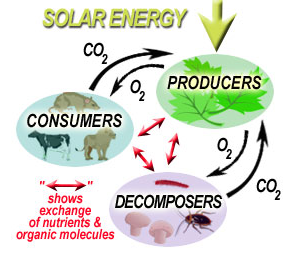
Producers: all the autotrophs of ecosystem are called as producers. The green plants are the main producers. Green plants absorb solar energy and convert it into chemical energy. It means energy enters into the ecosystem through the producers. The solar energy is the only ultimate source of energy in ecosystem. This energy is available to the remaining living organisms through the medium of food. Consumers: those organisms which consume food (eat food) prepared by producers are called consumers. The consumers depend on producers for food, directly or indirectly. The consumers get their food by eating other organisms or their products. All the animals are consumers. They are known as heterotrophs. Consumers can be further divided into three groups: herbivores, carnivores and omnivores.
- Herbivores: Some animals eat only plants (or their products). Those animals which eat only plants are called herbivores. The herbivores may eat grasses, leaves, grains, fruits or the bark of trees. Some of the examples of herbivores are: cow, buffalo, goat, sheep, horse, deer, camel, ass, ox, elephant, monkey, squirrel, rabbit and hippopotamus. Since herbivores obtain their food directly from plants (or producers), therefore, herbivores (like cattle, deer, goat, etc.) are primary consumers.
- Carnivores: Some animals eat only other animals. They do not eat plant food at all. Those animals which eat only other animals as food are called carnivores. Some of the examples of the carnivores are: lion, tiger, frog, vulture, kingfisher, lizard, wolf, snake and hawk. The carnivores are usually of two types (a) small carnivores and (b) large carnivores. The small carnivores which feed on herbivores (primary consumers) are called secondary consumers. For example, a grasshopper, rat, seed eating birds and frog, etc., are secondary consumers. The large carnivores (or top carnivores) which feed upon the small carnivores (secondary consumers) are called tertiary consumers. For example, lion, tiger, birds of prey (such as hawk) and humans (man) are some of the tertiary consumers.
- Omnivores: Some animals eat both, plants as well as other animals. Those animals which eat both, plants and animals are called omnivores. Some of the examples of omnivores are: man (human beings), dog, crow, sparrow, bear, mynah and ant.
Decomposers or microconsumers: those living organisms which decompose the dead bodies of producers and consumers and release mineral substances again into the soil which are present in the dead bodies. So that decomposers help in mineral cycle. Only because of this land is the main source of minerals. The main decomposers in ecosystem are - bacteria and fungi which decompose continuously dead animals and dead plants.
Importance of decomposers:
The decomposers help in decomposing the dead bodies of plants and animals, and hence act as cleansing agents of environment. Thus, it is only due to the presence of decomposers that the various nutrient elements which were initially taken by plants from the soil, air and water are returned to the soil, air and water, after the death of plants and animals. In the absence of decomposers, the soil, air and water would not be replenished by elements from the bodies of dead organisms. Thus, the decomposers help in recycling the materials in the ecosystem so that the process of life may go on and on like an unending chain.
Scavengers : Vulture never kills any animal so that vulture is a scavenger, not a decomposer. The process of decomposition takes place outside the body of bacteria. The breakdown of the food materials takes place in the body of vulture and minerals are released into the soil in the form faecal materials. They are also called as reducers because they decomposes and remove the dead bodies of the organism.
Abiotic (non-living) component: These include the non-living physico-chemical factors of the environment. These components not only affect the distribution and structure of organisms but also their behaviour and inter relationships. Abiotic factors include:
- Inorganic substances: Inorganic substances, e.G., carbon, nitrogen, oxygen, calcium, phosphorus etc. And their compounds (water, carbon dioxide, etc.) constitute the main abiotic components. These occur either in the form of compounds dissolved in water, in the soil or in free state in air.
- Organic compounds: These include carbohydrates, proteins, lipids, nucleic acids etc. These are present in living organisms and dead organic matter. The dead organic matter is broken down by the action of decomposers (e.G., bacteria, fungi) into inorganic substances for their recycling.
- Climatic factors: These include light, temperature, humidity, wind, rainfall, water etc. And also edaphic factors (e.G., soil, topography, minerals, ph etc.).
Structure of an ecosystem
The characteristic structure of an ecosystem is obtained by the systematic physical organisation of the abiotic and biotic components of that particular ecosystem.
The two main structural features of any ecosystem are its 'species composition' and 'stratification'.
An ecosystem can be represented by depicting the producers - consumers relationship in the given ecosystem.
This is also called the 'trophic structure' of an ecosystem, wherein each animal population forms the various trophic levels.
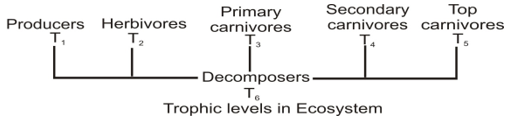
The producers (green plants) always form the first trophic level. Herbivores, which feed on producers, are at the second trophic level followed by secondary consumers, tertiary consumers and so on.
Trophic structure of an ecosystem can be described in terms of its total amount of nutrients or the amount of living material.
The amount of nutrients in the soil at any given time is referred as 'standing state' whereas the amount of living material is referred as 'standing crop'.
Functions of an ecosystem
Productivity: Ecosystem helps to maintain the productivity, of the system. The rate of organic matter or biomass production is called as productivity. The study of biomass production in the ecosystem is called as production ecology.
Energy flow: Energy flow in an ecosystem is a key function of an ecosystem. It determines the following two laws of thermodynamics:
- First law: It states, that energy can neither be created nor destroyed, but can be transferred from one form to other.
- Second law: It states, that every energy change involves the degradation or dissipation of energy, from concentrated to the dispersed form due to metabolic functions, so that only a small part of energy is stored in the biomass.
Nutrient cycles: All living organisms get matter from the biosphere component I.E. Lithosphere, hydrosphere and atmosphere. Essential elements or inorganic substances are provided by earth and are required by organisms for their body building and metabolism, they are known as biogeochemical or biogenetic nutrients.
Development and stabilization: This function is necessary for the development and giving stability to various life forms, by undergoing certain modifications.
Food chain
- The chain of organisms which involves transfer of energy from one trophic level to next trophic level is called as food chain.
- The flow of food or energy in an ecosystem is called food chain. Those organisms which join with the food chain are termed as trophic levels.
- Usually, there are four trophic levels present in the ecosystem because level of energy decreases during the flow of energy from one trophic level to another trophic level.
- First trophic level [t1] -> Producers
- Second trophic level [t2] -> Primary consumers
- Third trophic level [t3] -> Secondary consumers
- Fourth trophic level [t4] -> Top consumers
The flow of energy occurs in an ecosystem from the first trophic level to the fourth trophic level in the food chain, there are five trophic levels also found in a highly complex ecosystem in which tertiary consumers are present in between the secondary consumers and top consumers, then fifth trophic level (t5) formed by the top consumers.

Examples of food chain
A food chain represents a single directional transfer of energy. For example:
Food chain in a forest:
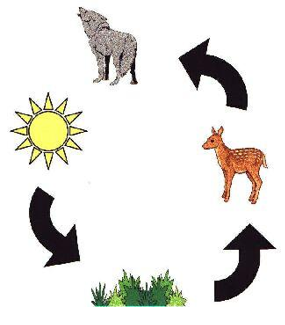
In this food chain, grass is the producer organism which uses sunlight energy to prepare food like carbohydrates by the process of photosynthesis. This grass is then consumed by a herbivore like deer. And the deer is consumed by a carnivore like lion.
Food chain in grassland:
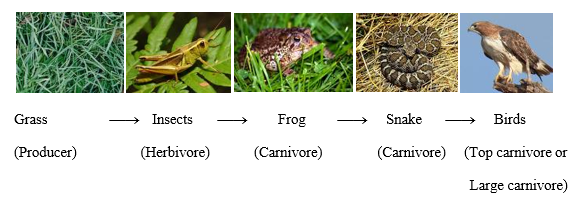
In this food chain, grass is the producer. The insects (herbivore) are the primary consumer, the frog (small carnivore) and snakes are the secondary consumers whereas the bird (top carnivore or large carnivore) is the tertiary consumer.
Food chain in a pond:
The food chain operating in the aquatic ecosystem (water ecosystem) like a pond, lake, or sea (ocean).
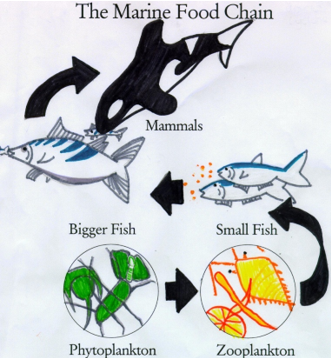
In this aquatic food chain, algae is the producer. The scorpion is the primary consumer, small fish is the secondary consumer. Swan is the tertiary consumer.
Types of food chain
There are three types of food chains which are found in nature.
- Predator food chain
- Parasitic food chain
- Saprophytic food chain
Predator food chain extends from producers through herbivores to carnivores, parasitic food chain starts from producers but ends with parasites and saprophytic food chain starts with decomposers. Producers are autotrophic organisms which synthesize organic food from simple inorganic raw material through photosynthesis by utilizing solar energy. A part of food synthesized by the producers is used in their body building, while the rest is utilized in providing energy for various life activities.
Some common predator food chains are given below :
Vegetation -> grasshoppers -> shrew -> hawk
Vegetation -> rabbit -> wolf -> tiger
Vegetation -> frog -> snake -> peacock
Plant -> rat -> snake -> hawk.
Aquatic food chains:
Phytoplanktons -> zooplanktons -> small crustacians -> predator insect -> small fish -> large fish -> crocodile
Phytoplanktons -> zooplanktons -> small fish -> large fish -> shark
Phytoplanktons -> zooplanktons -> fish -> crane -> hawk.
Length of food chain:
In different ecosystems, different food chains may have two, three, four or maximum five trophic levels. Such food chains in different ecosystems are depicted in figure given below. Accordingly, a food chain may end at the
(i) herbivore (primary consumer) level,
(ii) primary carnivore (secondary consumer) level,
(iii) secondary carnivore (tertiary consumer) level or
(iv) tertiary carnivore (quaternary consumer) level.

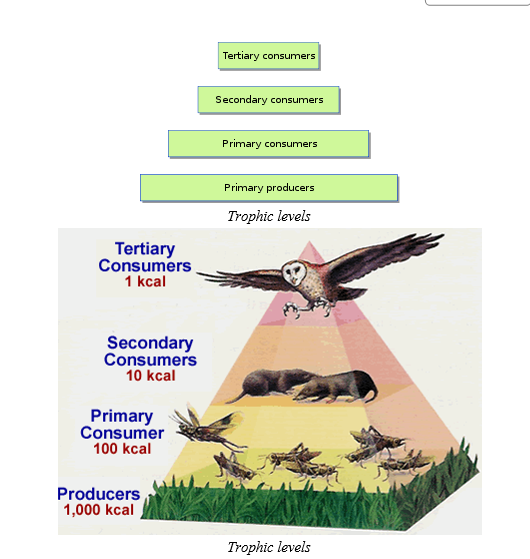
Trophic level
Each step or level of the food chain forms a trophic level.
- The autotrophs or the producers are at the first trophic level. They fix up the solar energy and make it available for heterotrophs or the consumers.
- The herbivores or the primary consumers come at the second.
- The small carnivores or the secondary consumers are at the third trophic level.
- The larger carnivores or the tertiary consumer form the fourth trophic level.
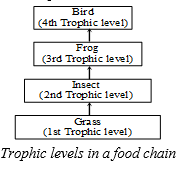
e.g. Food chain operating in the grassland, which is:
Grass -> insects -> frog -> birds
In this food chain, grass represents the 1st trophic level; insect represents the 2nd trophic level; frog represents the 3rd trophic level, whereas bird represents 4th trophic level.
Characteristics of a food chain
In a food chain,
- There is repeated eating in which each group eats the smaller one and is eaten by the larger one. Thus, it involves a nutritive interaction between the biotic components of an ecosystem.
- The plants and animals which depend successively on one another form the limbs of a food chain.
- There is unidirectional flow of energy from sun to producers and then to a series of consumers of various types. Thus, a food chain is always straight and proceeds in a progressing straight line.
- Usually 80 to 90% of potential energy is lost as heat at each transfer on the basis of second law of thermodynamics (transformation of energy involves loss of unavailable energy).
- Usually there are 4 or 5 trophic levels. Shorter food chains provide greater available energy and vice - versa.
- Omnivores occupy more than one trophic level and, some organisms occupy different trophic positions in different food chains.
Food web
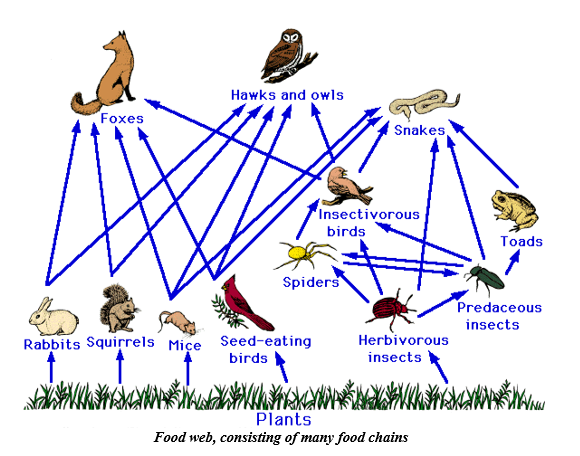
A food web (or food cycle) depicts feeding connections (what eats what) in an ecological community and hence is also referred to as a consumer-resource system. Ecologists can broadly lump all life forms into one of two categories called trophic levels: 1) the autotrophs, and 2) the heterotrophs. To maintain their bodies, grow, develop, and to reproduce, autotrophs produce organic matter from inorganic substances, including both minerals and gases such as carbon dioxide. These chemical reactions require energy, which mainly comes from the sun and largely by photosynthesis, although a very small amount comes from hydrothermal vents and hot springs.
A gradient exists between trophic levels running from complete autotrophs that obtain their sole source of carbon from the atmosphere, to mixotrophs (such as carnivorous plants) that are autotrophic organisms that partially obtain organic matter from sources other than the atmosphere, and complete heterotrophs that must feed to obtain organic matter. The linkages in a food web illustrate the feeding pathways, such as where heterotrophs obtain organic matter by feeding on autotrophs and other heterotrophs. The food web is a simplified illustration of the various methods of feeding that links an ecosystem into a unified system of exchange.
There are different kinds of feeding relations that can be roughly divided into herbivory, carnivory, scavenging and parasitism. Some of the organic matter eaten by heterotrophs, such as sugars, provides energy. Autotrophs and heterotrophs come in all sizes, from microscopic to many tonnes - from cyanobacteria to giant redwoods, and from viruses and bdellovibrio to blue whales.
Characteristics of a food web
- Unlike food chains, food webs are never straight. Instead, each food web is formed by interlinking of food chains.
- A food web provides alternative pathways of food availability. For example, if a particular species of producer is destroyed by a disease in the ecosystem, the herbivores of that area can feed on other species of producers. Similarly, secondary consumers (e.G., predatory birds) may feed on rats or mice in the event of decrease in population of rabbits in that area on which they also commonly feed.
- Greater alternatives available in a food web make the ecosystem more stable.
- Food webs also help in checking the overpopulation of highly fecundive species of plants and animals.
- Food webs also help in ecosystem development.
Difference between food chain and food web
| Food chain | Food web |
| 1. Food chain is the straight single path of transfer of food energy in the ecosystem | 1. It consists of a number of inter-connected food chains through which food energy is passed in the ecosystem |
| 2. Members of higher trophic level feed upon a single type of organisms of lower trophic level. | 2. Members of higher trophic level can feed as a number of alternative organisms of the lower trophic level. |
| 3. Presence of food web increases the stability of the ecosystem |
Flow of energy
Each organism needs energy to carry on vital activities, and for building up and repairing the body tissues.
- The ultimate source of entire energy, used by living organisms, is the sun.
- Of the total solar radiations falling on the earth, only about 1% are captured by green plants in a terrestrial ecosystem and converted into food energy by photosynthesis.
- When green plants are eaten by herbivores (primary consumers), a great deal of energy is lost as heat to the environment in accordance with the second law of thermodynamics. Some amount of energy is used in doing work and the remaining goes towards growth and reproduction. On an average, 10% of the food eaten is turned into body of herbivores and is made available for the next level of consumers. In other words, on an average, 10% of the amount of organic matter that is present at each step reaches the next consumer level (ten percent law).
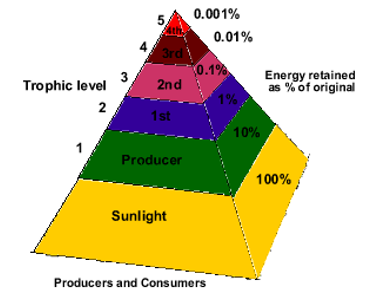
- Since, amount of available energy goes on decreasing at each trophic level, food chains usually consist of only 3 or 4 steps and rarely maximum of 5 steps.
- In an ecosystem, generally, the producers are maximum in number. As we move along the chain, number of individuals at each trophic level decreases.
From the energy flow diagram two things become clear. Firstly, the flow of energy is unidirectional. The energy that is captured by the autotrophs does not revert back to the solar input and the energy which passes to the herbivores does not come back to autotrophs. As it moves progressively through the various trophic levels it is no longer available to the previous level.
Another interesting aspect of food chain is how some harmful chemicals enter our bodies through the food chain. In water pollution, one of the reasons is the use of several pesticides and other chemicals to protect our crops from diseases and pests. These chemicals are either washed down into the soil or into the water bodies. From the soil, these are absorbed by the plants along with water and minerals, and from the water bodies these are taken up by aquatic plants and animals. This is one of the ways in which they enter the food chain. As these chemicals are not bio-degradable, these get accumulated progressively at each tropic level. As human beings occupy the top level in any food chain, the maximum concentrations of these chemicals get accumulated in our bodies. This phenomenon is known asbiological magnification. This is the reason why our food grains such as wheat and rice, vegetables and fruits, and even meat, contain varying amounts of pesticide residues. They cannot always be removed by washing or by other means.

Ecological pyramids
An ecological pyramid is a graphical representation of an ecological parameter like number of individuals or amount of biomass or amount of energy present in various trophic levels of a food chain with producers forming the base and top carnivores from the tip. Ecological pyramids could be upright, inversed or spindle shaped. There are three important parameters of each trophic level in a food chain I.E. Number of individuals, amount of biomass and amount of energy.
Pyramid of number: In this type of pyramid the number of individual organisms in various trophic levels is shown these pyramids may be upright or inverted. The number of organisms of any trophic level depends upon the availability of organisms which are used as food on lower level so that availability of food is the main factor. These producers are of two types:
- Phytoplanktons: They are the inactive floating plants, because they do not have locomotory organs e.G. Diatoms.
- Phytonektons: These plants swim actively in water, because in them locomotary organs are present. Usually flagella are present in these plants. E.G. Chlamydomonas and dinoflagellates. The number of phytoplanktons and phytonektons are higher per unit area of water because they are unicellular.
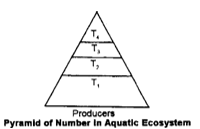
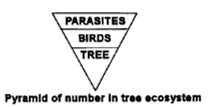
In a tree ecosystem the pyramid of number is inverted. This is called as parasitic ecosystem because birds depend upon tree and parasites depend upon birds. Therefore with the increase in the number of trophic levels, the number of the organisms increases sequentially.
The number of members of any particular species in a favourable condition is called as their biotic potential.
When the number of the members of any species increases then it is called as population explosion.
Pyramid of Biomass:
- The biomass of each trophic level is shown by this pyramid. Mostly these pyramids are also upright (erect). E.G. Tree ecosystem.
- Pyramid of biomass in aquatic ecosystem is inverted, because in this producers are micro organisms and their biomass is lesser than other trophic levels.
- Pyramids of biomass show the standing crop of ecosystem. It means total amount of living matter at a particular time in an ecosystem is called as standing crop.
- Total amount of nonliving matter in an ecosystem is called as standing state.
Pyramid of Energy:
- It always remains erect, because flow of energy is not cyclic. I.E. During the flow of energy at each trophic level goes on decreasing.
- According to the 10% law of linderman the 90% part of obtained energy of each organism is utilized in their various metabolic activities and only 10% energy is transferred to the next trophic level. So that 90% energy is lost at each trophic level therefore, top consumers like lion etc., are weakest ecologically.
- Pyramids of energy show the productivity of any ecosystem.
- Plant community: all types of plants present at a particular place to form a community, is called as plant community. The distribution of any species at a place depends upon social nature of that species which indicates cooperation between them.
- Synecology: the ecological study of any plant community is called as "Synecology".
- Phytosociology: the study of structure of plant community is known as "Phytosociology".
- Phytogeography: the study of distribution of the plants on the earth is called as "Phytogeography". Some characteristics of plant community are as follows :
- Species diversity: there are many varieties of organisms found in a community. The total number of species of plants called as population. The ecological study of population is called as autoecology. The maximum species diversity is found in tropical forest. The plants are called as flora and animals are termed as fauna. The lowest species diversity is found in tundra biome or arctic desert.
- Dominant species: the highest number of plants of a species present in a community is called as dominant species and whole plant community is known as the name of that species. Such as prosop is community on aravali hills and pinus community on himalaya.
Ozone layer and its depletion
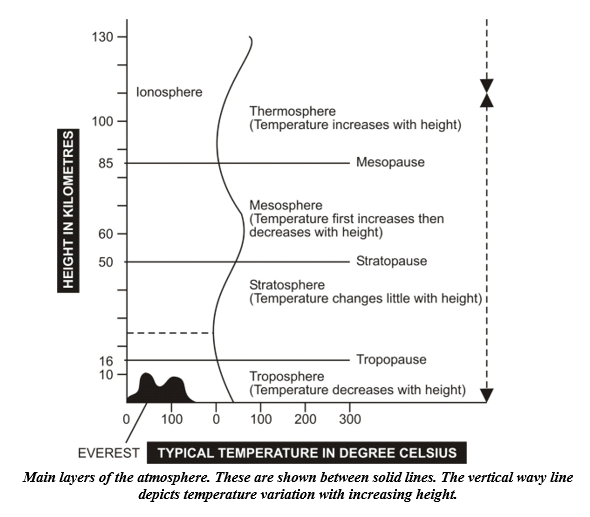
The global environment is basically formed by three parts – atmosphere, hydrosphere and lithosphere. The atmosphere extends over about 600 km from the earth’s surface. Four layers of atmosphere are – troposphere, stratosphere, mesosphere and thermosphere.
Ozone layer, commonly called ozone blanket, comprises of high concentration of ozone about 18-26 km above in the stratosphere. As per estimates, 90% of the total atmospheric ozone is present in this region.
Formation of ozone:
Ozone is a form of oxygen. Ozone (o3) is a molecule formed by three atoms of oxygen. While o2, which we normally refer to as oxygen, is essential for all aerobic forms of life. Ozone at the higher levels of the atmosphere is a product of uv radiation acting on oxygen (o2) molecule. The higher energy uv radiations split apart some molecular oxygen (o2) into free oxygen (o) atoms. These atoms then combine with the molecular oxygen to form ozone.
Function of ozone:
Ozone is a poisonous gas but is not stable nearer to earth’s surface. It performs an essential function where it is found. It absorbs the harmful radiations from the sun. It shields the surface of the earth from the ultraviolet (uv) radiation of the sun. Absorption of uv radiations by ozone blanket is proportional to its thickness.
Ozone layer depletion:
Between 20 and 26 km above the sea level ozone layer is present and the part of atmosphere containing it is called ozonosphere (stratosphere). This layer is established due to an equilibrium between photo dissociation of ozone by uv - radiations and regeneration of ozone. The thickness of this ozonosphere averages 5 km. The ozone layer acts as an ozone shield and absorbs the harmful uv-radiations of the sunlight so protects the earth's biota from the harmful effects of strong uv-radiations. So this layer is very important for the survival and existence of life on earth.
- Causes of thinning of ozone layer: the decline in spring - layer thickness is called ozone hole. Ozone hole is largest over antarctica and was just short of 27 million sq. Km. During september 2003. Main chemicals to be responsible for destruction of ozone-layer are: chlorofluorocarbons (cfcs), halogens (used in fire extinguishers), methane and nitrous oxide. Out of these, most damaging is the effect of cfcs which are a group of synthetic chemicals and are used as coolants in refrigerators and air conditioners; as cleaning solvents, propellants and sterilant etc. These cfcs produce "Active chlorine" in the presence of uv-radiations. These active chlorine radicals catalytically destroy ozone and convert it into oxygen. Ozone at the higher levels of the atmosphere is a product of uv radiation acting on oxygen (o2) molecule. The higher energy uv radiations split apart some molecular oxygen (o2) into free oxygen (o) atoms. These atoms then combine with the molecular oxygen to form ozone as shown –
In 1987, the united nations environment programme (unep) succeeded in forging an agreement to freeze cfc production at 1986 levels.
Nitrous oxide: is produced in industrial processes, forest fires, solid waste disposal, spraying of insecticides and pesticides, etc. Methane and nitrous oxide also cause ozone destruction.
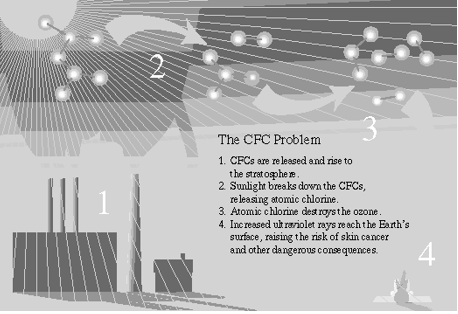
- Effects of ozone layer depletion : the thinning of ozone layer results in increase in the uv radiations (in the range of 290 - 320 nm) reaching the earth's surface. It is estimated that 5 percent loss of ozone results in 10 per cent increase in uv - radiations. These uv - radiations can:
- Increase in incidences of cataract and skin cancer.
- Decrease in the functioning of immune system.
- Inhibit photosynthesis in most of phytoptanktons so adversely affecting the food chains of aquatic ecosystems.
- Damage nucleic acids of the living organisms.
Saving the ozone layer:
The thinning of ozone layer started in 1980s. In 1987, the united nations environment programme (unep) succeeded in forging an agreement to freeze cfc production at 1986 levels.