About Class 10 Science (Biology) Notes on Chapter 03 – Reproduction
Reproduction in Class 10 Science is an important chapter that explains how living organisms produce offspring to continue their species. The process is broadly classified into asexual and sexual reproduction. Asexual reproduction includes binary fission, budding, fragmentation, regeneration, and spore formation.
It results in identical offspring and is common in microorganisms and simple organisms. Sexual reproduction involves the fusion of gametes, resulting in variation in offspring. In plants, sexual reproduction occurs through flowers, with male and female parts producing pollen and ovules. Pollination and fertilization lead to seed formation and fruit development.
In humans, reproduction involves the male and female reproductive systems, fertilization, embryo development, and birth. Key concepts include menstrual cycle, reproductive health, and contraceptive methods, which are vital from both exam and practical knowledge perspectives.
Diagrams such as the human male and female reproductive system and flower structure are frequently asked in board exams. This chapter also emphasizes the importance of genetic variation in evolution. Students should revise this chapter with the NCERT textbook and NCERT solutions for Class 10 Science for effective preparation and scoring good marks. Understanding reproduction is essential not just for exams but also for real-life health awareness and scientific curiosity.
Reproduction
Reproduction is a fundamental feature of life. Reproduction is the biological process by which new "offspring" individual organisms are produced from their "parents" The known methods of reproduction are broadly grouped into two main types: sexual and asexual.
Need For Reproduction
- Reproduction is essential for the survival of species on earth.
- The process of reproduction ensures continuity of life on earth.
- The reproducing organisms create new individuals which look exactly similar to their parents. The similar copies of individuals are created by DNA replication during cell division.
Types of Reproduction
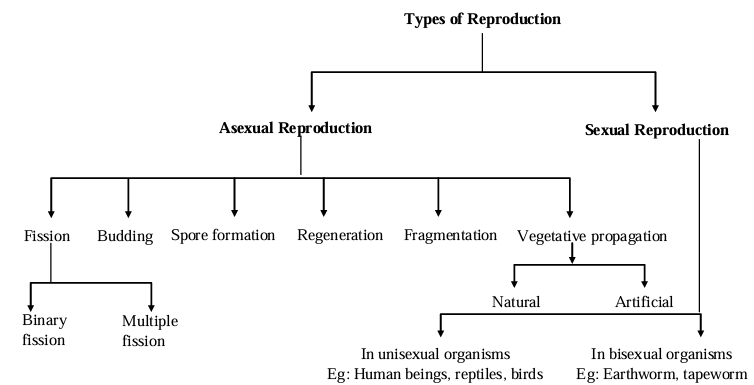
There are two main types of Reproduction in living organisms:
- Asexual Reproduction
- Sexual Reproduction
(a) Asexual Reproduction:
Production of off springs by a single parent without the formation and fusion of gametes is called as asexual reproduction. It is more primitive type of reproduction. It ensures rapid increase in number. Asexual reproduction occurs in protozoa and some animals such as sponges, coelentrates, certain worms and tunicates. It is absent among the higher invertebrates and all vertebrates.
Types Of Asexual Reproduction
(i) Fission:
It is defined as the splitting of a unicellular organism into two or more separate daughter cells. Example: bacteria, yeast, diatoms, mycoplasmas and protozoans.
Fission is of two types:
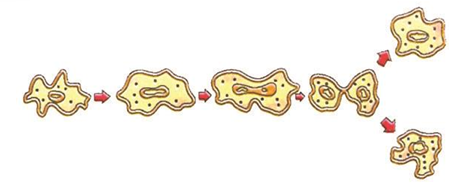
Binary fission:
Binary fission, meaning "division in half", refers to a method of asexual reproduction. It is the most common form of reproduction in prokaryotes and occurs in some single-celled eukaryotes. After replicating its genetic material, the cell divides into two equal sized daughter cells.
The genetic material is also equally partitioned, therefore, the daughter cells are genetically identical (unless a mutation occurred during replication) to each other and the parent cell. Transverse binary fission divides the cell across the short axis (e.g., most bacilli-shaped bacteria), longitudinal binary fission across the long axis (e.g., Trypanosoma), and random binary fission across no defined axis (e.g., Amoeba). Some biologist use this term for multi-cellular organisms that asexually reproduce by dividing into two (e.g., some star fish). This is also known as fragmentation. Spirogyra, a type of algae also reproduces by binary fission.
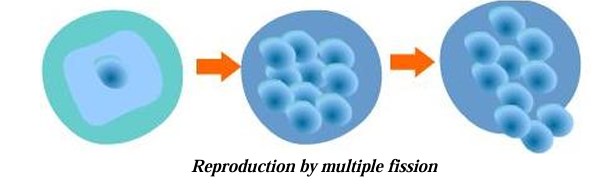
Multiple fission:
Sometimes the nucleus divides several times, into many daughter nuclei. The daughter nuclei arrange at the periphery of the parent cell, and a bit of cytoplasm around each daughter nuclei is present. Nucleus develops an outer membrane. Finally the multinucleated body divides into many daughter cells. e.g. Plasmodium.
(ii) Budding
Formation of a daughter individual from a small projection which is called as bud, arising on the parent body is called as budding.
Budding is also of two types:
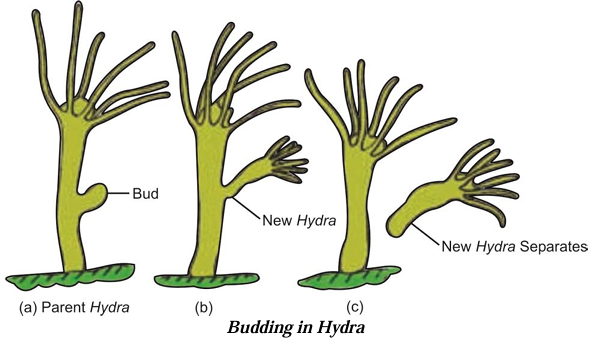
(A) Exogenous budding: [External budding] In this, bud arises from the surface of parent body. e.g., Hydra.
Budding in Hydra:
A bulge appears on the body as a result of repeated mitotic division in the cells resulting in the formation of lateral out-growth called bud. This bud enlarges in size by further division of cells and attains the shape of parent. It then separates from the parent body and starts behaving as new Hydra.
(B) Endogenous budding: [Internal budding] In this, bud arises inside or within the parent body. e.g., Sponges.
Budding in yeast:
A small bud like out-growth appears at one end of the parent cell which gradually enlarges in size. The nucleus also enlarges and divides into two daughter nuclei. One nucleus remains in the parent cell and other goes to the daughter. When the bud attains almost similar size like parent, a constriction appears at the base of the bud separating it from the parent. However, sometimes a chain of buds can also be seen.
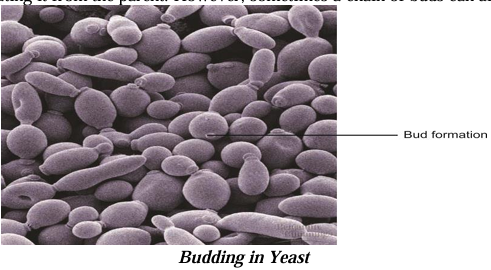
During the process of budding, the bud remains attached to the parent body so as the derive it's nutrition from the parent but as it matures, it gets detached from the parent body.
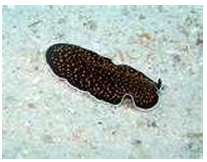
(iii) Fragmentation: It is a type of reproduction or the regeneration ability of the organism to replace their lost part. In this process an entire new organism can grow from certain pieces or of the parent organisms. e.g. Flatworm.
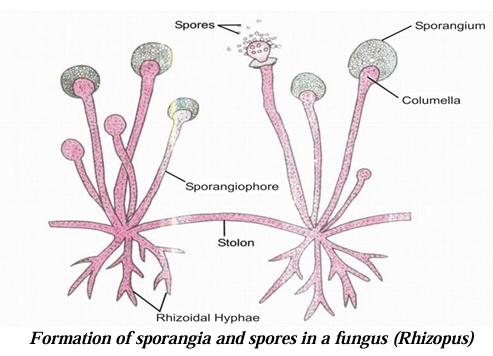
(iv) Spore formation: A spore is a single or several-celled reproductive structure that detaches from the parent and gives rise, directly or indirectly to a new individual. Spore formation takes place mostly in bacteria and fungi. In fungi e.g. Rhizopus, Mucor, Aspergillus, Penicillium etc., spores are formed in a sac-like structure called sporangium at the tips of fungal hyphae. The nucleus divides inside the sporangium and gets surrounded by a small mass of cytoplasm forming a spore. After attaining maturity, the sporangial wall ruptures releasing the spores. The spores are covered with thick walls that protect them until they come in contact with another moist surface and can begin to grow.
These spores can be non-motile called aplanospores or motile called zoospores.
(v) Regeneration- Regeneration is defined as a natural ability of some simple multicellular organisms to replace worn out parts, to repair damaged parts or to regrow cast off organs. It takes place mostly in Hydra, Planaria, sponges, etc. If sometimes the individual is somehow cut or broken into many pieces, many of these pieces grow into separate individuals. But regeneration is not same as reproduction since most organisms would not normally depend on being cut up to be able to reproduce.
Regeneration is performed by specialised cells. These specialised cells proliferate and make large number of cells. Different cells from the mass of cells undergo change to become various cell types and tissues. These changes takes place in an organized sequence referred to as development. Complex multicellular organisms cannot give rise to new individuals by regeneration. This is because they have complex body organization.
(vi) Vegetative propagation: Plant undergoing vegetative reproduction propagates by a part of their body other than a seed. This part is called propagule. Vegetative reproduction is of different types.
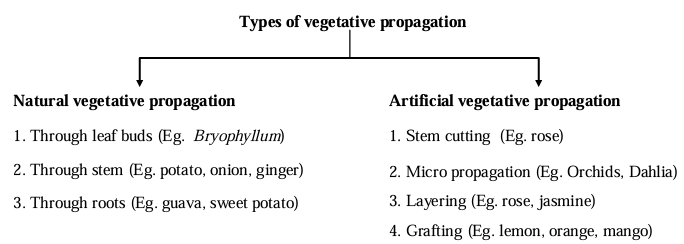
(a) Natural method: There are many plants which propagate naturally. Some plants propagate by roots e.g. sweet potato, guava, etc.; some by stems like ginger, banana, potato, strawberry; etc.; some by leaves like Bryophyllum, Begonia, etc.
(b) Artificial method: There are some plants which propagates artificially by following methods:
Cutting: This is the very common method of vegetative propagation practised by the gardeners all over the world. It is the process in which a vegetative portion from plant is taken and is rooted in the soil to form a new plant. e.g. Grapes, Sugarcane etc.
(B) Layering
In this process the development of adventitious roots is induced on a stem before it gets detached from parent plant, e.g., Mango, roses etc
It is of three types:
Mound layering: In the process of layering the lower stem branch of plant is used. Leaves are removed from this stem. Then it is bent close to the ground, pegged and covered with the moist soil in such a way that it's growing tip remains above the soil surface. This pegged down branch is called as layer. After a few days the covered portion of stem develops roots. This stem is then detached from the parent plant and is grown separately into a new individual. e.g. Jasmine
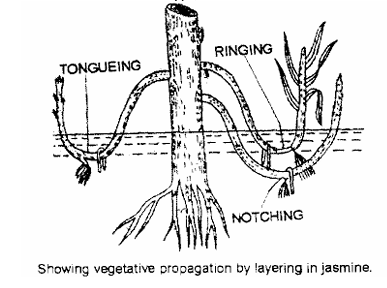
The formation of adventitious roots in a layer can be hastened by injuring the 'layer' by tonguing, ringing or notching.
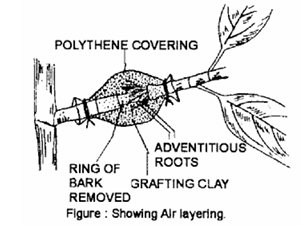
Air layering: It is adopted in those plants where stem cannot be bent to the ground. In this process the stem is girdled (i.e. ring of the bark is removed). Then it is covered with moist moss or cotton and wrapped with a polythene sheet to preserve the moisture. After few weeks adventitious roots develop from the injured part. The branch along with roots is then separated from the parent plant and planted to grow into a new plant. e.g. Orange, Pomegranate etc.
Grafting: The process of joining together of two different plants in such a manner that they live as one plants is called as grafting. Out of the two plants one is rooted in the soil and is known as the stock. The other part consists of a small shoot bearing one or more buds it is known as scion. Their union is carried out in such a way that their cambium must overlap each other. e.g. Mango, roses etc.
(vi) Micro propagation: It has now become possible due to recent techniques to produce a large number of plantlets from a small piece of tissue taken from the shoot tip or other suitable plant parts. This method of propagation is called as micro-propagation. It involves the process of tissue culture. e.g., Orchids. ornamental plants etc.
Mechanism of micro propagation
- A small piece of plant tissue placed in a culture medium divides rapidly to form a shapeless lump called 'callus'.
- The callus is then placed in different culture media to stimulate the development of root and shoot.
- Tiny plantlets are formed from just few cells which are transplanted into pots or soil where they can grow to form mature plants.
Advantages of micro propagation
- It is a fast technique producing many plantlets from a small plant tissue in few weeks and using very little space. In other words, it is quite economical.
- The plants produced by tissue culture are disease free.
Significance of vegetative propagation
- It is used to propagate a plant in which viable seeds are not formed or very few seeds are produced. e.g. Orange, pineapple, banana etc.
- Vegetative propagation helps us to introduce plants in new areas where the seed germination fails to produce mature plant due to change in environmental factors and the soil.
- Vegetative propagation is a more rapid, easier and cheaper method of multiplication of plants.
- By this method a good quality of a race or variety can be preserved.
- Most of the ornamental plants are propagated through vegetative propagation. e.g. Rose, Tulip etc.
Significance of asexual reproduction
The significance of asexual reproduction is that it is a means for a rapid and significant increase in the numbers of individuals. (Weeds, for instance, are successful partly because of their great capacity for vegetative reproduction.) The cells that result from asexual reproduction are genetically identical to their parent cells. In addition, vegetative reproduction in the bryophytes and pteridophytes is a means of by passing the somewhat lengthy and moisture-dependent sexual process; that is, the motile swimming sperm characteristic of these groups require the presence of water, which may be a limiting factor in drier times.
Sexual Reproduction
Sexual reproduction is the creation of a new organism by combining the genetic material of two organisms. There are two main processes during sexual reproduction; they are: meiosis, involving the halving of the number of chromosomes; and fertilization, involving the fusion of two gametes and the restoration of the original number of chromosomes. During meiosis, the chromosomes of each pair usually cross over to achieve homologous recombination.
The evolution of sexual reproduction is a major puzzle. The first fossilized evidence of sexually reproducing organisms is from eukaryotes of the Stenian period, about 1 to 1.2 billion years ago. Sexual reproduction is the primary method of reproduction for the vast majority of macroscopic organisms, including almost all animals and plants. Bacterial conjugation, the transfer of DNA between two bacteria, is often mistakenly confused with sexual reproduction, because the mechanics are similar.
Occurrence: Sexual reproduction occurs nearly in all animals including those which reproduce asexually. In most animals there are two sexes male and female, and the differences between them are genetically determined.
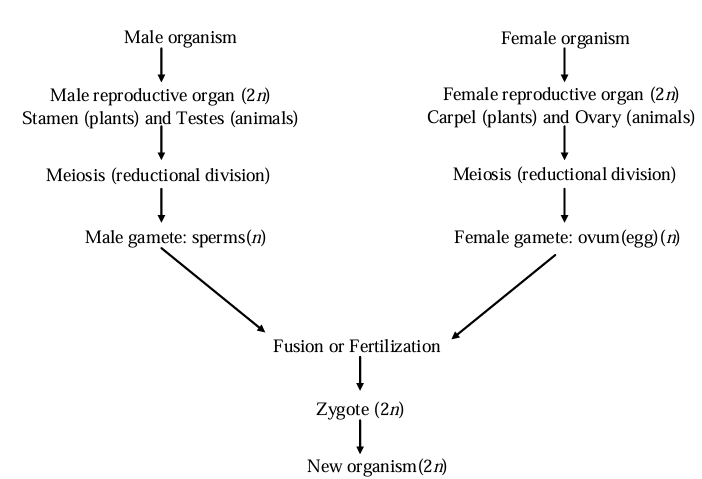
Types of sexual reproduction
Sexual reproduction is of two types.
- Syngamy
- Conjugation
Syngamy
It is the complete and permanent fusion of two haploid gametes to form a diploid zygote. When the two fusing gametes are morphologically and physiologically similar to each other, the process is called isogamy. e.g. Monocystis When the two organisms themselves acts as gametes it is called hologamy. e.g. Yeast
Conjugation
It is a temporary pairing of two parents to exchange male and female gametes, through a temporary cytoplasmic bridge. e.g. Ciliate protozoans like paramoecium.
Characteristics of sexual reproduction
- It is generally bi-parental [i.e. it involves two parents]
- It involves formation and fusion of gametes.
- Cell divisions are both meiotic & mitotic during gamete formation and mitotic during development of zygote into an offspring.
- The off springs are not genetically identical to the parents.
- Fertilization in case of humans is internal.
- Infants can be fed on mother's milk.
- Parental care is very well developed.
Significance of sexual reproduction
- It results in multiplication and perpetuation of species.
- It contributes to evolution of the species by introducing variation in a population much more rapidly than asexual reproduction.
General Terms
(i) Fertilization: Fertilization is more a chain of events than a single, isolated phenomenon. Indeed, interruption of any step in the chain will almost certainly cause fertilization failure. The chain begins with a group of changes affecting the sperm, which prepares them for the task ahead.
Successful fertilization requires not only that a sperm and egg fuse, but that not more than one sperm fuses with the egg. Fertilization by more than one sperm - polyspermy - almost inevitably leads to early embryonic death. At the end of the chain are links that have evolved to efficiently prevent polyspermy.
(ii) Unisexual organism: In case of humans male and female sex organs are separate and therefore called as unisexual.
(iii) Bisexual: In plants and some organisms like tapeworm, earthworm etc. both male and female organs are present in the same individual and therefore called as bisexual.
(iv) Gonads: Organs which are involved in the formation of gametes are called as gonads.
(v) Copulation or mating: The process of transfer of male gametes into female body.
Reproduction In A Flowering Plant
In the flowering plants, the step of sexual reproduction occurs within specialized reproductive organ called the flower.
A flower is defined as a specialized condensed reproductive shoot of flowering plants on which the essential reproductive parts are arranged.
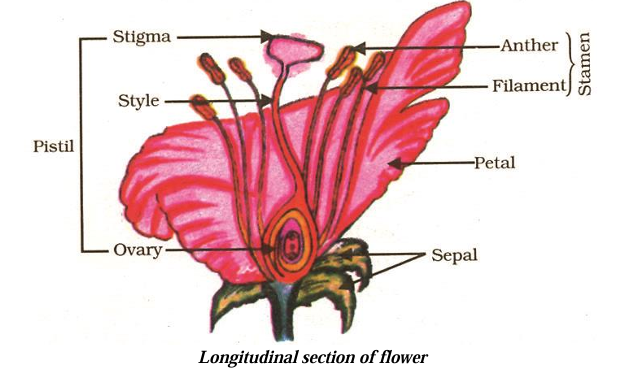
A flower Consists of Following Parts
(i) Calyx: The sepals collectively are called as calyx. They are usually green in colour and protect the inner whorls of a flower especially during bud formation.
(ii) Corolla: It consists of coloured petals. They are normally large often fragrant and bright coloured. Their primary function is to attract animals and insects for pollination.
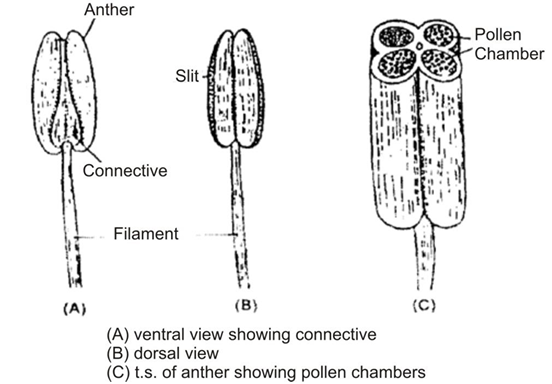
(iii) Androecium/stamen/male reproductive organ: The stamens are referred to as the male reproductive organ. A typical stamen is differentiated into three parts; these are filament, connective and anther.
(A) Filament: It forms the stalk that bears more or less cylindrical or ovoid anther.
(B) Connective: it connects anther to filament.
(C) Anther: It is present on the top of filament. Each anther consists of two lobes that is why it is called as bi-lobed. Each anther lobe has two pollen sacs which contain millions of tiny microscopic pollen grains, called as microspores. The pollen grains are like yellow dusty powder in appearance.
(iv) Gynoecium / pistil / female reproductive organ:
- It is located in the centre of a flower.
- It is composed of one or more carpels.
- The freely occurring units of the carpels in a flower are called pistils.
- Each pistil usually consists of three distinct parts - ovary, style and stigma.
(A) Ovary: It is a basal, swollen part of the pistil. The ovary has one or more chambers called the loculi which are distributed in a special cushion like parenchymatous tissue called the placenta, from which the ovule develops.
(B) Style: From the top of the ovary arises a long, elongated structure called as style.
(C) Stigma: The terminal end of style is called as stigma. It is rough, hairy or sticky to hold pollen grains during pollination process.
Types of flower based on reproductive organs
(a) Unisexual: In such flower, only one reproductive part is present, either male (stamen) or female (pistil) e.g. cucurbits, mulberry, papaya, watermelon, etc.
A flower which bear only stamen is called staminate flower and one in which only carpel is present is called a pistillate flower.
(b) Bisexual: When stamens and carpel are found in the same flower, it is called hermaphrodite or bisexual, e.g. Hibiscus (chinarose), mustard, rose, pea, cotton, etc.
Pollination
The transfer and deposition of pollen grains from the anther to the stigma of a flower is called as pollination.
Types of pollination:
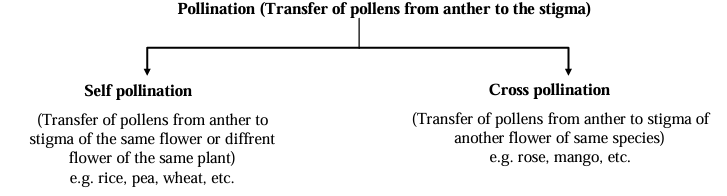
(i) Self pollination
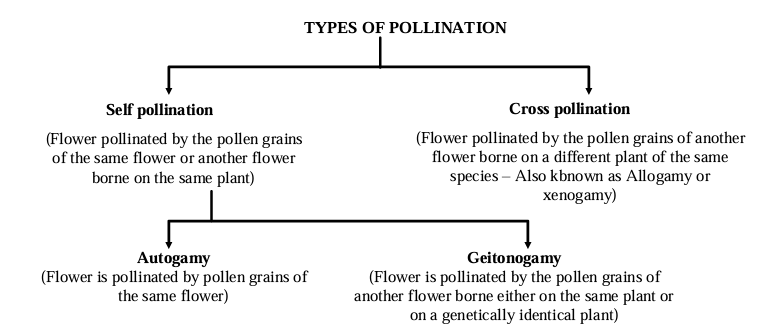
It is the process of transfer of the pollen grains from the anther to the stigma of either the same or genetically similar flower. It is further divided into two types:
(A) Autogamy: It is a type of self pollination in which the pollen grains are transferred from the anther to stigma of the same flower e.g. Wheat, rice, pea etc.
(B) Geitonogamy: It is a type of self pollination in which the pollen grains are transferred from the anthers of one flower to the stigma of another flower borne either on the same plant or a genetically identical plant.
Significance of self pollination
- It maintains purity of race.
- It also maintains the superiority of variety once developed.
(ii) Cross pollination
It is the process of transfer of the pollen grains from the anther of one flower to the stigma of another flower borne on a different plant of the same species.
Types Of Pollination
| (i) Abiotic factors | Technical terms | |
|---|---|---|
| Wind | Anemophily | |
| Water | Hydrophily | |
| (ii) Biotic factors | ||
| Insects | Entomophily | |
| Birds | Ornithophily | |
| Bats | Chiropterophily | |
| Snails | Malacophily | |
Significance of cross pollination:
- Increase in yield and adaptability.
- It eliminates defective traits and produces new varieties.
- It also leads to the hybrid production.
Fertilization In Plants
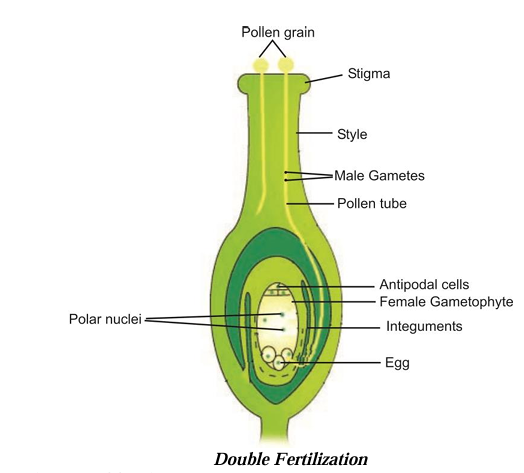
The fusion of male gamete with the female gamete to form a diploid zygote within the embryo sac is called fertilization.
(a) Mechanism of fertilization
- Due to pollination the related pollen grains are deposited over the receptive stigma of the carpel.
- These pollen grains absorb water, swell and then germinate to produce pollen tubes.
- The pollen tube grows into the stigma, passes through the style and then moves towards the ovarian cavity.
- Two male gametes are formed inside the tube during its growth through the style.
- After reaching the ovary, the pollen tube enters the ovule with its tip piercing the egg apparatus.
- The tip of the pollen tube ruptures releasing two male gametes into the embryo sac.
- One male gamete fertilizes the egg to form the diploid zygote by the process of syngamy.
- The other male gamete fuses with the two polar nuclei to form the triploid (3n), primary endosperm. This is known as triple fusion. The mechanism involving two acts of fertilization in an embryo sac is called double fertilization.
(b) Formation of fruits and seeds
- The fertilized egg divides several times to form an embryo within the ovule.
- The ovule then develops a tough coat around it which gradually gets converted into a seed.
- All the fertilized eggs in the ovules present in an ovary grow to become seed.
- The ovary of the flower develops and becomes a fruit, which may be soft like mangoes; juicy like oranges; hard, dry and woody like peanuts and almonds.
- The petals, sepals, stamens, style and stigma may shrivel and fall off.
- The fruit protects the seed. The seed is the reproductive unit of a plant. It contains the baby plant.
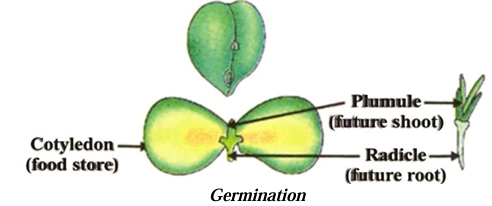
- The part of the baby plant that develops into shoot is called plumule and the part which develops into root is called radicle.
- The part of the seed which contains stored food for the baby plant is called cotyledon.
- The baby plant inside the seed develops into a seedling under suitable conditions like water, air, temperature, etc. This is called germination.
Differences Between Self Pollination And Cross Polination
| S.No. | Self Pollination | Cross Pollination |
|---|---|---|
| 1. | Pollen grains are transferred from the anther to the stigma of the same flower (autogamy) or another flower borne on the same plant (geitonogamy). | Pollen grains are transferred from the anther of one flower to the stigma of another flower borne on a different plant of the same species (allogamy). |
| 2. | Both the anther and stigma mature at the same time. | The anther and stigma of a flower generally mature at different times |
| 3. | It can occur even when the flowers are closed. | It occurs only where the flowers are open. |
| 4. | External agent is not required for self-pollination. | An external agent abiotic or biotic, is essential for cross-pollination |
| 5. | It is economical for the plant. | Cross-pollination is not economical as the nectar, scent and bright-coloured corollas, etc. |
| 6. | Self-pollination ultimately results in progenies which are pure lines i.e. homozygous. | Cross pollination produces the offsprings which are hybrids I.e., heterozygous. They show variations in characteristics. |
| 7. | It cannot eliminate useless or harmful characters. | It can eliminate useless or harmful characters. |
| 8. | Highly useful characters get preserved in the race | Useful characters cannot be preserved in the progenies. |
| 9. | Self-pollination does not introduce any variations and hence the offsprings are unable to adapt to the changed environment. | CrossPollination Introduce variations in the offsprings These variations make these plants to adapt better to the changed environment 'or the struggle for existence. |
| 10. | Immunity of the race towards disease falls in the succeeding progenies. | Immunity of the race towards disease is usually maintained in the succeeding progenies. |
| 11. | Yield of the plant gradually falls with time. | Yield of plant usually does not fall |
| 12. | Self-pollination never helps in the production of new varieties and species. | Cross-pollination is a mechanism of producing new varieties and species among plants. |
Do Organisms Create Exact Copies Of Themselves In Reproduction
Reproduction produces new individuals that look much similar to the parent. We have already studied that chromosomes contain units (genes) for inheritance from one generation to another. Chemically, genes are made up of DNA which encodes for different proteins. If somehow, the code for a particular protein is changed, a different protein would be produced. This would result in alternation of body designs.
Therefore, a basic event in reproduction is production of a DNA copy. The replication (copying) of DNA prior to cell division involves many biochemical reactions. These reactions do not produce same results all the time and hence slight variations are always likely in the two copies formed. DNA copying is accompanied by the creation of an additional cellular apparatus. The two copies of DNA each with its own cellular apparatus so formed are separated and daughter cells are formed from a single parent cell. The offsprings formed from the daughter cells will also show slight variations.
The Importance Of Variation
The importance of variation lies in the fact that it helps the species of various organisms to survive and flourish even in adverse environment. The various niches (well-defined places) in the ecosystem are filled by populations of organisms using their reproductive ability.
In case of drastic changes like excessive heat, cold or shortage of water, etc there is danger that all of them may die and no one would survive under these conditions. This will eliminate the species from the habitat completely. However, if some variations are present in some individual organisms to tolerate the extremities there is chance for them to survive in such conditions. Thus variations during reproduction provide stability to the populations of various species by preventing them for getting wiped.
For example, some variant mosquito has developed resistance to DDT (Dichloro diphenyl trichloro ethane) which prevented their population from being wiped out.
Reproduction In Human Beings
Human beings are unisexual and human reproduction is highly evolved. There is a distinct sexual dimorphism. Males visibly differ from females in physical standards, external genital organs and accessory sex characters.
- Mammals are unisexual.
- Reproductive system of each organism consists of many reproductive organs.
- These can be primary sex organs or secondary sex organs.
- The primary sex organs are called as gonads. They produce sex cells or gametes and also secrete sex hormones.
- The gonads of males are called as testis, which produce sperms.
- The gonads of females are called as ovaries, which produce ova or female gametes.
- Secondary sex organs include the reproductive ducts which transport gametes and reproductive glands which help in process of reproduction. These organs do not produce gametes.
- e.g., In males: Vasa efferentia, epididymis, seminal vesicles, ejaculatory duct, urethra etc.
In females: Fallopian tube, uterus, vagina, mammary glands etc. - Accessory or external sex characters help to distinguish the two sexes of a species externally.
- e.g., In male: Muscular body, more height, low pitched voice, moustaches etc.
In female: High pitched voice, breast development, lateral pubic hairs etc. - Puberty: Beginning of sexual maturity is known as puberty.
- At this stage primary sex organs start functioning.
- Secondary sex organs develop fully under the influence of sex hormones produced by primary sex organs.
- In the stage of puberty body growth is very rapid.
- It occurs at the age of 10 -14 years in girls and 13 -15 years in boys.
Sex Organs & Sexual Characters
The reproductive system of males and females consist of many organs which are distinguishable into primary and secondary sex organs.
(a) Primary sex organs:
The primary sex organs are gonads which produce gametes and secrete sex hormones. The gonad of male is called testis which produces sperm and male sex hormone testosterone. The gonad of female is called ovary which produces female gametes ova and female hormones estrogen and progesterone.
(b) Secondary sex organs:
The secondary sex organs include genital ducts and glands which help in the transportation of gametes and assist in the reproductive process. These organs do not produce gametes or secrete hormones.
(c) Primary sexual characters:
Primary sexual characters are those present at birth.
(d) Puberty:
Puberty is the period at which reproductive organs become functional in both human males and females, gonads start producing gametes and sex hormones, and the boys and girls become sexually mature.
(i) Puberty in males: It is attained at the age of 13 – 14 years. It is triggered by the secretion of testosterone from the testes which brings about the development of secondary sexual characters during puberty and maintains throughout life.
(ii) Puberty in females: It is attained at the age between 10 – 12 years. It is triggered by the hormone estrogen from the ovaries. This hormone causes growth, maturation of reproductive tracts and development of secondary sexual characters.
(e) Secondary sexual characters:
Secondary sexual characters are those that develop at puberty.
(i) In human males
- Enlargement of penis and scrotum.
- Broadening of shoulders.
- Growth of the body hair and facial hair.
- Deepening of the voice due to enlargement of larynx and thickening of vocal cords.
- Increase in the development of musculature and bones.
- Increase in height.
(ii) In human females
- Growth of breast and external genitalia.
- Growth of pubic hair and extra hair in the armpits.
- Broadening of pelvis.
- Initiation of menstruation and ovulation.
- Increase in fat particularly in thighs, shoulders, buttocks and face.
Male Reproductive System
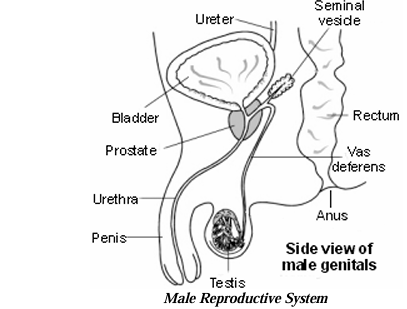
Male reproductive system comprises of following parts:
(i) Testis
(ii) Scrotum
(iii) Vasa efferentia
(iv) Epididymis
(v) Vas deferens
(vi) Ejaculatory duct
(vii) Urethra
(viii) Accessory sex glands
(ix) Penis
(i) Testis:
- They are soft, smooth, pinkish, oval organs. They are housed (present) in a sac like structure called as scrotum. Outer covering is called as tunica vaginalis.
- It's inner covering is called as tunica albuginea.
- Ingrowths of tunica albuginea are called as septa that divide the testis into 200-300 lobules.
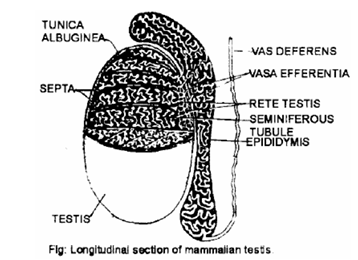
- It also consists of convoluted seminiferous tubules.
- These seminiferous tubules at one end join to form tubules which open into a network of irregular cavities known as rete testis.
- This rete testis comes out from a dorsal surface of the testis with the help of vasa efferentia.
- This vasa efferentia combines to form a single tube which becomes highly coiled and form epididymis.
- Epididymis opens into a narrow tube called vas deferens.
- Seminiferous tubules form the spermatogenic tissue of the testis.
- It consists of a germinal epithelial layer at the periphery. Spermatogenesis occurs at the centre.
Fig: Longitudinal section of mammalian testis
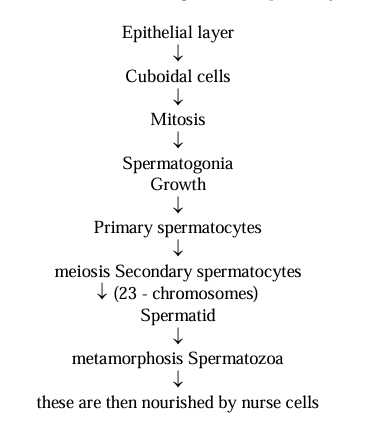
- It forms spermatogonia which grows and forms spermatocytes which further grow to form primary spermatocytes, which undergo meiosis to form secondary spermatocytes and then spermatids.
- The later (i.e. spermatids) metamorphose into spermatozoa.
- This process of formation of spermatozoa from spermatogonia is called as spermatogenesis.
- These spermatozoa are nourished during the development by nurse cells.
In between seminiferous tubules, there are interstitial cells known as Leydig cells which secrete male hormone called as testosterone. This hormone helps in the growth and development of male sex hormone.
(ii) Scrotum:
It is a pouch of pigmented skin arising from the lower abdominal wall and hanging between the legs.
- It is divided internally into two compartments by a muscular partition called as septum scroti.
- Scrotum possesses smooth involuntary dortus muscles.
- Scrotum sac is connected to the abdominal cavity through inguinal canal.
- Function of dortus muscle is to change the position of testis to keep them at proper temperature.
- Scrotum has temperature 1°3° lower than body temperature which favours the formation of sperms.
Duct system
(iii) Vasa efferentia
Rete testis is connected to epididymis through a fine tubule called as vasa efferentia. They help in conduction of sperms.
(iv) Epididymis
They are long tubules which lie compacted along the testis from their upper ends to lower back side. Its walls are muscular and glandular to provide or secrete nutritive fluid which provides nourishment to the sperms.
(v) Vas deferens
- Vasa efferentia from epididymal duct finally opens into vas deferens.
- It comes out through inguinal canal passing over urinary bladder to receive ducts from seminal vesicles.
- They are thick walled and muscular and conduct sperms.
(vi) Ejaculatory duct
They are short, straight, muscular tubes, each formed by the union of vas deferens and duct of seminal vesicles.
(vii) Urethra
It arises from urinary bladder forming a urinogenital canal. It carries urine, sperm and secretion of seminal vesicles, prostrate and cowper's glands.
(viii) Accessory glands
They consist of prostrate gland, a pair of seminal vesicles, and a pair of cowper's glands.
(A) Prostrate gland: It is a large pyramidal gland that encloses a part of urethra including it's junction with the ejaculatory duct. It contains 30 - 40 alveoli which open separately into urethra by fine ducts. Secretion is thick, milky and alkaline which constitute 20- 30% semen.
(B) Cowper's glands: These are a pair of small glands, present below the prostrate and consist of separate opening. Their secretion provides lubrication to the reproductive track.
(C) Seminal vesicle: It is paired and present between urinary bladder and rectum. Its secretion forms a major part of semen (60 – 70%). It is thick, viscous, alkaline having proteins, fructose and prostaglandins.
(ix) Penis
It is a male copulatory organ which also passes urine. It consists of highly sensitive covering of skin called prepuce.
(b) Semen
It is a milky, viscous and alkaline fluid, ejaculated by reproductive system of males during copulation.
- Its quantity is 2.5 -4.0 ml at a time having about 400 million sperms.
- Semen has chemicals for nourishment of sperms neutralizing the acidity of urethra and vagina, stimulating their movement in female tract.
- Spermatogenesis starts at puberty under the influence of gonadotropin secreted from anterior pituitary gland.
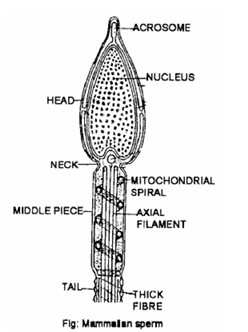
(c) Structure of Sperm
Each sperm consists of following parts:
(i) Head (ii) Neck (iii) Middle piece (iv) Tail
(i) Head: It is oval in structure. It is composed of a large nucleus and a small acrosome. The nucleus is compact. It consists of DNA and basic proteins. Acrosome lies at the tip of nucleus. It is formed of golgi complex. It consists of hydrolytic enzymes and is used to contact and penetrate the egg during fertilization.
(ii) Middle piece: It is cylindrical in human sperms. It consists of ATP and mitochondria in a thin layer of cytoplasm. Mitochondria are coiled round the axial filament, it provides energy and it is said to be the power house of the sperm.
(iii) Neck: It is very short and contains two centrioles. These play an important role during the first cleavage of the zygote.
(iv) Tail: It is very long, slender and tapering. It is formed of cytoplasm. Its main function is to provide mobility to the sperm. End piece consists of the exposed axial sheath, which forms a fine filament.
Female Reproductive System
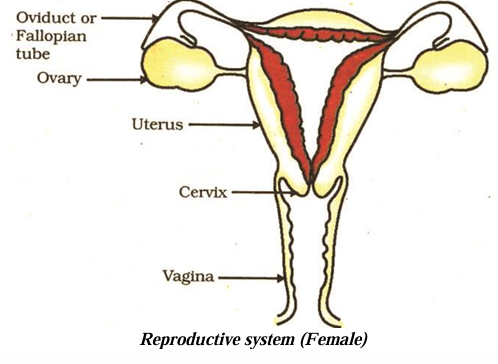
The female reproductive system is designed to carry out several functions. It produces the female egg cells necessary for reproduction, called the ova or oocytes. The system is designed to transport the ova to the site of fertilization.Conception, the fertilization of an egg by a sperm, normally occurs in the fallopian tubes. The next step for the fertilized egg is to implant into the walls of the uterus, beginning the initial stages of pregnancy. If fertilization and/or implantation does not take place, the system is designed to menstruate (the monthly shedding of the uterine lining). In addition, the female reproductive system produces female sex hormones that maintains the reproductive cycle.
It is more complex as compared to that of males. It consists of a pair of ovaries, a pair of fallopian tubes, uterus and vagina.
Ovaries
They are the primary sex organs located in the lower part of the abdominal cavity near kidney. Each ovary is connected by a ligament to the uterus. It produces gametes (eggs) and hormones like estrogen and progesterone. Ovary is composed of ovarian follicles. Each follicle contains a large ovum (egg) surrounded by many layers of follicle cells.
When a girl is born, the ovaries already contain thousands of immature eggs. At puberty some of these eggs start maturing. One egg is produced every month by one of the ovaries. The release of egg from the ovary is called ovulation. It is caused by increase in turgidity aided by contraction of unstriped muscle fibres around the follicles. The force of ejection carries the egg to the fallopian tube.
Fallopian tubes
These are narrow tubes that are attached to the upper part of the uterus and serve as tunnels for the ova (egg cells) to travel from the ovaries to the uterus. Conception, the fertilization of an egg by a sperm, normally occurs in the fallopian tubes. The fertilized egg then moves to the uterus, where it implants into the lining of the uterine wall.
Uterus (womb)
The uterus is a hollow, pear-shaped organ that is the home to adeveloping fetus. The uterus is divided into two parts: the cervix, which is the lower part that opens into the vagina, and the main body of the uterus, called the corpus. The corpus can easily expand to hold a developing baby. A channel through the cervix allows sperm to enter and menstrual blood to exit.
Vagina
The vagina is a large, median elastic muscular tube. It is adapted to receive the male penis during copulation. The vagina is also called "birth canal". It allows the passage of baby at the time of child birth.
Gland:
- Bartholin's gland: It secretes a clear, viscous fluid under sexual excitement.
- The fluid serves as a lubricant during copulation or mating.
(a) Menstrual Cycle:
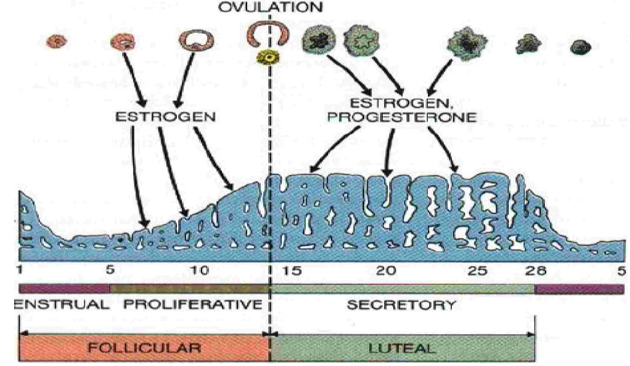
- It is a cyclic phase of the flow of blood with mucus and tissues etc. from the uterus of a woman at monthly intervals.
- It occurs on average of 28 days interval.
- It starts at the age of 12-14 years and stops at 45 - 50 years of life.
- This cycle stops during pregnancy.
- The menstrual cycle consists of following phases:
(i) Bleeding or menstrual phase:
- It is the first stage of menstrual cycle.
- Its duration is of 5 days but normally bleeding is found for 2 - 3 days.
- In this stage hormones oestrogen, progesterone, follicle stimulating hormone and luteinizing hormone are found in minimum quantity
- Total 100 ml, of blood flows in a complete bleeding phase.
(ii) Proliferative phase:
- In this phase F.S.H stimulates development and maturation of graffian follicles.
- In this phase oestrogen level rises which leads to formation of new endometrium.
- It lasts for about 10 - 14 days. Thinnest endometrium is found in this phase.
- It is also called as follicular phase.
(iii) Ovulation phase:
- At this phase ovulation occurs.
- Ovulation occurs in the presence of FSH and LH.
- Thickest endometrium found in this stage.
- It also lasts for about 14 days.
(iv) Secretory phase:
In this stage both oestrogen and progesterone levels are high.
- If fertilization takes place, this stage extends till to the parturition (giving birth to a child).
- If fertilization does not take place, this stage completes on 28th day of menstrual cycle.
- The commencement of menstruation at puberty is called as menarche.
- It's stoppage around the age of 50 years is called as menopause.
- The period between menarche and menopause is the reproductive phase in human female.
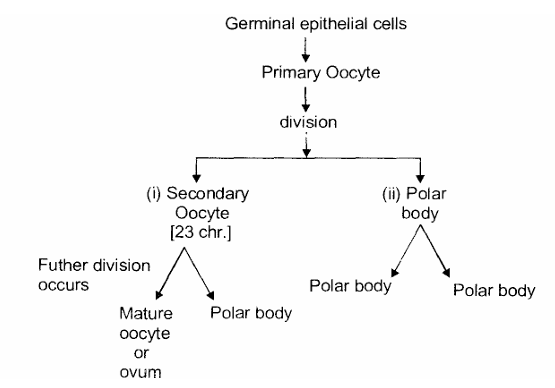
(b) Oogenesis:
Oogenesis is a process of formation of ovum. The ovum is a rounded, non-motile cell. Its size varies in different animals depending upon the amount of yolk in it.
Ovum consists of two types of coverings:
- Inner thin, transparent, non-cellular covering called as zona pellucida. It is composed of protein and sugars. It is secreted by follicle cells.
- Outer thick covering is called as corona radiata.
Fertilization
- It includes release of ovum from the ovary, where it remains viable for 12 -24 hours.
- At the time of sexual intercourse the sperm enters in to the vagina.
- Only one sperm is required for fertilization of the ovum.
- The head of the sperm penetrates the corona radiata layer of ovum and then the zona pellucida layer.
- This process is facilitated by acrosome and proteolytic enzymes.
- After penetration the tail and body of the sperm is lost, only head remains inside the ovum. Its head begins to swell and forms male pronucleus.
- Here the pronuclei of sperm and ovum fuse to form a new resultant nucleus each contributing 23 chromosomes, so that the resultant may have 46 chromosomes.
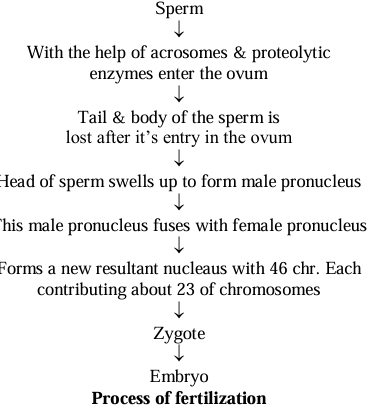
- Fusion of male & female gametes is called as fertilization. Zygote starts developing in fallopian tube and forms embryo, this later on moves to uterus It gets attached to uterine walls and the whole process is called as implantation
- Placental formation occurs between uterine wall and the foetus, which provides nourishment to the foetus.
- The time period for which a developing foetus remains inside the mother's womb is called as gestation period. It extends for about 9 months or 40 weeks or 280 days.
- The process of giving birth to baby is called as parturition.
Artificial Insemination
- It is a technique to make a female pregnant by artificially introducing semen into vagina.
- In this process semen from a good quality male is collected, preserved by freezing and used when required.
- In case of humans it is also being used for improving the chances of fertility.
- A man may be infertile due to insufficient number of sperms, weak or premature ejaculation, inability of penis to undergo and enter the vagina or non-motile sperms.
- In this case husband's semen is collected, concentrated and introduced artificially into the wife's vagina. This is called as artificial insemination.
- If the husband's sperms are faulty, some donor's sperm can be used. This is called as artificial insemination donor.
Artificial insemination has following two advantages:
- Semen of good quality male animal is used to inseminate a number of females.
- Preserved semen can be transported to distant places, excluding the need for sending the male animal there.
Differences between asexual and asexual reproduction
| Asexual reproduction | Sexual reproduction |
|---|---|
| 1. It is always unipraental. | It is generally bipraental. |
| 2. Gametes are not formed. | Gametes are formed |
| 3. There is no fertilization | Fertilization occurs in it. |
| 4. It involves mitotic cell division. | It involves meiotic cell division. |
| 5. Daughter individuals are genetically identical to the parent | Daughter individuals are different from the parents. |
| 6. It does not contribute to the evolution. | It contributes to the evolution by introducing variation in the offspring |
Population Growth
- The term population refers to the total number of individuals of a species occupying particular geographical area at a given time.
- The scientific study of human population is called as "demography".
Factors that lead to increase in population are:
- increase in protection from risk
- Illiteracy
- Desire of son
- Decline in death rate
- Desire for more earning hands
- Unawareness of various birth control measures
Birth Control Methods
The prevention of pregnancy in a woman is called contraception. Any device or chemical which prevents pregnancy is called a contraceptive. All the birth control methods are divided into:
- Barrier methods
- Chemical methods
- Intra uterine contraceptive device (IUCD)
- Surgical methods
Barrier methods
These are the physical devices to prevent the entry of sperm so that it does not reach the egg. e.g. condoms which can be used to cover the penis. Coverings like diaphragm worn in the vagina can serve the same purpose. Barrier methods also protect against STD's (sexually transmitted disease).
Chemical methods
(a) Oral pills: They are hormonal preparations. They act by changing the hormonal balance of the body, so that eggs are not released & fertilization cannot occur. They are taken orally, therefore commonly called oral contraceptives (OC). These pills can cause side effects.
(b) Vaginal pills: They contain spermicides and therefore they kill the sperms.
Intra-uterine contraceptive device (IUCD)
They are contraceptives such as a loop or the copper-T placed in the uterus. They prevent implantation in the uterus. They can cause side effects due to irritation of the uterus.
Surgical methods
(a) Vasectomy: In males, a small portion of vas deferens (sperm duct) is cut and the cut ends are then ligated (tied). This prevents the sperms from coming out.
(b) Tubectomy: In females, a small portion of fallopian tubes is cut & the cut ends are then ligated (tied). This prevents the egg to enter the fallopian tube.
Reproductive Health And Sexually Transmitted Diseases
Reproduction is an important biological process like nutrition, respiration, transportation etc. The reproductive life of human begins at puberty which continues throughout the life in males and upto menopause in females. Like the physical fitness, mental fitness and social fitness, the human beings need fitness of reproductive life as well.
Diseases are caused by bacteria, viruses, protozoa, fungi & other kinds of pathogens. These infectious diseases are spread by air, water and food. Similarly, there are some diseases which are spread by sexual contact with an infected person. Such diseases are called sexually transmitted diseases (STD).
For example:
- Gonorrhoea (bacterial disease)
- Syphilis (bacterial disease)
- Warts (viral infection)
- AIDS (viral infection)
The most common symptoms of gonorrhea and syphilis are burning sensation at urination, passing of urethral discharge and sores in the genitals.
AIDS (Acquired Immuno Deficiency Syndrome)
It is caused by HIV- Human immuno deficiency virus. This disease weakens the body's immune system so that body becomes weak & cannot protect itself against infection. AIDS is transmitted to a healthy person by:
- Sexual contact with infected person.
- Use of contaminated needles and syringes.
- Use of contaminated razors.
- Transfusion of infected blood.
- Mother to the baby during pregnancy and lactation.
This disease can be prevented by educating people about its transmission.
Solved Example
1. Define reproduction.
Sol. Reproduction is defined as the production of new generation of individuals of the same species that are physically independent of their parents.
2. Give two examples of organisms which reproduce by budding.
Sol. Hydra and Yeast
3. What is meant by vegetative propagation?
Sol. Vegetative propagation is a method by which plants reproduce vegetatively by a part of their body other than the seed.
4. Name the type of asexual reproduction in Rhizopus.
Sol. Rhizopus reproduces asexually by spore formation.
5. Name a plant propagated by
(i) Mound layering (ii) Grafting
Sol. (i) Jasmine
(ii) Rose
6. What is the difference between binary fission and multiple fission?
Sol.
| S. No. | Binary fission | Multiple fission |
|---|---|---|
| 1. | It takes place in favourable conditions. | It takes place in adverse conditions. |
| 2. | A single cell divides into two daughter cells. | A single cell divides into many daughter cells. |
7. What is regeneration? Give examples.
Sol. Regeneration is the natural ability of living organisms to replace worn out parts, to repair damaged parts or to regrow cast off organs. The process is performed by specialized cells which proliferate into large numbers. For example Hydra, Planaria.
8. List the advantages of vegetative propagation.
Sol.
- It is the only method of reproduction in those plants which have lost their capacity to produce seeds e.g. banana, orange, rose, etc.
- By this process plants retain their original types without variation.
- It is used to produce disease free plants.
- Plants produced by this process can give flowers and fruits earlier than those produced from seeds.
9. Write a note on tissue culture.
Sol. Tissue culture is defined as, "The production of plants from a small piece of plant tissue removed from the growing tips of a plant in a suitable growth medium (culture solution)". It is also called tissue culture. This technique is used for the production of ornamental plants like orchids, dahlia, etc.
Steps of tissue culture:
- A small piece of plant tissue placed in culture medium divides rapidly to form a shapeless lump called 'callus'.
- The callus in then placed in different culture media to stimulate the development of root and shoot.
- Tiny plantlets formed from just few cells are transplanted into pots or soil where they can grow to form mature plants.
10. Briefly explain artificial methods of vegetative propagation.
Sol. Artificial vegetative propagation developed by some plant growers is used in agriculture and horticulture. The various types of artificial vegetative propagation are:
- Cutting: A part of the plant root or stem is cut and buried partly in the moist soil. Example: Rose, grapes, etc.
- Layering: In this process, roots are artificially induced on the branches before they are detached from the parent plant for propagation.
- Mound layering: It is a method where a portion of the branch is covered with soil to develop roots.
- Air layering: In this method, a ring of bark is removed from the portion of the branch and that portion is covered by cow dung, hay, etc to develop roots.
- Grafting: This method is done to improve varieties, where a portion of the plant that is grafted on the other plant is called scion, and the plant on which it is grafted is called the stock. Two closely related plants are taken for this process.
- Micropropagation: It is the production of new plants from small pieces of plant tissue placed in a synthetic nutrient medium. The plant tissue divides to form callus which is then transferred to another culture medium containing hormones for growth and development. This technique is a faster method and is used in the propagation of orchids, Dahlia, etc.
11. Name the various parts of a flower.
Sol. Sepals, petals, stamens and carpals.
12. What is triple fusion?
Sol. Fusion of one male gamete with the two polar nuclei to form endosperm nucleus during sexual reproduction in plants is called triple fusion.
13. What is syngamy?
Sol. The fusion of haploid male gamete (in pollen grain) with a haploid egg in the embryo-sac of an ovule during sexual reproduction in plants is called syngamy.
14. What is placenta?
Sol. Placenta is a disc like specialized tissue attaching the developing foetus to the uterine wall.
15. Where is the male gamete formed?
(i) In humans
(ii) In flowering plants
Sol.
- In human males, gamete is formed in the testis.
- In flowering plants, male gamete is formed in the pollen grains.
16. Write the names of the male and female sex hormones.
Sol. Male sex hormone – Testosterone
Female sex hormone – Estrogen and Progesterone
17. Name the following structures:
(i) Birth-canal
(ii) A funnel like structure near the posterior end of ovary
(iii) The organ where foetus develops during gestation.
(iv) Small sac-like muscular structure that enclose testes.
Sol.
- Vagina
- Opening of fallopian tube
- Uterus
- Scrotum
18. Write notes on
(i) Testis (ii) ovaries
Sol.
- Testis: A pair of oval shaped testis forms the primary sex organs of males. The testis lies in a pouch-like muscular structure called scrotum outside the abdominal cavity. The function of the testis is to produce sperms and male sex hormone called testosterone.
- Ovaries: A pair of ovaries located in the lower part of the abdominal cavity near kidney forms the primary sex organs of females. The ovaries perform dual functions of production of ovum and secretion of female sex hormones, estrogen and progesterone.
19. Differentiate between self pollination and cross pollination.
Sol.
| S.No. | Self pollination | Cross pollination |
|---|---|---|
| 1. | The transfer of pollen grains from the anther of a flower to the stigma of same flower or different flower on the same plant. | Transfer of pollen grains from the anther of a flower to the stigma of another flower on a different plant of same species. |
| 2. | It is a surer method. | It is not a surer method. |
| 3. | It produces less variation. | It produces more variation. |
20. Draw a labeled diagram to show the male reproductive system.
Sol.
Reproductive system (Male)
21. What is the full form of AIDS?
Sol. Acquired immuno deficiency syndrome.
22. What is the causative organism for?
(i) Gonorrhoea (ii) Syphilis
Sol. The causative organism for gonorrhoea and syphilis is bacteria.
23. Expand IUCD. Give one example.
Sol. IUCD is intra uterine contraceptive device. Example is copper –T.
Sol. It is the surgical method of birth control in females where a small portion of the oviduct is removed by surgical operation. The cut ends of the oviducts are then ligated.
25. Name the different methods of birth control.
Sol. The various methods of birth control are:
- Barrier method
- Chemical method
- Surgical method
- Intra uterine contraceptive device (IUCD)