Chapter-10. Agriculture
The chapter “Agriculture” explores the importance of farming, types of crops, and agricultural practices worldwide. Students learn about subsistence and commercial farming, technological advancements, and the role of climate in cultivation. Using NCERT Solutions for Class 8, students can master every question with ease. Class 8 Notes simplify complex agricultural terms and processes, making revision faster. Personalized Class 8 Home Tuition provides hands-on understanding of farming systems, helping students relate classroom concepts with real-life agriculture in India. By mastering this chapter, learners understand how agriculture sustains life and drives economies, building awareness of global food security.
What are Economic Activities?
All those activities which give us income are called economic activities. There are three types of economic activities. These are primary, secondary and tertiary activities.
Primary Activities
The primary sector of the economy extracts or harvests products from the earth. The primary sector includes the production of raw material and basic foods. Activities associated with the primary sector include agriculture (both subsistence and commercial), mining, forestry, farming, grazing, hunting and gathering, fishing, and quarrying. The packaging and processing of the raw material associated with this sector is also considered to be part of this sector.
Secondary Activities
The secondary sector of the economy manufactures finished goods. All of manufacturing, processing, and construction lies within the secondary sector. Activities associated with the secondary sector include metal working and smelting, automobile production, textile production, chemical and engineering industries, aerospace manufacturing, energy utilities, engineering, breweries and bottlers, construction, and shipbuilding.
Tertiary Activities
The tertiary sector of the economy is the service industry. This sector provides services to the general population and to businesses. Activities associated with this sector include retail and wholesale sales, transportation and distribution, entertainment (movies, television, radio, music, theater, etc.), restaurants, clerical services, media, tourism, insurance, banking, healthcare, and law.
Agriculture
What is Agriculture?
(i) The word agriculture is derived from Latin words ager or agri meaning soil and culture meaning cultivation or tilling of soil. Agriculture is a primary activity. It includes growing crops; fruits, vegetables, flowers and rearing of livestock. In the world, 50 percent of persons are engaged in agricultural activity. Two-thirds of India's population is still dependent on agriculture.
.png)
(ii) Favorable topography of soil and climate are vital for agricultural activity. The land on which the crops are grown is known as arable land. Agricultural activity is concentrated in those regions of the world where suitable factors for the growing of crops exist.
The science and art of cultivation on the soil, raising crops and rearing livestock is also called farming.
Types of AGRICULTURE
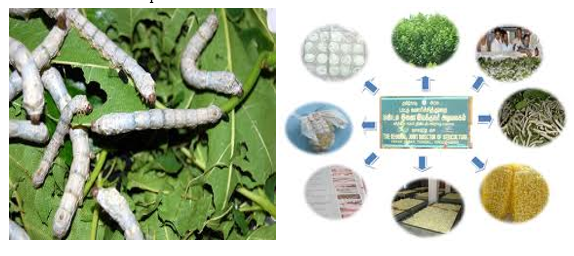
Sericulture - Commerical Rearing of Silk Worms
Sericulture is the commercial rearing of silk worms. It may supplement the income of the farmer.
Pisciculture
Breeding of fish in specially constructed tanks and ponds.
Viticulture
Cultivation of grapes for producing wine and other grape products.
.png)
Horticulture
Growing vegetables, flowers and fruits for commercial use.
.png)
What is Farm System?
Agriculture or farming can be looked at as a system. The important inputs are seeds, fertilisers, machinery and labour. Some of the operations involved are ploughing, sowing, irrigation, weeding and harvesting. The outputs from the system include crops, wool, dairy and poultry products.
Types of Farming
Depending upon the geographical conditions, demand of produce, labour and level of technology, farming can be classified into two main types. These are:
- (a) Subsistence farming
- (b) Commercial farming
Subsistence Farming:
Subsistence farming is characterised by small and scattered land holdings and use of primitive tools. Farmers are poor, they do not use fertilisers and high yielding variety of seeds. Facilities like electricity and irrigation are generally not available to them. Most of the food production is consumed by the farmers and their families.
.png)
Subsistence farming is of two types:
- (i) Intensive subsistence
- (ii) Primitive subsistence farming
Intensive Subsistence Agriculture
The farmer cultivates a small plot of land using simple tools and more labour. Climate with large number of days with sunshine and fertile soils permit growing of more than one crop annually on the same plot. Rice is the main crop. Other crops include wheat, maize, pulses and oilseeds. Intensive subsistence agriculture is prevalent in the thickly populated areas of the monsoon regions of south, southeast and east Asia.
Primitive Subsistence Agriculture
This type of farming activity is further classified into two types:
- Shifting Cultivation
It is practised in the thickly forested areas of Amazon basin, tropical Africa, parts of southeast Asia and Northeast India. In this type of agriculture, first of all a piece of forest land is cleared by felling trees and burning of trunks and branches. After the land is cleared, crops are grown for two to three years and then the land is abandoned as the fertility of the soil decreases. The farmers then move to new areas and the process is repeated. Dry paddy, maize, millets and vegetables are the crops commonly grown. Shifting cultivation is also known as 'slash and burn' agriculture.
- Nomadic Herding
It is practised in the semi-arid and arid regions of Sahara, Central Asia and some parts of India, like Rajasthan and Jammu and Kashmir. In this type of farming, herdsmen move from place to place with their animals for fodder and water, along defined routes. This type of movement arises in response to climatic constraints and terrain. Sheep, camel, yak and goats are most commonly reared. They provide milk, meat, wool, hides and other products to the herders and their families.
Commerical Forming
Crops are grown and animals are reared for sale in market. The area cultivated and the amount of capital used is large. Most of the work is done by machines. It has three types:
- (i) Commercial grain farming
- (ii) Mixed farming
- (iii) Plantation agriculture
.png)
- Commercial Grain Farming
Commercial grain farming is usually carried out on large, scientifically managed farms in areas of low population density. Crops are grown for commercial purpose. Wheat and maize are common commercially grown grains. Major areas are temperate grasslands of North America, Europe and Asia. These areas are sparsely populated with large farms spreading over hundreds of hectares. Severe winters restrict the growing season and only a single crop can be grown.
- Mixed Farming
Crop cultivation and animal husbandry are practised on the same farm. It is practised in Europe, eastern USA, Argentina, southeast Australia, New Zealand and South Africa.
.png)
- Plantations
Plantation farming is bush or tree farming. It is a single crop farming of rubber, tea, coffee, cocoa, spices, coconut and fruit crops like apples, grapes, oranges, etc. It is capital-intensive and demands good managerial ability, technical know-how, sophisticated machinery, fertilisers, irrigation, and transport facilities. Some of the plantations like tea, coffee and rubber have a processing factory within the farm itself or close to it. Major plantations are found in the tropical regions of the world. Rubber in Malaysia, coffee in Brazil, tea in India and Sri Lanka are some examples.
.png)
Major Crop Types
FOOD Crops
- (A) Rice
(i) Rice is the major food crop of the world.
(ii) It is the staple diet of the tropical and sub-tropical regions.
(iii) Rice needs high temperature, high humidity and rainfall. It grows best in alluvial clayey soil, which can retain water.
(iv) China leads in the production of rice followed by India, Japan, Sri Lanka and Egypt.
(v) In favourable climatic conditions as in West Bengal and Bangladesh two to three crops a year are grown.
- (B) Wheat
(i) Wheat requires moderate temperature and rainfall during growing season and bright sunshine at the time of harvest and loamy soil.
(ii) Wheat is grown extensively in USA, Canada, Argentina, Russia, Ukraine, Australia and India.
(iii) In India it is grown in winter.
- (C) Millets
(i) They are also known as coarse grains and can be grown on less fertile and sandy soils.
(ii) It is a hardy crop that needs low to adequate rainfall and high to moderate temperature.
(iii) Jowar, bajra and ragi are grown in India.
(iv) Other countries are Nigeria, China and Niger.
- (D) Maize
(i) It requires moderate temperature, rainfall and lots of sunshine and well drained fertile soils.
(ii) Maize is grown in North America, Brazil, China, Russia, Canada, India and Mexico.
(iii) The leading producer is the U.S.A.
FIBRE Crops
- (A) Cotton
(i) It requires high temperature, light rainfall, two hundred and ten frost-free days and bright sunshine for its growth.
(ii) It grows best on black and alluvial soils.
(iii) China, USA, India, Pakistan, Brazil and Egypt are the leading producers of cotton.
(iv) It is one of the main raw materials for the cotton textile industry.
- (B) Jute
(i) It was also known as the 'Golden Fibre'.
(ii) It requires alluvial soil, high temperature, heavy rainfall and humid climate.
(iii) This crop is grown in the tropical areas.
(iv) India and Bangladesh are the leading producers of jute.
BEVERAGE CROPS
- (A) Coffee
(i) It requires warm and wet climate and well-drained loamy soil.
(ii) Hill slopes are more suitable for growth of this crop.
(iii) Brazil is the leading producer followed by Colombia and India.
- (B) Tea
(i) Tea is a beverage crop grown on plantations.
(ii) This requires cool climate and well distributed high rainfall throughout the year for the growth of its tender leaves.
(iii) It needs well-drained loamy soils and gentle slopes.
(iv) Labour in large number is required to pick the leaves.
(v) Kenya, India, China, Sri Lanka produce the best quality tea in the world.
Agricultural Development
Agricultural Development refers to efforts made to increase farm production in order to meet the growing demand of increasing population. This can be achieved in many ways such as increasing the cropped area, the number of crops grown, improving irrigation facilities, use of fertilisers and high yielding variety of seeds. Mechanisation of agriculture is also another aspect of agricultural development. The ultimate aim of agricultural development is to increase food security.
Developing countries with large populations usually practise intensive agriculture where crops are grown on small holdings mostly for subsistence. Larger holdings are more suitable for commercial agriculture as in USA, Canada and Australia.
Agriculture Farm in INDIA vs USA
An Agricultural Farm in India
- The size of an average farm is very small. This is chiefly due to the repeated division of a plot among the heirs of the cultivator generation after generation.
- The land is intensively cultivated. Double cropping and multiple cropping are common.
- The farm produce is used mainly for self-sustenance and there is very little surplus.
- The use of machines is very limited. Most farmers are too poor to afford expensive farm machinery. As the density of population is high, manual labour is cheap and is widely used in farm operations.
- There is limited use of chemical fertilisers, pesticides, improved seeds and modern methods of farming. This is partly due to lack of awareness and partly due to poverty.
- There has been limited development of pastoral farming and mixed farming. The farm is used mainly for growing food. As the land is usually not used for growing fodder, farm animals are fed on farm wastes. No special provisions are made for housing these animals or caring for them.
- The farm is usually managed by illiterate farmers. Schemes are now being introduced to raise their level of awareness.
- The yield of crops is generally low.
.png)
An Agricultural Farm in the USA
- The average size of a farm in the USA is much larger than that of an Indian farm. A typical farm size in the USA is about 250 hectares. This is because land is abundant and cheap.
- The extensive type of agriculture is practised. Single-cropping is the usual practice, with scope for growing fodder crops.
- Agriculture is commercial. Most of the produce is sold. As the local demand is small, there is a large surplus, which is exported.
- Farms are highly mechanised, most operations being performed by machines. As farms are large, the use of machines is a necessity. Also, manual labour is scarce and hence expensive.
- High-yielding varieties of seeds, chemical fertilisers, pesticides and modern methods of farming are used. As the farmers are wealthy, they can easily afford these. However, due to the adverse effects of chemicals, farmers are now switching to eco-friendly methods.
- Animals are reared using scientific methods, both on ranches and on dairy farms. Mixed farming is common, which is a boon to farmers in the event of a crop failure. Fodder crops are grown to feed farm animals.
- The farm is managed by well-educated farmers, who are aware of the latest techniques and developments in the field of agriculture and the conditions prevailing in the market.
- The yield per acre is lower than in many other countries, but the yield per worker is high.
- The farmer in USA works like a businessman and not like a peasant farmer.
.png)
Detailed Comparison Table
| Aspect | Indian Farm | USA Farm |
|---|---|---|
| Farm Size | Very small (fragmented holdings) | Large (about 250 hectares) |
| Type of Cultivation | Intensive (multiple cropping) | Extensive (single cropping) |
| Purpose | Self-sustenance with little surplus | Commercial with large surplus for export |
| Mechanisation | Limited use of machines | Highly mechanised operations |
| Labour | Manual labour (cheap and abundant) | Machine labour (manual labour scarce and expensive) |
| Inputs | Limited use of fertilisers, HYV seeds | High-yielding seeds, modern methods |
| Animal Rearing | Limited pastoral farming | Scientific methods, mixed farming common |
| Farm Management | Often by illiterate farmers | Well-educated farmers with business approach |
| Crop Yield | Generally low | Low per acre but high per worker |
Some Interesting Facts
(i) Organic Farming: Organic farming is a type of farming in which organic manure and natural pesticides are used instead of chemicals. No genetic modification is done to increase the yield of the crop.
(ii) Different Names for Shifting Cultivation: Shifting cultivation is known by different names in different parts of the world. For e.g. Jhumming in North-East India, Milpa in Mexico and Ladang in Malaysia.
(iii) Maize Varieties: Maize is also known as corn. Various colourful varieties of maize are found across the world.
(iv) Discovery of Coffee: There are different versions about the discovery of coffee. In about AD 850, Kaldi, an Arab goat-herder, who was puzzled by the queer antics of his flock, tasted the berries of the evergreen bush on which the goats were feeding. On experiencing a sense of exhilaration, he proclaimed his discovery to the world.
(v) Food Security: Food security exists when all people, at all times, have access to sufficient, safe and nutritious food to meet their dietary needs and food preferences for an active and healthy life.
.png)
Exercise - Objective Questions
1. Horticulture means–
(A) growing of fruits and vegetables
(B) primitive farming
(C) growing of wheat
(D) growing of coffee
Answer: (A)
2. The term Golden fibre is often used for–
(A) Tea
(B) Cotton
(C) Jute
(D) Synthetic yarn
Answer: (C)
3. Leading producer of coffee–
(A) Brazil
(B) India
(C) Russia
(D) China
Answer: (A)
4. Coarse grains are also called–
(A) maize
(B) rice
(C) wheat
(D) millets
Answer: (D)
5. Type of farming to meet family needs –
(A) Commercial grain farming
(B) Subsistence farming
(C) Mixed farming
(D) Plantation
Answer: (B)
6. Rearing of animals for sale –
(A) nomadic herding
(B) shifting
(C) intensive farming
(D) commercial farming
Answer: (D)
7. Growing grapes for producing wine–
(A) Viticulture
(B) Sericulture
(C) Pisciculture
(D) Horticulture
Answer: (A)
8. Requires 210 frost-free days for growth –
(A) rice
(B) wheat
(C) maize
(D) cotton
Answer: (D)
9. Cultivation involving slash and burn–
(A) Shifting cultivation
(B) Nomadic herding
(C) Mixed farming
(D) Plantation
Answer: (A)
10. Which of the following is also called Golden Fibre?
(A) Jute
(B) Coffee
(C) Tea
(D) Cotton
Answer: (A)
11. When crops are combined with livestock the type of farming is known as–
(A) Mixed Farming
(B) Commercial grain farming
(C) Nomadic herding
(D) Intensive farming
Answer: (A)
12. Which country is the largest producer and seller of maize?
(A) China
(B) U.S.A.
(C) Russia
(D) Canada
Answer: (B)
13. The crop requires moderate temperature and rainfall during growing season and sunshine at the time of harvesting–
(A) wheat
(B) rice
(C) maize
(D) Millet
Answer: (A)
14. More number of labour is required in this type of agriculture –
(A) Shifting cultivation
(B) Horticulture
(C) Plantation
(D) Nomadic herding
Answer: (C)
15. Commercial grain farming is not common in –
(A) Asia
(B) Europe
(C) North America
(D) South America
Answer: (D)
Subjective Questions
1. What is sericulture?
2. Name the supplementary forms of farming.
3. What climatic conditions are required in tea plantation?
4. What is agriculture?
5. Name the factors influencing agriculture?
6. What is commercial farming?
7. What is mixed farming?
8. Name three major rice producing countries.
9. What is shifting cultivation? What are its disadvantages?
10. What is plantation agriculture?
11. Name the beverage crops. Discuss the climatic conditions required for their growth.
12. Mention the climatic conditions and types of soils required for wheat and cotton.
13. Write in brief about commercial grain farming.
14. Differentiate between –
- (i) Subsistence farming and commercial farming.
- (ii) Extensive farming and intensive farming
15. What are the reasons for higher production of wheat in the U.S.A.?
16. Write about nomadic herding.
17. Compare the agricultural development of developed and developing countries with the help of case study of farms from U.S.A. and India.
18. Name the major agricultural types and explain any one of them.