Chapter-13. The Indian Constitution
“The Indian Constitution” introduces students to the framework that governs India. It explains the key principles of democracy, equality, and justice, and how the Constitution ensures citizens’ rights and duties. Students learn about the Preamble, Fundamental Rights, Directive Principles, and the importance of secularism.
NCERT Solutions for Class 8 help students analyze constitutional concepts with precision. Class 8 Notes summarize core topics, making revision simpler before exams. Through Class 8 Home Tuition, tutors explain each article in detail, helping students connect theoretical learning with real-life examples. Understanding this chapter helps students appreciate India’s democratic values and strengthens their civic knowledge.
The Constitution lays down the basic structure of the government under which its people are to be governed. The Constitution is a fundamental legal document according to which the government of a country functions. A Constitution is superior to all the laws of a country. Every law enacted by the government machinery, has to be in conformity with the Constitution.
Framing of Indian Constitution
The Cabinet Mission came to India in 1945 and discussed the framework for the Constitution and laid down some details of the procedure to be followed by the constitution making body. Elections for the 296 seats assigned to the British-Indian provinces were completed by July-August 1946. With the independence of India, the Constituent Assembly became a fully sovereign body.
The Assembly started working from the ninth-day of December 1946. The Assembly had the benefit of a galaxy of outstanding leaders. Their farsightedness and visionary statesmanship found expression in the Constitution which is the supreme law of the land. Dr. Rajendra Prasad was elected President of the Constituent Assembly.
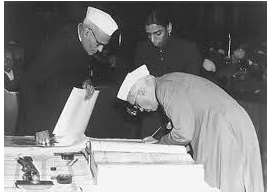
A Drafting Committee was appointed to drai tthe Constitution. Dr. B.R. Ambedkar was appointed the Chairman of the Drafting Committee. The Constituent Assembly met for 166 days spread over a period of 2 years, 11 months and 18 days. The Constitution was passed by the Assembly on 26 November 1949. It came into being on 26 January 1950.
Why do we need a Constitution?
Most countries in the world have a constitution. While all democratic countries are likely to have a constitution, it is not necessary that all countries that have a constitution are democratic. The constitution serves several purposes.
- It lays out certain ideals that form the basis of the kind of country that we as citizens aspire to live in. Constitution tells us the fundamental nature of our society.
- A country is usually made up of different communities of people who share certain beliefs but may not necessarily agree on all issues. A constitution helps serve as a set of rules and principles that all persons in a country can agree upon as the basis of the way in which they want the country to be governed.
- Constitution includes not only the type of government but also an agreement on certain ideals that the people believe the country should uphold.
Do Check: How, When and Where Class 8 Notes
Case Study of Nepal
- Until quite recently, Nepal was a monarchy. The previous Constitution of Nepal, which had been adopted in 1990, reflected the fact that the final authority rested with the king.
- A people's movement in Nepal fought for several decades to establish democracy and in 2006 they finally succeeded in putting an end to the powers of the King.
- Now the people wish to write a new Constitution to establish Nepal as a democracy. The reason why they do not want to continue with the previous Constitution is because it does not reflect the ideals of the country that they want Nepal to be, and that they have fought for.
- Nepal, by moving from a monarchy to a democratic government, needs to change all its constitutive rules in order to usher in a new society. This is why, the people of Nepal are in the process of writing a new Constitution for the country.
Nature of Political System
The second important purpose of a Constitution is to define the nature of a country's political system. In countries that have adopted a democratic form of government or polity, the constitution plays a crucial role in laying out certain important guidelines that govern decision-making within these societies. In a democracy, we choose our leaders so that they can exercise power responsibly on our behalf. However, there is always the possibility that these leaders might misuse their authority and the Constitution usually provides safeguards against this misuse of power by our political leaders.
This misuse of authority can result in gross injustice. In the case of the Indian Constitution, many of these laws are contained in the section on Fundamental Rights. The Indian Constitution guarantees the right to equality to all persons and says that no citizen can be discriminated against, on grounds of religion, race, caste, gender, and place of birth. The Right to Equality is one of the Fundamental Rights guaranteed by the Indian Constitution.
Safeguards the righs of Minority
Another important function that a Constitution plays in a democracy is to ensure that a dominate group does not use its power against other, less powerful people or groups.
The Constitution usually contains rules that ensure that minorities are not excluded from anything that is routinely available to the majority. Another reason why we have a Constitution is precisely to prevent domination by the majority of a minority. This can refer to one community dominating another, i.e. intercommunity domination, or members of one community dominating others within the same community, i.e. intra-community domination.
Check on Strong Decisions
The third significant reason why we need a Constitution is to save us from ourselves. This may sound strange but what is meant by this is that we might at times feel strongly about an issue that might go against our larger interests and the Constitution helps us guard against this.
Similarly, the Constitution helps to protect us against certain decisions that we might take that could have an adverse effect on the larger principles that the country believes in. For example, it is possible that many people who live in a democracy might come to strongly feel that party politics has become so acrimonious that we need a strong dictator to set this right.
Swept by the emotion, they may not realise that in the long run, dictatorial rule goes against all their interests. A good Constitution does not allow these whims to change its basic structure. It does not allow for the easy overthrow of provisions that guarantee rights of citizens and protect their freedom.
Key Features of the Indian Constitution
- During the freedom struggle the nationalists had devoted a great deal of time to imagining and planning what a free India would be like. Under the British, they had been forced to obey rules that they had very little role in making. The long experience of authoritarian rule under the colonial state convinced Indians that free India should be a democracy in which everyone should be treated equally and be allowed to participate in government.
- What remained to be done then was to workout the ways in which a democratic government would beset up in India and the rules that would determine its functioning. This was done not by one person but by a group of around 300 people who became members of the ConstituentAssembiy in 1946 and who met periodically for the next three years to write India's Constitution. Finally the constitution was passed by the constituent assembly on 26 November 1949.
- When the constitution was being written, India was going through considerable turmoil. The partition of the country into India and Pakistan was imminent, some of the Princely States remained undecided about their future, and the socio- economic condition of the vast mass of people appeared dismal. All these issues played on the minds of the members of the Constituent Assembly as they drafted the Constitution. They rose to the occasion and gave this country a visionary document that reflects a respect for maintaining diversity while preserving national unity.
- The final document also reflects their concern for eradicating poverty through socio-economic reforms as well as emphasizing the crucial role the people can play in choosing their representatives.
Do Check: Ruling the Country Side Class 8 Notes
Keeping above factors in mind, the framers of Indian constitution tried to balance these concerns such as diversity, unity, socio economic reform and representation with their commitment to transforming independent India into a strong democratic society.
- This refers to the existence of more than one level of government in the country. In India, we have governments at the state level and at the centre. Panchayati Raj is the third tier of government. The vast number of communities in India meant that a system of government needed to be devised that did riot involve only parsons sitting in the capital city of New Delhi and making decisions for everyone. Instead, it was important to have another level of government in the states so that decisions could be made for that Particular area. While each state in India enjoys autonomy in exercising powers on certain issues; subjects of national concern require that all of these states follow the laws of the central government.
- The Constitution demarcates the powers of the central and the state government into different lists of subjects. These lists are called the Union list, the State list and the Concurrent list.
- Subjects of nationai importance like defence, foreign affairs, atomic energy, banking, post and telegraph are included in the Union List. The central government can pass laws on the subjects mentioned in the union list. The union list has 99 subjects.
- The State List comprises those important subjects on which the state government can pass laws. Subjects like police, local government, trade and commerce within the state, agriculture are included in the State List. The State List has 66 subjects.
- In order to avoid any kind of ambiguity in the distribution of functions, the Constitution provides for a third list which is called concurrent List. These are the subjects which are of common concern both to the centre and the state governments. The Concurrent list has got 52 subjects.
- In addition the constitution also specifies where each tier of government can get the money from for the work that it does. Under federalism, the states are not merely agents of the federal government but draw their authority from the constitution as well. All persons in India are governed by laws and policies made by each of these levels of government.
Parliamentary Form of Government
The different tiers of government consist of representatives who are elected by the people. The Constitution of India guarantees universal adult suffrage for all citizens. When they were making the Constitution, the members of the Constituent Assembly felt that the freedom struggle had prepared the masses for universal adult suffrage and that this would help encourage a democratic mindset and break the clutches of traditional caste, class and gender hierarchies.
This means that the people of India have a direct role in electing their representatives. Also, every citizen of the country, irrespective of his/her social background, can also contest in elections. These representatives are accountable to the people.
Seperation of Powers
According to the Constitution, there are three organs of the State. These are the legislature, the executive and the Judiciary. The legislature refers to our elected representatives. The executive is a smaller group of people who are responsible for implementing laws and running the government.
The judiciary refers to the system of courts in this country. In order to prevent the misuse of power by any one branch of the State, the Constitution says that each of these organs should exercise different powers. Through this, each organ acts as a check on the other organs of the State and this ensures the balance of power between all three.
Fundamental Rights
The section on Fundamental Rights has often been referred to as the 'conscience' of the Indian Constitution. Fundamental Rights, protect citizens against the arbitrary and absolute exercise of power by the State. The Constitution, thus, guarantees the rights of individuals against the State as well as against other individuals.
The Constitution classifies the fundamental rights under seven groups. According to 44th amendment of Constitution, the right to property is now a legal right. Recently there are 6 Fundamental Rights. These are as follows -
Types of Fundamental Rights
- Right to Equality : All persons are equal before the law. This means that all persons shall be equally protected by the laws of the country. It also states that no citizen can be discriminated against on the basis of their religion, caste or sex. Every person has access to all public places including playgrounds, hotels, shops etc. The States cannot discriminate against anyone in matters of employment. But there are exceptions to this. The Constitution provides for special provisions in the form of reserve posts while guaranteeing right to equality. Reserve posts are provided for scheduled castes, scheduled tribes and other backward classes. Similarly, special provisions are provided for women and children. The practice of untouchability has also been abolished.
- Right to Freedom : This includes the right to freedom of speech and expression, the right to assemble peaceably and without arms, the right to form associations or unions, the right to move freely throughout the territory of India, the right to reside in any part of the country, and the right to practice any profession, occupation or business.
- Right against Exploitation : The Constitution prohibits human trafficking, forced labour, and children working under 14 years of age.
- Right to Freedom of Religion : Religious freedom is provided to all citizens. Every person has the right to practice, profess and propagate the religion of his \ her choice.
- Cultural and Educational Rights : The Constitution states that all minorities, religious or linguistic, can set up their own educational institutions in order to preserve and develop their own culture.
- Right to Constitutional Remedies : This allows citizens to move the court if they believe that any of their Fundamental Rights have been violated by the State.
Protection of Minorities
Moreover, the various minority communities also expressed the need to include rights that would protect minority group. The Constitution, therefore, also guarantees the rights of minorities against the majority. As Dr. Ambedkar has said about these Fundamental Rights, their object is two-fold.
The first objective is that every citizen must be in a position to claim those rights. And secondly, these rights must be binding upon every authority that has got the power to make laws.
Directive Principles of State Policy
In addition to Fundamental Rights, the Constitution also has a section called Directive Principles of State Policy. This section was designed by the members of the Constituent Assembly to ensure greater social and economic reform and to serve as a guide to the independent Indian State to institute laws and policies that help to reduce the poverty of the masses.
Do Check: When People Rebel Class 8 Notes
Secularism
India is a secular state. All citizens, irrespective of their religious beliefs are equal in the eyes of the law. The government cannot formulate such policies which discriminate between various religious communities which live in India.
Exercise
Ques. The Right to property is now a -
(A) Constitutional right
(B) Legal right
(C) Ordinary right
(D) None
Ques. Which constitutional amendment removed the right of property ?
(A) 42nd
(B) 44th
(C) 46th
(D) 45th
Ques. Which right provides reservations for SC, ST and 9BCs ?
(A) Right to equality
(B) Right to freedom
(C) Right against exploitation
(D) None of these
Ques. How many Fundamental Rights are provided in the Indian constitution ?
(A)10
(B) 8
(C) 6
(D) 7
Ques. Which right allows citizens to move to the court if they believe that any of their Fundamental Rights have been violated by the State?
(A) Right to freedom
(B) Right to constitutional remedies
(C) Right to equality
(D) Right against exploitation
Ques. In which year the Cabinet Mission came to India ?
(A) 1920
(B)1922
(C) 1929
(D) 1945
Ques. The Constitution was passed by the Constituent Assembly on -
(A) 26 Jan. 1931
(B) 22 Dec. 1946
(C) 26 Nov. 1949
(D) 26 Jan. 1950
Ques. During which years the constitution was framed ?
(A)1934 - 1939
(B) 1920 - 22
(C) 1946 -1949
(D) 1945 -1946
Ques. The monarchial type of constitution is Nepal was adopted in -
(A) 2006
(B) 2004
(C) 1990
(D) 1995
Ques. How many organs are there in Indian government ?
(A) 4
(B) 3
(C) 5
(D) 2
Ques. When was democracy established in Nepal ?
(A) 2006
(B)2004
(C) 2002
(D) 1990
Ques. How many subjects are there in union list?
(A) 66
(B) 68
(C) 99
(D) 52
Ques. How many subjects are there in the concurrent list ?
(A) 47
(B) 52
(C)71
(D) 66
Ques. How many subjects are there in state list ?
(A) 66
(B) 61
(C) 68
(D) 64
Ques. Our constitution was enacted on -
(A) 26th November 1949
(B) 26th January 1950
(C) 9th December 1946
(D)14 July 1949
Subjective Questions
- How many fundamental rights are given to Indian citizen ?
- In how many lists the powers are divided in the Indian Constitution ?
- How many freedoms are given in the right to freedom ?
- What is the majority group ?
- How many subject are there in concurrent list ?
- What was the aim of the people's movement in Nepal ?
- What is the right against exploitation ?
- What is Adult Franchise ?
- What are fundamental rights ?
- How the right to freedom of religion is protected in India ?
- What are cultural and educational rights ?
- Write about the democratic nature of Indian government.
- How India protects the minority ?
- Write about the Nepal's struggle for democracy.
- What is the importance of Fundamental Rights for the citizens?
- What is the meaning of secular state ?
- Explain briefly the right to equality.
- Why do we need a Constitution ?
- What are the Federal features of Indian Constitution ?
- Write about separation of powers in Indian Constitution
Answer to Exercise
- (B)
- (B)
- (A)
- (C)
- (B)
- (D)
- (C)
- (C)
- (C)
- (B)
- (A)
- (C)
- (B)
- (A)
- (B)