Chapter-5. When People Rebel (1857 and After)
The chapter “When People Rebel” covers the historic Revolt of 1857 — India’s first major struggle against British rule. Students learn about the causes, major events, key leaders, and aftermath of the rebellion. The revolt marked a turning point in India’s fight for freedom, influencing future movements.
For effective study, NCERT Solutions for Class 8 offer detailed answers that help clarify concepts and historical timelines. Using Class 8 Notes, students can easily revise causes like political, social, and economic discontent among Indians. Students can also benefit from Class 8 Home Tuition, where expert tutors explain the revolt’s significance, regional participation, and long-term effects. Tutors also help in answer writing and map practice. Understanding this chapter helps students appreciate India’s rich history of resistance and the roots of modern nationalism.
Policies and the People
The policies of the east india company affected different people. Kings, queens, peasants, landlords, tribals, soldiers were all affected in different ways. People resisted policies and actions that were against their interest or go against their settlements.
Nawabs lose their power:
- Since the mid-eighteenth century, nawabs and rajas had gradually lost their authority and honour. Residents had been stationed in many courts, the freedom of the rulers reduced, their armed forces disbanded, and their revenues and territories taken away by stages.
- Many ruling families tried to negotiate with the company to protect their interests for example, rani lakshmibai of jhansi wanted the company to recognise her adopted son as the heir to the kingdom after the death of her husband. Nana saheb, the adopted son of peshwa baji rao li, pleaded that he had been given his father's pension when the latter died. However, the company turned down these pleas.
- The company even began to plan how to bring the mughal dynasty to an end. The name of the mughal king was removed from the coins minted by the company. In 1849, governor-general dalhousie announced that after the death of bahadur shah zafar, the family of the king would be shifted out of the red fort. In 1856, governor - general canning decided that bahadur shah zafar would be the mughal king and after his death none of his descendants would be recognised as kings - they would just be called princes.
The peasants and the sepoys:
- In the countryside peasants and zamindars resented the high taxes and the rigid methods of revenue collection. Many failed to pay back their loans to the moneylenders and gradually lost the lands they had tilled for generations.
- The indian sepoys in the employ of the company were unhappy about their pay, allowances and conditions of service. New rules violated their religious sensibilities and beliefs. Many people in the country believed that if they crossed the sea they would lose their religion and caste. When in 1824 the sepoys were told to go to burma by the sea route to fight for the company. They refused to follow the order, though they agreed to go by the land route. They were severely punished. In 1856 the company passed a new law which stated that every new person who took up employment in the company's army had to agree to serve overseas if required.
- Many of sepoys were peasants and had families living in the villages. So the anger of the peasants quickly spread among the sepoys.
Responses to reforms:
- The british believed that indian society had to be reformed. Laws were passed to stop the practice of sati and to encourage the remarriage of widows. English - language education was actively promoted. In 1850, a new law allowed an indian who had converted to christianity to inherit the property of his ancestors. Many indians began to feel that the british were destroying their religion, their social customs and their traditional way of life.
- There were of course other indians who wanted to change existing social practices.
Do Check: How, When and Where Class 8 Notes
Through the eyes of the people
The list of eighty- four rules:
In his book majha pravas, vishnu bhatt godse has written that, "The english were determined to wipe out religions of the hindus and the muslims. They had made a list of eighty- four rules and announced these in a gathering of all big kings and princes in calcutta. They said that the kings refused to accept these rules and warned of dire consequences and massive upheaval if these were implemented. All the big people began making plans. A date was fixed for the war of religion and the secret plan had been circulated from the cantonment in meerut by letters sent to different cantonments."
" There was soon excitement in every regiment"
Subedar sitaram pande a sepoy in the bengal nativearmy, served the english for 48 years and retired in 1860. He helped the british to suppress the rebellion. On retirement he was persuaded by his commanding officer, norgate, to write his memoirs. He completed the writing in 1861 in awadhi and norgate translated it into english and had published under the title from sepoy to subedar. Sitaram pande wrote :
Seizing of oudh filled the minds of the sepoys with distrust and led them to plot against the government. Agents of the nawab of oudh and also of the king of delhi were sent all over india to discover the temper of the army. They worked upon the feelings of sepoys, telling them how treacherously the foreigners had behaved towards their king. They invented ten thousand lies and promises to persuade the soldiers to mutiny and turn against their masters, the english, with the object of restoring the emperor of delhi to the throne. They maintained that this was wholly within the army's powers if the soldiers would only act together and do as they were advised.
It chanced that about this time the sarkar sent parties of men from each regiment to different garrisons for instructions in the use of the new rifle. These men performed the new drill for some time until a report got about by some means or the other, that the cartridgs used for these new rifles were greased with the fat of cows and pigs. The men from our regiment wrote to others in the regiment telling them about this, and there was some excitement in every regiment. Some one pointed out that in forty years' service nothing had ever been done by the sarkar to insult their religion, but as I have already mentioned the sepoys' minds had been inflamed by the seizure of oudh. Interested parties were quick to point out that the great aim of the english was to turn us all into christians, and they had therefore introduced the cartridge in order to bring this about, since both mohammedans and hindus would be defiled by using it.
A mutiny becomes a popular rebellion
In the northern parts of india in 1857, after a hundred years of conquest and administration, the english east india company faced a massive rebellion that started in may 1857 and threatened the company's very presence in india. Sepoys mutinied in several places beginning from sections of society rose up in rebellion.
From meerut to delhi:
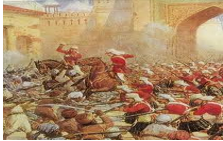
- On 29 march 1857, a young soldier, mangal pandey, was hanged to death for attacking his officers in barrackpore. Some sepoys of the regiment at meerut refused to do the army drill using the new cartridges. Eighty-five sepoys were dismissed from service and sentenced to ten years in jail for disobeying their officers. This happened on 9 may 1857.
- On 10 may, the soldiers marched to the jail in meerut and released the imprisoned sepoys. They attacked and killed british officers. The soldiers were determined to bring an end to their rule in the country. The sepoys of meerut rode all night of 10 may to reach delhi in the early hours next morning. As news of their arrival spread, the regiments stationed in delhi also rose up in rebellion: triumphant soldiers gathered around the walls of the red fort where the badshah lived, demanding to meet him. They forced their way into the palace and proclaimed bahadur shah zafar as their leader. Again british officers were killed arms and ammunition seized, buildings set on fire.
- The ageing emperor wrote letters to all the chiefs and rulers of the country to come forward and organise a confederacy of indian states to fight the british. This step taken by bahadur shah had great implications. Threatened by the expansion of british rule, many of the small rulers and chieftains felt that if the mughal emperor could rule again, they too would be able to rule their own territories once more, under mughal authority.
- Bahadur shah zafar's decision to bless the rebellion changed the entire situation dramatically. Often when people see an alternative possibility they feel inspired and enthused. It gives them the courage, hope and confidence to act.
The rebellion spreads:
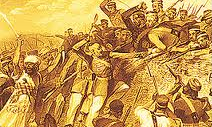
- After the british were routed from delhi, there was no uprising for almost a week. Then, a spurt of mutinies began. Regiment after regiment mutinied and took off to join other troops at nodal points like delhi, kanpur and lucknow. The people of the towns and villages also rose up in rebellion and rallied around local leaders, zamindars and chiefs who were prepared to establish authority and fight the british.
- Nana saheb gathered armed forces and expelled the british garrison from the city of kanpur. In lucknow, birjis qadr, the son of the deposed nawab wajid ali shah, was proclaimed the new nawab. His mother begum hajrat mahal took an active part in organising the uprising against the british. In jhansi, rani lakshmibai joined the rebel sepoys and fought the british along with tantia tope, the general of nana saheb.
- The british were greatly outnumbered by the rebel forces. They were defeated in a number of battles. This convinced the people that the rule of the british had collapsed for good and gave them the confidence to take the plunge and join the rebellion. A situation of widespread popular rebellion developed in the region of awadh in particular.
- Many new leaders came up, for example, ahmadullah shah, a maulvi from faizabad, prophesied that the rule of the british would come to an end soon. He raised a huge force of supporters. He came to lucknow to fight the british. In delhi, a large number of ghazis or religious warriors came together to wipe out the white people. Bakht khan took charge of a large force of fighters who came to delhi. He became a key military leader of the rebellion. In bihar, kunwar singh, joined the rebel sepoys and battled with the british for many months. Leaders and fighters from across the land joined the fight.
Do Check: Ruling the Country Side Class 8 NotesThe company fights back
- The company decided to repress the revolt with all its might. It brought reinforcements from england, passed new laws so that the rebels could be convicted with ease, and then moved into the storm centres of the revolt. Delhi was recaptured from the rebel forces in september 1857. Bahadur shah zafar was tried in court and sentenced to life imprisonment. His sons were shot dead before his eyes. He and his wife begum zinat mahai were sent to prison in rangoon in october 1858. Where he died in november 1862.
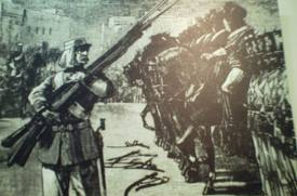
- People continued to resist and battle the british. The british had to fight for two years to suppress the massive forces of popular rebellion.
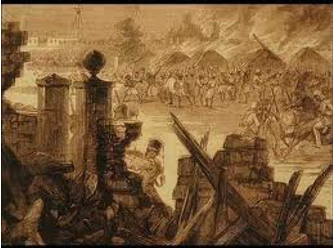
- Lucknow was taken in march 1858. Rani lakshmibai was defeated and killed in june 1858. Tantia tope escaped to the jungles of central india and rajputana and continued to fight a guerrilla war. He was captured, tried and killed in april 1859.
- The british also tried their best to win back to the loyalty of the people, they announced rewards for loyal landholders and allowed them to continue the traditional rights over their lands. Those who had rebelled were told that if they submitted to the british, and if they had not killed any white people, they would remain safe and their rights and claims to land would not be denied. Nevertheless, hundreds of sepoys, rebels, nawabs and rajas were tried and hanged.
Aftermath
The british had regained control of the country by the end of 1859, but they could not carry on ruling the land with the same policies any more.
Many changes were introduced by the british after the revolt of 1857 -
- The british parliament passed a new act in 1858 and transferred the powers of the east india company to the british crown in order to ensure a more responsible management of indian affairs. A member of the british cabinet was appointed secretary of state for india and made responsible for all matters related to the governance of india. He was given a council to advise him, called the india council. The governor-general of india was given the title of viceroy. The british government accepted direct responsibility for ruling india.
- All ruling chiefs of the country were assured that their territory would never be annexed in future. However, they were made to acknowledge the british queen as their sovereign paramount.
- It was decided that the proportion of indian soldiers in the army would be reduced and the number of european soldiers would be increased.
- The land and property of muslims was confiscated on a large scale and they were treated with suspicion and hostility.
- The british decided to respect the customary religious and social practices of the people in india.
- Policies were made to protect landlords and zamindars and given them security of rights over their lands.
Exercise
Ques. The personal grievance of Nana Saheb, on account of which he became staunch anti-British and raised the banner of Revolt in 1857, was:
(A) His claim to Peshwaship was abolished
(B) The British refused to pay him the pension earlier paid to his father Peshwa Baji Rao II
(C) The British humiliated him by declaring that he was not a natural son of Bajirao ii
(D) The British forced him to abandon his ancestral palace and to reduce his entourage
Ques. Who announced that afterthe death of bahadur Shah Zafar, the family of the king would be shifted out of the Red Fort ?
(A) King George V
(B) Queen Victoria
(C) Canning
(D) Dalhousie
Ques. Lord Dalhousie tried to snatch away the remaining glory of the Mughal Emperor Bahadur Shah II by:
(A) Reducing his pension
(B) Forcing him to disarm his bodyguards
(C) Derecognising his imperial title
(D) Asking him to vacate the Red Fort
Ques. The first serious mutiny of the Indian soldiers in the British Army took place at:
(A) Patna
(B) Barrackpore
(C) Vellore
(D) Meerut
Do Check: The Indian Constitution Class 8 Notes
Ques. Lord Dalhosie's single measure, which went a long way in spreading the Revolt of 1857, was:
(A) Annexation of native states on the plea of mismanagement
(B) Introduction of railway, post and telegraph
(C) Stopping or reducing the pensions of former Indian rulers
(D) Indiscriminate application of the Doctrine of Lapse
Ques. Where did the first signs of unrest appear early in 1857 ?
(A) Awadh
(B) Bengal
(C) Meerut
(D) Upper Provinces
Ques. At Barrackpore, Mangal Pandey was hanged on March 29, 1857 and became a martyr. His crime was that he :
(A) Refused to obey his officers
(B) Refused to use the greased cartridges
(C) Incited his fellow sepoys not to use the greased cartridges
(D) Revolted and attacked his superior officers
Ques. Where did the sepoys break out in open revolt on May 10, 1857 ?
(A) Kanpur
(B) Barrackpore
(C) Berhampore
(D) Meerut
Ques. The political significance of proclaiming the last Mughal Emperor Bahadur Shah ll as `King Emperor of Hindustan' was that :
(A) It signified the end of the British rule from India
(B) It signified the revival of the Mughal rule in India
(C) Both (a) and (b)
(D) Emperor Bahadur Shah ll became the rallying point for the rebels
Ques. Which of the following was not one of the storm-centres of the Revolt of 1857 ?
(A) Bareilly
(B) Jhansi
(C) Madras
(D) Arrah
Ques. Which of the following was/were responsible for the massacre at Kanpur ?
(A) Nana Saheb
(B) Tantia Tope
(C) Azimullah
(D) Nana's troops
Ques. Who incited the sepoys in Jhansi to hurl defiance at their officers and to commit violence and murder?
(A) Rani Lakshmibai
(B) Tantia Tope
(C) Lachman Rao
(D) Damodar Rao
Ques. The main centre of revolt, first recaptured by the British, was
(A) Delhi
(B) Lucknow
(C) Kanpur
(D) Jhansi
Ques. With the capture of which of the following rebels in April 1858 could the revolt be said to have ended ?
(A) Kunwar Singh
(B) Nana Saheb
(C) TantiaTope
(D) Begum Hazrat Mahal
Ques. Which of the following was the chief organiser of the Revolt of 1857 in Bihar ?
(A) Amar Singh
(B) Kunwar Singh
(C) Pir Ali
(D) Imaduddin
Subjective Type Questions
Ques. When was Awadh annexed ?
Ques. Why were the sepoys reluctant to serve overseas ?
Ques. When was a new law passed, if required, sepoy had to serve overseas ?
Ques. From where did the sepoy mutiny begin ?
Ques. Who was Nana Saheb ?
Ques. What reward was announced for the loyal landlords ?
Ques. When was Delhi recaptured from the rebel forces ?
Ques. Why were Muslims treated as hostile after 1857 ?
Ques. What plan did the company make to bring an end to the Mughal dynasty ?
Ques. Why were the sepoys employed in the service of the Company unhappy ?
Ques. What new rule was passed about the overseas service of the sepoy in 1856 ?
Ques. How did the following react during 1857 ?
(a) Nana Saheb (b) Begum Hazrat Mahal
Ques. What impact did Bahadur Shah Zafar's support to the rebellion have on the people and the ruling families ?
Ques. How did the British succeed in securing the submission of the rebel landowners of Awadh ?
Ques. In what ways did the British change their policies as a result of the rebellion of 1857 ?
Ques. What reforms were made by the British in the Indian society ? How did Indians see these laws?
Ques. In what ways Rani Lakshmi Bai of Jhansi have been an unusual woman for her times ?
Answers to Exercise
- (B)
- (D)
- (D)
- (C)
- (D)
- (B)
- (D)
- (D)
- (D)
- (C)
- (D)
- (C)
- (A)
- (C)
- (B)