Chapter-3. Ruling the Countryside
In “Ruling the Countryside,” students explore how British economic policies changed India’s agricultural landscape. The chapter focuses on systems like the Permanent Settlement and Ryotwari, explaining how revenue collection impacted farmers and the rural economy. It also discusses indigo cultivation and the peasants’ struggle against unfair practices.
To strengthen learning, NCERT Solutions for Class 8 guide students through each question, ensuring conceptual understanding. For quick revisions and summaries, Class 8 Notes on this chapter highlight essential points like Zamindari systems, economic exploitation, and rural distress. Personalized Class 8 Home Tuition can make this topic more engaging by explaining how colonial economic control influenced today’s agricultural systems. Tutors help students connect the past to the present, enhancing their critical thinking skills. Understanding this chapter is key to appreciating India’s struggle for economic independence and recognizing the lasting effects of colonial policies.
Company becomes the diwan
On 12 august 1765, the mughal emperor appointed the east india company as the diwan of bengal. As diwan, the company became the chief financial administrator of the territory under its control. Now it had to think of administering the land and organising its revenue resources in a way that could yield enough revenue to meet the growing expenses of the company and had to ensure that it could buy the products it needed and sell what it wanted.
Being an alien power, the company needed to specify those who in the past had ruled the countryside, and enjoyed authority and prestige. Those who had held local power had to be controlled, but they could not be entirely eliminated.
Do Check: How, When and Where Class 8 Notes
Revenue for the company
- Though the company had become the diwan. But it still saw itself primarily as a trader. It tried to increase the revenue as much as it could and buy fine cotton and silk cloth as cheaply as possible. Within five years the value of goods bought by the company in bengal doubled. The revenue collected in bengal was used to finance the purchase of goods for export.
- Because of the policies followed by the british, bengal economy was facing a deep crisis. Artisans deserted villages since they were being forced to sell their goods to the company at low prices. Peasants were unable to pay the dues that were being demanded from them. In 1770 terrible famine killed ten million people in bengal. About one-third of the population was wiped out.
The need to improve agriculture
Most company officials began to feel that investment in land had to be encouraged and agriculture had to be improved. The company finally introduced the permanent settlement in 1793. By the terms of the settlement, the rajas and taluqdars were recognised as zamindars. They were asked to collect rent from the peasants and pay revenue to the company. The amount to be paid was fixed permanently, that is, it was not to be increased ever in future. Since the revenue demand of the state would not be increased, the zamindar would benefit from increased production from the land, hence zamindar would encourage and improve the land cultivation.
The problems
Permanent settlement however created problems for company as well as for zamindars and tenants.
- Company officials soon discovered that the zamindars were in fact not investing in the improvement of land. The revenue that had been fixed was so high that the zamindars found it difficult to pay. Anyone who failed to pay the revenue lost his zamindari.
- By the first decade of the nineteenth century the prices in the market raise and cultivation slowly expanded. The income of the zamindars increased but no gain for the company since revenue demand it could not increase a revenue demand that had been fixed permanently.
- The zamindars now saw the possibility of earning without the trouble and risk of investment. As long as the zamindars could give out the land to tenants and get rent, they were not interested in improving the land.
- In the villages, the cultivator found the system extremely oppressive. The rent he paid to the zamindar was high and his right on the land was insecure. To pay the rent he had to often take a loan from the moneylender and if he failed to pay the rent he lost his land.
A new system is devised
By the early nineteenth century many of the company officials were convinced that the system of revenue had to be changed again. In the north western provinces of the bengal presidency an englishmen called holt mackenzie devised the new system in 1822. Under his directions collectors went from village to village, inspecting the land, measuring the fields and recording the customs and rights of different groups.
The estimated revenue of each plot within a village was added up to calculate the revenue that each village (mahal) had to pay. This demand was to be revised periodically, not permanently fixed. The charge of collecting the revenue and paying it to the company was given to the village headman, rather than the zamindar. This system came to be known as the mahalwari settlement.
The munro system
In the british territories in the south a new system was devised that came to be known as the ryotwar (or ryotwari). It was tried on a small scale by captain alexander read and was subsequently developed by thomas munro. Read and munro felt that in the south there were no traditional zamindars. The settlement had to be made directly with the cultivators (ryots) who had titled the land for generations. Munro thought that the british should act as paternal father figures protecting the ryots under their charge.
All was not well
Within a few years after the new systems were imposed it was clear that all was not well with them. Revenue officials fixed too high a revenue demand. Peasants were unable to pay, ryots fled the countryside. Villages became deserted in many regions.
Crops for europe
The british also realised that the countryside could not only yield revenue, it could also grow the crops that europe required. By the late eighteenth century the company persuaded or forced cultivators in various parts of india to produce other crops: jute in bengal, tea in assam, sugarcane in the united provinces (now uttar pradesh), wheat in punjab, cotton in maharashtra and punjab, rice in madras. The british used a variety of methods to expand the cultivation of crops that they needed.
Does colour have a history?
Kalamkari print was created by weavers of andhra pradesh in india. A floral cotton print was designed and produced by artists of nineteenth-century britain. There was one common thing in the two prints, both used a rich blue colour - commonly called indigo. It is likely that the blue dye used in the floral cotton print in nineteenth-century britain was manufactured from indigo plants cultivated in india. For india was the biggest supplier of indigo in the world at that time.
Do Check: When People Rebel Class 8 Notes
Why the demand for indian indigo ?
- By the thirteenth century indian indigo was being used by cloth manufactures in italy, france and britain to dye cloth. However, only small amounts of indian indigo reached the european market and its price was very high. European cloth manufacturers depended on another plant called woad to make violet and blue dyes. Worried by the competition from indigo, woad producers in europe pressurised their government to ban the import of indigo.
- Cloth dyers, however, preferred indigo as a dye. Indigo produced a rich blue colour, whereas the dye from woad was pale and dull. By the seventeenth century, european cloth producers persuaded their government to relax the ban on indigo import. The french began cultivating indigo in st. Domingue in the caribbean islands, the portuguese in brazil, the english in jamaica and the spanish in venezuela. Indigo plantations also came up in many parts of north america.
- By the end of the eighteenth century, the demand for indian indigo grew further. Britain began to industrialise, and- its cotton production expanded dramatically, creating an enormous new demand for cloth dyes. While the demand for indigo increased, its existing supplies collapsed for a variety of reasons. Cloth dyers in britain now deseparately looked for new sources of indigo supply.
Britain turns to india:
- Faced with the rising demand for indigo in europe, the company in india looked for ways to expand the area under indigo cultivation. From the last decades of the eighteenth century indigo cultivation in bengal expanded rapidly and bengal indigo came to dominate the world market. By 1810, the proportion of indigo imported into britain rose from 30 per cent to 95 per cent.
- Attracted by the prospect of high profits, numerous scotsmen and englishmen came to india and became planters. Those that had no money to produce indigo could get loans from the company and the banks that were coming up at that time.
How was indigo cultivated ?
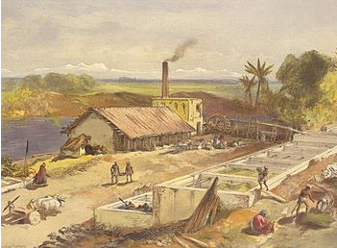
There were two main systems of indigo cultivation -nij and ryoti. Within the system of nij cultivation, the planter produced indigo in lands that he directly controlled and produced indigo by directly employing hired labourers.
The problem with nij cultivation:
- The planters found it difficult to expand the area under nij cultivation. Indigo could be cultivated only on fertile lands, and these were already densely populated. Planters needed large areas in compact blocks to cultivate indigo in plantations. They attempted to lease in the land around the indigo factory, and evict the peasants from the area. But this always led to conflicts and tension.
- A large plantation required a vast number of hands to operate. And labour was needed precisely at a time when peasants were usually busy with their rice cultivation.
- NIJ cultivation on a large scale also required many ploughs and bullocks. Investing on purchase and maintenance of ploughs was a big problem. Nor could supplies be easily got from the peasants since their ploughs and bullocks were busy on their rice fields.
Till the late nineteenth century, planters were therefore reluctant to expand the area under nij cultivation. Less than 25 per cent of the land producing indigo was under this system. The rest was under an alternative mode of cultivation - the ryoti system.
Indigo on the land of ryots
- Under the ryoti system, the planters forced the ryots to sign a contract, an agreement (satta). At times they pressurised the village headmen to sign the contract on behalf of the ryots. Those who signed the contract got cash advances from the planters at low rates of interest to produce indigo.
- When the crop was delivered to the planter after the harvest, a new loan was given to the ryot, and the cycle started all over again. The price they got for the indigo they produced was very low and the cycle of loans never ended.
- The planters usually insisted that indigo be cultivated on the best soils in which peasants preferred to cultivate rice. Indigo exhausted the soil rapidly and the land could not be sown with rice.
The “blue rebellion” and after
In march 1859 thousands of ryots in bengal refused to grow indigo, ryots refused to pay rents to planters, and attacked indigo factories. Those who worked for the planters were socially boycotted, and the gomasthas - agents of planters - who came to collect rent were beaten up. Ryots swore they would no longer take advances to sow indigo nor be bullied by the planters' lathiyals - the lathi-wielding strongmen maintained by the planters.
Causes of the blue rebellion:
- In 1859, the indigo ryots felt that they had the support of the local zamindars and village headmen in their rebellion against the planters. These zamindars were unhappy with the increasing power of the planters and angry at being forced by the planters to give them land on long leases.
- The indigo peasants also thought that the british government would support them in their struggle against the planters. When the news spread of a simmering revolt in the indigo districts, the lieutenant governor toured the region in the winter of 1859. The ryots saw the tour as a sign of government sympathy for their plight. When the magistrate ashley eden issued a notice stating that ryots would not be compelled to accept indigo contracts, word went around that queen victoria had declared that indigo need not be sown. Eden's action was read as support for the rebellion.
- As the rebellion spread, intellectuals from calcutta rushed to the indigo districts. They wrote of the misery of the ryots, the tyranny of the planters, and the horrors of the indigo system.
Outcome of the blue rebellion
- Worried by the rebellion, the government brought in the military to protect the planters from assault, and set up the indigo commission to enquire into the system of indigo production. The commission held the planters guilty. It declared that indigo production was not profitable for ryots. The commission asked the ryots to fulfill their existing contracts but also told them that they could refuse to produce indigo in future.
- After the revolt, indigo production collapsed in bengal. But the planters now shifted their operation to bihar. With the discovery of synthetic dyes in the late nineteenth century their business was severely affected, but yet they managed to expand production. Mahatma gandhi's visit in 1917 marked the beginning of the champaran movement against the indigo planters.
The effect on the british rulers in india
The historians describe the revolt as a non-violent revolution and give this as a reason why the indigo revolt was a success. They call it a forerunner of the non-violent passive resistance later successfully adopted by gandhi. The revolt had a strong effect on the government, which immediately appointed the "Indigo commission" in 1860. In the commission report, e. W. L. Tower noted that "Not a chest of indigo reached england without being stained with human blood". Evidently it was a major triumph of the peasants to incite such emotion in the europeans' minds.
Do Check: The Indian Constitution Class 8 Notes
Exercise
Ques. When the Mughal emperor appointed the East India Company as the Diwan of Bengal ?
(A) 12 August 1735
(B) 12 August 1745
(C)12 August 1755
(D)12 August 1765
Ques. Though the Company had become the Diwan, but it still saw itself primarily as -
(A) Ruler
(B) Trader
(C) Soldier
(D) None of these
Ques. Munro introduced ryotwari system in -
(A) North India
(B) South India
(C) Western India
(D) Eastern India
Ques. In which year a terrible femine occurred in Bengal, which killed 10 million people ?
(A) 1769
(B) 1770
(C) 1772
(D) 1773
Ques. In which year Permanent Settlement was introduced ?
(A) 1793
(B) 1783
(C) 1773
(D) 1763
Ques. Who were asked to collect rent under the permanent settlement ?
(A) Zamindars
(B) Talukdar
(C) Subedar
(D) District Collector
Ques. Under which system the amount to be paid was fixed permanently ?
(A) Permanent Settlement
(B) Munro System
(C) Mahalwari Settlement
(D) All of the above
Ques. In which provinces the Mahalwari settlement was introduced ?
(A) North Western
(B) Central
(C) Madras Presidency
(D) N. W. F. Province
Ques. Who introduced the Mahalwari Settlement ?
(A) Cornwallis
(B) Thomas Munro
(C) Holt Mackanzie
(D) Alexander Read
Ques. Mahal means
(A) Cultivator
(B) Land patch
(C) Tenant
(D) Village
Ques. Indigo was demanded for
(A) weaving the cloths
(B) dying of cloths
(C) stitching of cloth
(D) none
Ques. Under which system land remained with the cultivators ?
(A) Ryotwari
(B) Permanent
(C) Mahalwari
(D) All of the above
Ques. Ques. Ques. Ques. Ques. Ques. Ques. Ques. Ques. Captain Read was related with -
(A) Ryotwari
(B) Mahalwari
(C) Permanent settlement
(D) Revenue
Ques. What was common between Kamalkari print and floral cotton print?
(A) Both were British print
(B) Both were Indian print
(C) Use of Indigo
(D) The design was common
Ques. The European cloth manufacturers depended on plant to make violet and blue dyes ?
(A) Indigo
(B) Woad
(C) Cotton
(D) None of these
Subjective Questions
Ques. What was Mahal ?
Ques. When the Company became Diwan, what impact it had on Bengal economy ?
Ques. Who was Munro ?
Ques. Who were ryots ?
Ques. What was the motive behind introduction of Permanent Settlement?
Ques. Which state had the Kalamkari print in India ?
Ques. Why Mackenzie wanted the land to be kept with the village ?
Ques. Why numerous Scotsmen and Englishmen came to India and became planters ?
Ques. What was the Munro system ?
Ques. Explain Mahalwari system of Revenue.
Ques. What was Diwani system ?
Ques. What was Niz cultivation ?
Ques. Why the woad producers in Europe pressurised their government to ban the import of indigo ?
Ques. What problems were faced by nij cultivators ?
Ques. What was permanent settlement ?
Ques. Why there was a great demand for Indigo in Europe ?
Ques. "The Company had become the Diwan, but it still saw itself primarily as a trader." How we can say that ?
Ques. Write in brief the land tenure system of British.
Ques. What were the problems faced by the British after the enactment of Permanent Settlement ?
Ques. Why the British persuaded or forced cultivators in various parts of India to produce other crops ?
Ques. Which system was adopted by the British to force the ryots to grow indigo on their land ?
Ques. Write in detail about the `Blue Rebellion.
Ques. Why did indigo riots took place ?
Answers to Exercise
- (D)
- (B)
- (B)
- (B)
- (A)
- (A)
- (A)
- (A)
- (C)
- (D)
- (B)
- (A)
- (A)
- (C)
- (B)