Chapter-21. Water and the People of Chennai
This chapter explores how urbanization affects water resources, using Chennai as an example. “Water and the People of Chennai” discusses unequal access to water, conservation methods, and sustainable solutions. NCERT Solutions for Class 8 simplify the concepts of water management and scarcity. Class 8 Notes provide quick summaries for exam revision. Class 8 Home Tuition allows students to explore local water issues and practical conservation ideas. The chapter builds environmental awareness and highlights the importance of equitable water distribution.
Senior government officials like Mr. Ramagopal live in Anna Riagar, Chennai. This area looks lush and green with lawns maintained by a generous spraying of water. Bungalows here have tap water for major part of the day. On days when the water supply is inadequate, a water tanker is easily arranged. Apartments in Mylapore suffers from water shortage. This area gets municipal water once in two days. A private borewell meets some of the resident's water needs. Water is purchased from tankers. For drinking water; residents have installed water purification systems in their homes.
Madhipakkam and gets water once in four days. Shortage of water is one major reason why Siva can't bring his family to Chennai, For drinking, residents buy bottled water.
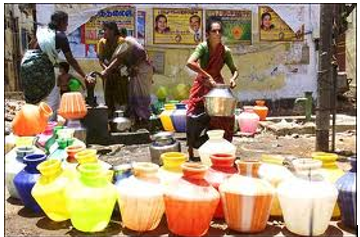
In Saidapet for 30 hutments there is a common tap at one corner, in which water comes from a borewell for 20 minutes twice daily. A family gets to fill a maximum of three buckets within this time. The same water is used for washing and drinking. In summer, the flow becomes a trickle, so that one family gets water only at the cost of another. People have to wait long hours for water tankers.
Water as Part of the Fundamental Right to Life
- Water is essential for life and for good health. Not only is it necessary for us to be able to meet our daily needs but safe drinking water car, prevent many water-related diseases. India has one of the largest number of causes of diseases such as diarrhoea, dysentery, cholera. Over 1,600 Indians most of them children below the age of five, reportedly die everyday because of water-related diseases. These deaths can be prevented if people have access to safe drinking water.
- The Constitution of india recognises the right to water as being a part of the Right to Life under Article 21. This means that it is the right of every person, whether rich or poor, to have sufficient amounts of water to fulfil his/her daily needs at a price that he/she can afford. In other words, there should be universal access to water. Courts and the Supreme Court have held that the right to safe drinking water is a Fundamental Right.
Do Check: How, When and Where Class 8 Notes
Public Facilities
Like water, there are other essential facilities that need to be provided for everyone. Such facilities consists of healthcare, sanitation, electricity, public transport schools and colleges. These are known as public facilities.
The important characteristic of: a public facility is that once it is provided; its benefits can be shared by many people. The supply of electricity to an area can be useful for many people : farmers can run pumpsets to irrigate their fields, people can open small workshops that run on electricity; students will find it easier to study and most people in the village will benefit in some way or the other.
The Government's Role
One of the most important functions of the government is to ensure that public facilities are made available to everyone.
Private companies operate for profit in the market. In most of the public facilities, there is no profit to be had. A private company will probably not be interested in undertaking such work. For some public facilities such as schools and hospitals, private companies may well be interested. In Cities, private companies supply water through tankers or drinking water in sealed bottles. In such cases, private companies provide public facilities but at a price that only some people can afford. This facility is not available to all at an affordable rate.
Public facilities relate to people's basic needs. Any modern society requires that these facilities are provided so that people's basic needs are met. The Right to Life that the Constitution guarantees is for all persons living in this country. The responsibility to provide public facilities, therefore, must be that of the government.
Where does the Government get Money for Public Facilities?
In the budget, the government announces the various ways in which it plans to meet these expenses. The main source of revenue for the government is the taxes collected from the people, and the government is empowered to collect these taxes and use them for such programmes. For instance, to supply water, it meets expenses partly from the various taxes that it collects and partly by charging a price for water. This price is set so that most people can afford a certain minimum amount of water for daily use.
Do Check: Ruling the Country Side Class 8 Notes
Water Supply to Chennai: Is it available to all?
While there is no doubt that public facilities should be made available to all, in reality there is a great shortage of such facilities.
Water supply in Chennai, is marked by shortages. Municipal supply meets only about half the needs of the people of the city, on an average. There are areas which get water more regularly than others. Those areas that are close to the storage points get more water whereas colonies further away receive less water.
The burden of shortfalls in water supply fails mostly on the poor. The middle class, when faced with water shortages, are able to cope through a variety of private means such as digging borewelis, buying water from tankers and using bottled water for drinking.
Apart from the availability of water, access to `safe' drinking water is also available to some and this depends on what one can afford. People who can afford it have safe drinking water, whereas the poor are again left out. In reality, therefore, it seems that it is only people with money who have the right to water - a far cry from the goal of universal access to `sufficient and safe' water.
In Search of Alternatives
The shortage in municipal water is increasingly being filled by an expansion of private companies who are selling water for profit. The supply of water per person in an urban area in India should be about 135 litres per day (about seven buckets) - a standard set by the Urban Water Commission. Whereas people in slums have to make do with less than 20 litres a day per person (one bucket), people living in luxury hotels may consume as much as 1,600 litres (80 buckets) of water per day. A shortage of municipal water is often taken as a sign of failure of the government.
Why water supply should not be given to private companies ?
- Throughout the world, water supply is a function of the government. There are very few instances of private water supply.
- There are areas in the world where public water supply has achieved universal access.
- When the responsibility for water supply was handed over to private companies, there was a steep rise in the price of water, making it unaffordable for many. Cities saw huge protests, with riots breaking out in places like Bolivia, forcing the government to take back the service from private hands.
- Within India, there are cases of success in government water departments, though these are few in number and limited to certain areas of their work.
Conclusion
- Public facilities relate to our basic needs and the Indian Constitution recognises the right to water, heath, education etc. as being a part of the Right to Life. Thus one of the major roles of the government is to ensure adequate public facilities for everyone.
- But, progress on this front has been far from satisfactory. Handing over these facilities to private companies may not be the answer. Any solution needs to take account of the important fact that every citizen of the country has a right to these facilities which should be provided to her/him in an equitable manner.
Do Check: When People Rebel Class 8 Notes
Exercise
Ques. In which part of Chennai, people have tap water for major part of the day ?
(A)Anna Nagar
(B) Mylapore
(C) Madipakkam
(D) Saidapet
Ques. How many Indians, reportedly die everyday because of water-related diseases ?
(A) Over 5000
(B) Over 3500
(C) Over 2600
(D) Over 1600
Ques. Under which Article, the Constitution of India recognises the right to water as a pan`. of the right to life.
(A) Article 17
(B) Article 19
(C) Article 21
(D) Article 23
Ques. Why the private companies are not interested in undertaking works of public facilities
(A) It needs heavy investment
(B) There is no profit to be had
(C) It's a time consuming process
(D) You have to deal directly with public
Ques. Who has the primary responsibility of providing public facilities ?
(A) Private companies
(B) Individuals
(C) NGO's
(D) Government
Ques. Which is the main source of revenue for the government, from where it gets money for public facilities ?
(A) Charging a price for public facilities
(B) Help provided by various rich people of the society
(C) Various taxes that it collects
(D) Name of the above
Ques. The burden of shortfalls in public facilities mostly falls on -
(A) The rich
(B) The middle class
(C) The poor
(D) Above all
Ques. What should be the sUpply of water per person in an urban area in India, according to the standard set by the Urban Water Commission ?
(A) 35 litres per day
(B) 75 litres per day
(C) 100 litres per day
(D) 135 litres per day
Do Check: Resources, Types And Development Class 8 notes
Ques. The water supply department of which city among the following raises enough money through water charges to cover its expenses on supplying water ?
(A) Delhi
(B) Mumbai
(C) Chennai
(D) Kolkatta
Ques. Public facilities relate to our basic needs and the Indian constitution recognises the right to water, health education etc. as being a part of the -
(A) Right to life
(B) Right to Equality
(C) Right to Freedom
(D) Right to iive a prosperous life
Subjective Questions
- What is private industry ? Give one example.
- What alternative methods are used by the middle class to meet the water shortages ?
- What are the major sources of water in rural areas ?
- How much water should be supplied to per person in an urban area in India ?
- According to the official figures of 2001 how much per cent of the households in India have access to drinking water and sanitation ?
- What is Sulabh ?
- Why did the residents of Mylapore spend up to Rs. 500 - Rs.600 per month on buying water from the tankers ?
- The Constitution of India recognises the right to water as being a part of the Right to Life underArticle 21. What does this mean ?
- Private companies do not take interest in undertaking the work projects of public interest. Why ?
- Is the water distributed according to the standard set by the Urban Water Commission in India ?
- Why is it argued that the task of water supply should be handed over to private companies ?
- Mention the public facilities which are also provided by the private companies. Are they provided at affordable rate ?
- Do you think water in Chennai is available and affordable by all? Discuss.
- How is the sale of water by farmers to water dealers in Chennai affecting the local people ? Do you think local people can object to such exploitation of ground water ? Can the government do anything in this regard ?
- Why are most of the private hospitals and private schools located in major cities and not in towns or rural areas ?
- Do you think the distribution of public facilities in our country is adequate and fair? Give an example of your own to explain.
Answers to exercise
- (A)
- (D)
- (C)
- (B)
- (D)
- (C)
- (C)
- (D)
- (B)
- (A)