The chapter Diversity in Living Organisms teaches students about the classification of plants and animals. Using NCERT solutions for Class 9 Science, learners understand how living beings are grouped based on characteristics and evolution. Our class 9 notes simplify topics like the five-kingdom classification, microorganisms, and animal phyla for easy learning. Through our class 9 science tuition, students can visually understand taxonomy through charts, diagrams, and live explanations. Tutors emphasize conceptual clarity, ensuring students remember examples and traits of each kingdom. Personalized Class 9 tuitions make it easier to grasp the hierarchy of biological classification and its scientific significance. Our tutoring helps students connect theory with real-life examples, making biology more interesting and scoring.
Meta Title: Class 9 Science Tuition for Diversity in Living Organisms | Biology Notes
Meta Description: Explore Diversity in Living Organisms with detailed class 9 notes and professional science tuition. Understand classification easily through expert biology guidance.
Diversity in Living Organisms
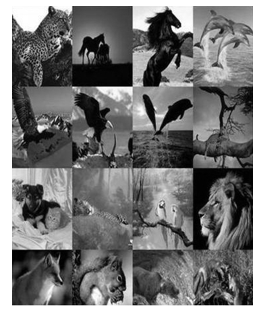
The Living world includes an incredible number of diverse fascinating organisms. Living beings are found wherever the life is possible. They are found in cold mountains, forests, oceans, lakes, deserts and hot water springs. There are so many varieties of living organisms that it would be almost impossible to study them all in a lifetime.
The branch of science that deals with the identification, naming and classification of organisms is called systematics or taxonomy.
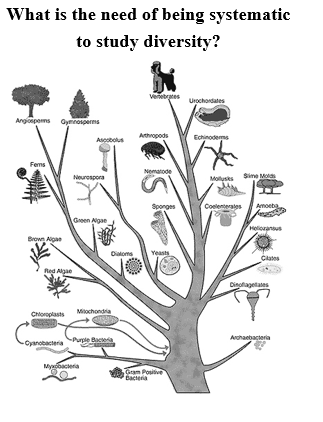
It is not possible to study each and every organism existing on this earth. If we are able to arrange the organisms into groups and study one of the organisms from each group, it gives sufficient information about the essential features of that particular group. But without any system of classification, organisms cannot be studied Further, the extinct organisms cannot be studied without the help of a well-established system of classification. Thus, the classification enables us to know the relationship among different groups of organisms. On the basis of this relationship existing among various groups, an evolutionary tendency can be established.
How do we study such vast diversity?
What is the need of being systematic to study diversity?
Biodiversity: A general idea
Every organism of this living world, whether an animal, a point or a microorganism is unique in itself. The uniqueness is the basis of the diversity (or species richness) in life forms, which is the most important aspect of the biological world.
Diversity simply means variety of forms. Thus, Biodiversity means different forms of living organisms or a variety of life forms found in a particular region.
For example, compare yourself with your friend. Both of you have different looks, different heights and different qualities. Now, compare ourselves and our friends with a monkey. The monkey is quite different from us, because we and our friends have close similarities. The distinction becomes sharper if we compare ourselves with a monkey and a cow.
Naturally, we and the monkey have more similarities in comparison to a cow. We can very easily observe that each organism has its own identifying characters that make it to identify and differentiate from others.
Different places in different parts of the world have their own distinct types of animals (i.e. fauna) and plants (i.e. flora). They vary in their shapes, sizes, colours, external appearance, longevity and behavior. This clearly indicates that the extent of biodiversity is endless.
Classification of Living Organisms
Basis of Classification:
Classification of organisms may be defined as a system or arrangement of organisms into different groups and sub-groups on the basis of their similarities, differences and relationship.
Early attempts of classifying the organisms were made by Greek thinker Aristotle (384-322 B.C.),
Theophrastus (372-287 B.C.) etc. These earlier biologists used habitats and major habits of the organism as the basis of classification.
The system of classification which is based on one or few arbitrarily chosen criteria such as habitat or one or more major habits or organisms is called artificial Classification.
Aristotle classified animals according to whether they lived on land, in water or in the air. The major drawback of artificial classification was that it did not reflect natural relationships of organisms. As a result, different types of organisms were grouped together (e.g. flying animals – insects, birds and bats) while related organisms such as bat (flying mammal), whale (aquatic mammal) and rat (land mammal) were separated.
Natural Classification:
This process of classification is based on certain characters to divide into broad groups and then on the basis of some other characters into sub-groups and so on, should continue till the smallest unit of classification is achieved.
Some examples of such characters, used in grouping and sub-grouping of organisms are:
(a) Cells are prokaryotic or eukaryotic.
(b) Organism is unicellular or multicellular
(c) Organism is photosynthetic or heterotrophic.
(d) Organization of different body parts.
Taxonomy:
It is a branch of science dealing with identification, nomenclature and classification of organisms followed by certain rules or principles.
Carolus Linnaeus (1707 – 1778), a Swedish scientist, is called father of Taxonomy. He introduced the system of binomial nomenclature.
One of the most important 18th century naturalists was a Swedish botanist and medical doctor named Karl von Linne. He wrote 180 books mainly describing plant species in extreme detail. Since his published writings were mostly in Latin, he is known to the scientific world today as Carolus Linnaeus, which is the Latinized form he chose for his name.
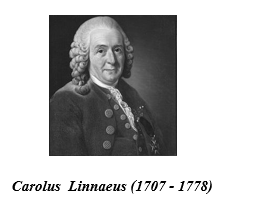
In 1735, Linnaeus published an influential book entitled Systema Naturae in which he outlined his scheme for classifying all known and yet to be discovered organisms according to the greater or lesser extent of their similarities. This Linnaean system of classification was widely accepted by the early 19th century and is still the basic framework for all taxonomy in the biological science today.
The Linnaean system uses two latin name categories, genus and species, to designate each type of organism. A genus is a higher level category that includes one or more species under it. Such a dual level designation is referred to as a binomial nomenclature or binomen (literally “two names” in Latin). For example, Linnaeus described modern humans in his system with the binomen Homo sapiens or “man who is wise”. Homo is our genus and sapiens is our species.
Importance of Classification:
Classification has the following advantages:
(i) Classification makes the study of a wide variety of organisms convenient and easy.
(ii) It is not possible to know about all the organisms but the study of few representatives from each taxonomic group gives a general idea of all life forms at a glance.
(iii) Classification also reveals the inter-relationship among different groups of organisms.
(iv) Classification of organisms provides a base for the development of other biological sciences, such as biogeography, ecology, forestry and behavioral science.
(v) Studies concerned with the identification, nomenclature and classification are needed in various fields of applied biology [Such as agriculture, horticulture, floriculture, pisciculture, pharmacology, public health and environmental biology].
Classification and Evolution
If we keep a watch on the form and function of a particular organism for several generations, there is a possibility of a slight variation in one or the other character in some generation. There is a chance that some generations may acquire a specific character which was not present in earlier generation. This may be due to mutation or any other reason. A change in organisms with time is called organic or biological evolution.
This theory states that the present day complex organisms have originated during the course of ages from the earlier simple forms of life by an accumulation of changes in body design. These changes are acquired in a sequential manner and according to the environmental requirements.
Some groups of organisms having ancient body designs have not changed very much and considered as ‘primitive’ or ‘lower organisms’. While others have acquired their body designs relatively recently. They are called ‘advanced’ or ‘higher organisms’.
Living species having complex form and structure are more recent and advanced, whereas older organisms, having simpler form and structure are primitive. The system of classification of organisms which is based on large number of characteristics and also reflects their evolutionary relationships is called phylogenetic classification.
Diverse life forms share the environment and are affected by each other too, so that a stable community of different species comes into existence. The diversity of such communities is affected by particular characteristics of land, water, climates and so on. The warm and humid tropical regions of the earth, between the tropics of cancer and the tropic of Capricorn are rich in diversity of plants and animal life. This is called the region of mega diversity. More than half biodiversity of the planet is concentrated in a few countries – Brazil, Colombia, Madagascar, Australia, China, India, Indonesia and Malaysia.
The Hierarchy of classification – Groups
In classification, the organisms that closely resemble one another are placed in a group. These groups are further placed in large groups on the basis of similarities. The large groups are again placed in still larger groups. Various grouping levels are known as categories. There are seven major categories:
(i) Species
(ii) Genus
(iii) Family
(iv) Order
(v) Class
(vi) Phylum [for animals] / Division [for plants]
(vii) Kingdom.
Species is the lowest category regarded as basic unit of classification.
The various categories used in biological classification can be arranged in a hierarchy (i.e. ranked one above the other). It was introduced by Linnaeus and is, therefore, called Linnaean hierarchy.
The hierarchy of major categories is given below:
- Kingdom
- Phylum / Division
- Class
- Order
- Family
- Genus
- Species
A brief idea of the taxonomic categories are given below
- Species: Lowest taxonomic category capable of interbreeding to given birth to offsprings, e.g.,
- Pisum sativum (Pea)
- Genus: Consists of closely related species ranked higher than species. e.g., dog and wolf are kept in the same genus Canis.
- Family: Group of related genera having several common characters to from a family. E.g., cat and lion belong to same family Felidae.
- Order: Assemblage of a number of families having common characters.
- Class: Organisms of related order or orders having similarity are placed together in a class. E.g., rats, camels and monkeys are all included in same class Chordata.
- Phylum: The classes having same specific characters which are common in them are placed under same Phylum. E.g., Phylum – Angiospermae.
- Kingdom: Highest category of taxonomic studies, consisting of set of distinguishing common characters.
- Under a kingdom, the organisms having same fundamental characteristics are grouped together.
- E.g., Kingdom-Plantae and animalia.
Classification of Organisms
- Two kingdom Classification: It was given by Carolus Linnaeus in 1758. Organisms were divided into Plant Kingdom and Animal Kingdom. Fungi, Bacteria and Euglena could not find an appropriate position.
- Three kingdom Classification: It was given by Ernst Haeckel. In this Kingdom Protista was also included along with plant kingdom and animal kingdom.
- Four kingdom Classification: It was given by Copeland. Kingdom Monera was also included in this system of classification.
- Five Kingdom classification: Robert H. Whittaker [1969], an American ecologist, gave five kingdom classifications. These kingdoms are:
(i) Kingdom Monera (ii) Kingdom Protista (iii) Kingdom Fungi
(iv) Kingdom Plantae (v) Kingdom Animalia
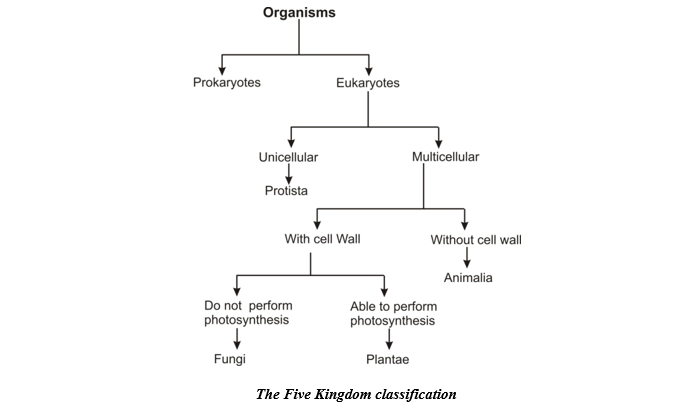
The Five Kingdom classification
Table: Comparative account of five Kingdoms
| Kingdoms | Body organization | Prokaryotic / Eukaryotic | Cell Wall | Mode of Nutrition |
| Monera | Unicellular | Prokaryotic | Some have, while some don’t | Autotrophic as well as Heterotrophic |
| Protista | Unicellular | Eukaryotic | Some have, while some do not. | Autotrophic as well as Heterotrophic |
| Fungi | Multicellular | Eukaryotic | Cell wall made up of Chitin | Heterotrophic |
| Plantae | Multicellular | Eukaryotic | Cell wall made up of Cellulose | Autotrophic |
| Animalia | Multicellular | Eukaryotic | Without cell wall | Heterotrophic |
Kingdom: Monera
Monerans are characterized by the following:
(i) The organisms are mostly unicellular. The cyanobacteria are, however, filamentous.
(ii) They do not have a definite nucleus. The genetic material is a circular, double – stranded, helical DNA, not enclosed by a nuclear envelope. Such organisms are called ‘prokaryotes’.
(iii) The cytoplasm of organisms is devoid of membrane bound organelles, i.e. mitochondria, plastids, Golgi apparatus, lysosomes, endoplasmic reticulum, centrosome, etc. However, ribosomes are present.
(iv) Cell wall is generally present. Some of them do not have cell wall.
(v) The mode of nutrition of organisms is either autotrophic [i.e. synthesize their own food] or heterotrophic [i.e. get their organic food from the environment].
(vi) Single stranded flagella are present in many Monerans.
Kingdom Monera includes these groups:
(a) True bacteria : e.g; : Cocci, Diplococci, Bacilli, Spiralli, Vibrio etc.
(b) Actinomycetes : Unicellular, branched, filamentous bacteria, e.g; Streptomycetes, Mycobacterium, Actinomycetes etc.
(c) Cyanobacteria [Blue – green algae] : e.g; Nostoc, Anabaena (N2 fixation), Oscillatoria, Trichodesmium (red colour to sea)
(d) Mycoplasma : e.g; Mycoplasma pneumoniae
(e) Archaebacteria: e.g; Methanogens [methane makers], Halophiles [Salt lovers], Thermo acidophiles [Heat lovers].
Kingdom: Protista:
They are characterized by the following:
(i) Protists are mostly aquatic and live where ever there is water.
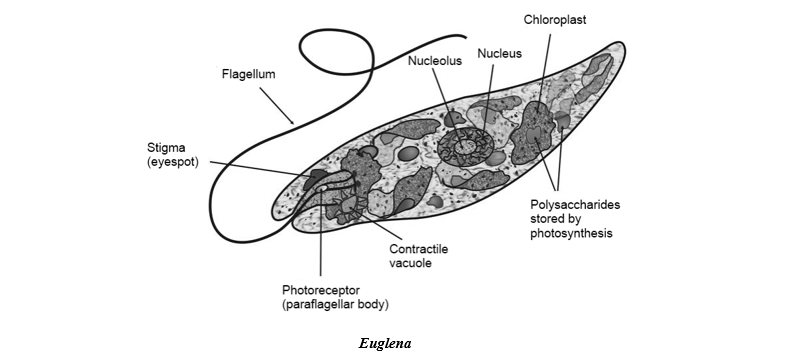
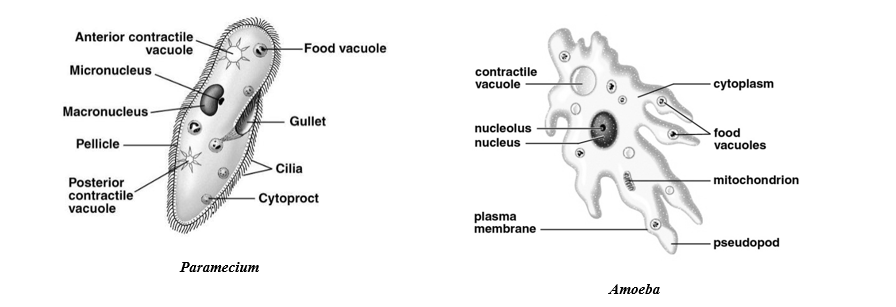
(ii) The cell structure is typically eukaryotic. The protoplasm is surrounded by a distinct plasma membrane. In addition, some protists have an outer covering of pellicle, cuticle or cellulose wall.
(iii) The cytoplasm contains membrane bound organelles such as mitochondria, plastids, Golgi bodies, endoplasmic reticulum, ribosome etc.
(iv) The genetic material is linear, double stranded, Helical DNA, complexed with proteins and organized into distinct chromosomes. The chromosomes are enclosed by nuclear envelope. Nucleolus is present.
(v) Mode of nutrition can be autotrophic or heterotrophic.
(vi) Motile protists can move from one place to another with the help of pseudopodia, flagella or cilia.
Protists have been broadly divided into three major groups:
The Protistan algae:
Plant like protista e.g; Dinoflagellates, Diatoms, Euglena, Chlamydomonas, Volvox etc.
Protozoa: Animal like protista e.g. Amoeba, Entamoeba, Paramecium, Trypanosoma, Plasmodium. etc.
Slime moulds: Fungus like protista e.g., Physarum, Dictyostelium etc.
Kingdom: Fungi:
The kingdom fungi is characterized by the following:
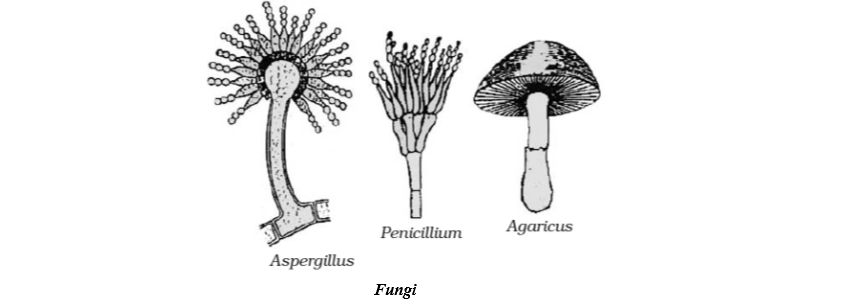
(i) Fungi are thalloid [plant body is not differentiated into root, stem and leaves], Unicellular or multicellular, filamentous, or mycelial. Single filament is called hypha and the cluster of filaments is called mycelium.
(ii) Fungi possess a definite cell wall made up of chitin [a tough complex sugar].
(iii) Fungi lack chlorophyll and are unable to synthesize their own food by photosynthesis. They are heterotrophic.
(iv) The reserve food material is in the form of glycogen and oil drops [Globules].
(v) Fungi have two distinct phases in their life-cycle, the vegetative phase and the reproductive phase.
Vegetative phase is mainly concerned with assimilation of food; reproductive phase is mainly concerned with reproduction. Asexual reproduction mainly occurs by the formation of spores. Sexual reproduction occurs by the formation of sex organs and fusion of gametes.
E.g., yeast, mushrooms, Rhizopus, Penicillium, Aspergillus etc. Commonly edible mushroom is Agaricus campestris.
Eichler (1883) divided plant kingdom into two subkingdom:
Difference between Cryptogamae and Phanerogamae
| Cryptogamae | Phanerogamae |
|
1. It includes seedless plant. 2. It has both non-vascular and vascular plants. 3. Plants body may or may not be differentiated into true root, stem and leaves. 4. Water is required for fertilization. |
1. It includes plants having seeds. 2. It has only vascular plants. 3. Plant body is differentiated into true roots, stem and leaves. 4. Water is not required for fertilization. |
Characters of Kingdom Plantae:
(i) They are multicellular eukaryotes having chlorophyll to synthesize their own food by the process of photosynthesis.
(ii) Cells have a large central vacuole and a rigid cell wall, composed of cellulose.
(iii) Mode of nutrition is autotrophic. The reserve food material is starch and fat.
(iv) The plants are mostly non-motile, being anchored to the substratum. A few forms are free-floating in fresh water and sea water.
(v) Growth of plants is indefinite and new organs are continuously added throughout life.
(vi) Plants are producers of food in the biosphere.
Classification of Kingdom Plantae
Division: Thallophyta
- The division is characterized by the following:
- The division comprises of most primitive and simple plants, not differentiated into true roots, true stem and true leaves. Therefore, they are called thalloid [thallus – like].
- They are predominantly aquatic, occur both in marine (sea water) as well as fresh water habitats. However, some are terrestrial and grow in moist places.
- There is no vascular system.
- Reproductive organs are single-celled and there is no embryo formation after fertilization.
- Gametophytic phase is dominant.
Three classes of thallophyta are:
(A) Algae:
- Characters
- These are aquatic or terrestrial, fresh water or marine, Autotrophic, photosynthetic containing various pigments like chlorophyll, carotenoids, xanthophylls etc.
- Unicellular, colonial, filamentous and multicellular.
- Cell wall of cellulose.
- Reserve food material is starch.
- E.g. Blue green algae, (Nostoc), Anabaena {Green algae} (Ulothrix, Chara, Cladophore, Ulva,
- Spirogyra) Brown algae, Red algae etc.
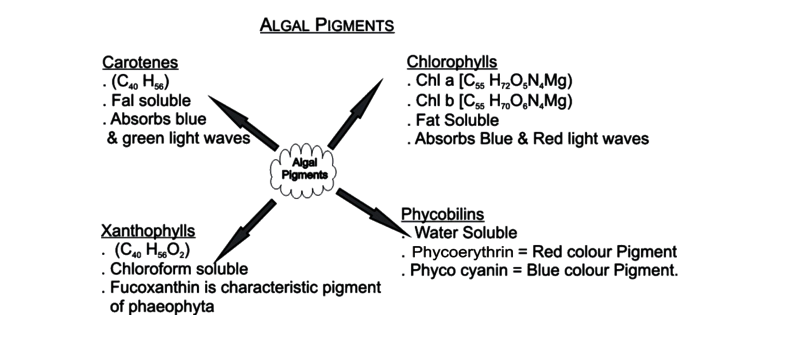
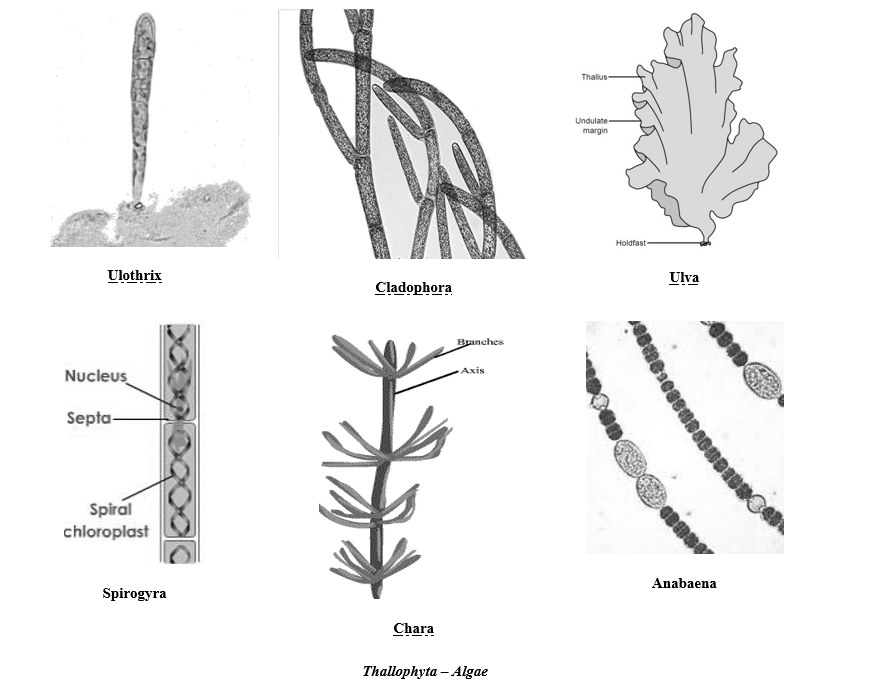 Table: Comparative Study of Classes of Algae
| S. No. | Class | Pigments | Reserve Food | Sexual Reproduction |
| 1. | Chlorophyceae | Chl a, b & Carotenoids | Starch | Iso, Aniso & oogamous type |
| 2. | Rhodophyceae | Chl a, Carotenoids, Phycobilins, Xanthophill | Floridean Starch | Oogamous Type |
| 3. | Phaeophyceae | Chl a & c, fucoxanthin & Carotenoids | Larminarin Mannitol | Iso, aniso & oogamous type |
(B) Fungi:
Characters:
- These are heterotrophic.
- They lack chlorophyll but have cell wall of chitin (fungus cellulose).
- They can be parasitic or saprotrophic.
- Their body is filamentous called as mycelium.
- Reserve food material consists of glycogen. E.g. Moulds (Rhizopus), Yeasts (Saccharomyces). Mushroom, Agaricus, Aspergillus, Pencillium
(C) Lichens:
Characters:
- It is a symbiotic relationship between algae and fungi.
- Algal part is phycobiont and fungal part is mycobiont.
- They grow on rocks, tree trunks, grounds etc.
- E.g. Parmelia, Alectoria etc.
Division: Bryophyte
(i) The division bryophyte includes the simplest and primitive non-vascular land plants, having an embryo stage in their life cycle.
(ii) The plants are essentially terrestrial but require water at every step of life cycle. They usually grow in moist and shady places. They are called amphibians of the plant kingdom.
(iii) The main plant body is gametophyte (haploid body responsible to produce gametes).
(iv) The plant body is commonly differentiated to form stem and leaf like structures. The vascular tissues (xylem and phloem) are completely absent.
E.g., Moss (Funaria), Riccia, Marchantia etc.
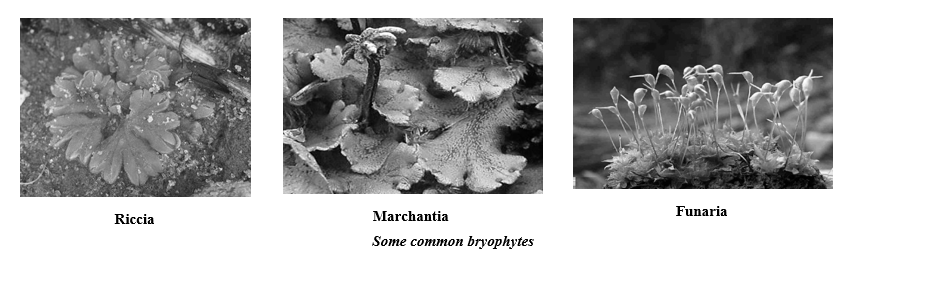
Some common bryophytes
Something Special
Bryophytes
Alternation of Generation
It describes the life cycle of plants. The haploid generation is called Gametophytic because it undergoes sexual reproduction to produce gamete.
The gametes fuse to form diploid zygote, which grows into the next generation called sporophytic. It undergoes asexual reproduction to produce spores and involved meiosis
In Bryophytes : Sporophytic generation is short and dependent on gametophyte.
Division: Pteridophyta
(i) The division pteriodophyta includes first Vascular plants.
(ii) The plants are sporophytes (diploid) and made up of true root, stem and leaves.
(iii) All plants possess vascular tissues (i.e. xylem and phloem).
(iv) Asexual reproduction occurs by spores produced inside sporangia. Sex organs are multicellular and jacketed. The male, sex organs are antheridia and female sex organs are archegonia. Flowers and seeds are not produced.
E.g: Lycopodium, Selaginella, Equisetum, Marsilea, Azolla, Pteridium etc.
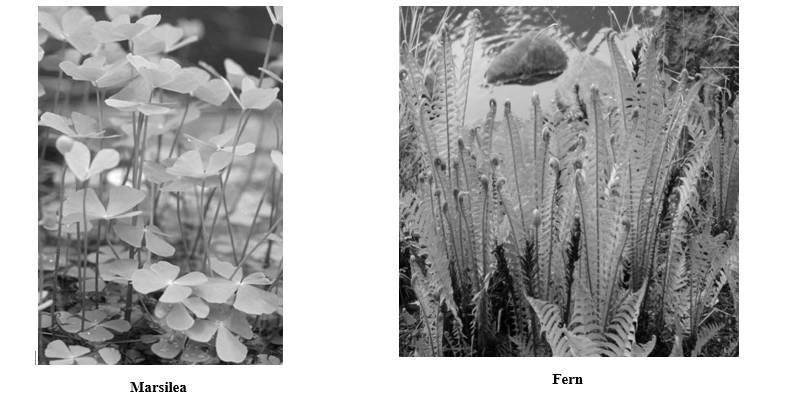
| Bryophytes | Pteridophytes |
| (1) Plant body is gametophyte (Haploid) | (1) Plant body is sporophyte (Diploid) |
| (2) Plant body is either thallus or foliose, however, true stem, leaves and roots are absent | (2) Plant body is differentiated into true root, stem and leaves. |
| (3) Plant is fixed to the substratum by rhizoids. | (3) Plant is fixed to the substratum by roots. |
| (4) Sporophyte is parasitic over gametophytic plant body through-out life. | (4) It has small independent gametophyte. |
| (5) These are non-vascular plants. | (5) There are vascular plants. |
Something Special
Pteridophyta
Heterospory is the production of spores of two different sizes and two different developmental pattern. Small spores are called microspores (male spores) and larger as megaspores (female spores).
In Pteridophytes : Gametophytic generation is dependent on sporophyte.
Division: Gymnosperms
The group gymnosperms include those vascular plants which are usually perennial, evergreen and woody.
Sporophyll is aggregated to form cones. There are separate male and female cones. The male spores are called microspores and female spores are eggs, formed inside ovule. The ovules are not enclosed within the ovaries so that they are naked. After fertilization, the ovules become seeds. Thus, the seeds are naked and not enclosed inside the fruits.
Eg., : Cycas, Pinus, Ephedra etc.
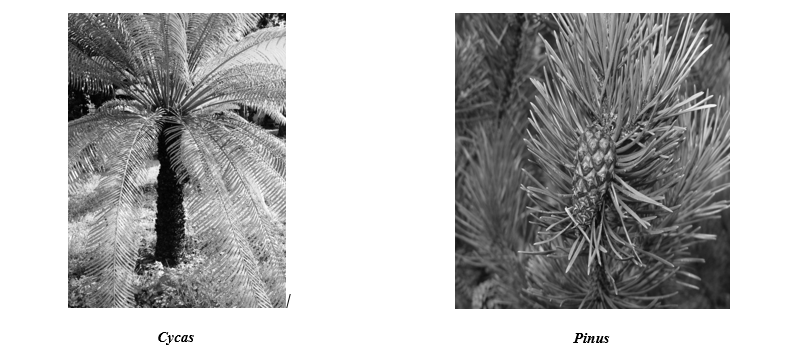
Division: Angiosperms
(a) It includes those vascular plants which produce flower. The flowers bear stamens and carpel. The stamens are male reproductive organs which produce pollen grains. The carpel is female reproductive organs which bear ovules. After fertilization, the ovules develop into seeds and ovary develops into fruits. Thus, the seeds are protected and enclosed within the fruits.
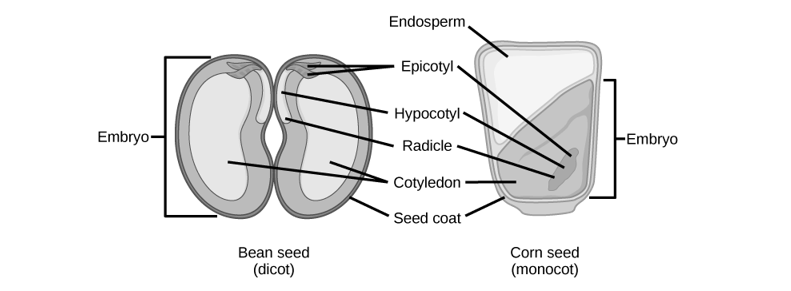
(b) The seeds enclosed embryo, the miniature of plant body. The embryo has plumule (future shoot) radicle (future root) and cotyledons (seed leaves).
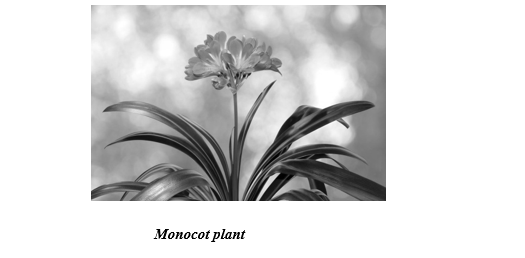
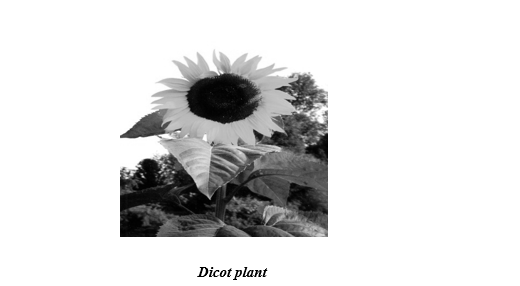
(c) On the basis of number of cotyledons in the embryo, the angiosperms are distinguished into two groups: Dicotyledons and Monocotyledons.
Group: Dicotyledons
This group includes those flowering plants in which the embryo possesses two cotyledons (embryonic leaves). E.g., Pea (Pisum sativum), Gram (Cicer aeritinum), Mustard etc.
Group: Monocotyledons
This group includes those flowering plants in which the embryo possess single cotyledon. E.g.Wheat (Triticum vulgare), Rice (Oryza sativa), Maize (Zea mays) etc.
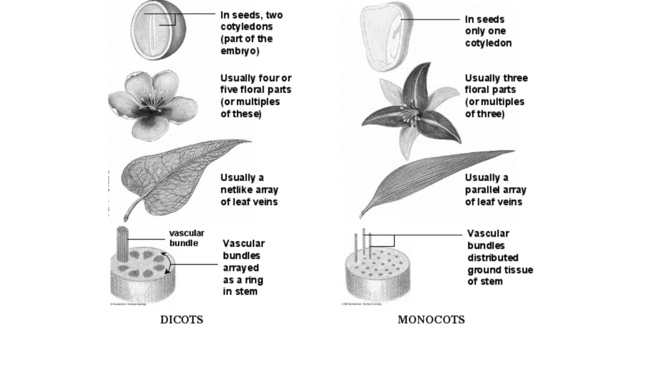
Differences between Dicotyledoneae and Monocotyledoneae
| Dicotyledoneae | Monocotyledoneae | |
| 1. | In the seeds, the embryo bears two cotyledons | In the seeds, the embryo bears one cotyledon. |
| 2. | The leaves show reticulate venation. | The leaves show parallel venation. |
| 3. | Vascular bundle of the stem are open and arranged in a ring. | Vascular bundle of the stem are closed and scattered in the ground tissue. |
| 4. | The plants have tap root system. | The plants have fibrous root system |
| 5. | Flowers are pentamerous (have five of each floral part) or tetramerous. | Flowers are trimerous (have three of each floral part). |
Differences between Gymnosperms and Angiosperms
| Gymnosperms | Gymnosperms | Angiosperms |
| 1. | They are aggregated to form cones | Sporophylls are aggregated to form flowers. |
| 2. | The seeds are naked. | The seeds are enclosed by fruit wall. |
| 3. | The microspores and megaspores are produced by male and female cones. | They are produced in the same or two different types of flowers. |
| 4. | Xylem lacks vessels and phloem lacks companion cells. | Xylem vessels and phloem contains companion cells. |
| 5. | The ovules are not contained in the ovary. | The ovules are enclosed in the ovary. |
1. Fill the flowchart answering the questions given below:
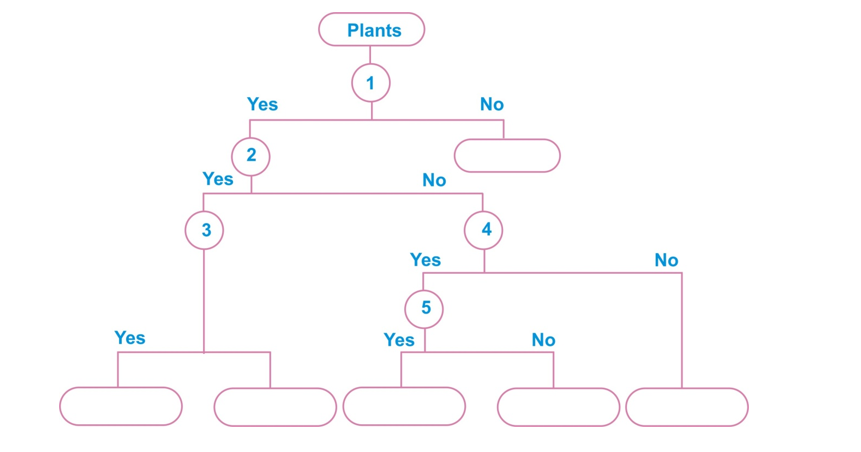
(1) Does it have chlorophyll? (2) Does it reproduce by seeds?
(3) Does it have flowers? (4) Does it have roots?
(5) Does it have a stem?
Kingdom : Animalia
Characters of the kingdom : Animalia
(a) These organisms are multicellular, eukaryotic and lack chlorophyll.
(b) The cell possesses no cell wall and plastids.
(c) Central vacuole is absent but small vacuoles may occur.
(d) Most of them are free moving (except sponges and some coelenterates).
(e) Nutrition is primarily due to ingestion.
(f) Reproduction is generally sexual and haploid stage is represented by gametes.
(g) Growth of organisms stops when the adult stage is reached.
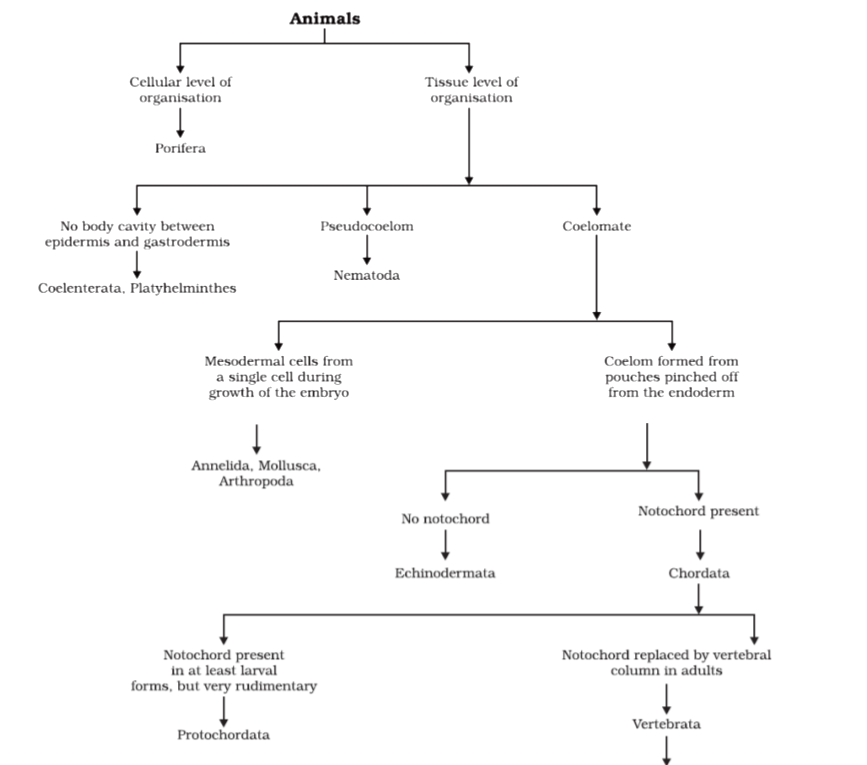
Some of the criteria of classifying animals are given below:
(a) The structural organization of animal body.
(b) Body symmetry.
(c) Presence or absence of notochord.
(d) Presence or absence of body cavity.
(e) Germ layers and mode of origin of mouth.
Kingdom : Animalia
Non Chordates
(i) Porifera (ii) Coelenterata or Cnidaria (iii) Ctenophora (iv) Platyhelminthes
(v) Nematoda or Aschelminthes (vi) Annelida (vii) Arthropoda
(viii) Mollusca (ix) Echinodermata (x) Chordata
Phylum : Porifera
(i) Porifera includes plants-like creatures commonly called Sponges. They are mostly marine but one group lives in fresh water.
(ii) Some sponges are vase-like or cylindrical having radial symmetry, while others are flat, globular, branched and asymmetrical.
(iii) They are mostly sessile (stalk-less) and attached to the substratum.
(iv) Sponges are simplest multi-cellular animals. There are no tissues, organs and systems. Thus, they have cellular level of organisation. The cells are loosely held together and perform life functions more or less independently.
(v) Body is perforated by numerous pores (Ostia), with a single opening called osculum on the top. The Ostia open into a canal system consisting of intercommunicating canals.
Quick Digest Porifera Canal System is the characteristic of sponges. By constant beating of flagella of choanocyte cells, a water current is produced which has a fixed direction. All exchange between sponge body and external medium are maintained by means of the current. It helps in respiration, circulation, excretion, nutrition & reproduction etc.
(vi) The current of water enters through ostia and after passing through various canals, enters the spongocoel and finally leaves through osculum. The water brings food and oxygen. Sponges lack mouth, digestive cavity and anus.
(vii) Sponges are covered with a hard outside layer or skeleton, called spicules.
(viii) Reproduction is asexual and sexual, both. Asexual reproduction occurs by budding or by special cell masses termed gemmules. Sexual reproduction involves the formation of ova and spermatozoa. The sperms leave one sponge and enter another with water current to fertilize the egg.
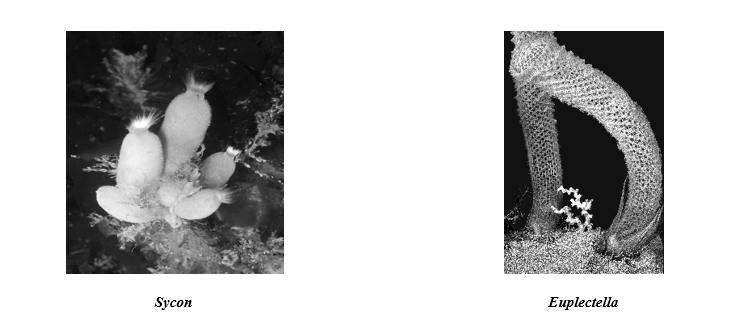
(xi) Examples : Euplectella, Sycon, Euspongia, Spongilla etc.
Phylum: Coelenterata or Cnidaria
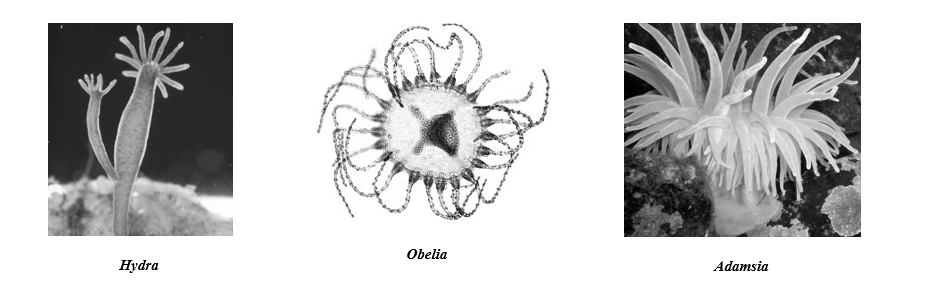
(i) It includes Hydra, Jelly fish, Sea-anemones and corals. They may be solitary or colonial. They all are aquatic (both fresh water and marine).
(ii) Body of animals is made up of two layers of cells. They are having tissue level of organization. However, they lack organs and organ-system.
(iii) Symmetry of body is usually radial.
Quick Digest Corals & Coral Reefs Corals are solitary or colonial polypoid coelenterates living in a secreted skeleton of their own. These lives in a stony cup with radial ridges in the bottom. Coral reefs may be defined as the extensive mass of coral calories which grow continuously in size by budding of polyps. Coral reefs are important to oil industries and serve as good nursery grounds for commercially important fishes.
(iv) The body encloses a single cavity. It has a single aperture, the mouth. There is no anus.
(v) The body wall of cnidarians is supplied with special stinging cells called cnidoblasts, for offence and defense purpose.
(vi) Reproduction is usually asexual and sexual both. The mouth often bears slender, flexible processes called tentacles. The soft body may be supported by calcareous skeleton.
(vii) E.g.,: Hydra [Fresh water polyp], Obelia [Sea fur] Adamsia [Sea-anemone], Aurelia [jelly fish]
Phylum : Ctenophora
| (i) | Body is transparent with radial symmetry. |
| (ii) | They posses comb plates that are ciliated and 8 in number. These help in locomotion. They also possess tentacles. |
| (iii) | Marine, solitary and free swimming.e g Cestum, Comb Jelly. |
Phylum: Platyhelminthes [flat worm]
(i) It includes bilaterally symmetrical flat worms.
(ii) The animal body is soft and leaf like or ribbon like dorso-ventrally flattened, without segmentation.
(iii) Most of the animals are parasites. A few of them are free living.
(iv) They are first animals where third primary germ layer, the mesoderm has appeared between the ectoderm and endoderm. This makes the flatworms triploblastic animals.
(v) There is no body cavity or coelom. The digestive tract is incomplete.
(vi) The excretory system includes characteristic flame cells (protonephridia) leading into tubules that open out by one or more pores.
(vii) Animals are mostly hermaphrodite [bisexual] i.e., both male and female sex organs are present in the same animals.
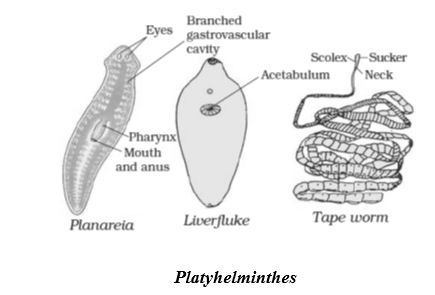
(viii) E.g., : Dugesia [Planaria], Fasciola [Liver fluke], Taenia solium [Tape worm] etc.
|
Quick Digest : Two unique adaptations are seen in tapeworms regarding their parasitic mode of life i.e.,
|
Phylum : Nematoda or Aschelminthes [Round worm]
(i) The animal body is cylindrical or flattened, bilaterally symmetrical, triploblastic and unsegmented.
(ii) Body wall is covered with a tough & resistant cuticle. Cilia are absent.
(iii) The cavity present between the body wall and the digestive tract is not a true coelom. It is called ‘Pseudocoelom’.
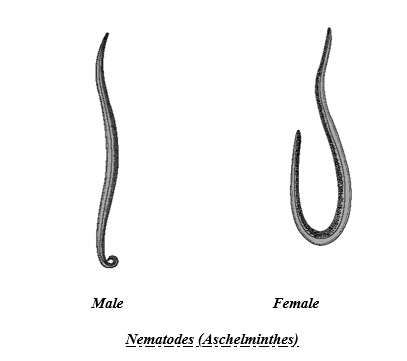
| Quick Digest No segmentation or cila are present over the body. In some of the cases, the cuticle is striated thus giving the appearance of segmentation, called – Pseudosegmentation. ● Body space is “Pseudocoel”, a cavity which is not lined by mesoderm. |
(iv) There is a straight, one way alimentary canal with mouth as well as anus.
(v) Sexes are generally separate.
(vi) Animals included in the phylum are generally parasitic and cause disease. Few are free living in soil or water.
(vii) E.g., : Ascaris (the giant intestinal round worm) Enterobium (the pinworm), Ancylostoma (the hook worm) etc.
Phylum : Annelida [Segmented worm, ring worm]
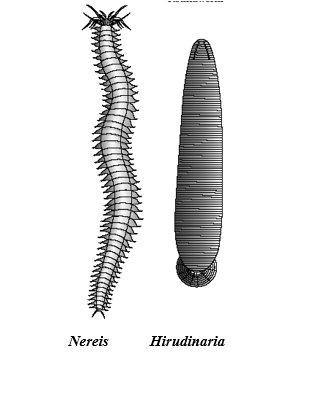
(i) Phylum Annelida includes the segmented worms such as earthworms, leeches, Nereis etc. which occur in moist soil, fresh water and sea.
(ii) Animal body is soft, elongated, bilaterally symmetrical, dorsoventrally flattened.
(iii) The body is divided into segments or metameres by ring like grooves called annuli.
(iv) Some of the anterior body segments concentrate to form head.
Quick Digest Metamaric Segmentation : is the characteristic feature of annelids. Metamerism is the division of body into similar parts which is evident in the external feature of worms. It increased the efficiency of body movements by allowing the effect of muscle contraction.
(v) In some animals, each segment has paired locomotory appendages called parapodia, chitinous setae or chaetae.
(vi) The body cavity is a true coelom. Alimentary canal is complete, straight and extends the entire body from mouth to anus.
(vii) Excretory system consists of coiled tubules called metanephridia. Circulatory system is closed type.
(viii) The nervous system includes a circumcenteric nerve ring and a solid nerve cord with ganglia.
(ix) Animals are either unisexual or hermaphrodite, both types. E.g.,: Nereis (sandworm) Pheretima (earthworm), Hirudinaria (cattle leech) etc.
Phylum : Arthropoda [Animals with jointed feet]
1. It is largest phylum [includes about 900000 species] which includes prawns, crabs, insects, spiders, scorpions, mites, centipedes, millipedes etc.
2. The body is segmented externally, but not separated internally by septa. The segments are grouped into two regions – Cephalothorax (head and thorax together) and abdomen, or grouped into three regions (head, thorax and abdomen).
3. Anterior part of the body forms a distinct head. It bears well developed sense organs and brain. Some body segments bear jointed legs.
4. Exoskeleton is made of thick chitinous cuticle. Body cavity is reduced, contains blood and is called haemocoel.
5. Alimentary canal is complete. Respiration generally from gills, trachea, book-lungs etc. Sexes are separate.
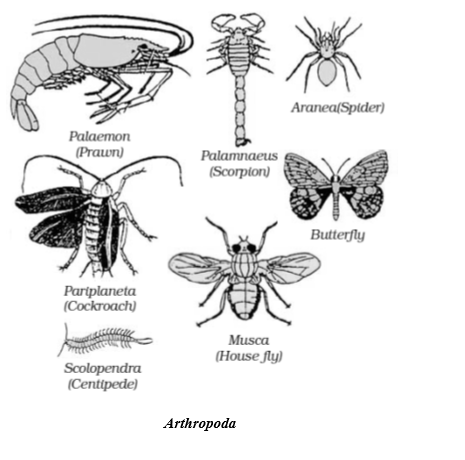
E.g., Palaemon (Prawn), Palamnaeus (scorpion) Scolopendra (centipede), Housefly, spider, Butterfly, crabs, cockroach, Dragonfly etc.
Something Special
● Body of organisms is divided into head, thorax and abdomen. Head and thorax fuse to form cephalothorax. The segmentation is external only. This kind of metamerism in which regionalization of segments is seen is called tagmatization.
● Circulatory system is open type with dorsal heart, distributing blood through small arteries/sinuses to organs tissues. The blood called haemolymph, is colourless and contains white blood corpuscles.
Phylum : Mollusca [soft animals]
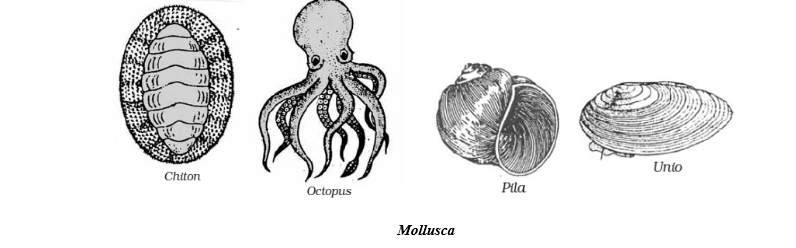
1. Phylum mollusca include aquatic forms like mussels, oysters, snails, cuttle fish, octopus etc.
2. The animal body is soft and unsegemented, without external appendages.
3. The body is differentiated into three regions-anterior head with sense organs, dorsal visceral mass containing organ-system and ventral foot for locomotion.
4. A thin fleshy outgrowth of dorsal body wall covers the body. This is called mantle. A calcareous shell is secreted from the mantle which covers the body.
5. Respiration usually takes place by gills, called ctenidia. Alimentary canal is complete.
6. Sexes are usually separate.
7. E.g., : Chiton, Pila (apple snail), Unio(water mussel), Loligo, Sepia, Octopus etc.
Phylum : Echinodermata [Spiny skinned animals]
1. It includes marine, slow moving and free living animals.
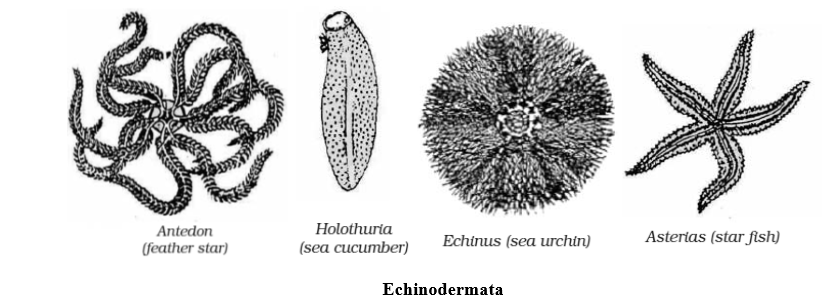
2. The shape of animals may be star-like, cylindrical, melon-like, disc-like or flower-like.
3. They are unsegmented animals having radial symmetry in adults. The body surface is covered all over by mesodermal exoskeleton of calcareous spines.
4. All echinoderms lack head.
5. A true coelom is present. Peculiar tube feet are developed for locomotion. Sexes are separate.
E.g., Asterias (star fish), Holothuria (sea cucumber), Echinus (sea urchin), Antedon (A feather star), brittle stars, sea dollars, sea lilies etc.
Phylum : Chordata [Chorda = string]
Chordata is the most advanced animal phylum. The main distinctive characters of this phylum are:
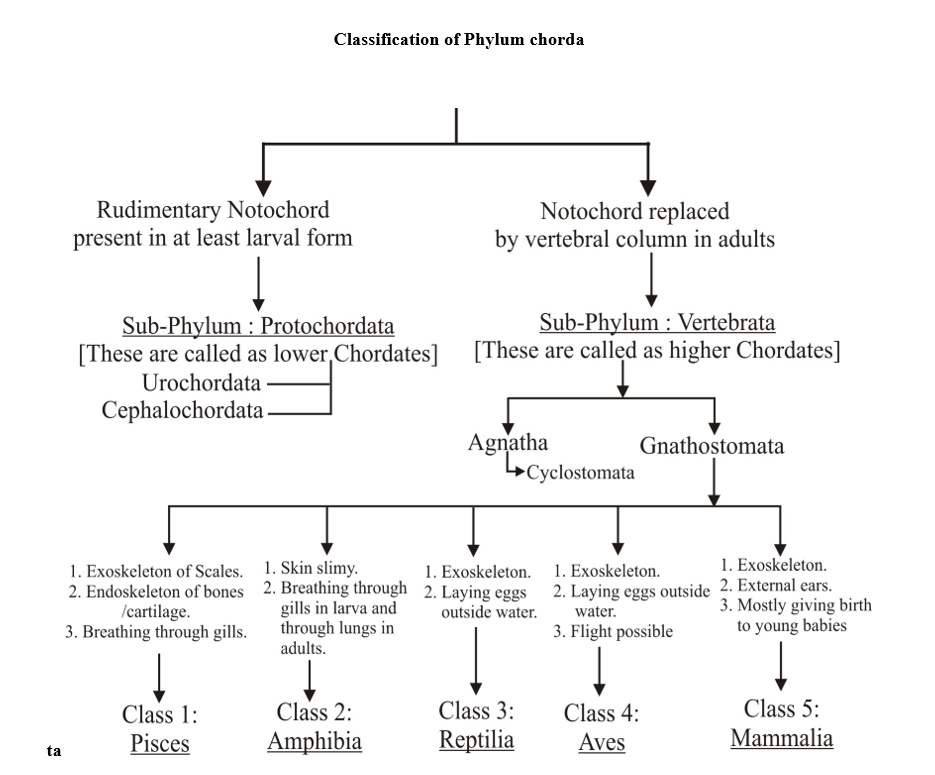
1. Notochord, a solid unjointed rod is present in chordates at some stage of life. In lower chordates it persists throughout life, but in higher ones it is present in the embryo and is replaced by vertebral column.
2. A dorsal hollow nerve cord develops in embryo which usually persists throughout life in most chordates.
3. Gill slits are present at some stage of life.
4. A tail is present behind the cloacal or anal opening at some stage of life. It is reduced or absent in the adults of some chordates.
Sub-phylum : Protochordate
1. It includes animals which are bilaterally symmetrical, unsegmented, triploblastic and have a body cavity or coelom.
2. The animals belonging to protochordata possess a notochord at some stage in life history, which is flexible rod that lies between the dorsal nerve tube and the gut.
3. Notochord provides place to muscles for attachment and increase locomotory power.
4. Protochordates are usually marine, soft and have worm-like or vase-like forms.
E.g:Balanoglossus (A corn worm or tongue worm) Herdmania, Amphioxus etc.
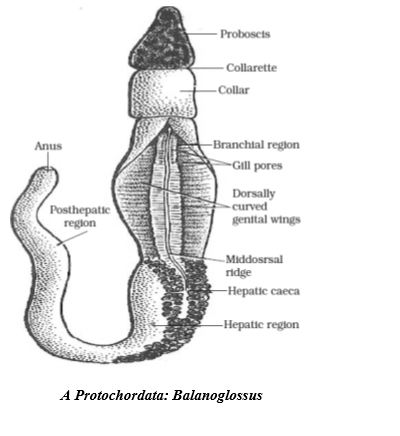
Protochordates are further divided into two groups:
(i) Sub-phylum: Urochordata
- They are commonly known as tunicates.
- The notochord is present in the tail of the larva and disappears in the adult.
- The larva (tadpole) undergoes retrogressive metamorphosis, i.e., changes from a
- better developed larva to a less developed adult.
- e,g. Herdmania (sea squirt), Doliolum, Pyrosoma.
(ii) Sub-phylum: Cephalochordata
- Animals are fish like without a head.
- A notochord which extends upto the entire length of the body and persists
- throughout the life.
- A post anal tail throughout life. e.g.. Branchiostoma (Amphioxus; Lancelet)
Sub-phylum : Vertebrata
1. It includes animals which are bilaterally symmetrical, triploblastic, coelomic and segmented.
2. Animal body typically consists of four regions head, neck, trunk and tail.
3. The notochord is replaced partly or fully by a jointed vertebral column (back bone) in the adult. Vertebrates are characterized by the presence of well developed skeletal system that allows a special distribution of muscle attachment points, to be used for movement.
4. Vertebrates have well developed nervous system (brain) and sense organs (eyes, ears and nose). They have two pairs of appendages (fins or limbs). Respiration is by gills in lower aquatic vertebrates and by lungs in higher land forms. Sexes are separate.
Differences between Invertebrata and Vertebrata
| Invertebrata | Invertebrata | Vertebrata |
| 1. | Notochord is absent | Notochord present at some stage of development |
| 2. | Nervous system: Central Nervous system is solid and ventral. | It is hollow and dorsal |
| 3. | Heart, if present, is dorsal. | Heart is ventral. |
| 4. | Vascular system may be open or closed. | Vascular system is closed. |
| 5. | Haemoglobin, if present, is dissolved in plasma. | Haemoglobin is present in red blood corpuscles. |
| 6. | Pharyngeal gill slits are absent. | Pharyngeal grill slits are present |
| 7. | The anus is posterior, so no post-anal tail. | A post-anal is present. |
Agnatha
Class cyclostomata:
- These are the most primitive vertebrates.
- Animals are jawless and possess a circular mouth.
- They are ectoparasites on fish and use mouth to stick to fish; the mouth is therefore suctorial.
- Notochord is present in the form of a cylindrical rod.
- Head and brain are poorly developed.
- Cartilagenous endoskeleton is present.
- Respiration occurs through gills contained in pouches.
- Heart is two-chambered consisting of one auricle and one ventricle.
- Gonad is single and fertilization is external. e.g. Petromyzon (lamprey), Myxine (hag fish)
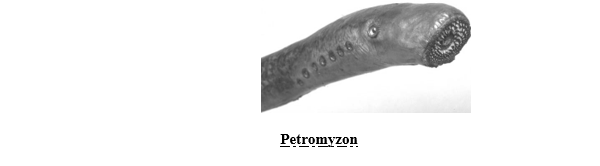
Verterbrata
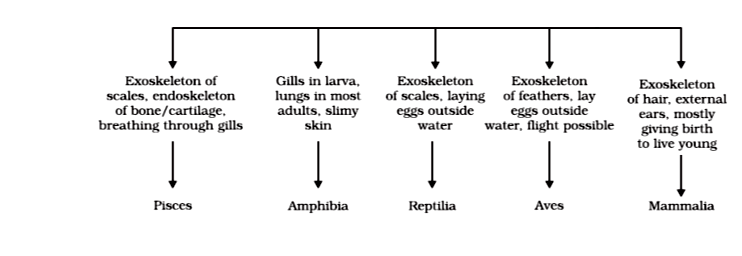
Sub-phylum vertebrata is divided into five classes.
Class : Pisces
1. They are commonly called fish and exclusively live in water.
2. The body of fish may be long, laterally compressed or dorso-ventrally flattened and skin is covered with scales. It usually consists of head, trunk and muscular tail which help to swim in water.
3. Fishes are cold blooded animals and their heart has only two chambers-one auricle and one ventricle. They obtain oxygen which is dissolved in water and breathe through gills.
4. They are egg laying animals. Fertilization is external.
Pisces is divided into two classes : -
(i) Class Chondrichthyes :
- Skeleton is cartilagenous, hence the name Chondrichthyes is given.
- The body is either laterally compressed and spindle shaped, or dorso ventrally flattened and disc shaped.
- Mouth is ventral in position on the head. Jaws are well-developed.
- Respiration occurs through gills.
- The skin is covered with placoid scales (exoskeleton).
- Heart is two chambered, consisting of an auricle and a ventricle.
- Air bladder is absent.
- They reproduce by laying eggs (oviparous) or produce eggs which hatch inside the mother’s body (ovoviviparous).
- Fertilization is internal.
- Mostly marine and large is size (upto 10 – 20 meters long) .e.g. Sharks, , rays and skates, Scoliodon (Indian shark, dog fish), Torpedo (electric ray), Trygon (sting ray), Rhinobatus (guitar fish). Synchirpus splendidus (Mandarin fish), Calculophyryne jordeni (Angle fish), Pterois volitans (lion fish)
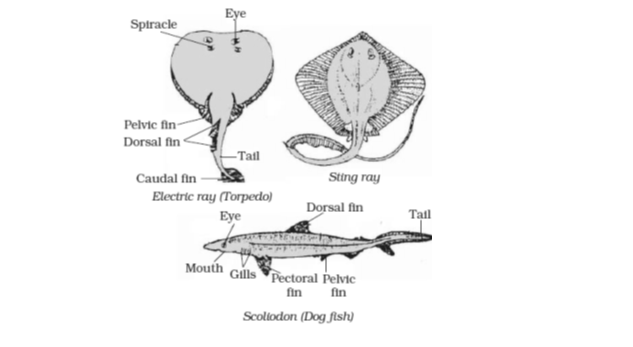
(ii) Class Osteichtyes :
- Skeleton is cartilagenous in the embryonic stage, but is replaced by bones in adult form (bony endoskeleton), hence the name osteichthyes is given.
- Body is generally spindle shaped.
- The exoskeleton, if present, consists of cycloid or ctenoid scales.
- The mouth is terminal (anterior) on the head.
- Gills are covered by bony flap called as the operculum.
- A swim bladder (or air bladder) is usually present. It helps in floating.
- Heart is two chambered.
- Fertilization is mostly external.
- They live both in fresh and sea water.
- In size, they vary from 10 mm to 4 meters e.g., Labeo, Hippocampus (sea horse), Anabas (climbing perch), Muraena (eel), Protopterus (fish).
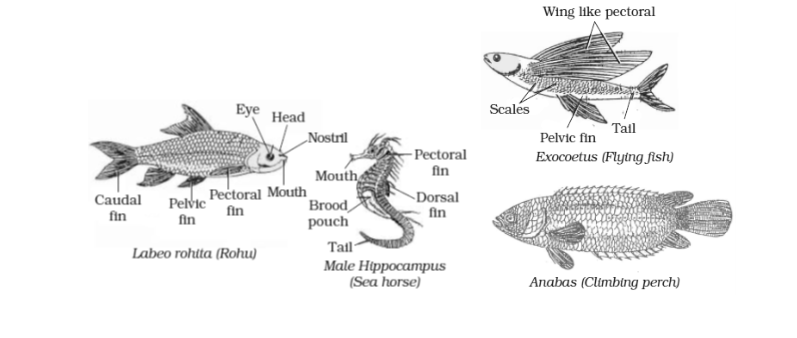
Differences between Chondrichthyes and Osteichthyes
| S.No | Chondrichthyes | Osteichtyes |
| 1. | Mouth ventral. | Mouth terminal. |
| 2. | Tail fin asymmetrical (heterocercal). | Tail fin is symmetrical (homocercal). |
| 3. | 5 – 7 pairs of gills are present. | 4-5 pairs of gills are present. |
| 4. | Gills are naked. | Gills are covered by operculum. |
| 5. | Cloacal aperture is present. | Anus and urinogenital apertures are separate. |
| 6. | No swim bladder. | Swim bladder usually present. |
| 7. | Fertilization is internal. | Fertilization is external. |
Class : Amphibia [Amphi – double, bios – life]
1. Vertebrates that live both on land and in water are amphibians. They are first vertebrates to invade land.
2. Skin of the animals is smooth, moist and rich in mucous and poison glands. There are two pairs of pentadactyl limbs, each with 4-5 digits.
3. Respiration takes place by gills, lungs, lining of bucco-pharygeal cavity and skin.
4. Heart is three chambered: two auricles and one ventricle.
5. There are no marine forms of amphibians.
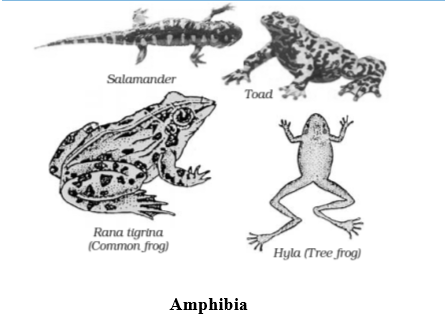
Quick Digest They are first cold-blooded vertebrates. Brain well-developed with ten pairs of cranial nerves. They have large RBC’s of animal kingdom. Larva ammonotelic but adults ureotelic. Metamorphosis is controlled by a hormone called thyroxine.
E.g., Rana tigrina (common Indian frog), Bufo (toad), Hyla (tree frog), Necturus (mud puppy), Salamandra (spotted salamander) etc.
Class : Reptilia [Creeping vertebrates]
5. Teeth are usually present in all reptiles except tortoises and turtles.
6. Respiration occurs by lungs. Heart is three chambered: two auricles and a partly divided ventricle. Mostly they are carnivorous and insectivorous (Tortoises are herbivorous).
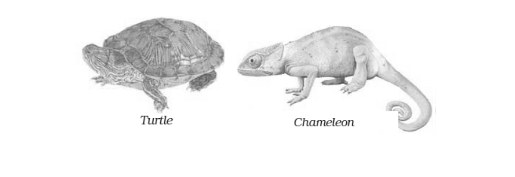
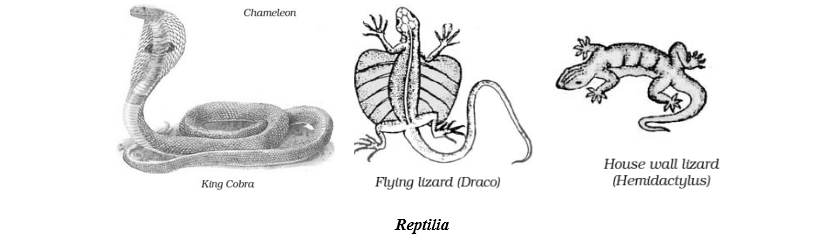
E.g., Hemidactylus (wall lizard), Chamaeleon, Draco (flying lizard), Python (ajgar), Naja (cobra).
Testudo (tortoise), Chelone (turtle), Crocodiles (crocodile), Gavialis (gharial) etc.
1. They are first vertebrates fully adapted for life on dry land. These are cold-blooded animals.
2. They are mostly terrestrial animals, however, some are aquatic and live in water but they too return to land for breeding.
3. Body of the animals is covered by horny epidermal scales, made up of a water proof protein-keratin.
4. There are two pairs of pentadactyl limbs each with 5 digits bearing horny claws. Limbs are absent in snakes.
Quick Digest: Creeping and burrowing cold-blooded vertebrate. Skin cornified and epidermal cover. Heart incompletely four chambered with two auricles and partly divided ventricles. Crocodiles are ammonotelic turtle and alligators are ureotelic lizards and snakes are uricotelic. They possess 12 pairs of cranial nerves. Eggs are macrolecithal with calcareous shells [Cleidoic eggs] Fertilisation is internal, metamorphosis is absent.
Differences between Amphibia and Reptilia
| S.No | Amphibia | Reptilia |
| 1. | Skin is smooth and moist. | Skin is dry and cornified. |
| 2. | Scales are absent. | Scales are present over the body. |
| 3 | Digits do not possess claws. | Digit end in claws. |
| 4. | Heart is three chambered. | Heart is incompletely four chambered. |
| 5. | Fertilization is external. | Fertilization is internal. |
| 6. | Extra-embryonic membranes are absent. | Extra-embryonic membranes are present. |
| 7. | Example: Frog, Toad. | Example: Lizard, Snake, Tortoise. |
Class : Aves [Birds]
1. It includes birds which are found in all continents, seas and most islands.
2. There are two pairs of limbs. The forelimbs are modified into wings for flight. The hind limbs alone support the body.
3. Body is covered by an epidermal horny exoskeleton of feathers. Endoskeleton is bony but spongy and light. Mouth is surrounded by beak but teeth are absent.
4. Respiration takes place by lungs. Heart is four chambered, having two auricles and two ventricles. They are warm-blooded animals.
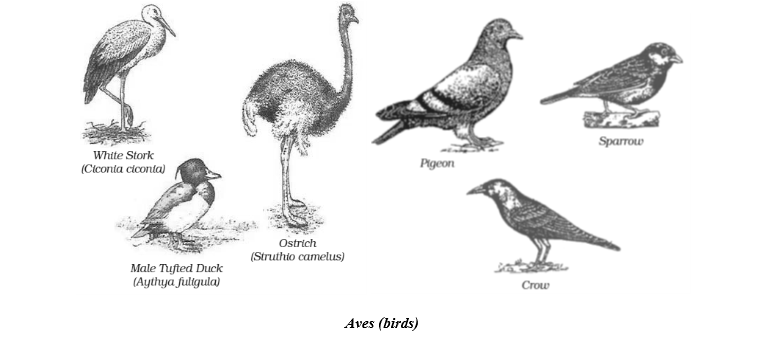
E.g., Columbo (pigeon), Struthio (ostrich), Pavo (pea fowl), Passer (sparrow), Corvus splendens (crow) etc. Kiwi, Penguin and Ostrich are examples of flightless birds.
Something Special
- Flightless Birds
- Flightless birds have powerful legs, rudimentary eyes and wings. Their bones and legs are solid.
- Example : Ostrich [Africa and Arabia]
- Rhea [South America]
- Kiwi [New Zealand]
- Emu [Australia]
- Penguin [Australia]
- Tinamou [Austrailia]
- Doled became extinct during 17th century.
Class : Mammalia
1. Mammals are primarily terrestrial vertebrates.
2. Body is variously shaped and generally divisible into head, neck, trunk and tail.
3. Skin is glandular and mostly covered by a horny epidermal exoskeleton of hair. There are two pairs of pentadactyl limbs.
4. Respiration occurs only by lungs. Heart is four chambered, having two auricles and two ventricles. They are warm-blooded animals.
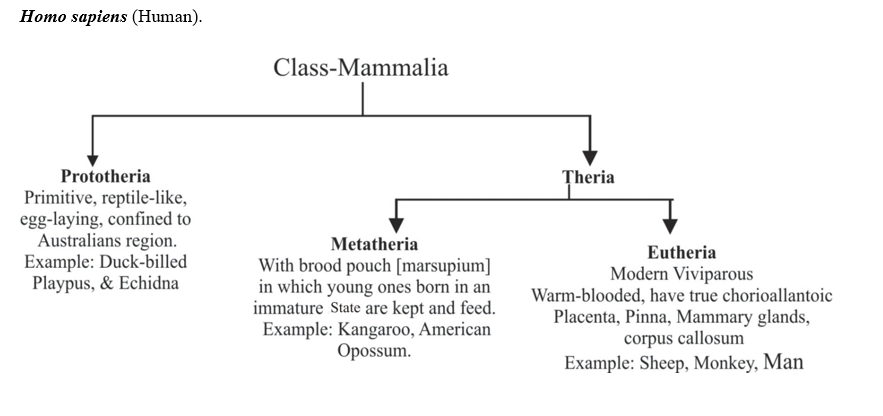
5. Mammals are usually viviparous (alive-bearing). However, some are oviparous and lay eggs (e.g. Platypus, Echidna etc.) Kangaroos give birth to very poorly develop young ones.
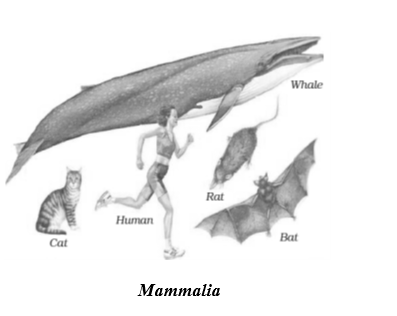
Mammals are characterized by having milk-secreting mammary glands. E.g., Macropus (kangaroo), Bat, Rattus (rat), Felis (cat), Panthera (lion, tiger, leopard), Elephas (elephant), Balaena (whale), Macaca (monkey) Homo sapiens (Human).
Nomenclature :
- Organisms are identified by their own distinct names. In biology, the organisms are categorized into different taxa (sing. Taxon). Taxon is a taxonomic group such as species, genus, family, order, class, phyla etc.].
- Species is a smaller taxon which includes individuals sharing the common characters, able to breed together and produce off springs. A number of species are grouped into a genus. Several genera are grouped into a family, and several families are grouped in an order. Similarly, several orders are placed under a class and several classes are grouped into a phyla/division.
- Giving a correct specific name to an organism or a taxon is called nomenclature. It involves the principles governed by set rules formulated by International organizations so that particular organism or taxon is known by its specific name throughout the world.
- Vernacular names of any organism are mostly made up of regional or native languages of the country. The scientific names are mainly based on Latin language and preferred over common vernacular names in the scientific world.
Binomial Nomenclature
- Binomial nomenclature was proposed and established by Carolus Linnaeus in [1753] and he is considered as father of taxonomy.
- According to it, the scientific name of an organism consists of two separate components-first one designates the genus and the second one designates the species. Since, this system of naming organisms gives the two names to an organism it is known as Binomial Nomenclature.
- This system is accepted internationally and guided by a set of rules stated in International Code of Nomenclature. ICBN and ICZN for botanical and zoological nomenclature respectively.
Certain conventions are followed while writing the scientific name:
- The name of the genus begins with a capital later.
- The name of the species begins with a small latter.
- When printed, the scientific name is given in Italics.
- When written by hand, the genus name and the species name have to be underlined separately.